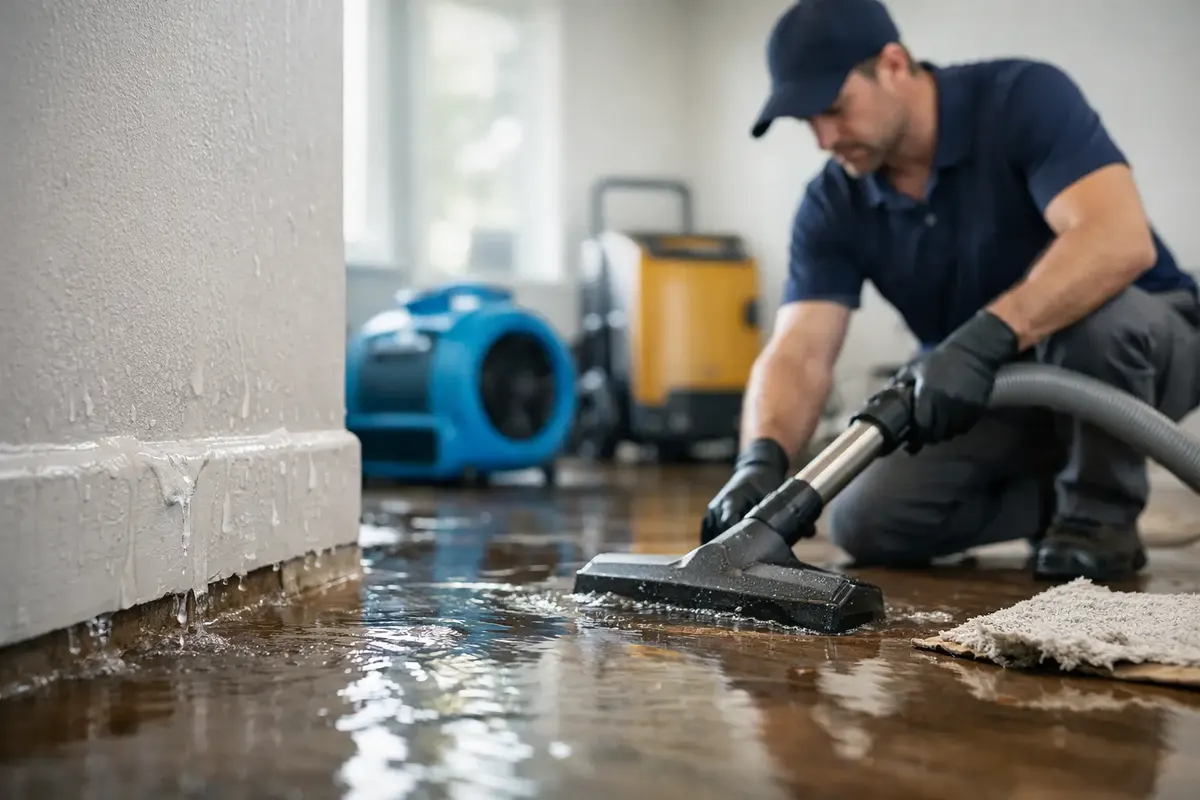
Quick answers
The short answers before the full definition
Most people land here with one of three questions: what the service is, what it covers, and whether their situation counts. These three cards answer them in plain words. Everything after them is the full working detail behind each answer, drawn from the IICRC S500 standard, the EPA and CDC guidance, and New York State and City rules.
Asked: what is it, in one breath?
It is the professional service that takes a water damaged building back to safe, dry and usable: inspect the damage, remove the water, dry the structure, clean what the water touched, and repair what the water ruined. People who ask what is water damage restoration usually picture the drying fans; the fans are one stage of five, and the definition on this page covers all of them.
Asked: what does it include?
Fifteen services make up the full offer, from emergency extraction and moisture assessment through structural drying, cleaning, contents care and reconstruction, ending with the documentation your insurer reads. A small supply line leak may need four of them; a flooded floor of a building can need all fifteen. The services section lists each one the way it should appear in a written scope.
Asked: does my situation count?
If water has entered materials that cannot dry on their own, yes. Burst pipes, appliance leaks, sewer backups, storm flooding and slow hidden leaks all count, because the deciding factor is not how dramatic the water looked but how far it travelled and how long it stayed. The causes and signs sections below help you judge your own home honestly.
Read the cards as headlines. The sections below carry the working detail: why no agency publishes a one sentence definition, what the standard actually says, the four terms separated, the causes and the signs, the water categories and classes, the fifteen services, the city permit and violation rules, and the insurance basics. Nothing on this page quotes a price, because no honest crew prices restoration work sight unseen; what it gives you instead is the knowledge to read any scope and know whether a part of the service is missing.
The honest definition
No agency defines it in one sentence, and this page will not pretend one does
Here is a fact most pages in this search hide: no single authoritative one sentence definition of this service exists from the EPA, the CDC or the IICRC. This page says so plainly, then builds its definition from the closest authoritative wording there is, the scope and components of the industry standard itself.
Start with the standard. The ANSI/IICRC S500, now in its Fifth Edition of 2021, is the document professional restorers work to, and its published scope reads: "This Standard describes the procedures to be followed and the precautions to be taken when performing water damage restoration in residential, commercial, and institutional buildings, and the systems and personal property contained within those structures." Notice what that sentence does. It does not define the term in a single line; it sets the procedures and the precautions. Anyone who asks what is water damage restoration and expects a dictionary answer from the standard itself will not find one, because the standard answers with a method instead of a motto.
The components the standard names fill out the picture. Its contents include the principles of water damage restoration, inspections with preliminary determinations and pre-restoration evaluations, structural restoration, HVAC restoration, and contents evaluation, restoration and remediation. Read together, scope plus components describe a service with a beginning, an inspection; a middle, the drying and cleaning of structure, systems and belongings; and an end, a building and its contents returned to use. The definition in the box at the top of this page is built from exactly that material, written in plain words for a homeowner rather than in standard language for a technician.
One boundary inside the standard matters to every homeowner. The S500 framework assumes that the determination and correction of the underlying source or cause of the water intrusion is the responsibility of the property owner and not the restorer. In plain words: the restorer dries, cleans and rebuilds what the water damaged; fixing the pipe, the roof detail or the failed hose that caused it sits on the owner side, usually through a plumber, a roofer or the building staff. A straight company names that boundary on day one. A company that blurs it will blur others, and the choosing section near the end of this page returns to the point.
The agencies answer the question from their own corners. The EPA writes about the moisture problem and its cleanup: its Brief Guide to Mold, Moisture and Your Home states that you must have completely fixed the water or moisture problem before the cleanup or remediation can be considered finished, and that visible mold and moldy odors should not be present when the work is done. The CDC writes about safe reentry after flooding, covered in the safety section below. Neither agency defines the trade term, and this page does not put a definition in their mouths. What they supply is the finish line the service works toward: source fixed, structure dry, no growth, no odour, safe to live in.
There is also a separate standard for the neighbouring problem. The ANSI/IICRC S520 describes the procedures to be followed and the precautions to be taken when performing mold remediation in residential, commercial, and institutional buildings. When water is the problem, S500 governs; when growth is the primary concern, S520 takes over, and in New York the mold licensing law described later on this page joins it for larger projects. Knowing which standard governs your job is part of knowing what is water damage restoration and what is the service beside it.
Why this section is written this way. A definition page earns trust by showing its seams. The boxed definition at the top is this site working definition, built from the S500 scope and components. Where a claim on this page comes from a standard, an agency or a city rule, the source is named in place. Where the evidence runs out, the page says so in place too, starting with the category and class tables below.
Four terms, separated
Mitigation, restoration, remediation and repair: four words that are not synonyms
The search results for this question mix four terms as if they were interchangeable. They are not. Two filmed lessons in the case studies section make the same point on camera: the words matter because they decide what you are actually buying. Here they are, separated, with the honest label on each: one term has a legal definition in New York, and the rest are industry usage, labelled as such.
| Term | What it covers | Where the meaning comes from |
|---|---|---|
| Water mitigation | The emergency first stage: stopping the loss from getting worse, extracting water, removing what cannot be saved, and starting drying. Mitigation limits damage; it does not by itself return the home to its prior condition. | Industry usage. No EPA, CDC or IICRC one line definition was verified for this page. |
| Water damage restoration | The full arc: inspection, extraction, drying, cleaning and repair that returns the property to safe, dry and usable condition. Mitigation is its opening stage, not a rival service. | Industry usage, built on the S500 scope and components quoted above. |
| Water damage remediation | In industry usage, the containment and cleanup side: removing contaminated water and material, cleaning and sanitizing so the property is safe. One related term does carry a precise New York meaning: Labor Law Article 32 defines mold remediation, not water remediation, and the mold pages of this site carry that definition in full. | Industry usage for water; statutory for mold. |
| Water damage repair | The fixing and rebuilding part: drywall, flooring, trim, paint and fixtures put back after drying. Repair is the closing stage of a full restoration, and on its own, without the drying and cleaning before it, it is how damp cavities get sealed behind new finishes. | Industry usage. No verified EPA, CDC or IICRC definition exists, and this page labels it as such rather than inventing one. |
The practical test is the scope in your hand. If a quote covers only the first row, you are buying mitigation, whatever the letterhead calls it. If it covers extraction and drying but stops before cleaning and rebuild, you are buying most of what is water damage restoration with the ending missing, and the ending is the part you live with. Read every scope against the four rows and the gaps name themselves.
One more confusion deserves a sentence. Cleaning companies, plumbers and general contractors each touch one part of this work, and each part is real work. The distinction is not the badge; it is the sequence and the measurement. The service defined on this page is the one that inspects with meters, grades the water, dries to a measured standard, cleans what the water touched, and documents the whole job for the claim that usually runs beside it.
What it includes
What the service includes, from first call to final check
A definition is only useful if it survives contact with a real job. This section walks the full arc the boxed definition compresses, stage by stage, in the order the work actually happens.
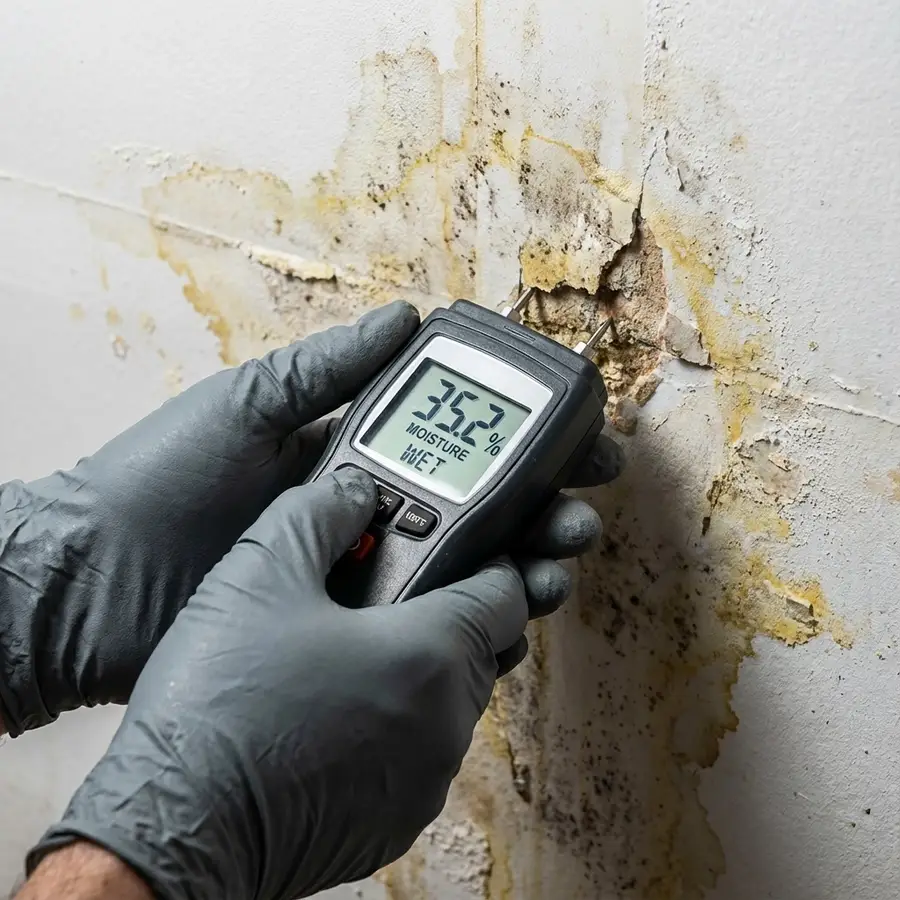
It begins with an inspection, because nobody can restore what they have not measured. A trained inspector traces the source, reads walls, floors and ceilings with moisture meters, checks the pattern with a thermal camera, and draws a moisture map: what is wet, how wet, and where the dry edge sits. The map grades the loss by category and class, the subject of its own section below, and it decides everything that follows. Understanding what is water damage restoration starts here, with the unfashionable truth that the service is measurement first and machinery second.
Extraction follows, and it is the fastest drying there is. Pumps and extraction tools remove standing water from floors, carpets and basements, working from the deepest area outward. Every gallon carried out by hose is a gallon the dehumidifiers never have to pull from the air. Contents move as part of this stage: furniture lifted onto blocks or carried to dry ground, salvageable belongings separated from saturated ones while the evidence is fresh.
Removal comes next, and it is surgical rather than theatrical. Material that cannot dry safely in place comes out: drywall that has swollen and lost its strength, soaked insulation, carpet padding hit by contaminated water. Openings are cut neatly, waste is bagged and removed on a protected route, and the framing behind is exposed so air can reach it. Nothing sound is removed to pad a scope, and nothing unsound is left to save a day.
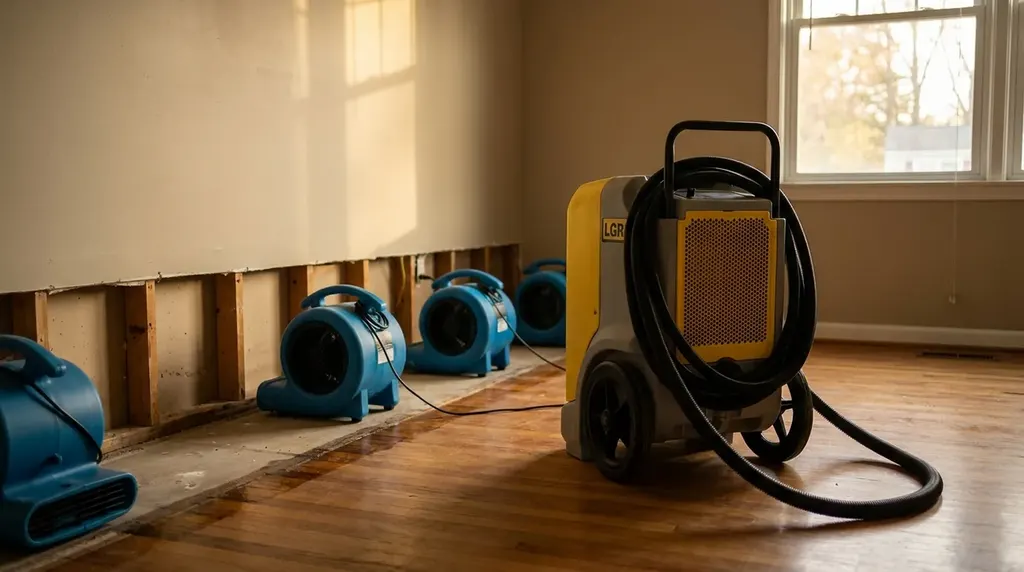
Drying is the longest stage and the least visible. Air movers and dehumidifiers are placed from the moisture map and balanced as one system of temperature, humidity and airflow, and a technician returns daily to read the same marked points and adjust the setup as the numbers fall. Drying ends when each material reaches its dry standard, the level of the same material in an unaffected part of the same building. That standard, not a date on a calendar, is the finish line inside what is water damage restoration as the trade practises it.
Cleaning and rebuilding close the arc. Surfaces the water touched are washed and, where the water category requires it, sanitized; odour is treated at its source material rather than masked; contents are cleaned, dried and honestly sorted. Then the rebuild puts back what removal took out, drywall, flooring, trim and paint, with city permits where the work needs them. The final service is paper: the moisture map, the daily log, the scopes and the invoices, assembled as the job runs, because the claim file is part of what the homeowner is paying for.
Wet home, and the definition is no longer academic?
Describe where the water came from and what is wet, and you will be told plainly which stage your job starts at and what the inspection needs to check. The moisture map sorts the rest.
Causes
What causes water damage in a New York City home
One of the four questions Google shows for this search is what causes water damage, and it deserves a careful answer. No single authoritative cause list exists from the EPA, the CDC or the IICRC, so this section separates what the EPA names in its own guidance from the common industry list, and labels each part.
The EPA Brief Guide names its causes in the form of prevention advice, quoted here in its own words: "Clean and repair roof gutters regularly"; "Make sure the ground slopes away from the building foundation, so that water does not enter or collect around the foundation"; "Keep air conditioning drip pans clean and the drain lines unobstructed"; "Fix plumbing leaks and other water problems as soon as possible". The same guide points at condensation on windows, walls and pipes as a moisture source, and its standing advice is that if mold is a problem in your home, you should clean up the mold promptly and fix the water problem. Read as a cause list, that is plumbing leaks, roof and gutter failure, ground water collecting at the foundation, air conditioning drainage, and condensation.
The city adds its own verified corner. The Department of Environmental Protection frozen pipes guidance makes frozen pipe protection the property owner responsibility, and advises that if you are unable to thaw the frozen pipes, you should consult a licensed master plumber. The department also maintains a sewer backup page for the drain side of the problem. Frozen and burst pipes and sewer backups are therefore city documented causes, stated here with their sources, not as folklore.
The remaining familiar causes are common sense and industry items, labelled as such because no single primary list behind this page verifies them as a set: appliance leaks from washing machines, dishwashers and water heaters; storm and flood water entering from outside; foundation seepage after heavy rain; and leaks from the home upstairs, the upstairs neighbour problem every apartment dweller in this city knows. Each one is a routine call in this trade, and each one starts the same question, what is water damage restoration going to have to cover here, but none of them is presented on this page as an agency quotation.
Why the cause matters to the definition: the cause decides the water category, the likely path of the water, and who owns the fix. A supply line burst sends clean water through clean paths. A sewer backup sends contaminated water that changes the protective gear, the removal list and the cleaning standard from the first minute. A slow leak sends small amounts of water for a long time, which is why the quiet causes produce the largest hidden damage: by the time a radiator weep or a misting hose announces itself, the cavity behind it has been wet for a season.
- Plumbing failures. Burst pipes, failed supply lines, leaking traps and valves, frozen pipes in cold snaps. The largest single family of calls in this city, winter and summer alike.
- Appliances. Washing machine hoses, dishwasher lines, refrigerator water lines and water heaters, failing quietly under cabinets and inside closets.
- Roof, gutters and grading. The EPA named group: water arriving from above and from the ground at the foundation, entering where maintenance lapsed.
- Drains and sewers. Backups and overflows, documented by the city DEP, carrying the contaminated grades of water.
- Weather. Storms, heavy rain and coastal flooding, the Sandy and Ida record covered in its own section below.
- The home upstairs. Tub overflows, failed wax rings and neighbour plumbing, read in your ceiling before they are found in their floor.
Signs
Signs your home needs the service, with the verified ones marked
The mirror question to causes is how you know. Here too this page separates the signs verified from a primary source from the familiar industry list, because a page that defines a service should not dress common sense up as an agency finding.
Two signs are verified from the EPA Brief Guide. The first is smell: "You may suspect hidden mold if a building smells moldy, but you cannot see the source, or if you know there has been water damage and building occupants are reporting health problems". The second is visible growth itself, with the guide finish test that visible mold and moldy odors should not be present after cleanup, and that a revisited site should show no signs of water damage. A musty or moldy odour you cannot source, and visible growth on a surface, are therefore agency backed reasons to act, not hunches.
The fuller familiar list, stains spreading on ceilings and walls, paint peeling or bubbling, flooring that warps, cups or buckles, baseboards and trim that swell, and materials that feel soft or spongy underfoot, is industry and common sense knowledge. A fuller list circulating in search summaries attributes those signs to the EPA and FEMA together; that attribution was not verified on a primary page in the research behind this page, so the list stands here on its own footing. In practice the list is sound: each sign is water announcing that it has been inside a material long enough to change it, and each one earns an inspection with a meter, which is the instrument that turns a suspicion into a reading.
Timing sharpens every sign. A stain that appears the week of a known leak is a drying question. A smell with no known leak is a hunting question, and the hunt follows the plumbing: below bathrooms, behind washing machines, inside the wall under window air conditioners, along the ceiling line of the room beneath a wet room. People often ask what is water damage restoration for, in the small, and the honest small answer is this hunt, done with instruments, before the opening gets large.
One sign deserves its own sentence because renters meet it most: the ceiling stain in a home that has never had a leak of its own. In stacked buildings the sign downstairs is the symptom and the cause sits upstairs or inside the stack between the homes, which is why the inspection reads both homes and the building riser where access allows. The HPD route in the rules section below is the paper engine that makes that access happen when goodwill does not.
Categories and classes
Categories and classes: the two grades inside the definition
Two grading systems sit inside the service. Category describes the water itself, how contaminated it is. Class describes the loss, how much material is wet and how readily it will dry. Together they set the protective equipment, the removal list and the drying plan for any job that claims the name.
| Category | What it means | Typical sources |
|---|---|---|
| Category 1, clean water | Water from a sanitary source that poses no substantial risk on contact, per the training summary. | Broken supply lines, tub and sink overflows without contaminants, appliance supply failures. |
| Category 2, gray water | Water with significant contamination that can cause discomfort or sickness on exposure, per the training summary. | Washing machine and dishwasher discharge, toilet water with urine only, sump and seepage water that has picked up soil. |
| Category 3, black water | Grossly contaminated water that can contain pathogenic, toxigenic or other harmful agents, per the position statement summary of the standard. | Sewage, toilet backflows originating beyond the toilet trap regardless of visible content or color, all forms of flooding from seawater, ground surface water and rising water from rivers or streams, and other contaminated water entering the indoor environment such as wind driven rain from hurricanes, tropical storms or other weather related events. |
One correction matters here, and this page follows the newest word on it. The IICRC position statement headed 16 March 2026 states the headline point plainly: "Top-down water ingress, wind-driven rain and water from weather related events are not automatically considered Category 3 Water." The reasoning given is that the word can in the standard signifies ability or possibility, not a standard of care for all instances; the example does not apply when the water is not grossly contaminated regardless of its entry route; and the standard requires the restorer to inspect and gather information for the preliminary determination. The same statement, at section 12.2.6, notes that time and temperature can affect or retard amplification of microorganisms in water damaged materials, thereby affecting its category. No explicit sentence setting no fixed time limit for a category change was found in the statement pages read for this page, so this page reports the assessment based rule and the time and temperature point, and prints no invented stopwatch quotation. Category is a finding, recorded at your home, and that finding is part of what is water damage restoration done properly.
| Class | What it means | What it asks of drying |
|---|---|---|
| Class 1, least and slowest | Only part of a room is wet, or materials present absorb little moisture. | Least evaporation load; small equipment setups, often the fastest dry. |
| Class 2, large and fast | A whole room or more is wet, with walls wet to at least 12 inches up. | Large evaporation load; more air movement and dehumidification, daily checks essential. |
| Class 3, greatest and fastest | Ceilings, walls, insulation, carpet and padding are saturated, often from water overhead. | Greatest load; ceiling and cavity drying, removal of saturated material, close monitoring. |
| Class 4, specialty drying | Water is bound inside low evaporation materials that need special methods. | Hardwood, plaster, brick, concrete and stone dried with low humidity, heat and time. |
Read the two tables together and the logic of the service comes into focus. Category decides how carefully people and materials are handled. Class decides how much drying power arrives and how long it stays. A clean water Class 1 loss in one corner is a small, quick job. A Category 3 Class 3 loss from a sewer backup is a protected, staged project. Both carry the same name because both run the same arc; the grades are what change its weight.
Three subtopics
Structural drying, commercial work, and fire and water: three questions answered here
Three smaller searches belong to this page rather than to pages of their own: structural drying, the commercial version of the service, and the combined fire and water version. Each gets its plain answer here, in the language the rest of the page has built.
What is structural drying in water damage restoration?
Structural drying is the stage that dries the building itself, as distinct from its contents: framing, subfloors, wall cavities, masonry and the assemblies water hides inside. It is the longest stage of the service and the one governed by measurement. Air movers push moisture out of materials into the room air, dehumidifiers pull it out of the air and drain it away, and heat and airflow are tuned so evaporation stays ahead of condensation. The stage ends at the dry standard described above, proven by daily readings at marked points. When people ask what is water damage restoration and picture only this stage, they are picturing the middle of the arc: extraction has already happened, and cleaning and rebuild still wait behind it.
What is commercial water damage restoration?
It is the same service, run for a business rather than a home, with the same standard, the same grades and the same measured finish. The S500 scope quoted on this page names commercial and institutional buildings in its own sentence, alongside residential ones. What changes is the choreography: extraction and drying phased around trading hours, stock, files and equipment triaged as contents with their own priorities, and documentation produced for landlord and insurer in parallel. A separate page of this site carries the commercial subject as its own keyword; here it stands as a subtopic of the definition, which is where the search data puts it.
What is fire and water damage restoration?
It is the combined recovery after a fire in which water did much of the damage: firefighting water, sprinkler discharge and burst heated pipes soaking a building that also carries soot, debris and odour from the fire itself. The water side runs the arc on this page, extraction, drying, cleaning, rebuild, while the fire side adds debris removal, soot cleaning and its own permit path, carried at full depth on the fire pages of this site. The combined term exists because the two events arrive together so often; the definition of the water half does not change when smoke is in the room.
Services
Fifteen services inside the definition
Fifteen services make up the full offer behind the definition. A small supply line leak may need four of them; a flooded floor of a building can need all fifteen. Each one is described the way it should appear in a written scope, so you can check any quote against it line by line.
Emergency water extraction
Pumps, weighted extraction and wands remove standing water from floors, carpets and basements, the opening service inside the definition and the one that takes out in hours what drying would need days to evaporate. It is the local shape of what is water damage restoration.
Inspection and moisture assessment
The meter led walk through that starts the service on site: source traced, wet rooms and hidden cavities read, and the moisture map drawn before any cutting is proposed or any scope is priced. Asked what is water damage restoration here, the crew would point at this.
Water category and class assessment
The grading that steers the whole job: category for how contaminated the water is, class for how much material is wet and how fast it can dry, both set by findings at your home, never by telephone. That is what is water damage restoration when the map leads and the machines follow.
Structural drying and dehumidification
Air movers and dehumidifiers balanced as one system until the structure reaches its dry standard, the longest running service in the set and the one its daily readings govern from start to finish. It is what is water damage restoration stripped of everything decorative.
Moisture mapping with daily readings
Same points, same meters, every day, logged on paper: the mapping and monitoring discipline that proves progress, tells the crew when equipment moves, and tells everyone when drying is honestly done.
Cleaning and sanitizing
Every surface the water touched washed and, where the category requires, sanitized, the hygiene service that follows drying and precedes any rebuild, worked from the cleanest area toward the last wet corner.
Odor removal and deodorization
Odour treated at its source material rather than covered with scent, the finishing discipline that only works when removal and drying were complete, because a smell that survives cleaning is a reading, not a nuisance.
Contents cleaning and drying
Furniture and belongings sorted, cleaned and dried, with an honest written list of what cannot be saved, the personal property track of the service that insurers read as closely as the drying log itself.
Wet wall and ceiling drying
Targeted drying for cavities and ceiling assemblies, including controlled openings where a closed wall cannot dry, the precision service for stack leaks, upstairs floods and the stains that report them downstairs.
Floor drying and repair assessment
Hardwood, subfloor and slab read and dried with cupping, buckling and delamination risk assessed honestly, the flooring service that decides repair against replacement from readings rather than from hope.
Mold prevention during drying
Speed, airflow and humidity control aimed at the growth clock: drying inside the EPA window and holding indoor humidity down until readings pass, the prevention habits woven through every other service here.
Damaged material removal
Swollen drywall, soaked insulation and ruined padding cut out neatly, bagged and carried out on a protected route, the controlled opening service that exposes framing to the air and ruin to the daylight.
Reconstruction and rebuild
Drywall, flooring, trim, paint and fixtures put back over a proven dry structure, with permits where the work requires them, the closing service that makes the water event invisible in the rooms it hit.
Insurance claim documentation
Dated photos, the moisture map, daily logs, scopes and invoices assembled as the job runs, the paper service that connects your loss to the covered event and gives the claim its evidence in order.
24/7 emergency response
The around the clock intake that starts everything: source advice on the phone, a crew dispatched, and the first visit focused on stopping water and making the home safe, at any hour of any day.
When you compare companies, hold their scope against this list. The missing lines are where the trouble hides: no assessment, no monitoring, no documentation. A cheaper quote that skips three services is not cheaper; it is a second job waiting to be sold to you when the smell returns. That, in the end, is the working test of what is water damage restoration as a purchase: all fifteen available, each one named, and the ones your job does not need explained rather than billed.
The work itself
The service in six moves, in the order they happen
The definition becomes a job in six moves. They are summarized here so the shape of the service is visible on one screen; the full step by step method, with its timelines and drying science, lives on the method page of this site and is cross referenced rather than repeated here.
1Stop the water and make the home safe
Call (212) 555-0147 and say where the water is coming from, how much of the home is wet, and whether the water is still flowing. Shut the valve feeding a burst pipe or a failed appliance if you can reach it safely, and keep clear of wet electrics. That first call starts the clock: the crew is dispatched, the plan begins, and every later move runs faster because the source stopped early.
2Inspect and map every wet surface
A trained inspector walks every wet room and the rooms beside and below it, reading walls, floors and ceilings with moisture meters and checking the pattern with a thermal camera. The readings become a moisture map that shows how far the water travelled, what category and class the loss is, and which materials can dry in place. You see the map and the plan before any wall is opened.
3Extract water and remove what cannot dry
Crews remove standing water with pumps and extraction tools, working from the deepest area outward until floors, carpets and basements hold no free water. Material that cannot dry safely in place comes out under controlled conditions: swollen drywall, soaked insulation, padding hit by dirty water. Openings are cut neatly, waste is bagged, and the framing behind is exposed so air can reach it.
4Dry the structure to its dry standard
Air movers and dehumidifiers are placed from the moisture map and run around the clock, with room conditions managed as one system of temperature, humidity and airflow. A technician returns daily, takes fresh readings at the same marked points, and adjusts the equipment as the numbers fall. Drying ends when each material reaches its dry standard, the level of the same material in a dry part of the home, not when a set number of days passes.
5Clean, sanitize and remove odour
With the structure dry, crews clean and sanitize every surface the water touched, treat odour at its source, and HEPA vacuum the work area. Contents run on their own track beside the structure work: cleaned, dried, and honestly sorted into what recovers and what goes on the insurance list as lost, while the evidence is still in front of everyone.
6Repair, rebuild and document the claim
The rebuild puts the home back together: drywall, flooring, trim and paint, with permits where the work needs them. You get the moisture log and the closing checks in writing, the scopes and invoices filed with the claim, and the rooms return to normal use, dry, safe and documented, which is the state the definition at the top of this page promises.
Hold those six moves against any scope you are handed. The service fails in predictable places: a scope with no moisture map, a drying stage with no daily readings, a rebuild that starts before the dry standard is met. Each missing piece is visible on paper before it becomes visible in your walls, which is why this page spends so long on what the words actually cover.
Safety first
Before any of it: coming home to water, safely
The definition of the service starts with a limit: restoration never outranks safety. The rules in this section come from the CDC guidance on reentering a flooded home and the EPA cleanup guidance, quoted in their own words, because paraphrase is how safety advice gets bent.
The CDC opening rule is the whole section in one line: "Return home only when authorities say it is safe." Where gas is concerned the guidance is equally plain: if you smell gas, leave the house immediately and contact local authorities or 911, and do not turn on lights or appliances or use electrical switches, matches, or lighters. On power, the CDC wording this page follows is the electrician wording: "If the power is out, have an electrician inspect the electrical system before turning the power on." Two phrases often attached to the CDC in search summaries, a structural check first and switching power off at the main breaker as a quoted CDC rule, were not found verbatim on the CDC page read for this page, so they are not printed here as CDC quotations. The practical advice to stay out of a visibly unsafe structure stands on common sense; the attribution discipline stands on the sources.
The CDC water and electrics rules are absolute, and they shape the first hour of any job: "Avoid wading through standing water in your home."; "Never touch an electrical switch, socket, or plug while standing in water or if you are wet."; "Do not turn the power back on if you see any sparks or smell burning, or if you see signs of an electrical fire."; "do not enter the flooded area if there is a risk of electrical shock"; and, if entry is unavoidable, "wear rubber boots and gloves, and avoid touching electrical equipment." Two household rules complete the set: "Never use a generator or other gasoline-powered machine indoors." and "Never use a gas or charcoal stove, grill, or lantern indoors." Ventilation and food follow: "Open windows and doors to air out your home." and "Throw away any food that has come in contact with floodwater."
The EPA draws the line where professional help becomes the advice rather than the option. In its words: "If the water and/or mold damage was caused by sewage or other contaminated water, then call in a professional who has experience cleaning and fixing buildings damaged by contaminated water." And: "If there has been a lot of water damage, and/or mold growth covers more than 10 square feet, consult the U.S. EPA's guide: Mold Remediation in Schools and Commercial Buildings." Its mold cleanup page allows the smaller end honestly: "Mold growing in your home can be a problem, but you can clean up mold yourself if you are comfortable doing so", with the balance that "If you have a lot of mold or are not sure how to clean it up, you may want to hire a professional." Its flooded homes guidance adds the general form: "If you have extensive water damage in your home, you may need to hire a professional." Knowing where that line sits is part of knowing what is water damage restoration for: the extensive, the contaminated and the hidden belong to a crew.
The mold clock runs underneath all of it, and this page quotes its two EPA forms separately because they were written for different situations and merging them would misquote both. The Brief Guide says: "It is important to dry water-damaged areas and items within 24-48 hours to prevent mold growth." and "If wet or damp materials or areas are dried 24-48 hours after a leak or spill happens, in most cases mold will not grow." The flood cleanup page puts the warning the other way round: "Mold can grow on wood, drywall, carpet and furniture if they remain wet for more than 24 hours." Humidity control is the standing defence, again in the EPA words: "Keep indoor humidity low. If possible, keep indoor humidity below 60 percent (ideally between 30 and 50 percent)." And the porous rule decides many removal lists: the Brief Guide notes that absorbent or porous materials, such as ceiling tiles and carpet, may have to be thrown away if they become moldy, while the flood page lists carpet padding, carpet, upholstery, wallpaper, drywall, floor tiles, ceiling tiles, and wood byproducts among the porous materials to remove and throw away when contaminated.
New York rules
Permits, landlord duties and mold law: the city frame around the service
The service is defined nationally by its standard, but it is practised in this city inside three sets of local rules: Department of Buildings permits for the rebuild, Housing Preservation and Development enforcement when a landlord stalls, and the state mold licensing law when growth enters the job.
DOB permits: what needs approval and what does not
The Department of Buildings states the general rule on its own guidance page: "Most construction in New York City needs an approved permit from the DOB to protect the safety of the workers and public." and "In most cases, a licensed professional is needed to file the work permit." The same page lists minor alterations that need no permit, including painting, plastering, and other interior finishes; installing or replacing kitchen cabinets; minor repairs to existing masonry; and installing flooring and other similar finishing work. Cosmetic drying and cleaning needing no permit follows from that minor alterations list; it is not a DOB statement about drying itself, and this page phrases it that way deliberately. Emergency work has its own discipline, quoted exactly because an earlier version of this site family got the timing wrong: "You may start emergency work without a permit, but you must file an Emergency Work Notification within 2 business days after the work is completed." After the work is completed, not after it starts. A complete scope tells you at the start which side of the permit line your rebuild sits on.
HPD: when the home is a rental and the landlord stalls
For tenants, the Department of Housing Preservation and Development route begins before any complaint: "Before filing a compliant, contact your property owner or landlord first, this is the easiest way to resolve a housing quality or safety issue. If your landlord is unresponsive, file a complaint with 311." The complaint can be filed by calling 311, by TTY at (212) 504-4115, or through 311 online and mobile. HPD then attempts to contact the managing agent, and if the condition is not corrected, a uniformed Code Enforcement inspector is sent; a confirmed problem becomes a Notice of Violation to the managing agent. The correction deadlines run by class: Class A at 90 days, Class B at 30 days, and Class C at 21 days, with mold listed in Class C, so a mold violation carries the 21 day window. Keep your written notice, your dated photos and your complaint number together; that file is what moves the work, and it is also the file your restoration crew will ask about on the first visit.
When mold enters the job: Article 32 in one paragraph
New York Labor Law Article 32, the mold licensing law in force since the statute took effect on 28 July 2015 with licensing from 1 January 2016, changes the staffing of a job once mold is the primary concern. A mold project is one covering more than 10 square feet. The assessor and the remediator must be separate companies: the same business cannot assess and remediate the same property. Five licences exist under the article, an assessor licence runs for two years, and liability insurance of at least fifty thousand dollars is required. In this city, Local Law 55 of 2018 adds the housing layer for buildings of three or more apartments, with licensed and independent assessor and remediator required at ten or more units. The depth of the mold rules lives on the mold pages of this site; here they mark the boundary of the water service, the point where the definition hands over to a licensed neighbouring trade.
Insurance basics
What insurers cover, in the words of the state regulator
This page covers insurance only as far as the definition needs it: the coverage boundary, the mold rule, and the documentation habit. The full claim clocks, denial ladder and appeal routes live on the insurance claim page of this site, cross referenced here rather than repeated.
The flood boundary first, cited to the sources that actually state it. The FEMA flood insurance questions page answers the standard question directly: "No. Flood damage is not typically covered by a homeowners insurance policy". The city facing FloodHelpNY service states the same line for this city: "Homeowners and renters insurance policies do not cover flood damage". The Department of Financial Services flood page, in the text read for this page, explains that flood insurance can be bought through an agent and that a standard flood policy covers structural damage with contents coverage available to add; it does not itself state the homeowners exclusion in that text, so this page cites the exclusion to FEMA and FloodHelpNY, where it is actually written.
The mold rule, by contrast, is the DFS wording, quoted verbatim because it is short and exact: "Mold damage is covered if it is due to a covered event. Many policies have a mold limitation for the payment of remediation services. Your policy has to be reviewed for the specific language." No dollar limit is stated by the department, and none is printed here. The practical reading is the one the sentence gives: mold that follows a covered water event sits inside the claim, mold from a long ignored leak usually does not, and the policy language, not a website, decides your case.
Documentation is the part of the claim you control, and it begins before cleanup: dated photos and video of the damage and the source, a written list of damaged items, receipts kept for every expense, and no permanent repairs until the insurer has had the chance to inspect. That habit is why the documentation service closes the fifteen service list on this page. Homeowners who ask what is water damage restoration from the claim side usually discover the same truth from the other direction: the service is the evidence, produced in the right order, while the work runs.
Help lines, for when a claim stalls. The Department of Financial Services consumer line is (800) 342-3736, and its disaster hotline is (800) 339-1759. Keep claim numbers with the drying log, and keep both with the folder described in the records section below.
Claim running alongside the drying?
Ask for the documentation package as part of the job, not after it: photos, moisture map, daily readings and scopes, assembled while the work runs. Paper built in month three persuades nobody.
Do it yourself, or call
Where home cleanup ends and the defined service begins
A small, clean water spill caught in the first hour is honest home work. Everything past that line is the professional service, and the line is drawn by water quality, area and what the water reached, not by confidence.
Home response done well looks like this. Stop the source, mop and wet vacuum the free water, lift furniture and rugs out of the wet area, run household fans and a home dehumidifier if you own one, and wash hard surfaces. The EPA mold cleanup wording quoted in the safety section allows the small end of the problem to the homeowner who is comfortable doing it. Home response succeeds only when the water was clean, the area is small, nothing entered a wall cavity or a floor system, and the material is measurably dry within a day or two. Without a meter you cannot know that last part, which is the quiet limit of every home attempt: dry to the touch and dry at the dry standard are different addresses.
Home response done badly makes the professional job bigger. The classic errors are fans pointed at a wet wall with no dehumidification, which moves moisture into the air and the next room; bleach sprayed over porous material, which wets the surface while growth and contamination sit deeper; carpet left down because the top feels dry while the padding underneath stays soaked; and walls closed or repainted on a schedule instead of a reading. Each error converts a drying job into a removal job, and the conversion is one way.
Call a professional when any of these are true. The water came from a drain, a sewer, soil or any source you would not drink. The wet area covers more than a small corner, or water entered walls, ceilings, flooring systems or cabinetry. The material stayed wet past a day. Anyone at home has asthma, a weak immune system, or is very young or older. The property is a rental, a co op or any building where other homes sit beside, above or below yours. Or you need the documentation an insurer will actually read. That list, read plainly, is the practical edge of what is water damage restoration as a trade: everything beyond it is why the trade exists.
Borough by borough
One definition, five boroughs of buildings
The definition never changes. The building wrapped around it changes everything else: access, neighbours, paperwork and where the water hides. A short tour of how the same service runs in each borough.
Brooklyn: brownstones, basements and garden levels
In Brooklyn the service leans on basement and garden level work: pumps in cellars, slab and stud readings, and stack leaks traced through brownstone plumbing that predates modern codes. Park Slope and Williamsburg jobs plan around occupied floors above and below, because in a brownstone every leak has neighbours in three directions, and the inspection reads all of them. It is what is water damage restoration looks like from the doorway.
Queens: every housing type in one borough
Queens runs the service through the most varied stock in the city, Astoria pre war apartments, Flushing and Jamaica houses, converted spaces with brave plumbing. Detached houses give drying chambers room to breathe; the below grade rooms still demand the full discipline of extraction, removal and measured drying before anyone calls the job done. Anyone asking what is water damage restoration in this city will meet this version sooner or later.
Manhattan: stacks, boards and service elevators
Manhattan work runs inside co op and condo government: board notice, insurance certificates, booked elevators, strict work windows in Harlem, the Upper West Side and the Upper East Side. The moisture map and the drying log carry extra weight here, because managing agents and boards judge the job by its paper as much as by its plastic sheeting. That is what is water damage restoration with the paperwork included.
The Bronx: risers, steam and pre war plaster
In the Bronx the service meets riser leaks and steam system condensation in big pre war buildings, from Riverdale houses to Grand Concourse scale apartments. Plaster hides moisture well, so readings set the openings, and tenant jobs keep the HPD route from the rules section in view from the first written notice to the landlord. It is what is water damage restoration when the neighbours are part of the plan.
Staten Island: storm water and the long damp
Staten Island runs the service after outside water: coastal storms, heavy rain in below grade rooms, and the slow damp that follows in shore side houses. Flood discipline rules here: contaminated grades assumed until assessment says otherwise, porous material out, structures dried to standard, documentation kept for the storm claims that follow. This is what is water damage restoration when the building, not the room, sets the rules.
Long Island City and the new towers
New towers add a modern variant: the service chasing HVAC condensate, construction moisture and shared systems in tight envelopes across Long Island City. Building engineers join the inspection early, because the source is often a system serving many homes, and the documentation goes to management as a matter of course. That is what is water damage restoration, one room at a time.
Wherever the call comes from, the arc holds: inspect, extract, remove, dry, clean and rebuild. What changes is the choreography around it, and a crew that plans for the building before it plans for the wall finishes faster in every borough on this list.
Case studies on video
Two filmed definitions, and what each one teaches
Two short films anchor the video research for this page. Both are linked, not embedded, so this page stays fast; each opens on YouTube. Both are cited with their verified details, including the two caveats the research surfaced, because a definition page that hides caveats about its own sources has missed its own lesson.
Case study one: restoration 101, the terminology lesson
"Water Damage Restoration 101 | What is restoration?", from the channel Shane O'Dazier | RestorationProfits, uploaded 15 November 2024, running 29 minutes 36 seconds. The film covers what restoration actually is and what it is not, the commonly misused terms, mitigation, rebuilds and remediation among them, the differences between emergency services, cleaning and drying, and why the terms matter for running a restoration business. Its chapters run from industry terminology at the start through defining restoration terms, the restoration sequence, structural mitigation, evaluation and scoping, and a plain summary of the processes. Watch it for the vocabulary: it is the four terms section of this page, taught on camera. One sourcing note, stated plainly: the keyword tool that first listed this video gave an address that now shows the video as unavailable; the live video at the address linked here carries the same title and channel, and the one character difference in the address suggests a transcription error in the tool listing. The link below is the verified live one.
Case study two: the short definition, safety first
"What Is Water Damage Restoration?", from Reets Drying Academy, uploaded 30 March 2023, running 1 minute 19 seconds. The verified content, taken from its transcript, defines the work as getting buildings clean and dry and, more philosophically, helping people get back to their lives in a place where they feel comfortable, with safety and health paramount: not just dry, not just clean, but a building people feel is safe for them and for their families. It is the shortest honest definition in the research, and this page borrows its emphasis rather than its words: safe and healthy are part of the finish line, not a bonus after it. One viewing caveat: the first roughly 52 seconds heard on the research viewing were a car insurance advertisement rather than the video itself; the definitional content begins at about 0:53, so do not judge the film by its first minute.
Use both films as a measuring stick when a company describes its own service on the phone. If the description matches what the cameras teach, terms used precisely, safety named as part of the finish, sequence in the right order, you are talking to people who know what is water damage restoration as a discipline rather than as a slogan.
From real threads
What neighbours ask each other before they ask a company
Beyond the search data, the research for this page read the questions people post to each other on Reddit, Quora, WikiHow and community forums, and the gaps in the answers given by the big AI assistants. The same worries recur, paraphrased here with the answers this page stands behind.
Is it just drying, or is there more to it?
More, and the thread answers that say drying alone usually come from people whose job stopped early. Drying is the middle stage of the arc on this page: inspection before it, cleaning and rebuild after it, documentation through all of it. A home that was only dried is a home whose ruined material, residue and claim paper were left for later, and later is when the smell threads start. That is what is water damage restoration in working clothes.
The crew wants to cut my wall. Is that part of it?
Sometimes, and a good scope shows its working. Walls open when readings say the cavity is wet and cannot dry closed, or when the material itself has lost strength. Walls stay closed when targeted drying through small access points reaches the standard. Ask for the readings behind any cut; every opening should trace back to a number, and a crew that cannot produce the number is decorating a guess. It is a plain answer to anyone asking what is water damage restoration.
Can I just rent equipment and do the whole thing?
For a small clean spill on a hard floor, rental gear helps. For water inside walls, floors or padding, rental fans without dehumidification and without meter readings move moisture around and call it drying. Threads are full of the sequel: the smell three weeks later. The test is measurement, and home setups rarely include the meter that makes the test possible, which is the honest core of what is water damage restoration as a trade service.
My insurer sent their own company. Can I use mine instead?
Homeowners generally choose who works in their home, and the claim file matters more than the logo on the truck. Whoever you use, hold them to the arc on this page and keep your own copies of every document. The research found assistant answers glossing over the state regulator wording entirely; the DFS mold sentence and the flood boundary in the insurance section are the lines that actually govern your claim. This, more than any slogan, is what is water damage restoration.
It only smells musty now. Did I get away with it?
A musty smell after water is the building reporting a damp cavity, not celebrating an escape. The EPA sign quoted on this page covers exactly this case: a building that smells moldy while you cannot see the source is a building to investigate. Odour means material stayed wet long enough for growth to start, and the fix is to find the wet pocket with meters and dry or open it while the opening is still small. Homeowners who ask what is water damage restoration usually have this picture in mind by the end.
The downstairs neighbour says my bathroom is leaking. Whose job is it?
Usually both, in sequence. The source sits in one home and the damage shows in another, so the inspection reads both, the building often owns the riser or stack between them, and the paper trail decides the rest. One moisture map serving the whole line ends more arguments than any lease clause, and the HPD route on this page exists for the cases where goodwill runs out first.
The pattern across the threads is the same one the search data shows: people do not lack effort, they lack the definition. They dry without measuring, repair without drying, and clean without removing, because nobody told them the service is one arc with an order. That gap is exactly what a definition page exists to close.
Choosing a company
Seven phone checks that reveal whether a company does the real service
The research behind this page read the companies ranking for this search and checked their structured data on the live validator. The findings shape these checks: of thirteen competitor pages that loaded, only one carries a FAQ section in its markup, only one carries a step by step HowTo, and not one carries a service catalogue. You cannot see competence in a search result, but you can hear its absence on a phone call.
- Ask what happens on the first visit. The answer should be source control, inspection and a moisture map. A company whose first visit starts with cutting or with a signature has the arc in the wrong order.
- Ask how drying ends. The answer should name the dry standard and daily readings at marked points. A company that answers with a number of days has told you its finish line is the calendar.
- Ask which tools measure. Meters measure; cameras locate where to measure. If the pitch treats a thermal image as a moisture reading, the service you are buying is theatre at the exact point it should be science.
- Ask what comes out and why. Every removal item should trace to a reading or a strength test. Removal by habit, everything out or nothing out, both fail the inspection logic this page sets out.
- Ask about the water grade. Category set by assessment findings at your home, following the March 2026 IICRC position, not by source alone and not by a stopwatch. Grading sets protection, handling and disposal, so it is worth hearing done carefully.
- Ask what paper you hold at the end. Moisture map, daily log, scopes, invoices and closing checks, in writing, as part of the job. Insurers, boards and buyers all read paper; a company that produces none leaves you arguing from memory.
- Ask who fixes the source. Restorers dry and rebuild; the underlying leak repair sits with the owner side, often a plumber or roofer. A company that blurs that line will blur others, and knowing what is water damage restoration includes knowing where it stops.
Cost questions deserve the same plain treatment here as everywhere on this site. Callers ask what the service costs more than almost anything else, and this page answers that question in the FAQ without figures, on purpose: a figure attached to an uninspected home is marketing, not information. Compare scopes stage by stage instead, and the honest one usually identifies itself.
The definition at work
Sixteen ordinary jobs, and the part of the definition each one used
Patterns repeat across the boroughs. These sixteen short accounts are the calls that come in again and again, each with the stage of the service that decided how it ran. Names and addresses are left out; the plumbing, you will notice, is identical everywhere.
The burst pipe at two in the morning
A supply line let go in a wall and ran for an hour before the super closed the riser. The definition at work was extraction: two rooms pumped and wanded, one wall band removed, drying done in four days because the call came the same night and the map was drawn before the water finished travelling. That is what is water damage restoration in working clothes.
The washing machine hose in the closet laundry
A rubber hose misted the wall behind the machines for weeks. Here the decisive stage was inspection: the wet wall section read, removed and dried, and the job ended with braided hoses and a leak pan fitted by the owner plumber the same week, the source fixed on the owner side as the standard frames it. It is a plain answer to anyone asking what is water damage restoration.
The upstairs tub that overflowed twice
The downstairs ceiling reported what the upstairs floor hid. One service call served both homes: ceiling opened below, joists read and dried, and the overflow cause, a slow drain, cleared before the ceiling closed again. Two households learned the definition from opposite sides of the same floor. This, more than any slogan, is what is water damage restoration.
The basement after the September storm
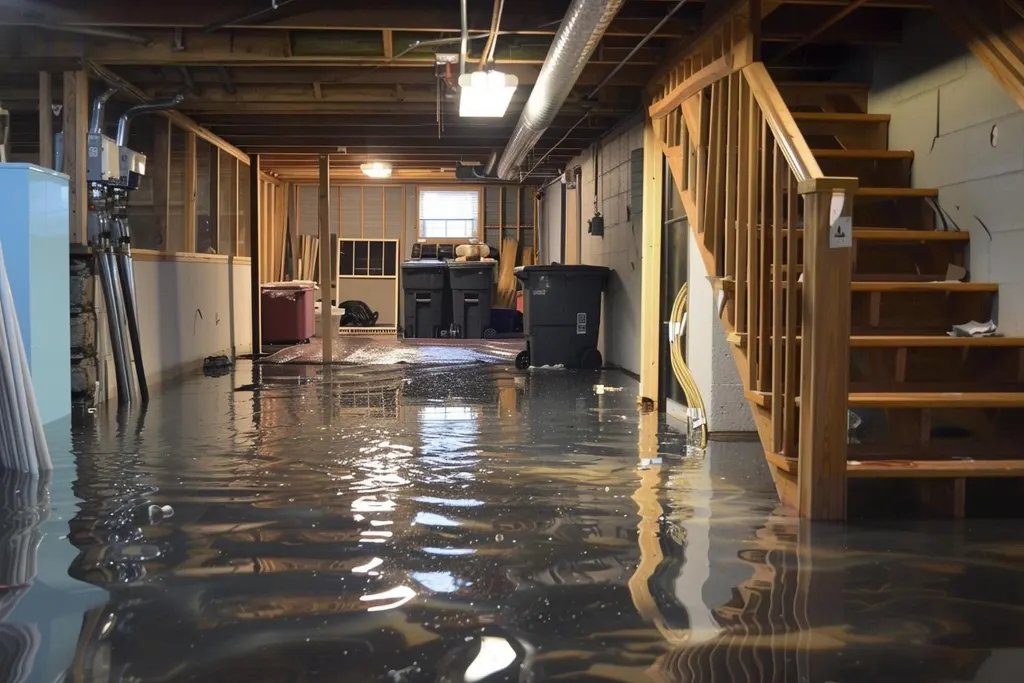
Rain came through the foundation and the floor drain together. The job ran on flood discipline: contents raised and sorted, porous material out, slab and studs dried to standard, and the claim file built alongside the drying log, because storm work is documentation as much as drying. Homeowners who ask what is water damage restoration usually have this picture in mind by the end.
The radiator valve that wept all winter
A slow weep fed the wall behind a bedroom radiator from November to March. The service here was small and precise: baseboard and a wall section out, framing dried, valve replaced by the building plumber before the wall closed. Slow causes make hidden damage; the meter, not the stain, set the opening. Read it as one more working answer to what is water damage restoration.
The dishwasher that leaked under the cabinets
The kitchen floor felt soft near the sink. Under the cabinets the subfloor was saturated. The crew removed two cabinets and the ruined subfloor section, dried the joist bay, and rebuilt over readings the owner could check, repair following drying in the order the definition demands. That is what is water damage restoration when the definition is put to work.
The roof leak over the top floor bedroom
Every hard rain spotted the same ceiling corner. The job paired with the roofer: ceiling section out, decking and insulation dried, roof detail repaired first, ceiling closed only after a dry reading and a dry storm. The EPA gutter and grading advice in the causes section is this job, written as prevention. It shows what is water damage restoration better than a paragraph of promises.
The sewer backup in the garden level
Category 3 from the first minute. The service ran protected: porous material out and bagged, hard surfaces cleaned and sanitized, drying verified before the tenant belongings returned, with disposal handled as contaminated throughout, exactly the professional case the EPA wording describes. Anyone wondering what is water damage restoration can start with this picture.
The water heater that emptied into the utility room
Forty gallons across a ground floor before anyone woke. Extraction the same morning, the floor system dry in three days, and the replacement heater went in with a pan and a drain the old install never had. A clean water job, graded honestly, is the fastest version of the service there is. That is what is water damage restoration at household scale.
The frozen pipe in the vacant house
A cold snap split a line in an empty house, found days later by a neighbour. This job started late and showed it: removal in three rooms, growth treatment under the mold rules, and a rebuild measured in weeks, not days. The definition did not change; the delay changed how much of it was removal. It is what is water damage restoration means once the vans arrive.
The air conditioner that drained into the wall
A window unit tilted inward fed the wall below it all summer. The crew opened the wall under the window, removed the wet drywall, dried the cavity, and the unit went back with its tilt corrected and its drain aimed outside, the EPA drip pan and drain line point made visible in one wall. This is what is water damage restoration when the water is uninvited and the hour is bad.
The office that flooded over a weekend
A commercial tenant found inches of water on Monday. The service ran nights to protect trading hours: extraction first, contents and files triaged, drying logged for the landlord each morning, rebuild phased around the business calendar, the commercial subtopic of this page in working clothes. That is what is water damage restoration, stage by stage, in one address.
The brownstone cellar that took the street water
Storm water entered at the front area way and filled the cellar. Pumps ran for hours, stored porous material came out, and masonry and timber dried slowly, the Class 4 patience that old buildings demand and that no honest schedule can hurry past the readings. It is the local shape of what is water damage restoration.
The nursery ceiling under the bathroom
A failed wax ring fed the ceiling cavity above a crib for months. One service, two homes, and a building that learned to read a downstairs stain as an upstairs alarm. The room was verified dry and clean before the crib returned, the safety first finish the short film in the case studies describes. Asked what is water damage restoration here, the crew would point at this.
The gym that could not close
Showers on one side, lockers on the other, a wall drinking steam and splash for years. The work phased around opening hours, opened the wall in sections, and put ventilation correction into the same project so the wall stayed dry, because a definition that ends at dry but ignores the cause is a subscription. That is what is water damage restoration when the map leads and the machines follow.
The co op sale saved by paperwork
A buyer inspector flagged a smell in a rear bedroom days before closing. The service produced a moisture map, a small contained scope and a verified dry closing note, and the sale completed on documents instead of assurances. The fifteenth service, documentation, was the whole job this time. It is what is water damage restoration stripped of everything decorative.
Room by room
Ten rooms, ten places the definition gets tested
Every room has its own water supply, its own materials and its own hiding places. A short tour of what crews read first in each one, and which part of the service each room leans on hardest.
Bathrooms
The wettest room by design. Work here starts under the tub and behind the toilet, reads the floor system through the ceiling below, and treats grout failure as a plumbing fact, not a cosmetic one. Bathrooms test the inspection stage more than any other room in the home. This is what is water damage restoration on an ordinary weekday.
Kitchens
Sinks, dishwashers and refrigerator lines fail quietly under cabinets. A kitchen visit pulls toe kicks, reads the subfloor, and checks inside cabinet bases before it believes the dry looking floor, because kitchens hide their water under furniture that never moves. That is what is water damage restoration when measurement, not habit, runs the job.
Basements
Below grade rooms collect the building water and the soil damp together. Basement work pumps first, removes porous material that stayed wet, and ends with a humidity plan, because a dried basement with no dehumidification is a repeat appointment wearing a closing certificate. It is what is water damage restoration looks like from the doorway.
Bedrooms
Bedrooms report other rooms water: the bathroom above, the radiator in the corner, the window unit in the wall. Work here follows stains and readings back to a source that is rarely inside the bedroom itself, which is why the map, not the symptom, leads. Anyone asking what is water damage restoration in this city will meet this version sooner or later.
Living rooms
Hardwood country, where cupping and crowning write the damage report. A living room job reads the floor board by board, dries from above and below where access allows, and gives the repair verdict from readings, not hope, because floors forgive early water and remember late water. That is what is water damage restoration with the paperwork included.
Laundry rooms
Hoses, standpipes and dryer vents in one small space. Every laundry inspection checks behind both machines and inside the wall the hoses feed, because the misting hose is the most patient leak in the home and the one most often found by the ceiling below. It is what is water damage restoration when the neighbours are part of the plan.
Utility and boiler rooms
Heaters, boilers and pumps fail here and flood outward. Utility room work pairs drying with the mechanical inspection the equipment needs before it returns to service, because a dry room around an unchecked boiler is a job half finished. This is what is water damage restoration when the building, not the room, sets the rules.
Hallways and entry closets
Hallways carry other rooms water downhill and hide it under flooring runs. A hallway check reads along the baseboards toward the lowest point, where the water has usually been sitting longest and where the removal list quietly grows. That is what is water damage restoration, one room at a time.
Attics
Roof leaks wet insulation and decking long before a stain shows below. Attic work removes soaked insulation, dries decking and framing, and pairs with the roof repair, because drying under a live leak is effort spent defending a ceiling, not restoring a home. That is what is water damage restoration in working clothes.
Commercial spaces
Shops and offices add stock, files, trading hours and landlords to the same science. A commercial job phases extraction and drying around the business day and documents for insurer and landlord at once, the definition wearing its working clothes. It is a plain answer to anyone asking what is water damage restoration.
From the phones
Fourteen things callers ask before they know the name of the service
Shorter than the FAQ, closer to the phone call. These are the questions that arrive in the first two minutes, usually before the caller has the vocabulary this page exists to give them.
Can you come today?
Yes, for the stages that cannot wait: source stopped, inspection, extraction and drying started. The full service then runs in sequence, and you will be told the real arrival window on the call, not a pleasing fiction invented to end the conversation. This, more than any slogan, is what is water damage restoration.
Do I have to move out?
Often not for the whole job, but this page will not promise it as a rule, because it depends on the water category, the rooms involved and who lives there. A crew will tell you plainly on the first visit which nights, if any, are better spent elsewhere. Homeowners who ask what is water damage restoration usually have this picture in mind by the end.
How loud is the drying?
Noticeable. Air movers and dehumidifiers hum day and night for the drying days, and bedrooms near the chamber are the usual complaint. Drying cannot pause at night without losing the race against growth, so crews plan placement with sleep in mind where the map allows. Read it as one more working answer to what is water damage restoration.
What about my pets?
Pets stay out of open work areas and away from extraction hoses and cables. Tell the crew on the first call; a work plan notes animals early, because a drying chamber door and a curious cat are natural enemies and nobody needs that story. That is what is water damage restoration when the definition is put to work.
Will you move my furniture?
Yes, as part of extraction and drying: pieces are moved to dry areas or blocked up off wet floors. What cannot be saved is listed honestly and early, because contents are part of the claim file, not an afterthought discovered at the invoice. It shows what is water damage restoration better than a paragraph of promises.
Can you save my hardwood floor?
Sometimes, and the meter decides. Floors caught early often dry flat; cupped or buckled floors go to repair assessment. A crew will read the boards and the subfloor and give you the verdict with numbers attached, which is the only version worth hearing. Anyone wondering what is water damage restoration can start with this picture.
Do you work with my insurer?
You receive the documentation package insurers read: photos, moisture map, daily log, scopes and invoices. Claims are argued by paper, and a service that generates the paper as it runs saves you the month three reconstruction of evidence. That is what is water damage restoration at household scale.
Can you just dry it without cutting?
When readings say a cavity can dry closed, yes, with targeted airflow. When material has lost strength or a cavity will not move, cutting is the honest route. The readings decide either way, and so should any quote you accept, whatever the company calls itself. It is what is water damage restoration means once the vans arrive.
What if the water smells?
Smell is information: it suggests the water carried soil or waste, or that material has stayed wet long enough for growth. Tell the crew before they arrive, because the protective gear and handling change the moment category is in question. This is what is water damage restoration when the water is uninvited and the hour is bad.
How soon can I repaint?
After the dry standard is met and recorded, not before. Paint over a damp wall traps moisture and voids the point of the job. The repaint date comes from the readings, and the rebuild stage usually handles the painting for you. That is what is water damage restoration, stage by stage, in one address.
Do you handle the rebuild too?
Yes, the rebuild is the closing stage of the service on this page: drywall, flooring, trim and paint over a proven dry structure, with permits where the Department of Buildings rules require them. One sequence, one file, no handover gap. It is the local shape of what is water damage restoration.
What should I do until you arrive?
Stop the water if you safely can, keep clear of wet electrics, photograph everything, lift what you can off wet floors, and do not start cutting walls or spraying chemicals. Those moves protect your home and your claim, and they make the first visit faster. Asked what is water damage restoration here, the crew would point at this.
My landlord is ignoring the leak. What now?
Written notice first, kept. Then 311, an HPD inspection, and a violation with a correction clock by class. Rental work runs faster with that paper behind it, and the rules section of this page carries the classes and windows in full. That is what is water damage restoration when the map leads and the machines follow.
Is the work documented for resale or boards?
Yes. The closing file, map, logs, scopes and verification, is exactly what co op boards, buyers and managing agents ask for after water work. Documentation turns a past leak from a rumour into a closed item, and it is a named service on this page, not a favour. It is what is water damage restoration stripped of everything decorative.
Neighbourhood notes
Twelve neighbourhood notes from definition questions asked on real jobs
The service area list is easy to print. Harder, and more useful, is what differs street by street: building age, water source, and the rules of the house. Notes from the neighbourhoods named in the service area.
Long Island City
New towers, shared systems, tight envelopes. Work here starts with building engineers, because condensate and riser sources serve many homes at once, and access planning matters as much as extraction when the wet home sits thirty floors up. This is what is water damage restoration on an ordinary weekday.
Flushing
Houses of every vintage, many converted, with added bathrooms and laundry rooms plumbed bravely. The inspection in Flushing walks the additions first, because that is where the hoses, traps and vents were improvised and where the water usually starts. That is what is water damage restoration when measurement, not habit, runs the job.
Jamaica
Basements and below grade rooms after heavy rain lead the call list. Work in Jamaica leans on flood discipline and ends with sump, drainage and humidity conversations while the memory is fresh and the readings are still on the wall. It is what is water damage restoration looks like from the doorway.
Harlem
Brownstones and big pre war elevator buildings with stack plumbing older than the tenants. A Harlem job often serves two homes at once, the one that leaked and the one that reported it, under one moisture map and one honest conversation. Anyone asking what is water damage restoration in this city will meet this version sooner or later.
Upper West Side
Co op country: boards, alteration files and bathrooms stacked since the twenties. A job here arrives with its paperwork in order or it does not arrive at all. The water follows the stacks like everywhere else; the paper follows the board. That is what is water damage restoration with the paperwork included.
Upper East Side
Staff buildings, service entrances and strict work windows shape the job. Work here plans around the building day, and the drying log goes to the managing agent as routinely as to the owner, because the building keeps its own file on your flood. It is what is water damage restoration when the neighbours are part of the plan.
Astoria
Pre war apartments and houses under flat roofs that announce themselves one ceiling at a time. Calls in Astoria spike after storms, and the roof edge is part of the inspection, not an afterthought discovered at the second leak. This is what is water damage restoration when the building, not the room, sets the rules.
Williamsburg
Warehouse conversions and new builds share the list. Converted industrial floors hide plumbing in creative places; work in a loft reads like archaeology, layer by layer, until the wet layer confesses and the map can be drawn honestly. That is what is water damage restoration, one room at a time.
Park Slope
Brownstone garden levels and family bathrooms retrofitted into history. Work here respects the fabric: openings are surgical, plaster is probed before it is cut, and the moisture fix is built to outlast the listing photos and the next sale. That is what is water damage restoration in working clothes.
Riverdale
Houses and garden apartments on the hill, with finished basements that meet the water table politely until a wet spring. Riverdale jobs pair drying with drainage and dehumidification plans more often than anywhere else on this list. It is a plain answer to anyone asking what is water damage restoration.
Staten Island neighbourhoods
From St. George to the South Shore, the calls follow the water: coastal damp, storm history, below grade rooms. Work here documents for insurers as carefully as it dries, because storm claims run alongside so many of the jobs. This, more than any slogan, is what is water damage restoration.
The Bronx beyond Riverdale
Grand Concourse pre wars and Co-op City scale buildings bring the volume. Work here plans around occupied neighbouring units on every floor, and tenants who know the 311 route cold get their buildings moving fastest when landlords stall. Homeowners who ask what is water damage restoration usually have this picture in mind by the end.
Plain words
A short glossary for the words inside the definition
Scopes, logs and violation notices use trade words without apology. Fourteen of them, translated once, here, so every document in your folder makes sense the first time you read it.
Moisture map
The room by room record of readings that opens the service: what is wet, how wet, and where the dry edge sits. Every later decision, openings, equipment, finish, traces back to this document, and no honest scope exists without it. Read it as one more working answer to what is water damage restoration.
Dry standard
The moisture level a material sits at when normally dry in that building, taken from an unaffected sample of the same material. Drying ends at the dry standard, and the service has no other finish line worth the name. That is what is water damage restoration when the definition is put to work.
Category
The contamination grade of the water itself, 1 clean, 2 gray, 3 black, set by assessment findings at the property. Category decides protective gear, handling and disposal, and it is a finding, not a guess made on the phone. It shows what is water damage restoration better than a paragraph of promises.
Class
The size and drying difficulty grade of the loss, 1 least to 4 specialty. Class decides how much drying power arrives and how long it stays, which is why two jobs with the same wet area can run on different clocks. Anyone wondering what is water damage restoration can start with this picture.
Mitigation
The emergency opening stage of the service: stop the loss, extract the water, remove what cannot be saved, start the drying. Mitigation limits damage. It does not, on its own, return a home to its prior condition. That is what is water damage restoration at household scale.
Remediation
In water work, industry usage for the containment and cleanup side of a loss. In mold work in New York, a statutory term under Labor Law Article 32 with licensed assessors and remediators. Same word, two weights; ask which one a speaker means. It is what is water damage restoration means once the vans arrive.
Extraction
Physical removal of liquid water by pump, vacuum and weighted tools. Extraction is the fastest stage of drying ever invented, because water carried out in a hose never has to evaporate through your walls or your week. This is what is water damage restoration when the water is uninvited and the hour is bad.
Structural drying
Drying the building itself, framing, subfloors, cavities and masonry, as distinct from drying contents. It is the longest stage of the service, governed by daily readings against the dry standard of each material. That is what is water damage restoration, stage by stage, in one address.
Air mover
The fan unit that pushes air across wet surfaces to strip moisture into the room air. Air movers without dehumidification only relocate water, which is why the two machines always appear together in a real scope.
Dehumidifier
The machine that pulls moisture out of the air and drains it away, completing the circuit the air movers start. Commercial units on these jobs are sized from the class of loss and the volume of the drying chamber.
HEPA
High efficiency particulate air filtration, fine enough to capture the dust and fragments that cleaning and cutting release. HEPA vacuuming finishes the cleaning stage before finishes go back on the dried structure.
S500
The IICRC standard for professional water damage restoration, Fifth Edition 2021, a voluntary industry standard rather than a law. It sets procedures, precautions and components, without publishing one sentence definition or one fixed drying number.
S520
The companion IICRC standard for mold work. When growth becomes the primary concern, the job crosses from the water standard to this one, and in New York the Article 32 licensing rules join it for larger projects.
Emergency Work Notification
The Department of Buildings filing made within two business days after emergency work is completed. It is the paper bridge between a fast response and a legal rebuild in this city, and its deadline runs from completion, not from the start.
Buildings and seasons
Eight building types and six seasons, read through one definition
Two shorter tours to finish the field notes: the building types that shape the work, and the calendar that schedules it. The definition stays constant through both; the emphasis moves.
Pre-war apartment buildings
Plaster, stacks and steam. Work here is cavity work: moisture hides behind hard plaster that looks innocent, and readings, not stains, set the openings. Neighbours above and below are part of every plan and every map. Read it as one more working answer to what is water damage restoration.
Brownstones and townhouses
Garden levels, cellars and retrofitted bathrooms. A brownstone job balances fabric and speed: surgical openings, careful drying of old timber, and moisture fixes that respect a house built before indoor plumbing was normal. That is what is water damage restoration when the definition is put to work.
Co-ops and condos
The building is a government as well as a structure. Work in co ops runs on board packets, insurance certificates and booked elevators. The science is identical; the choreography is not, and experience in these buildings shows quickly. It shows what is water damage restoration better than a paragraph of promises.
New construction towers
Tight envelopes and shared systems grow modern water problems: condensate, construction moisture, risers serving dozens of homes. Tower jobs coordinate with building engineers, because the source is often a system, not a pipe. Anyone wondering what is water damage restoration can start with this picture.
One and two family houses
Basements, attics and additions carry the risk in the city houses. A house job walks the whole envelope, roof to slab, because the owner owns every layer of the problem and every part of the fix that follows it. That is what is water damage restoration at household scale.
Rental buildings, large
Scale turns water into a compliance calendar: inspections, violation clocks, filings. Large landlord work is a system, standing plumber, standing crew, records kept like accounts, or every leak becomes a legal hobby nobody enjoys. It is what is water damage restoration means once the vans arrive.
Public housing
Public housing follows its own reporting tracks and programs, and residents should use the channels their housing authority publishes first, keeping ticket numbers and photos. Private crews support the surrounding work where the program directs it. This is what is water damage restoration when the water is uninvited and the hour is bad.
Shops, gyms and offices
Commercial tenants trade by the day, so commercial work phases around hours, extracts fast, and documents for landlords and insurers at once. A closed week costs more than the drying; planning is the saving, every time. That is what is water damage restoration, stage by stage, in one address.
Winter
Frozen pipes, steam heat and sealed windows. Winter calls split between bursts in cold snaps and slow radiator weeps found months late. The fix includes insulation and airflow, or the same pipe keeps its February appointment next year. It is the local shape of what is water damage restoration.
Spring
Snowmelt, rain and rising water tables test every basement. Spring work is flood discipline repeated house by house: extraction, porous material out where it stayed wet, structures dried, drainage finally discussed while the memory is fresh. Asked what is water damage restoration here, the crew would point at this.
Summer
Humidity season. Air conditioners drain into walls, basements sweat, and drying fights August air. Summer jobs lean on dehumidification capacity, because evaporation into already wet air is the slowest version of the science. That is what is water damage restoration when the map leads and the machines follow.
Storm season
Late summer and autumn storms write the year biggest chapter: flooded ground floors from the Rockaways edge to the Bronx. Storm work runs on triage, source and safety first, extraction fast, drying measured, documents ready for the claims that follow. It is what is water damage restoration stripped of everything decorative.
Autumn
Heating restarts, radiators weep at valves untouched since spring, and the first cold walls collect condensation. Autumn calls are small and numerous, which is exactly when catching them is cheapest and the openings stay smallest. This is what is water damage restoration on an ordinary weekday.
The holiday weeks
Guests, cooking steam, full houses and pipes under holiday load. The holiday call is usually an emergency one, and it is answered the same way as any other night of the year: source, inspection, extraction, drying, in that order. That is what is water damage restoration when measurement, not habit, runs the job.
Read across all of these notes and one sentence survives every version: the water arrived first, stayed too long, and found material that could not take it. Every durable fix, in every building and every season, is the same arc wearing different clothes: stop it, map it, carry it out, open what it ruined, dry what remains, clean it, rebuild it, and prove it. That is the whole trade, and it is enough.
The city record
Sandy and Ida: the two storms that taught this city the definition
Twice in a decade, water arrived at a scale that made the whole city ask the question this page answers. The record of both storms is part of the local evidence, stated here with its sources and its corrections showing.
Hurricane Sandy hit New York City on 29 October 2012. The city Hurricane Sandy recovery page records that the storm inflicted about 19 billion dollars in damage and took the lives of 44 city residents. That figure, 44, is the current city number and the one this page uses; an older 2013 recovery report carried 43, and pages in this site family that once printed 43 have been corrected to 44, because a definition page that teaches source discipline should practise it on its own history. What Sandy taught the trade here was scale discipline: triage across thousands of homes at once, contaminated grades handled by findings, porous material out by the truckload, and documentation running hot because every claim in the city competed for the same adjusters at the same time.
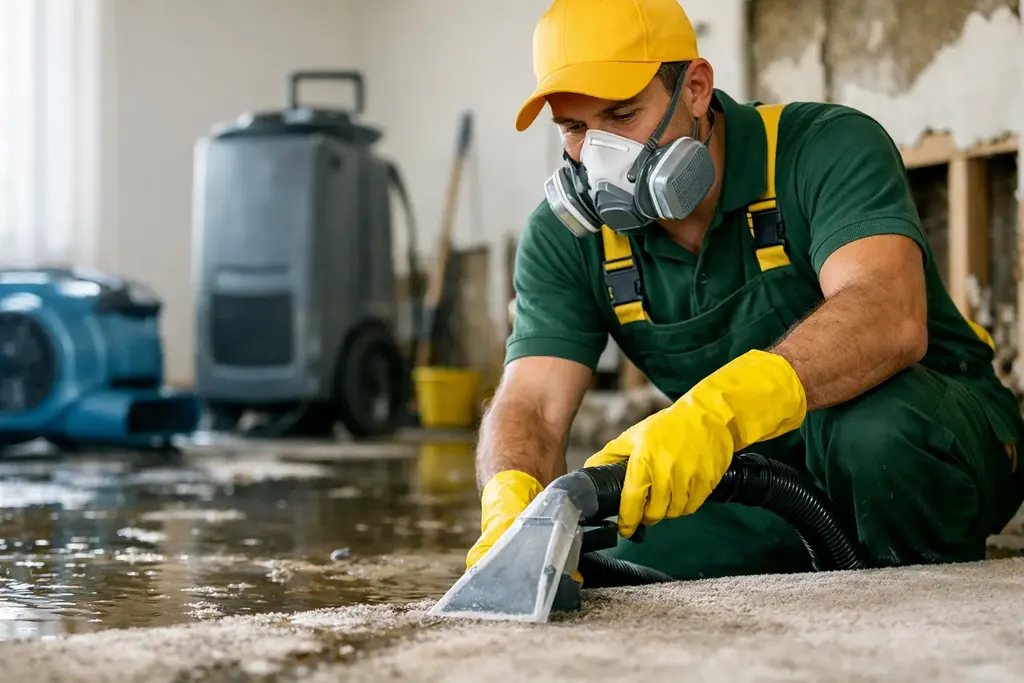
Hurricane Ida remnants arrived on the evening of 1 September 2021 as a post tropical cyclone, and the city Ida recovery page records that the storm smashed the city record for the most single hour rainfall, that the city sewer system is designed to handle about 1.75 inches per hour, that the storm damaged approximately 33,500 buildings in New York City, and that 13 New Yorkers lost their lives. The rainfall record itself is verified at Central Park, where 3.15 inches fell in a single hour between 8:51 and 9:51 in the evening, with a daily total of 7.13 inches corroborated by the National Weather Service record and news reporting. Of the 13 deaths, at least 11 happened in basement apartments, a detail reported by ABC News and the New York Times at the time and cited to them here, because it does not appear on the city recovery page.
Ida changed what the definition means in a basement city. The lesson written into every basement job since is that below grade homes meet water at its fastest and dirtiest, that minutes matter more than machinery, and that the safety rules in the CDC section of this page, authorities first, no wading, electrics treated as live until an electrician says otherwise, are not boilerplate. They are the distilled version of a night this city remembers. When a homeowner asks what is water damage restoration for, in the deepest sense, Ida is part of the honest answer: it is the organised version of what thousands of households needed at once, and mostly did not have.
Both storms also explain the documentation habit this page keeps recommending. Storm claims are read months later by people who were not in your street that night. The homes that could produce photographs, dates, readings and scopes settled on evidence. The homes that could not settled on memory. The service, defined properly, produces the first kind of file as a by product of doing the work in the right order.
The science, briefly
Why the definition is built on measurement, in four facts
You do not need an engineering degree to judge a restoration scope, but four facts from the standards and agencies do most of the work. Everything else on this page is these four facts, applied.
First: water moves until it is stopped twice, once at the source and once at the material. A closed valve stops the supply; only extraction and evaporation stop the water already inside your walls and floors, and evaporation without measurement is a hope. That is why the arc puts pumps before fans and meters before both, and why the inspection, not the equipment, is the first service on the list.
Second: materials differ, and the differences decide the job. Porous materials drink deeply and dry slowly; some, like saturated drywall, lose their structure in the drinking. Semi porous framing usually survives and dries; non porous surfaces mostly need cleaning. The removal list is simply this fact with your room names attached, and any scope that treats every material the same has not understood its own work.
Third: damp is a clock, not a condition. The agency guidance converges on speed: dry within 24 to 48 hours and growth will in most cases not start, in the Brief Guide wording; leave material wet for more than 24 hours after flooding and the growth question changes, in the flood page wording. Humidity held below 60 percent, ideally between 30 and 50 percent, starves the process further. Every scheduling choice on a real job, night work, weekend work, equipment counts, is this fact wearing a calendar.
Fourth: dry is a comparison, not a feeling. A material is dry when it matches the same material in a dry part of the same building, read with the same instrument. Not when it feels dry, not when a week has passed, not when the paint looks fine. The comparison matters because walls closed over damp cavities are how small jobs become large ones, and because the reading, written down, is what lets a later buyer, tenant, insurer or board trust that the work ended where it claimed to end.
Hold those four facts and the definition reads as common sense: inspect before acting, because water hides; extract before evaporating, because hoses beat air; remove what water ruined, because structure does not heal; dry to a standard, because moisture is the cause of everything downstream; clean what remains, because residue is the flood signature; rebuild last, because finishes are a lid, and a lid belongs on a dry box.
After the job
Keeping the next flood small: maintenance the definition points to
Verification day is not the end of the story; it is the start of the part you control. Water needs a source, a path and time. The job took away the water. Prevention takes away the other two, permanently.
Replace the hoses that fail silently. Washing machine and dishwasher supply lines, refrigerator water lines and toilet supply lines all age out, and braided replacements with a leak pan under the machine convert a future flood into a future puddle. Know your shutoffs: the apartment valve, the house main, the riser your super controls. The safety section of this page is short only when the valve is findable in the dark.
Hold indoor humidity down and watch the cold spots, in line with the EPA guidance quoted earlier: below 60 percent where possible, ideally between 30 and 50 percent. Bathrooms get real ventilation run during and after showers. Dryers vent outside, full stop. Basements and garden levels get a dehumidifier that drains itself, sized for the room, because a bucket nobody empties is a decoration. Once a season, walk your home the way an inspector would: smell each room, look under every sink, check behind the machines, glance at the ceiling below every bathroom. Five minutes, four times a year.
And treat every small leak as the first chapter of a large one. A dripping trap, a sweating line, a window that weeps in January: each is small plumbing and large prevention. The homes that never need a large restoration are not luckier homes. They are homes where somebody looked, early and often, and fixed water while it was still plumbing, which is the cheapest form the service ever takes.
Found something on your seasonal walk?
A photo and a phone call now is the cheapest version of this problem you will ever be offered. Crews would rather map a damp corner than open a wall, and so would your wall.
How this page was built
Sources, method, and the claims this definition page refuses to make
A definition page that asks for your trust should show its working. This one was researched the way this site researches every page: competitor pages and their structured data read one by one, keyword tools run fresh, and every load bearing fact checked against the agency or standard that owns it.
The demand figures behind the page come from SEMrush and Moz, run on 23 November 2026 through RankyTools, and the two tools disagree in a way readers deserve to know. SEMrush reports volume of 480 searches a month with a difficulty of 39 percent, classed Possible, and a cost per click figure this page does not print because the site carries no prices. Moz reports volume of 24, with a difficulty of 30, classed Low, and a click through rate of 93 percent. The volumes disagree by twenty times. An older keyword sheet behind this site carried 590 a month at 25 percent difficulty for this search; the fresh figures do not match it, so the sheet figure is not quoted as current anywhere on this page. The tools also split on intent: SEMrush classes the search as informational, while Moz tags it informational and its primary intent card says transactional. This page reports both and averages neither. What both tools agree on matters more: an AI Overview is present in both, and the top of the Moz list is beatable, a topical page on a domain with authority 8, ahead of national brands whose pages answer the definition more thinly.
The competitor structured data was checked on the live Schema validator across sixteen attempted pages, of which thirteen loaded; three failed to load and stand as unmeasured rather than zero. Of the thirteen measured, one carries a FAQ section with five distinct questions, one carries a HowTo with five steps, and none carries a service catalogue, a rating, a search action or video markup. Two of the thirteen carry no structured data at all. The strongest visible page, a national brand, shows eleven questions and a displayed rating from a very large review count, but marks up neither in its data. This page answers with thirty questions, a six step HowTo with full text, and a fifteen item catalogue, and it publishes those numbers here so the comparison can be checked rather than believed. One honest gap stands: this service has no rating markup, because it has no collected review count to mark up, and inventing one is exactly the kind of claim this page exists to refuse.
The refusals run through the whole page, and they are deliberate. No prices, because the site books work by phone after inspection. No one sentence definition attributed to an agency, because none exists. No Category 1, 2 or Class 1 to 4 wording presented as a quotation from the standard, because the standard text is paywalled and only the training summary and the position statement citations were verified. No fixed drying percentage and no fixed number of drying days, because the standard sets neither. No Con Edison guidance, because no primary source from that utility was verified for this page. Each refusal costs the page a little drama and buys it the only asset a definition page cannot fake: the reader justified belief that the rest of it is true too.
Where a fact could not be verified, the page says so in place: the fuller signs list stands labelled as industry knowledge rather than an agency quotation, the cause list separates the EPA named items from the common sense ones, and the position statement date is given as 16 March 2026, the date on the statement heading, after an earlier February date in circulation failed verification. Facts carried here are the ones that survived that filter, attributed to the IICRC and its March 2026 position statement, the EPA, the CDC, the Department of Buildings, the Department of Housing Preservation and Development, the Department of Financial Services, FEMA, FloodHelpNY and the city storm recovery pages. If any of them updates its guidance, this page next revision starts from their text, not from this one.
Paper that protects you
The folder: every document a defined job should leave behind
The FAQ closes with the insurance version of this list. This is the full folder, the one that serves landlords, boards, buyers and your future self as well as any insurer.
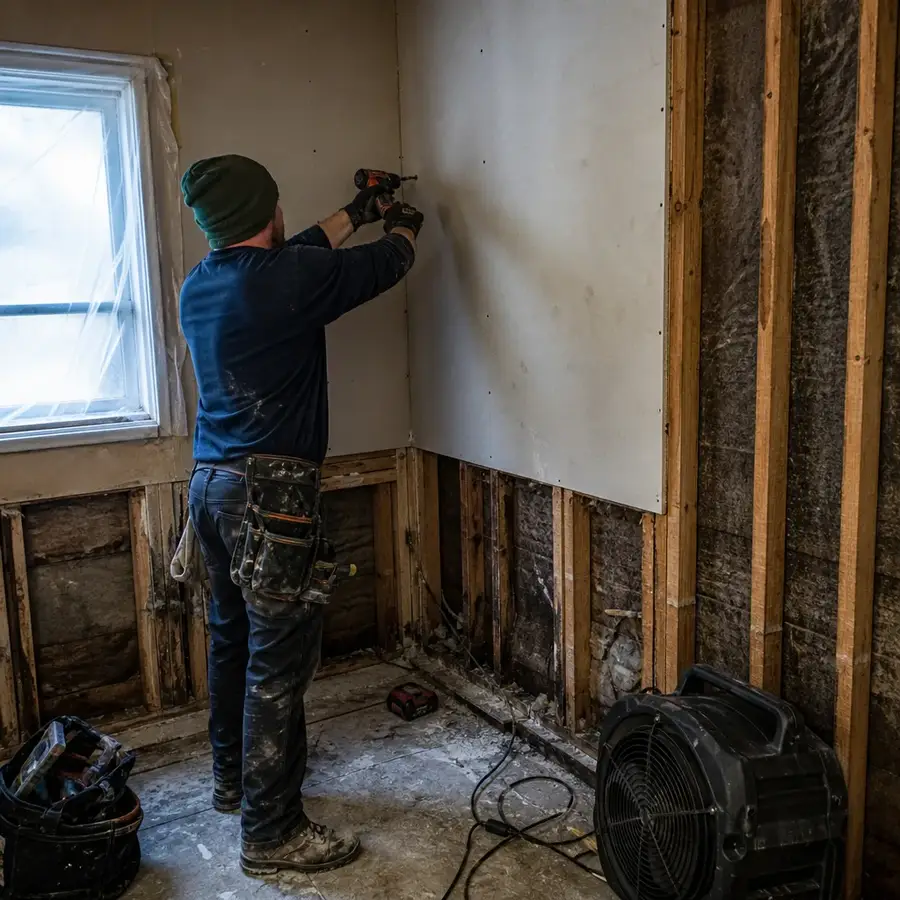
Keep the inspection report and the moisture map, the documents that say what was found, where, how wet, and what the job was supposed to do about it. The service begins on paper, and that paper is the baseline every later argument is measured against. Keep the scope and the contract, and check them against each other before work starts: the scope should implement the map, stage by stage, and any difference should be explained in writing by the crew lead before the first cut, not discovered by you at the invoice.
Keep every invoice and proof of payment. Keep the daily moisture readings and the drying log, with the dry standard reference readings from your unaffected rooms written at the top, because a falling number means little without the target it was falling toward. Keep the closing verification: readings at standard, cleaning done, rebuild complete, permits filed where the work required them. That closing note is the document that converts a wet month into a closed file, and it is the first thing a buyer, a board or an insurer will ask for when the story is retold.
Keep your photographs, before, during if you can, and after, with their dates intact. Keep the correspondence: landlord notices, board emails, 311 complaint numbers, violation copies, insurer letters and claim numbers, and your own dated notes of every phone call, with the name of the person you spoke to. Store it twice, once on paper if the job was large, once in the cloud, and keep it for years rather than months. Label the folder with the address and the year, and tell one other person in the household where it lives, because the day it is needed is usually a stressful day involving water, a telephone and a deadline, and a folder nobody can find protects nobody at all.
The maintenance calendar
A year of small checks that keep the definition theoretical
Prevention has a calendar. None of these checks takes more than a few minutes, and every one of them exists because a specific, ordinary failure in a specific month is how the jobs on this page begin. Tape this list inside a kitchen cabinet; it is the cheapest page of the whole site.
January and February: cold pipes and radiator season
The deep cold months test every pipe on an outside wall. Let taps on exposed lines drip on the coldest nights, keep cabinet doors under sinks open to warm air, and know where your shutoff is before you need it at speed. Feel radiator valves for the first weep of the season and look at the wall behind each radiator once a month. The job that starts in January usually began as a December weep nobody touched, and a bucket under a valve today is a story, while the same leak found in April is a wall opening.
March and April: water from above and below
Spring rain tests roofs, parapets and grading all at once. After the first heavy rain, look at every ceiling, especially below bathrooms and below the roof line, and check basement walls for new damp lines and the floor drain for slowness. Outside, confirm that soil and paving still slope away from the foundation and that downspouts discharge clear of the walls, the grading point the EPA names in its own list. In houses, this is the month to service the sump pump rather than to meet it during a storm.
May and June: machines go back to work
Air conditioners go back in, and each one is a small plumbing system aimed at your wall. Set units to drain outside, check the tilt, and look at the wall beneath after the first week of running. Start the basement dehumidifier before the room smells like summer, and confirm it drains somewhere that is not its own bucket. Supply hoses get their annual look now: washing machine and dishwasher lines, refrigerator water lines, the trap under every sink. Rubber hoses older than anyone can remember are replaced on suspicion, because their failure mode is a flood plus a season of hidden damp.
July and August: the growth months
Heat and humidity double the speed of everything alive in a wall, and they slow drying to its hardest setting. Keep bathroom fans running longer than feels necessary, and leave interior doors open where you can so air moves. Check below grade rooms weekly in a wet summer; a musty smell in August is a wet cavity announcing itself while the opening is still small, and the EPA hidden mold sign quoted on this page is exactly that smell, taken seriously.
September and October: storm season discipline
The storm months ask for the flood routine: know where your water shutoff is, keep documents and photographs of your rooms current, and move storage off basement floors and away from below grade walls before the forecast, not during it. After any storm water entry, the clock rules apply: porous material that stays wet is a removal decision within days, and drying is measured, not assumed. The Sandy and Ida record in the storms section is the reason this page of the calendar is written in a firmer hand than the others.
November and December: heat returns, guests arrive
The heating restart brings back radiator weeps and the first frozen pipe warnings, so repeat the January walk in November while the season is young. Holiday cooking and guests load bathrooms and kitchens with steam and water for hours; run the fans, and dry the bathroom properly after the big days rather than letting a week of celebration humidity settle into the grout and the ceiling paint. And when the year closes, file the year paper: inspection notes, repair invoices, photographs. The folder described on this page grows by a few sheets a year, and it is worth more than it weighs.
That is the whole calendar: six short walks a year, a handful of hoses and valves, and a habit of looking. Every professional will tell you the same thing the calendar implies. The homes that never need the service defined here are not luckier homes. They are homes where somebody looked, early and often, and fixed water while it was still plumbing.
Explained, plainly
The definition explained: meaning, scope and the questions inside it
Some readers arrive with the variant searches, the meaning of the term, the definition itself, the service version of the question. They are the same intent wearing different words, and each part of it gets its plain answer here, in the language the rest of the page has built.
Start with the meaning at the deepest level. The word restoration carries its sense in its root: restoring, returning something to the state it was in before the event. Applied to water, it means the building and its contents are returned to the condition the water interrupted, safe, dry and usable, not merely emptied of the visible puddle. That is why the service defined here reaches from inspection to rebuild: a job that stops at dry has restored the moisture level but not the home, and the word itself objects.
The scope question follows. The service covers the building structure, the systems inside it, heating and air systems among them as the standard contents list names, and the personal property the water reached. It does not cover the cause: the pipe, the roof detail, the failed hose belong to the owner side, a boundary the standard states and this page repeats because so many disputes are born exactly there. Two homes with the same visible stain can honestly receive different scopes, because the inspection findings, map, category, class and dry standard, differ, and the scope is those findings written down.
The technician question deserves its answer, because one of the smaller searches asks what a water damage restoration technician is. The technician is the trained person who runs the arc on site: reading moisture with meters, grading category and class from findings, placing and adjusting drying equipment, taking the daily readings, and recording the log that proves the finish. The role is defined by instruments and records more than by machinery; anyone can rent a fan, and the technician is the person who can tell you, in numbers, what the fan achieved overnight.
The service version of the question, the one that adds the word service to the search, is asking about the purchased form of the same thing: a company that answers around the clock, inspects, extracts, dries, cleans, rebuilds and documents, under one scope and one file. Judged as a purchase, the tests are the ones in the choosing section: order, measurement, grading, paper. Judged as a definition, it is identical to the rest of this page, because the service and the discipline are the same thing seen from two sides of the phone call.
Commercial readers find their version here too. The standard scope sentence names commercial and institutional buildings in its own words, and the service inside them is the same arc with harder choreography: trading hours, stock and records as contents, landlords reading the same logs as insurers. Nothing about the definition relaxes because the building earns money; if anything the documentation standard rises, because more parties hold a copy of the file.
Vacant and second homes deserve their own warning. Work in an empty property almost always starts late, because nobody heard the pipe or saw the stain, and late starts convert drying jobs into removal and rebuild projects. Owners of homes that sit empty should fit water alarms, keep heat at safe levels through cold snaps, and have a neighbour or manager walk the property after every storm. The cheapest version of the service is the one that begins while the water is still only in one room.
Rentals add a paper engine to the same machine. Work in a tenanted home runs on written notice, inspection access, and where the landlord stalls, the 311 and violation route whose clocks this page sets out in the rules section. Tenants who photograph early and write promptly get their homes dried and rebuilt fastest, not because crews favour them, but because the building permission and payment questions are already answered when the crew arrives.
Insurance runs beside the work, not after it. The service generates its claim evidence as a by product of doing the job properly: the map is the loss record, the log is the drying proof, the scopes are the cost record. Homeowners who understand this stop treating documentation as bureaucracy and start treating it as one of the services, which is exactly where this page lists it, fourteenth of fifteen and present from the first photograph.
Second opinions follow a simple rule. The work can be audited at any stage by a fresh set of readings: an independent inspector with a meter can verify the map, the drying progress or the closing claim in a single visit. Homeowners in dispute with a crew or an insurer should buy that visit before buying arguments, because moisture is one of the few subjects in a home where the truth is a number two honest people cannot disagree about for long.
Guarantees should be read against the science. The service can honestly promise that treated materials reached their dry standard, that ruined material was removed, and that cleaned surfaces were verified, all in writing. It cannot honestly promise that a home will never flood again or that a new leak will behave like the old one. A guarantee written in the language of readings is worth filing; a guarantee written in the language of forever is worth framing as a warning.
And the whole definition compresses into one sentence a homeowner can hold. It is stopping the water, proving where it went, carrying it out, opening what it ruined, drying what remains to a measured standard, cleaning what it touched, and rebuilding only over dry structure, with paper at every stage. Any quote, any crew and any claim can be tested against that sentence, line by line, and the gaps will show themselves before your walls have to. Readers who came asking what is water damage restoration in its shortest honest form can take that sentence as the answer, and the rest of this page as its evidence.
FAQ
Thirty questions about the definition, answered straight
These thirty answers are drawn from the same sources as the rest of the page: the IICRC S500 standard and its March 2026 position statement, the EPA, the CDC, the Department of Buildings, the Department of Housing Preservation and Development, the Department of Financial Services, FEMA and FloodHelpNY. The four questions Google shows for this search are answered here word for word as asked, the price questions included, answered without figures because honest restoration pricing follows an inspection. Search the list, or read it whole.
What is water damage restoration, exactly?
It is the professional service that returns a water damaged building to safe, dry and usable condition: inspect and map the damage, extract the water, remove material that cannot dry, dry the structure to a measured standard, clean and sanitize what the water touched, and rebuild what was removed. No EPA, CDC or IICRC one sentence definition exists; the working definition on this page is built from the IICRC S500 scope and components, which set the procedures and precautions for the work in residential, commercial and institutional buildings.
How to do water damage restoration?
Follow the arc on this page. Stop the source, inspect the whole path of the water and map moisture with meters, grade the loss by category and class, extract all standing water, remove material that cannot dry safely in place, dry the structure to its dry standard with daily readings, clean and sanitize every touched surface, then rebuild. The full step by step method, with timelines and drying science, is set out on the method page of this site; the order and the measurement at each stage are what make the work restoration rather than guesswork.
Will insurance pay out for water damage?
It depends on the cause and the policy. Flood damage is not typically covered by a homeowners policy, as FEMA states, and FloodHelpNY states the same line for this city; separate flood cover exists for that risk. Sudden and accidental water events inside the home sit at the centre of standard cover, and the Department of Financial Services advises photos and video before cleanup, a list of damaged items, receipts kept, and no permanent repairs until the insurer inspects. Your policy wording decides your claim, so report fast and document everything.
How expensive is it to fix water damage in a house?
No honest figure exists for an uninspected home, which is why this page carries no price list. What decides the work involved is measurable: how much area is wet, what category the water is, how much material must come out, how long drying runs, and how much rebuild follows. Two houses on the same street can need entirely different scopes. The safe route is an inspection with a moisture map first, then a written scope you can compare stage by stage. Call (212) 555-0147 and describe what you see; the number follows the inspection, not the other way round.
What causes water damage?
The EPA guidance names plumbing leaks, roof gutters that go uncleaned, ground sloping toward the foundation, air conditioning drip pans and drain lines, and condensation, in the form of prevention advice. City guidance adds frozen pipes and sewer backups. The familiar industry list adds appliance failures, storm and flood water, foundation seepage and leaks from the home upstairs. No single authoritative cause list exists, so this page labels which part comes from which source; the cause matters because it decides the water category, the path of the water and who owns the fix.
What is the meaning of water damage restoration?
The meaning sits in the word restoration itself: returning the building and its contents to the state the water interrupted, safe, dry and usable, not merely emptied of the visible puddle. In practice it means the full arc, inspection, extraction, removal of ruined material, measured drying, cleaning and rebuild, with documentation through all of it. A job that stops at dry has restored the moisture level but not the home. The variant search that asks for a definition is asking for the same thing, and the boxed definition at the top of this page is this site answer.
What does water damage restoration include?
Fifteen services make up the full offer: emergency water extraction; inspection and moisture assessment; water category and class assessment; structural drying and dehumidification; moisture mapping with daily readings; cleaning and sanitizing; odor removal and deodorization; contents cleaning and drying; wet wall and ceiling drying; floor drying and repair assessment; mold prevention during drying; damaged material removal; reconstruction and rebuild; insurance claim documentation; and 24/7 emergency response. A small leak may need four of them; a flooded building floor can need all fifteen.
What is the difference between water mitigation and water damage restoration?
In industry usage, mitigation is the emergency opening stage: stopping the loss from getting worse, extracting water, removing what cannot be saved and starting drying. Restoration is the full arc that contains mitigation and continues through measured drying, cleaning and rebuild until the property is back to safe, dry and usable condition. A quote that covers only mitigation leaves the ending of the job unbought, whatever its letterhead calls it. Neither term carries a verified one line definition from the EPA, CDC or IICRC, and this page labels both as industry usage.
What is the difference between water damage remediation and restoration?
In industry usage, remediation is the containment and cleanup side: removing contaminated water and material, cleaning and sanitizing so the property is safe. Restoration is the full arc that returns the property to its pre loss condition, including drying, repair and reconstruction. New York law gives one related term a precise meaning on the mold side: Labor Law Article 32 governs mold remediation with licensed assessors and remediators on projects over 10 square feet, and the same business cannot perform both roles on one property.
What is water damage repair, and how is it different?
Repair is the fixing and rebuilding part of the arc: drywall, flooring, trim, paint and fixtures put back after drying is proven complete. On its own, without the inspection, drying and cleaning before it, repair is how damp cavities get sealed behind new finishes, which is why the order matters. No verified EPA, CDC or IICRC definition of water damage repair exists, and this page labels the term as industry usage rather than inventing an authority for it. In a full restoration, repair is the closing stage, not a separate trade.
What is structural drying in water damage restoration?
Structural drying is the stage that dries the building itself, as distinct from its contents: framing, subfloors, wall cavities, masonry and the assemblies water hides inside. Air movers push moisture out of materials into the room air, dehumidifiers remove it from the air, and a technician reads the same marked points daily. The stage ends when each material reaches its dry standard, the level of the same material in an unaffected part of the same building. It is the longest stage of the service and the one governed entirely by measurement.
What is commercial water damage restoration?
It is the same service run for a business rather than a home. The IICRC S500 scope names commercial and institutional buildings alongside residential ones in its own sentence, and the standard, the grades and the measured finish do not change. What changes is the choreography: extraction and drying phased around trading hours, stock, files and equipment triaged as contents, and documentation produced for landlord and insurer in parallel. A closed week usually costs a business more than the drying, so commercial scopes front load planning.
What is fire and water damage restoration?
It is the combined recovery after a fire in which water did much of the damage: firefighting water, sprinkler discharge and heated pipes bursting, soaking a building that also carries soot, debris and odour from the fire itself. The water side runs the arc on this page, extraction, measured drying, cleaning and rebuild, while the fire side adds debris removal, soot cleaning and its own permit path. The combined term exists because the two events arrive together so often; the definition of the water half does not change when smoke is in the room.
What is a water damage restoration technician?
The technician is the trained person who runs the service on site: reading moisture with pin and pinless meters, grading category and class from findings at the property, placing and adjusting extraction and drying equipment, taking the daily readings at marked points, and keeping the log that proves the finish. The role is defined by instruments and records more than by machinery. Anyone can rent a fan; the technician is the person who can tell you, in numbers, what the equipment achieved overnight and what it will do next.
What are water categories 1, 2 and 3?
Category 1 is clean water from a sanitary source. Category 2, gray water, carries significant contamination that can cause discomfort or sickness. Category 3, black water, is grossly contaminated and can contain pathogenic, toxigenic or other harmful agents, and includes sewage, seawater and rising river or ground surface water. The IICRC position statement of 16 March 2026 adds a correction this page follows: top down water ingress and wind driven rain are not automatically Category 3, and category is set by assessment findings at the property. Categories 1 and 2 are summarized here from training material, not quoted from the paywalled standard.
What are water classes 1, 2, 3 and 4?
Classes grade how much of the space is wet and how it will dry. Class 1 is the least and slowest, part of a room or low absorption materials. Class 2 is large and fast, a whole room or more with walls wet to at least 12 inches. Class 3 is the greatest and fastest, with ceilings, walls, insulation, carpet and padding saturated, often from water overhead. Class 4 is specialty drying for water bound in hardwood, plaster, brick, concrete and stone. The class sets equipment counts and drying time, and like the categories it is summarized from training material on this page.
How long does water damage restoration take?
The drying stage is the part with the honest ranges: industry practice puts most drying at three to five days, smaller losses at two to four, and larger or specialty jobs at five to ten days or more, with the EPA noting that drying after a flood usually takes several days to weeks. The full arc including rebuild typically runs one to two weeks for a smaller job and four to six weeks or longer for a large one. The deciding measure is not the calendar: drying ends when each material reaches its dry standard, proven by daily readings.
When should I call a restoration company?
Call when any of these are true: the water came from a drain, a sewer, soil or any source you would not drink; the wet area covers more than a small corner; water entered walls, ceilings, flooring systems or cabinetry; material stayed wet past a day; anyone at home has asthma, a weak immune system, or is very young or older; the property is a rental or a building with other homes beside, above or below yours; or you need documentation an insurer will read. The EPA advises a professional for sewage or contaminated water and for extensive damage.
What are the signs that my home needs restoration?
Two signs are verified from the EPA Brief Guide: a building that smells moldy when you cannot see the source, especially where water damage is known and occupants report health problems, and visible mold itself, which should not be present in a finished cleanup. The fuller familiar list, spreading stains, peeling or bubbling paint, warping or buckling floors, swollen trim, and materials soft underfoot, is industry knowledge rather than an agency quotation, and this page labels it that way. Every sign on either list earns an inspection with a meter.
Can I do water damage restoration myself?
The small end, yes: a clean water spill caught in the first hour is honest home work, stop the source, mop and wet vacuum, lift furniture, wash hard surfaces and dry fast, and the EPA allows small mold cleanup to a homeowner who is comfortable doing it. Past that line, call a professional. Contaminated water, water inside walls or floor systems, areas that stayed wet past a day, and any loss needing insurance grade documentation belong to a crew with meters, extraction equipment and dehumidification. Without a meter you cannot know a cavity reached its dry standard.
What happens during the inspection?
A trained inspector traces the source and walks every wet room and the rooms beside and below it, reading walls, floors and ceilings with moisture meters and checking the pattern with a thermal camera. The readings become a moisture map showing how far the water travelled and where the dry edge sits, and the loss is graded by category and class. Reference readings are taken in dry rooms to set the dry standard. You see the map, the removal list and the drying plan, with the reasons for each item, before any wall is opened.
Why does the EPA say to dry within 24 to 48 hours?
Because that window is where mold is usually prevented. The EPA Brief Guide says it is important to dry water damaged areas and items within 24 to 48 hours to prevent mold growth, and that if wet or damp materials are dried within that window after a leak or spill, in most cases mold will not grow. The EPA flood cleanup page words the same warning differently: mold can grow on wood, drywall, carpet and furniture if they remain wet for more than 24 hours. This page quotes each source in its own words rather than merging them into one number.
What happens if water damage is left untreated?
The job changes kind. Water wicks higher into walls, padding and insulation saturate fully, and growth can establish on damp material once the EPA window passes. Categories worsen as water sits against building soil and contents, hardwood begins cupping that drying may not reverse, and more material crosses from dryable to removable. Corrosion follows on fasteners and fixtures, odour sets into porous material, and insurers read the gap between the loss date and the report date unkindly. A late start still follows the same arc; it just removes more, saves less and documents a harder claim.
Does restoration remove mold as well?
Drying done inside the EPA window prevents growth in most cases, and prevention during drying is a named service on this page. Established growth is a different job with a different standard: while water is the problem, work follows IICRC S500; once mold is the primary concern, the companion S520 standard takes over. In New York, a mold project over 10 square feet also falls under Labor Law Article 32, with a licensed assessor defining the scope and a licensed remediator carrying it out, and no licensee performing both roles on the same property.
Do I need a permit for restoration work in NYC?
It depends on the work. The Department of Buildings states that most construction in the city needs an approved permit, and its minor alterations list, which needs no permit, covers painting, plastering and other interior finishes, kitchen cabinets, minor masonry repairs and flooring. Cosmetic drying and cleaning needing no permit follows from that list. Structural and building system work does need approval. Emergency work may start without a permit, but an Emergency Work Notification must be filed within 2 business days after the work is completed. A complete scope tells you at the start which side of the line your rebuild sits on.
My landlord is ignoring a leak. What can I do?
Contact your property owner or landlord first, as HPD advises, and keep a written copy with dated photos of the damage and the leak. If the landlord is unresponsive, file a complaint with 311, by phone, by TTY at (212) 504-4115, or online. HPD attempts to contact the managing agent, and if the condition is not corrected, a uniformed Code Enforcement inspector is sent and a Notice of Violation can issue to the managing agent. Correction deadlines run by class: Class A at 90 days, Class B at 30 days, and Class C at 21 days, with mold in Class C.
What is typical cost for water damage restoration?
There is no typical figure that survives contact with a real home, and this page prints none. The scope drivers are measurable: the wet area, the water category, how much material must come out, how long drying runs and how much rebuild follows. A clean water corner and a sewer flooded floor share a name and nothing else. The honest sequence is inspection and moisture map first, then a written scope priced stage by stage, which you can compare against the fifteen services listed on this page. Any figure offered before an inspection is marketing, not information.
What is the average cost of water damage restoration?
An average across unlike jobs misleads in both directions, which is why this site answers every price question without figures. Averages blend a one room clean water dry out with a multi room contaminated rebuild and describe neither. What can be stated plainly is the order of the work and what drives its size: area, category, class, removal, drying days and rebuild scope, all established by the inspection. Call (212) 555-0147, describe the source and what is wet, and the written scope after inspection is the number worth comparing.
How do I know the drying is really finished?
By the log, not by the quiet. Drying is finished when readings at the marked points reach the dry standard, the moisture level of the same material in an unaffected part of the same building, measured with the same meter, on consecutive checks. The daily log records material readings alongside room temperature and humidity, so the claim that a wall or floor is dry is a set of numbers anyone can recheck. A crew that cannot show the log is asking you to take the finish on faith, and faith is not part of the definition on this page.
What records should I keep for my insurance claim?
Keep one folder, paper or digital, with six things: dated photos and video of the damage and the water source before anyone cleans; the inspection report and moisture map; the removal and rebuild scopes, invoices and proof of payment; the daily moisture readings and the closing verification; a written list of damaged items with dates; and every letter, email and claim number from your insurer, plus your own notes of calls with dates and names. The Department of Financial Services advises reading your policy early, and this folder is what connects the damage to the covered event that caused it.
Sources: IICRC S500 Fifth Edition 2021 and the IICRC position statement of 16 March 2026; EPA Brief Guide to Mold, Moisture and Your Home and EPA flood cleanup guidance; CDC reentering your flooded home guidance; NYC Department of Buildings permit guidance; NYC Department of Housing Preservation and Development complaint and violation guidance; NY Department of Financial Services mold and flood guidance; FEMA flood insurance questions; FloodHelpNY. Figures for search demand and competitor structure are from SEMrush and Moz via RankyTools, 23 November 2026, reported in the research behind this page and never averaged.
All pages on this site
All Fifty-Six Pages, in a Single List
This definition page is the thirty-eighth page of this site. The thirty-seven pages below are the rest of it: the state home page, the NYC hub, the borough, city and region pages, and the specialist guides, including the method page and the insurance claim page that pair with this one. Start where your problem lives.
Water Damage Restoration New York
The home page: the full New York water damage guide, from the first 60 minutes to the last drying check.
Water Damage Restoration NYC
All five boroughs, the Hudson and East rivers, one fast response.
Water Damage Restoration Brooklyn
Brownstones, pre-war pipes, sewer backups and basement flooding across 20 Brooklyn neighbourhoods.
Water Damage Restoration Queens
Queens water systems, storm flooding and drying for the borough most varied housing stock.
Water Damage Restoration Bronx
Pre-war risers, steam heat, Co-op City and Ida lessons for Bronx apartment buildings.
Water Damage Restoration Staten Island
Sandy, the seawall, raised houses and three source flooding on the Island.
Water Damage Restoration Long Island
Nassau and Suffolk, sewers against cesspools, Sandy and the nor'easter record, town by town.
Water Damage Restoration Manhattan
Stack leaks, co-op boards and pre-war plaster in the borough of apartment buildings.
Water Damage Insurance Claim New York
The claim clocks, the denial ladder and the paper trail, for water and fire losses alike.
Water Damage Behind Walls NYC
Moisture meters, hidden leaks and the tests that find water before the wall comes open.
Fire Damage Restoration NYC
The full road back after a fire: cleanup, repair, permits and rebuild, with the same New York fire record.
Flood Cleanup NYC
Storm, sewer and coastal flooding cleanup, flood zones and the basement rules that keep people safe.
Water Damage Remediation NYC
Mold remediation under IICRC S520 and New York mold law, with clearance testing explained.
Fire Damage Cleanup
Debris, soot cleaning and odor removal after a fire, before the rebuild begins.
Rochester
Lake Ontario shoreline, Genesee River flooding and frozen pipes across Monroe County.
Albany
Hudson River flooding, frozen pipes and historic homes across the Capital Region.
Buffalo
Lake-effect snow, frozen pipes and basement floods across Erie County.
Water Damage Restoration Syracuse
Lake-effect snow, frozen pipes and creek floods across Onondaga County.
Water Damage Restoration Yonkers
Saw Mill River floods, burst pipes and pre-war buildings across Westchester County.
Water Damage Restoration New Rochelle
Long Island Sound storms, Hutchinson River floods and pre-1980 homes across Westchester County.
Water Damage Restoration Mount Vernon
Hutchinson River floods, century-old sewers and basement backups in Westchester's most densely packed city.
Water Damage Restoration Schenectady
Mohawk River floods, Stockade ice jams and frozen pipes across the Capital Region.
Water Damage Restoration Utica
Mohawk River floods, Sauquoit Creek overflows and frozen pipes across Oneida County.
Water Damage Restoration White Plains
Bronx River floods, Mamaroneck River overflows and frozen pipes across Westchester County.
Water Damage Restoration Troy
Hudson River floods, Poesten Kill overflows and frozen pipes across Rensselaer County.
Water Damage Restoration Niagara Falls
Niagara River ice jams, Cayuga Creek floods and frozen pipes across Niagara County.
Water Damage Restoration Binghamton
Susquehanna and Chenango River floods, burst pipes and frozen pipes across Broome County.
Water Damage Restoration Westchester County
Mamaroneck River floods, Bronx River and Saw Mill River flash floods, frozen pipes across Westchester County.
Water Damage Restoration Hudson Valley
Hudson River and creek floods, tidal surge, frozen pipes across the Hudson Valley.
Water Damage Restoration Capital Region
Hudson and Mohawk floods, burst pipes, ice jams across the Capital Region.
Water Damage Restoration Western New York
Lake effect snowmelt, ice jams and creek floods across the eight county region.
Water Damage Restoration Finger Lakes
Eleven lakes, Genesee River floods and canal towns across the fourteen county region.
Water Damage Restoration Central New York
Syracuse and Utica, Oneida Lake and the Mohawk River, across two state regions.
Water Damage Restoration Southern Tier
Binghamton and Elmira, Susquehanna and Chemung rivers, across eight counties.
Mold Removal in New York City
Safe mold removal, containment and drying for every NYC home.
How Long Does Mold Take to Grow After Water Damage?
The 24 to 48 hour mold timeline, warning signs, and what stops it.
Water Damage Restoration Process
The full restoration process, step by step, from first call to dry home.
Mold Remediation New York
New York's licensed remediation system, from assessment to clearance.
Water Removal NYC
Standing water pumped out fast, then dried safe, for every NYC home.
Water Damage NYC
Water damage in NYC explained plainly, with fast help for every home.
Water Damage Cleanup Nyack NY
Water damage cleanup in Nyack explained plainly, with fast help for every home.
How to Choose a Water Damage Restoration Company in New York
How to choose a water damage restoration company in New York, with every check that protects your home.
How to Choose a Water Damage Restoration Company in New York
Commercial Water Damage Restoration NYC | 24/7 Emergency Help
Commercial water damage in NYC explained plainly, with fast help for every business.
Commercial Water Damage Restoration NYC | 24/7 Emergency Help
Basement Water Damage Restoration NYC
Basement water damage in NYC explained plainly, with fast help for every basement.
Water Damage Repair New York
Water damage repair in New York explained plainly, with fast help for every home.
Water Damage Restoration Poughkeepsie New York
Water damage restoration in Poughkeepsie explained plainly, with fast help for every home.
Emergency Water Damage NYC
Emergency water damage in NYC explained plainly, with fast help when every minute counts.
Water Damage Cleanup in NYC
Water damage cleanup in NYC explained plainly, from torn-out materials to dry rooms again.
Flood Damage Restoration NYC
Flood damage restoration NYC explained plainly, from flood events and NFIP claims to dry rooms and a flood-resistant rebuild.
How Long Does Water Damage Restoration Take
How long water damage restoration takes explained plainly, from water extraction and drying to the final repairs.
Flood Damage Cleanup Washington Heights
Flood damage cleanup in Washington Heights explained plainly, with fast help for every home.
Does Insurance Cover Water Damage Restoration
Whether insurance covers water damage restoration, explained plainly, by cause and New York rule.
Water Damage Mold Remediation
Mold that grew after a leak or flood, remediated the New York way, by licensed assessor and remediator.
Water Damage Restoration Companies New York
Compare the companies serving New York: national franchises, regional firms and local independents, and how to verify licences and certification before you hire.
Water Damage From Upstairs Neighbor
Water damage from an upstairs neighbor in New York City: who pays, what to do in the first hour, and how to document, report and claim.