This is the fifty-fourth page of this site, and it is the one the other pages kept pointing at. The water pages tell you how a home gets dry. This page takes the harder half of the same event: the mold that grows when the drying came too late, started too slowly, or never reached the water hiding inside a wall. Water damage mold remediation is where a plumbing problem becomes a legal one, because New York licenses this work, splits it between two independent licence holders, and ends it with a clearance most states never require. The short version is dry fast and follow the law. The long version, with the statute sections, the drying windows kept separate by source, the city deadlines for landlords, and the questions people actually ask, is the rest of this page.
Water damage mold remediation is the licensed removal, cleaning and drying of mold that grew after a leak or flood in New York. A licensed assessor inspects the damage and writes a plan, then a separate licensed remediator contains, removes and cleans the mold before clearance.

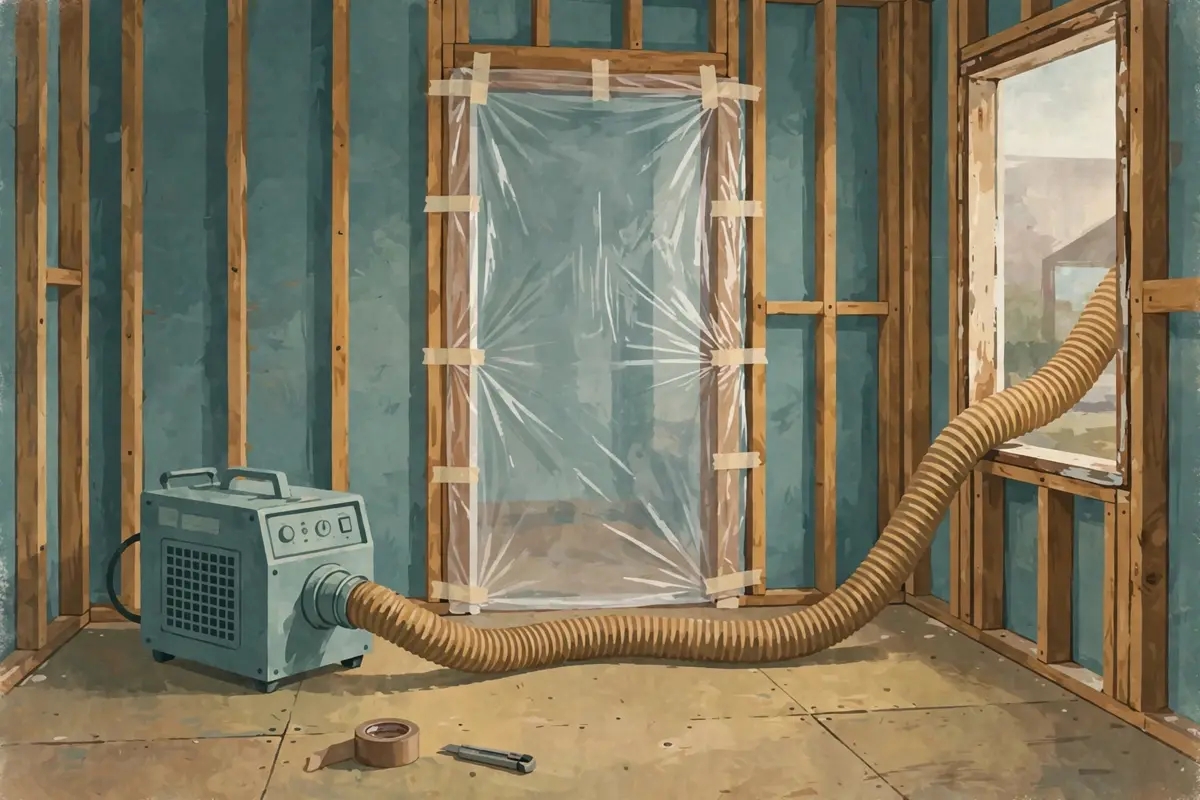
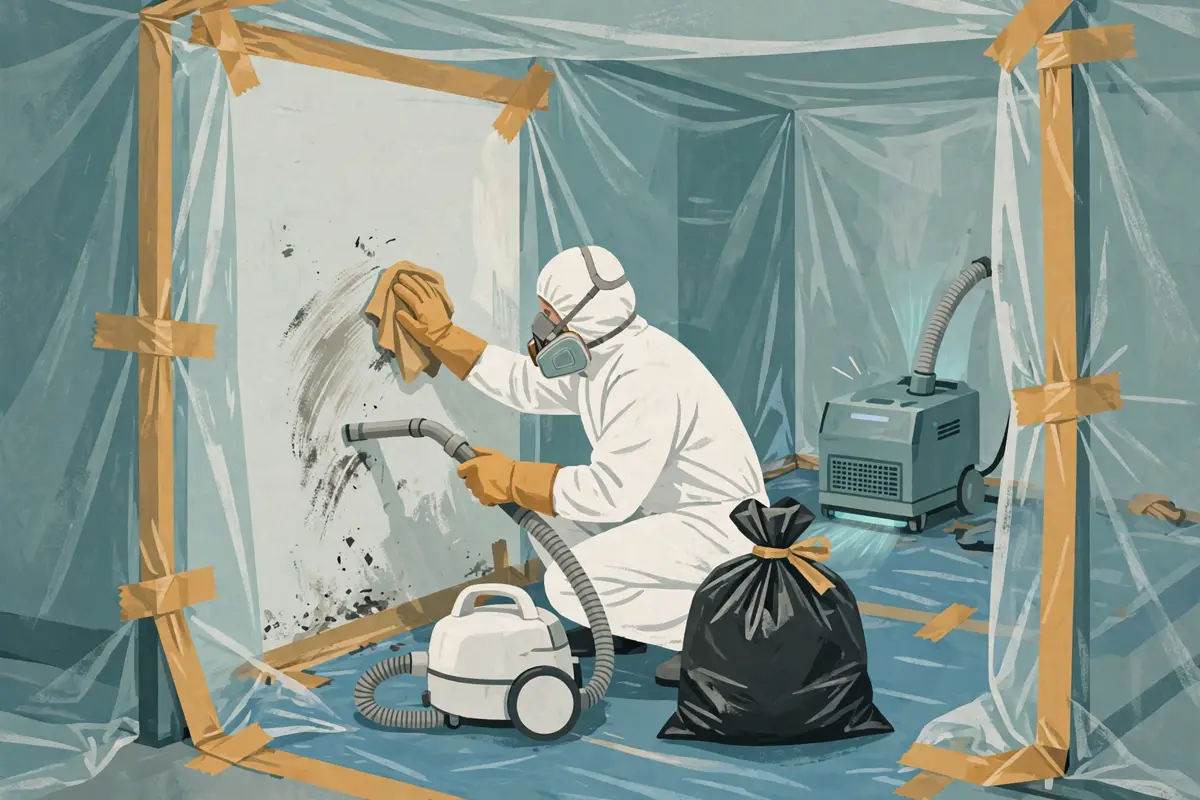
The shape of the work in one room: containment sealed before anything is disturbed, and a negative air machine holding the pressure so the rest of the home stays clean. Everything on this page follows from that discipline.
Stop the water if you can do it safely, start drying today, and call (212) 555-0147. The first two days decide whether you have a drying job or a water damage mold remediation job. If you rent in the city and your landlord is not moving, the complaint route on this page starts with a written notice and then 311.
Start with the sentence every standard in this field is built on. Mold grows where water stays. The Environmental Protection Agency's Brief Guide to Mold, Moisture and Your Home, last updated February 18, 2026, says it is important to dry water damaged areas and items within 24 to 48 hours to prevent mold growth, and the New York Department of Labor's mold guidance says mold can begin to grow within 24 to 48 hours. So the first answer to any question about water damage mold remediation is a clock: if the leak was stopped and the structure dried inside that window, in most cases mold will not grow, and there is nothing to remediate. If the window was missed, or the water reached places drying cannot reach, the job changes its name and its rules.
The second part of the short answer is the part no national page gives you, because it is pure New York. Once growth has started on a project over ten square feet, water damage mold remediation in this state is licensed work under Article 32 of the Labor Law, and it has been since January 1, 2016. A licensed assessor inspects the property and writes the plan. A separate licensed remediator, who by law cannot be the assessor and cannot share an owner with the assessor, does the work inside containment. An assessor then clears the finished job, in writing, before the walls go back together. That sequence, assessment, plan, containment, removal, clearance, is not a company's preference. It is the statute, sections 930 to 947, and this page walks through it piece by piece.
The third part is about scope, and it corrects the most common misunderstanding at the door. Water damage mold remediation does not include fixing the leak. Section 930 of the Labor Law defines remediation as the removal, cleaning, sanitizing, demolition or other treatment of mold and mold contaminated matter, and states that it shall not include remediation of the underlying sources of moisture. The pipe, the roof, the failed hose: those belong to a plumber or a roofer, and their repair is separate work that has to happen alongside, because no clearance can pass over a live water source. Homeowners who expect one company and one bill for leak, mold and rebuild are expecting a package the law deliberately unbundles.
And the fourth part is for the city's renters, who hold rights here that owners upstate do not. In New York City, owners of buildings with three or more apartments must keep homes free of mold under Local Law 55 of 2018. Buildings with ten or more homes must use licensed, independent assessors and remediators under Local Law 61 and section 24-154 of the Administrative Code. And the housing agency, HPD, puts landlords on a clock that runs from 90 days down to 21 depending on how much mold an inspector finds in a room. Water damage mold remediation in a city rental is therefore not a favour to request. It is a duty with deadlines, and the second half of this page sets out exactly how to set those deadlines running.
The words get used loosely at kitchen tables and precisely in the statute, and the gap between the two causes real arguments. Mold is the broad word: a family of fungi that grow on damp material and feed on it, rooting into porous surfaces like drywall paper, wood and insulation. Mildew is the household word for the flat, surface growth that sits on top of damp material, the grey film on grout or the powdery dusting on a basement wall, and wipes away because it never rooted in. Water damage mold remediation concerns the first kind: growth that has entered the material, which is why it ends in removal of that material rather than a wipe and a spray.
Removal and remediation are the second pair, and the difference is a standard. Removal promises the mold is gone, full stop, and taken literally it promises what no one can deliver, because spores ride ordinary air into every home every day. Remediation is the word the law uses, and in New York it carries the whole apparatus: an assessor's plan, containment, removal of what cannot be cleaned, cleaning of what can, drying, and an independent clearance at the end. When a company sells you removal, ask what the work ends with. When it sells water damage mold remediation in this state, the ending is already written: a clearance report from a licensed assessor who did not do the work.
Assessment and testing are the third pair, and confusing them wastes money. An assessment is the licensed act: inspection, investigation, evaluation of the conditions that caused the growth, and a written remediation plan, ending in a report the law requires the assessor to give you. A test is a sample sent to a lab. The Department of Labor's guidance is blunt about the relationship between them: in most cases, if visible mold growth is present, sampling is unnecessary, and there are no federal or state standards for airborne mold levels for a lab result to be judged against. Water damage mold remediation runs on assessments. Tests answer narrow questions inside an assessment, when a hidden source is suspected or after cleanup, and they never replace the licensed act itself.
The last pair is the one that decides schedules: drying and remediation. Drying is the emergency discipline of the first two days, fans, dehumidifiers, extraction and open walls, and it belongs to the restoration sequence this site's water pages describe. Remediation begins where drying failed or arrived late. The two trades overlap in the same wet rooms and often in the same week, which is why they are so often confused, but they answer different questions. Drying asks how wet the structure is and how fast it can be brought down. Water damage mold remediation asks what has grown in the wet structure, under whose plan it comes out, and who certifies that it is gone.
Read the statute's definition once and the whole trade rearranges itself. Section 930 of the Labor Law says mold remediation means the removal, cleaning, sanitizing, demolition or other treatment, including preventive activities, of mold or mold contaminated matter, and shall not include remediation of the underlying sources of moisture that may be the cause of mold, where that work needs expertise not specific to the acts the article authorises. In plain words: the remediator's licence covers the mold, not the plumbing. Water damage mold remediation starts after the water problem is understood, and it succeeds only if the water problem is separately fixed.
That single sentence explains the order of every honest job. First the source is found and repaired by the trade that owns it: the plumber cuts out the split pipe, the roofer renews the failed flashing, the building engineer repacks the riser valve. Then the structure is dried, because remediation performed on a still wet wall is theatre. Then the assessment and the plan, then containment and removal, then clearance, then rebuild. Skip the first step and the last step becomes impossible, because section 947 will not let an assessor clear a job whose underlying cause is still live. Water damage mold remediation is the middle of that sequence, not the whole of it, and a company that prices it as the whole of it has not read its own licence.
The definition also explains a boundary homeowners trip over: construction, repair, removal or demolition done for other purposes is not a mold project at all. A renovation that opens a wall and finds a historic stain is a renovation question. A gut renovation of a dry apartment is not remediation because no growth is being treated. The licensing regime switches on when the work is the assessment, remediation or abatement of mold over ten square feet. That threshold, ten square feet, appears twice in this city's life: it is the state line for licensing, and it is the line HPD uses to grade rental violations. Water damage mold remediation lives above that line, in licensed hands, and below it in the smaller world of careful cleaning the DIY section of this page describes.
One more consequence of the definition deserves its own paragraph, because it protects homeowners from a quiet upsell. Since remediation excludes the moisture source, a remediator who discovers the leak is still running must stop being your only call. The assessor's clearance duty under section 947 even anticipates the moment: if the underlying cause has not been remediated, the assessor recommends the type of contractor needed to remedy the source. The law, in other words, builds the handoff into the paperwork. A water damage mold remediation quote that silently includes plumbing, or that proposes to remediate first and find the leak later, is a quote written against the statute's grain.
Ask the internet how fast mold grows and you will be handed one confident number. Ask the agencies and you get several, each attached to a specific document, and this page prints them the way the research found them: separately, with their sources named, because merging them into a single average window would manufacture a fact none of the sources stated. The window that governs water damage mold remediation work in practice is the Environmental Protection Agency's: dry water damaged areas and items within 24 to 48 hours to prevent mold growth. The EPA's Brief Guide adds the hopeful half: if wet or damp materials or areas are dried 24 to 48 hours after a leak or spill happens, in most cases mold will not grow.
| Source | What it actually says | The window |
|---|---|---|
| EPA, A Brief Guide to Mold, Moisture and Your Home (updated February 18, 2026) | Dry water damaged areas and items to prevent mold growth; materials dried inside the window will in most cases not grow mold | 24 to 48 hours |
| New York Department of Labor, mold program guidance | Mold can begin to grow on wet material; dry water damaged items and areas promptly | 24 to 48 hours |
| CDC, Preventing Mold page (dated August 26, 2026) | Clean and dry wet items after rain or flood waters enter a building | 48 to 72 hours |
| CDC, Dry Off Wet Items After a Storm, and CDC, 8 Tips to Clean up Mold | Clean and dry or remove wet items as quickly as possible to prevent mold from growing | 24 to 48 hours |
| New York State Department of Health, Mold in Schools guidance | Clean and dry wet or damp spots promptly, with fans and a wet dry vacuum; written for schools, not homes | 24 to 48 hours |
The Centers for Disease Control and Prevention is the source that teaches the lesson, because it disagrees with itself across its own pages. Its Preventing Mold page says to clean and dry wet items within 48 to 72 hours. Its storm page and its cleanup tips say 24 to 48 hours. Both statements are real, both are dated August 26, 2026, and neither cancels the other; they are different documents written for different moments, one for flood recovery at scale, the others for the household event. Anyone who tells you the CDC says 48 to 72 hours, as if that were the agency's single position, has read one page of it. Water damage mold remediation planning on this page uses the stricter window, because a home dried to the stricter window satisfies every source on the table.
The schools guidance needs its own warning label, and it gets one here. The state health department's 24 to 48 hour wording appears in its Mold in Schools material, guidance written for school buildings and the staff who maintain them. It agrees with the EPA and the Labor Department, which is reassuring, but it is schools guidance, not a residential rule, and in the research for this page the live page itself could not be loaded, so the wording is carried as snippet verified and scoped to schools. It is printed here because homeowners find it in search results and deserve to know what it is. No part of water damage mold remediation in a home depends on it.
What the table means at the level of a wet apartment is simple enough to say plainly. The first two days are not a grace period before the problem starts. They are the period in which the problem is decided. A leak found on Monday and dried by Wednesday is a story told at dinner. The same leak found on Monday and mopped on Friday is a licensed project with containment, a work plan and a clearance at the end of it. Every section after this one assumes the window was missed, because water damage mold remediation is the name of what happens next.
A wall cavity after a leak is close to a designed incubator. The spores were already there, settled in dust on every surface, because spores are part of ordinary indoor air and no cleaning regime removes them from a lived in home. What the leak adds is the two things spores wait for: moisture that lasts, and food in direct contact with it. The paper face of drywall is food. So is wood, wallpaper paste, insulation, carpet backing and the dust itself. Water damage mold remediation exists because a wall supplies all of it at once, in the dark, with no moving air to dry it.
Water also travels in ways that defeat a quick look. It wicks upward through drywall well above the visible waterline, so the wet band inside a wall is taller than the stain outside it. It runs sideways along the tops of ceiling joists and pools at the low end of a room you never saw wet. It slips under vinyl and laminate floors and sits on the subfloor, invisible, for weeks. It condenses inside a heating and cooling duct that took water during a flood. This is why the assessor's moisture meter matters more than the assessor's eyes: water damage mold remediation is scoped from readings taken through the structure, not from the geography of the stains.
Growth follows the water with a short delay. Germination begins inside the first two days on wet material, invisible at first. Colonies establish over the following days, feeding outward from the wettest points, and the signs a homeowner can see, the spot, the bubbling paint, the smell when a closed room is opened, are late reports of a process that started much earlier. By the time a baseboard swells, the cavity behind it has usually been wet and growing for a while. That lag is the practical reason water damage mold remediation treats a known old leak as growth until an assessment proves otherwise, rather than the other way round.
Temperature and air complete the picture. Warm rooms grow mold faster than cold ones, which is why a summer leak outruns a winter one and why a heated bathroom wall is such reliable territory. Still air is the other accomplice: the backs of wardrobes against exterior walls, the closed closet full of boxes, the cabinet under a sink that is opened twice a day and never dried. Every prevention rule later on this page is one of these conditions being removed. Water damage mold remediation, read backwards, is just the list of conditions read forwards: water, food, warmth, stillness and time, and the job is to break the chain at every link the plan can reach.

The signs arrive in a rough order, and knowing the order stops two opposite mistakes: panic at a water stain that is only a stain, and calm in front of a wall that is quietly growing. The earliest sign is usually smell, a musty, earthy odour that is strongest when a room has been closed and that survives airing. It reports growth somewhere in the room's hidden volume, inside a wall, under a floor, behind a cabinet run, before anything shows. In the geography of water damage mold remediation, a persistent musty smell after a known leak is treated as a finding, not a nuisance.
Sight comes next, and it lies in both directions. Spots that appear or spread on a wall or ceiling, in black, green, grey or white, are growth on the surface, which means growth through the material is likely behind them. Paint that blisters or peels, wallpaper that lifts at the seams, baseboards that swell and pull away, a floor that cups or a door that begins to stick: these are the building reporting moisture from inside its own structure. The lie in the other direction is the clean looking wall over a wet cavity. Water damage mold remediation scopes from the meter because the eye, unaided, reads the last chapter of the story and calls it the first.
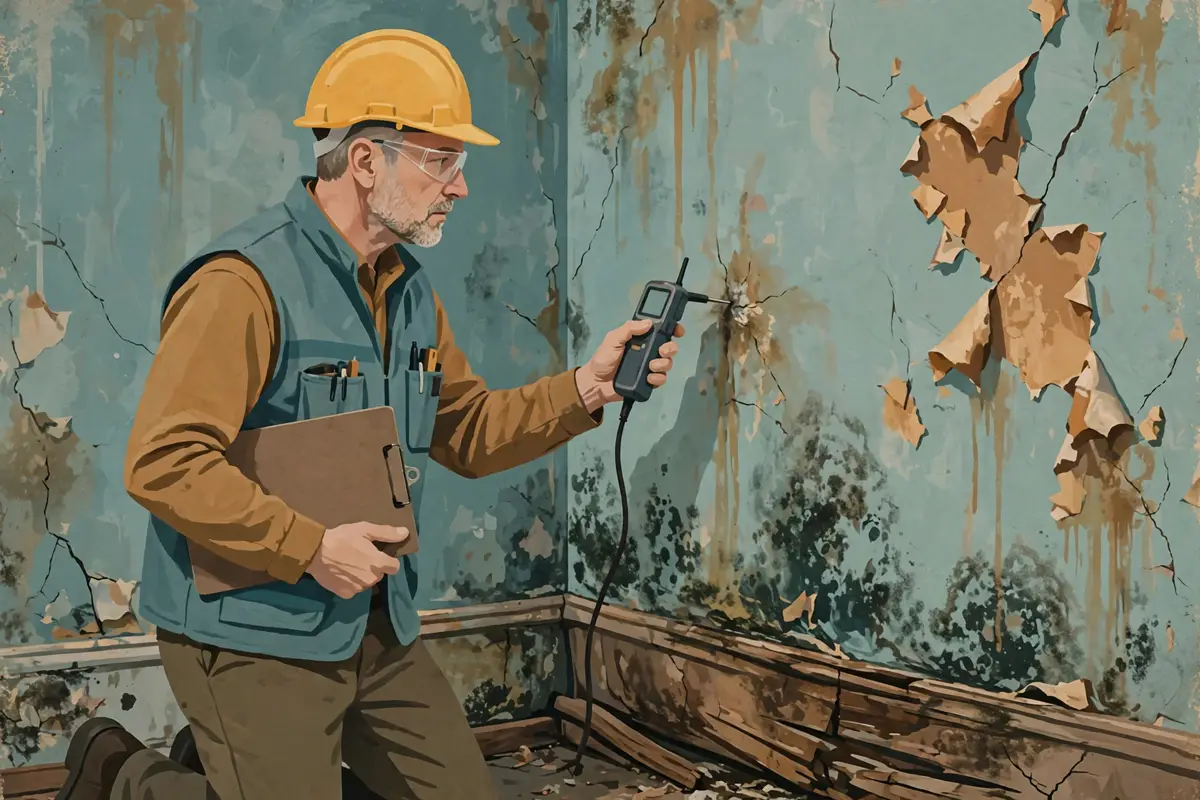
The meter is the third witness and the one the law's process is built around. A licensed assessor reads moisture through walls, floors and trim, compares wet areas against dry reference points in the same home, and maps the true extent of the event. The map is what the remediation plan is drawn from: it decides which sections of wall open, which stay, and where containment needs to stand. Homeowners can borrow the logic before any professional arrives. A wall that feels cold and damp in one patch, a stain that keeps growing after the leak is fixed, readings from an inexpensive pin meter that stay high in one spot while the room dries around it: each is a reason to move from watching to assessing. Water damage mold remediation begins, in most real homes, with someone taking a smell seriously and a reading more seriously still.
The bathroom wall is the famous address, and the forum story later on this page lives there, but the full map of hiding places is longer. Behind and under kitchen cabinets, where a dishwasher or ice maker line weeps for months into a dark, warm, unventilated box. Inside the wall under a window whose flashing failed, wetting one stud bay at a time with every rain. Under a bathroom floor, where a wax ring or a tub overflow sends water into the subfloor and the ceiling of the room below. Water damage mold remediation crews learn these addresses the way plumbers learn the buildings that flood: by repetition.
Basements and cellars hold their own list. The bottom plate of a framed wall sitting on a slab that takes groundwater. Cardboard boxes stored on a floor that sweats in summer, wicking damp into everything stacked on them. The insulation wrapped around a cold water pipe that condenses all season. A finished basement is the riskiest version, because the finishes hide the water until the growth is established, which is why this site's basement page and this page meet so often. In cellars, water damage mold remediation usually starts with the unglamorous truth that storage habits, not storms, feed half the growth found there.
Heating and cooling systems are the hiding place with a distribution network attached. A drain pan that overflows, a duct that took flood water, insulation inside an air handler: growth in any of them is growth with a fan behind it, able to seed the rest of the home. The EPA's cleanup guidance treats mold in heating, ventilation and air conditioning systems as professional territory for exactly that reason. An assessor who finds the water path leads into the system writes it into the plan, and water damage mold remediation then includes the system's cleaning under the same containment discipline, rather than leaving the one reservoir that can re seed every cleaned room.
The last hiding place is the one built by kindness: the repair done too fast. A wall closed while its cavity was still damp, a floor laid over a subfloor that felt dry on top and read wet underneath, a fresh coat of paint over a stain that was never opened. Each is a small sealed incubator with a new finish on it. Assessors ask about recent repairs for this reason, and a homeowner who had a leak fixed and a wall closed in the same week should say so early. Much of water damage mold remediation is detective work about the last event, and the repairs that followed it are evidence, not embarrassment.
Every month, homeowners in this state pay for mold tests that the law never asked for and that cannot answer the question they bought them for. The question is usually some version of: is my home safe, and is this the bad kind. A lab report answers neither. It names the kinds of mold found in a sample and estimates how much was present, and then stops, because there are no federal or state standards for airborne mold levels against which to grade it. The Department of Labor's guidance could not be plainer: in most cases, if visible mold growth is present, sampling is unnecessary. Water damage mold remediation in New York is set in motion by an assessment, and an assessment is a person, a licence and a plan, not a petri dish.
Testing does have honest work to do, in narrower places. When a room smells of growth and no source can be found, sampling can help an assessor decide where to open. When a cleanup is finished, a sample can sit alongside the visual clearance as one more input, though it never replaces it. When two parties are heading toward a dispute, a dated lab result is a document in a file. Notice the pattern: in each case the test serves a decision that someone qualified is making. Sold on its own, as a verdict, it is a number without a scale. The companies that lead with testing are often selling the test because the test is what they have; the assessor who leads with inspection is selling the thing the statute actually requires for water damage mold remediation.
There is also a legal trap inside the test first habit, and it is worth stating before it costs someone a season. A homeowner who spends the first weeks after a leak exchanging samples with a lab has spent the very weeks in which drying was still possible and in which an insurer expects mitigation to happen. The growth, meanwhile, has been following its own schedule. By the time the report arrives, the project is larger, the coverage argument is harder, and the licensed assessment still has to happen before any water damage mold remediation over ten square feet can lawfully begin. The order that protects the home is the order this page teaches: stop the water, dry, assess, then test only if the assessor says a sample would change the plan.
One sentence from the state's own guidance deserves to stand alone, because it ends most arguments at the door. There are no federal or state standards for airborne mold levels. Everything a test seller implies about pass marks, safe counts and dangerous counts is built on ground that sentence removes. What exists instead is a standard of condition: visible growth, its extent, its cause, and whether the cause has been fixed, judged by a licensed assessor and recorded in a written report. That is the currency water damage mold remediation trades in, and it is why the next four sections are about a law, not a laboratory.
New York is one of the few states that licenses the trade of water damage mold remediation at all, and it has done so since January 1, 2016, when the licensing provisions of Article 32 of the Labor Law took effect. The article's full title is Licensing of Mold Inspection, Assessment and Remediation Specialists and Minimum Work Standards, and it does what the title promises in two directions: it licenses the people, in sections running from 930 to 947, and it sets minimum standards for the work itself. The Department of Labor runs the programme. Anyone who wants to check a section can read the same text this page was written from, on the State Senate's open legislation site, where Article 32 sits under the Labor Law.
The licence comes in five types, and the types are the first thing to check when a company arrives at your door. There is a Mold Assessor licence and a Mold Assessment Contractor licence for the inspection side. There is a Mold Remediation Contractor licence for the company doing the work. And there are two worker licences, Abatement Worker Supervisor and Abatement Worker, for the people inside the containment. Section 931 makes it unlawful to engage in mold assessment, remediation or abatement on a project, or to advertise those services, without a valid licence from the Commissioner of Labor. The same section adds a detail with real teeth at a work site: a copy of a valid licence must be conspicuously displayed at the site on a mold project. Water damage mold remediation that cannot show you its licence, on paper, at the site, is not licensed work whatever the van says.
The word project carries the threshold that switches the whole regime on. Section 930 defines a project as the mold assessment, mold remediation or mold abatement of areas greater than ten square feet, not including routine cleaning, and not including construction, repair, removal or demolition done for other purposes. Under that line, the law leaves small work to ordinary care and the EPA's small area guidance. Over it, every protection in the article applies: the licensed assessor, the written report, the work plan, the containment rules and the clearance. Ten square feet is not a large area. It is roughly the size of a closet door, which means most real events after a serious leak cross it, and most water damage mold remediation in this state is licensed work whether the homeowner knew it or not.
Two honest gaps in the public record belong in this section, because this page prints what it could not settle as plainly as what it could. The Department of Labor's own pages disagree about licence fees: its frequently asked questions list fees for the five licence types, while its mold programme page states that the fees for the supervisor and individual assessor licences have been eliminated. The research for this page found the conflict and could not reconcile it, so this page publishes no fees at all. What is not in conflict is the structure: five licences, a ten square foot trigger, and a statute that splits the judging of the work from the doing of it. That split is the subject of the next section, and it is the single most protective idea in water damage mold remediation law anywhere in the country.
Section 936 of the Labor Law contains the sentence around which this entire trade is organised, and it deserves to be quoted exactly: No licensee shall perform both mold assessment and mold remediation on the same property. The section goes further. No person may own an interest in both the licensee who performs the assessment and the licensee who performs the remediation on the same property, which closes the obvious workaround of two sister companies under one owner. The assessor who scopes your job and later clears it cannot profit from the size of the scope, and cannot be paid by the company whose work is being judged. Water damage mold remediation in New York is built so that judgement and profit never share a roof.
The reason is not suspicion of any one company. It is arithmetic. An assessor who also remediates earns more when the plan is bigger: more wall opened, more material removed, more days inside containment. The same assessor, at clearance, would be grading their own homework with their own invoice attached to the grade. Separation removes both temptations at once, by making the assessor's only saleable product their judgement. It is the same reason a building inspector does not pour the concrete. Homeowners sometimes experience the rule as friction, two companies, two schedules, two invoices, and it is worth saying plainly that the friction is the protection. Every water damage mold remediation job in this state is checked by someone with nothing to gain from passing it.
Section 936 also gives the homeowner a document to hold. The assessor must provide a written report to each person for whom assessment services are performed for compensation. That report is the finding the whole job stands on: what was found, where, in what condition, and the plan that follows from it. Keep it with the claim file, the lease file or the sale file, because it outlives the job. Years later, when a buyer, a tenant or an insurer asks what was in that wall and what was done about it, the report is the answer that carries a licence number behind it. A water damage mold remediation job that produced no written assessment report was not run under section 936, whatever else it produced.
The city writes the same rule a second time for its larger rental buildings, which tells you how seriously the principle is taken. Under Local Law 61 and section 24-154 of the Administrative Code, owners of residential buildings with ten or more homes must hire a licensed mold assessor and a licensed remediator who are completely independent of each other, with filings to the Department of Environmental Protection. State law separates the roles on every project over ten square feet; city law underlines the separation for the buildings where the most tenants are affected. If a company offers to handle your water damage mold remediation end to end, assessment included, as one tidy package, it is offering to break the rule that exists to protect you, and the offer itself is the review you needed of that company.
Section 946 of the Labor Law sets the minimum work standards for the remediation itself, and its first demand is a document. The remediation licensee must prepare a project specific work plan that fulfils the assessor's remediation plan, and must provide it to the client before site preparation begins. Read that order again, because it reverses the way informal work usually runs: the plan exists, in writing, in the client's hands, before the plastic goes up. The work plan is where water damage mold remediation becomes auditable. It says what will be contained, what will be removed, what will be cleaned, what protection the workers will wear and what the finished area must look like.
Containment is the section's physical heart. The statute requires that containment be constructed so as to prevent the spread of mold to areas outside the containment, which is a performance standard, not a materials list: plastic, tape, negative air machines and HEPA filtration are the usual means, but the legal test is whether spores stay inside. Signs must be posted at all accessible entrances to the work area. Workers use the protective equipment the plan specifies. And the section sets the rule that gives clearance its leverage: containment may not be removed or dismantled before the clearance notice under section 947 exists. The plastic that goes up first comes down last, after an independent assessor has passed the work, and water damage mold remediation that tears down early has broken the sequence the law wrote.
The chemical shelf is regulated by the same section, narrowly and sensibly. Disinfectants, biocides and antimicrobial coatings may be used only if they are specified in the remediation plan, only if they are registered with the Environmental Protection Agency, only as their labels direct, and with the sensitivities of the building's occupants taken into account. That is a quiet rebuke to the fog everything approach sold elsewhere: in New York, a chemical earns its place in the plan or it stays on the truck. It also means a homeowner can ask a precise question with the statute behind it: show me where in the plan that product is specified. Water damage mold remediation under section 946 has an answer to that question. Work done off plan does not.
Hold the work plan next to the invoice at the end of the job and the value of section 946 becomes obvious. The plan promised a scope; the invoice charges for a scope; the two can be compared line by line by anyone, including an insurer's adjuster and, if it ever comes to it, a judge. Jobs run without a plan produce invoices that cannot be checked against anything, which is why disputes about mold work so often turn out to be disputes about paper that was never created. The statute creates the paper first, on purpose. It is one more reason the research behind this page found the New York framework stronger than anything the fourteen competitor pages described: none of them mentioned a work plan at all, and water damage mold remediation in their states is, on paper, whatever the company says it was.

Every job on this page ends at section 947, the post remediation assessment, which most people meet under its working name: clearance. A mold assessment licensee, independent of the remediator, examines the finished work area and must determine that the project is free from visible mold and in compliance with the remediation plan and its clearance criteria. That is the first determination, about the work. The second is about the future, and it is the sentence that gives the whole statute its spine: the assessor must determine that the underlying cause of the mold has been remediated so that it is reasonably certain that the mold will not return from that remediated area. Water damage mold remediation is not finished when the wall looks clean. It is finished when someone licensed to judge says the water story is over.
Failure is provided for, and provided for honestly. If the cause has not been fixed, the assessor does not pass the job and wish everyone luck. The assessor recommends the type of contractor needed to remedy the source or the moisture, and the outcome is recorded in a final status report delivered to the client and to the remediation licensee. If the work passes, the client receives a passed clearance report. Either way there is a document, signed by a licence, that states the condition of the property at the end of the job. Keep it. It is the paper a future buyer, tenant, insurer or court will ask for, and it is the paper that separates water damage mold remediation from a cleaning visit in every argument that matters.
Notice what clearance does to the incentives of everyone upstream. The remediator works knowing an independent assessor will examine the area against the plan, so shortcuts have a witness scheduled. The assessor who wrote the plan knows its criteria will be applied at the end, so vague criteria help no one. The homeowner holds a pass or a fail that does not depend on trusting either of them. And the containment rule in section 946, no dismantling before the clearance notice, means the evidence cannot be tidied away before the judge of it arrives. It is a small, complete system of checks, and it is the reason this page can say something few pages in this field can: in New York, water damage mold remediation has a defined ending, and the ending is not the contractor's opinion.
One boundary of clearance deserves plain words, because homeowners over read it. A passed clearance certifies the remediated area, against the plan, at the time of inspection, with the cause addressed. It does not certify the whole building, the air in every room, or the future behaviour of every pipe. A new leak next year is a new event with its own assessment. That limit is not a weakness in the system; it is the system being honest about what an inspection is. What clearance does give you is the strongest statement this trade can make about the area that was treated, made by the one participant with no reason to flatter it. On a page full of clocks and thresholds, that statement is the destination every water damage mold remediation job in this state is driving toward.
Article 32 is a licensing law for people who do this work for others, and its exemptions mark the boundary. The Department of Labor's guidance lists them: a residential property owner performing work on their own property is exempt. A non residential property owner, or that owner's employee, is exempt. An owner, a managing agent, or a full time employee of a residential property is exempt, which is why a building's own staff can lawfully handle mold work in the building they serve. One exclusion inside the exemptions is easy to miss and matters to public housing and municipal buildings: agents of a government unit are not exempt. Water damage mold remediation hired out to a contractor, on any property, over ten square feet, is licensed work with no way around it.
Design professionals licensed under Title 8 of the Education Law, architects and engineers acting inside their own scope of practice, are also outside the licensing requirement for the parts of the work their own licences cover. That carve out explains why a large building's remediation plan sometimes arrives signed by an engineer rather than an assessor. It does not widen into a general loophole: the exemption follows the professional's own scope, not the size of the job. For the ordinary homeowner, the practical reading of the exemptions is short. Your own hands, in your own home: exempt. Anyone you hire for water damage mold remediation: licensed. A landlord's own full time staff: exempt. A landlord's hired crew: licensed, and in the city's larger buildings, licensed and independent, with filings.
The law also stops at the state's edge in a way worth naming, because so much advice online is written for other states. Texas licenses mold work too, with its own separation rules, and the research for this page met a Texas licensing note inside a search result and left it there, where it belongs. Other states license nothing at all, which is why national pages describe this trade as if it were unregulated everywhere. It is not unregulated here. A homeowner in Buffalo or the Bronx reading a national guide is reading about a different legal country, and the differences are not details: who may assess, who may remediate, what paper must exist. Water damage mold remediation is local law wearing work clothes, and this page keeps it local on purpose.
Finally, the law stops at the water's edge of its own subject. Article 32 governs mold: its assessment, its remediation, its abatement. It does not license the drying, the plumbing, the roofing or the rebuilding that surround a mold job, each of which answers to its own trades and rules. That is why a full recovery from a bad leak involves several kinds of professional, and why the sequence matters more than any single hire. The statute also says nothing about price, and this page follows it in that too, for reasons set out in the section on prices near the end. What the law does, completely, is define the mold chapter of the event: who judges, who works, what paper, what ending. Water damage mold remediation, done lawfully in New York, is that chapter and no other.
The whole page compresses into six steps, and the steps are in the only order that works. They assume the water event has already happened and that growth is present or likely. Steps one and two are emergency work that belongs to the first hours and days. Steps three to six are the licensed sequence New York law imposes once the project is over ten square feet. Follow them and water damage mold remediation stays a managed project. Rearrange them, most often by rebuilding before clearance or remediating before the leak is fixed, and the job has to be done twice.
Shut off the water at the fixture, the apartment valve or the building main, and keep people out of rooms where water may be near electrics or a ceiling is sagging. If the water is sewage or flood water, treat the room as contaminated and stay out until it is assessed. Photograph the source before anyone repairs it: the split pipe, the failed hose, the overflowed tray. The leak itself is not part of remediation under New York law, so a plumber or roofer fixes it as separate work, but nothing else on this list works while water is still arriving. Every later step assumes a source that has stopped and a room that is safe to enter.
Get standing water out and start drying the same day. The Environmental Protection Agency's Brief Guide to Mold, Moisture and Your Home says to dry water damaged areas and items within 24 to 48 hours to prevent mold growth, and that if wet materials are dried inside that window, in most cases mold will not grow. Run fans across wet surfaces, run dehumidifiers to pull moisture from the air, open cabinets and closets, and lift or remove coverings that trap water against the structure. Porous items that cannot be dried inside the window, soaked carpet padding, wet ceiling tile, drenched cardboard, are usually discarded. Take moisture readings as you go: drying is finished when the readings say so, not when the surface feels dry.
If growth has started, or the wet area is large or hidden, the next step in New York is not a test kit but a licensed assessment. On a project over ten square feet, Article 32 of the Labor Law requires the work to run under licence: a licensed assessor inspects the property, evaluates the conditions that caused the growth and writes a remediation plan, and under section 936 you receive a written report. The assessor must be independent of the company that will do the work, because the same law forbids one licensee from assessing and remediating the same property. The plan the assessor writes is the document the rest of the job obeys: what is contained, what is removed, what is cleaned and what the finished work must look like to pass.
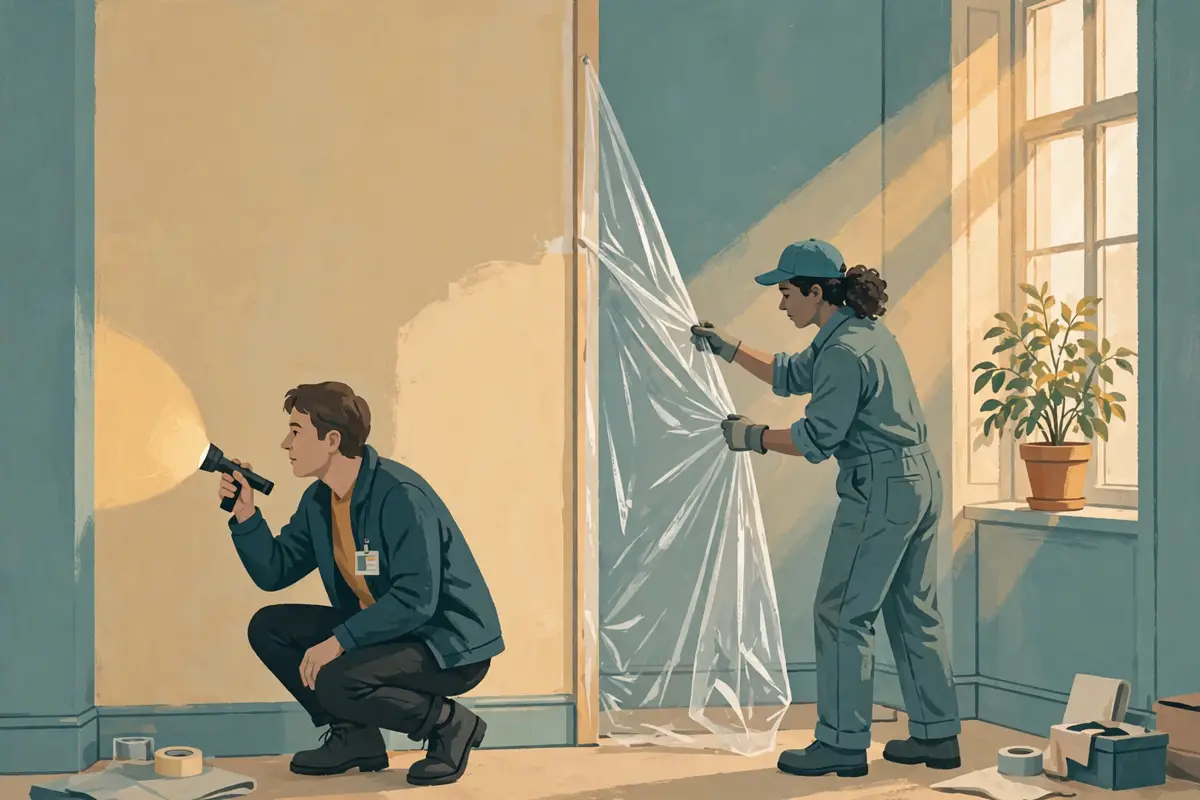
Before any growth is disturbed, the remediator builds containment around the work area, following the assessor's plan as section 946 of the Labor Law requires. Plastic sheeting seals the area off from the rest of the home, a negative air machine keeps air pressure lower inside the containment so air flows in rather than carrying spores out, and the exhaust runs through HEPA filtration. Signs go up at the entrances, workers wear the protective equipment the plan specifies, and anything that leaves the containment, bagged debris, tools, clothing, is handled so the clean rooms stay clean. Containment is what turns a mold job from a spreading event into a controlled one, and under the law it may not be taken down until clearance has been given at the end of the work.
Inside containment, the crew works the plan. Porous material that mold has rooted into, drywall, insulation, carpet and padding, swollen trim, is cut out, bagged in heavy duty plastic and removed; it cannot be cleaned back to sound. Hard surfaces that can be cleaned, framing, masonry, metal, glass, are HEPA vacuumed, wiped and cleaned, then dried. Disinfectants, biocides and antimicrobial coatings are used only where the assessor's plan specifies them, and then only products registered with the Environmental Protection Agency, used exactly as their labels direct, with the sensitivities of the people who live in the home considered. The structure is dried to the readings the plan sets. Nothing is closed up or rebuilt at this stage, because the work still has to be judged.
The last step belongs to an assessor, not to the crew that did the work. Under section 947 of the Labor Law, a mold assessment licensee examines the finished area and must determine that it is free from visible mold, that the work complies with the remediation plan, and that the underlying cause of the mold has been remediated so that it is reasonably certain the mold will not return from that area. If the cause is still live, clearance fails and the report says what kind of contractor must fix it. If it passes, you receive a passed clearance report, containment may come down, and only then does rebuilding begin: new drywall, new finishes, paint. Rebuilding before clearance buries the evidence and, if growth remains, buries the problem with it.
Two of these steps are the ones households most often try to skip, and both skips are expensive. The assessment step gets skipped because a test kit is cheaper and arrives by post; the clearance step gets skipped because the room looks finished and the builder is available Tuesday. Each skip removes one of the two independent judgements the law built into the job, at the start and at the end. What remains after both skips is a cleaning, performed on trust, with no plan before it and no finding after it. The six steps are not bureaucracy laid over water damage mold remediation. They are the difference between the remediation and the cleaning.
Every account of a water damage mold remediation job that went wrong contains a first hour that went wrong first. The water ran while people looked for the valve. The valve was behind the boiler, or painted shut, or in the flat below. The lesson the trade repeats is unglamorous: know your shutoffs before you need them. The fixture valve under the sink, the apartment valve by the water meter or the entry pipe, the building main in the cellar, and the super's number for everything above your own ceiling. In a city of shared risers and stacked bathrooms, half the sources that wet a home are not in the home at all, which is why the first call in an apartment event is so often to the building, not to a plumber of your own.
Safety outranks speed in one specific way. Water and electricity are the dangerous pair, and a room with water near outlets, appliances or a ceiling light is a room to leave until the power is off. A sagging ceiling is a weight of water looking for a way down, and it should be treated as a load, not a surface. Sewage and flood water change the category entirely: that water is contaminated, the room is not a cleaning problem, and entry waits for people equipped for it. None of this delays water damage mold remediation by more than minutes. It decides whether the first hour produces a drying job or an injury report alongside one.
Photograph the source before it is repaired, if that takes a moment and can be done safely. The split hose, the cracked trap, the overflowed pan: this is the evidence that later decides insurance coverage, landlord responsibility and, in the forum story on this page, a contractor's warranty. Then let the repair happen fast and keep the failed part if you can. The plumber's written finding, what failed, how it failed, and any signs of how long it had been failing, is the second most useful document in the whole event after the assessor's report. Water damage mold remediation is argued about later, in offices, and the side with the dated photographs and the written finding usually wins the argument.

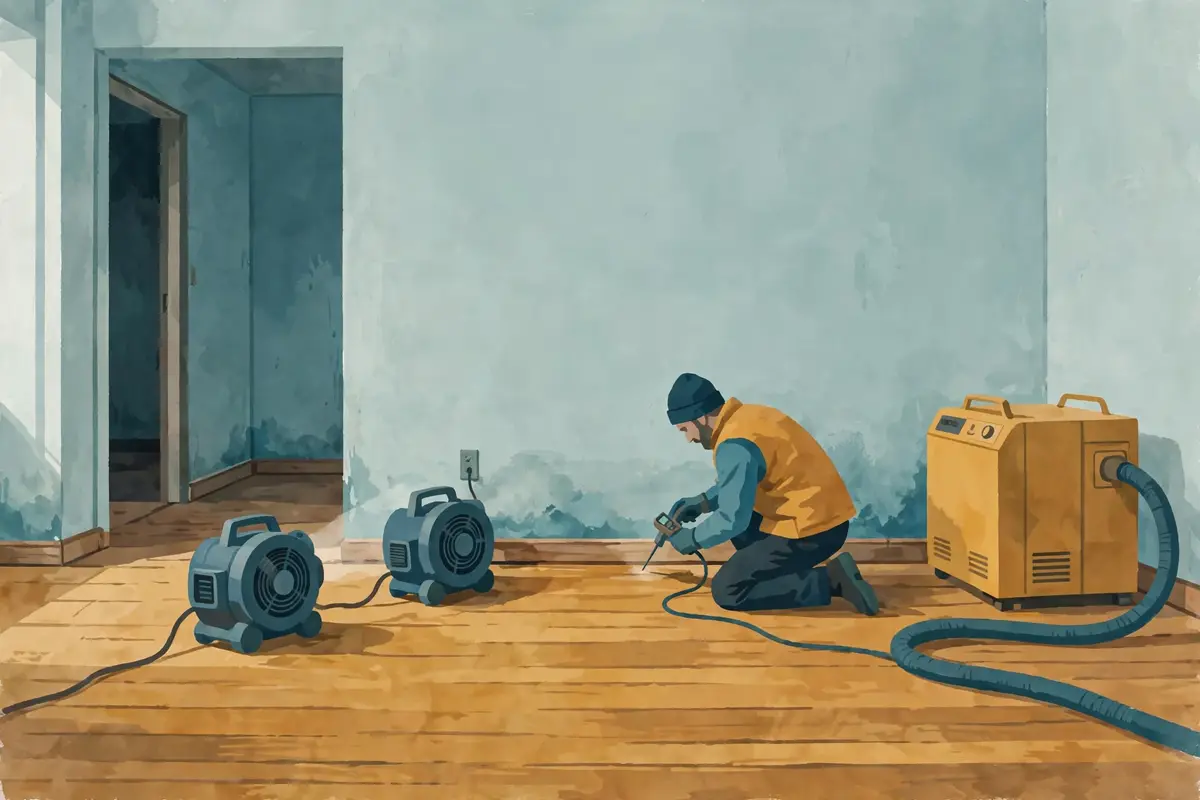
Drying looks simple from the doorway, a few fans making noise, and is technical underneath. The goal is not to dry the room's air or the surface of the wall. It is to pull the water out of the structure: out of the drywall, the studs, the subfloor and the insulation, before the 24 to 48 hour window closes and after it, because even late drying shrinks the territory growth can claim. Air movers push air across wet surfaces to lift moisture off them. Dehumidifiers pull that moisture out of the air so it cannot settle back. The two machines are a pair, and a room full of fans with no dehumidification is mostly moving damp air in a circle. Water damage mold remediation crews and drying crews share this machinery because the boundary between their jobs is a moisture reading, not a machine.
Readings are what turn drying from an opinion into a record. A moisture meter reads the material itself: this stud, this plate, this section of subfloor, compared against the same material in a dry part of the home. The daily log of those readings is the drying job's diary, and in water damage mold remediation it earns its keep three times over: it tells the crew when to stop, it tells the assessor what the structure's condition is, and it tells the insurer that mitigation actually happened, on dates, with numbers. A homeowner running their own drying after a small leak can borrow the whole method with a rented meter and a notebook. Dry to the reading, not to the touch: a wall can feel dry on its painted face while its cavity is still wet enough to grow.
Some materials cannot be dried in place and pretending otherwise is how small events become projects. Carpet padding holds water like a sponge and is usually discarded. Wet insulation loses its shape and its function and holds moisture against the structure. Vinyl flooring seals water against the subfloor beneath it. Swollen particleboard cabinet bases do not unswell. The honest drying conversation names these early, because removing a base cabinet or lifting a floor section on day one is a small violence compared with opening a finished room on day thirty. Water damage mold remediation inherits whatever drying refused to face, so the two sections of this page should be read as one instruction: dry completely, remove what cannot dry, and write down what the meter said.
An assessment, the first licensed act of water damage mold remediation, begins before the assessor touches a wall, with the history of the event. When did the water arrive, from where, how long did it run, what was done in the first two days, what was repaired and what was closed up. A good assessor asks about previous leaks too, because old growth and new growth share walls and the plan has to know which event it is answering. Bring the photographs, the plumber's finding and any earlier paperwork to this conversation. The assessment is an investigation, and investigations run on evidence the client often does not realise they are holding.
The inspection itself moves from the visible to the hidden in a deliberate order. The assessor examines the affected rooms, the water's likely path through the structure, and the materials it met. Moisture readings map the wet territory, including the parts no eye can reach: the cavity behind the tile, the subfloor under the finish floor, the ceiling below the bathroom. Where a hidden source is suspected and the findings would change the plan, samples may be taken; where growth is visible, the Department of Labor's guidance says sampling is usually unnecessary, and a thorough assessor will tell you so rather than bill you for ceremony. Water damage mold remediation plans are only as good as this hour, because every later decision, containment size, removal scope, clearance criteria, is written here.
What leaves the visit with you is the section 936 written report and the remediation plan inside it. Read the plan the way you would read a contract, because functionally it is one: it defines the water damage mold remediation the remediator will price and perform, and the criteria the clearance will apply. If the plan is vague, the job will be vague, and the time to sharpen it is now, while the person who wrote it is standing in the room. Ask what opens and what stays. Ask what the clearance criteria are. Ask what happens if the opened wall shows more than the plan expects, because it often does, and a plan with a stated route for surprises is worth more than a plan that pretends there will be none.

Containment is the part of the job visitors remember, the plastic and the tape and the machine humming in the corner, and it deserves a plain explanation because it is widely misunderstood as decoration. Its purpose is stated in section 946 as a performance: containment must be constructed so as to prevent the spread of mold to areas outside the containment. Remediation disturbs growth. Cutting drywall, pulling insulation and vacuuming debris all put spores into the air of the work area in quantities the undisturbed room never had. Without containment, the job of cleaning one room becomes the seeding of the rest of the home. Water damage mold remediation contains first so that everything it stirs up has somewhere controlled to go.
The pressure is the active ingredient of containment in water damage mold remediation. A negative air machine exhausts air from inside the containment to the outside, through HEPA filtration, so the pressure inside sits lower than the pressure in the clean rooms. Air therefore leaks inward, under the plastic and through every small gap, instead of leaking outward carrying spores. The plastic is the boundary; the pressure difference is the guard on the boundary. An air scrubber may also run inside the space, filtering the work area's own air through HEPA media while the crew works. When a homeowner watches a containment being built, the details worth noticing are the unglamorous ones: seams taped fully, the entry arranged so workers pass through without opening the space to the home, and exhaust actually ducted outside rather than blown into the next room.
Two short videos linked later on this page show this machinery better than paragraphs can, one a real residential job's containment setup and safety walkthrough, the other a fifteen second tip on the steps of building a containment, and both are labelled there with where they were and were not filmed. What no video can show is the discipline at the edges: tools and bagged waste leaving through the entry in a controlled way, workers' outer layers staying inside, the clean side of the home treated as clean. That discipline is why the statute writes containment as a standard to be met rather than a product to be bought, and why water damage mold remediation judges a crew by its plastic as much as by its cleaning.

The dividing line inside a containment is porosity. Porous materials that mold has rooted into cannot be cleaned back to sound, because the growth is not on them, it is in them. Drywall is the everyday case: its paper face is food and its gypsum core holds moisture, so affected sections are cut out, commonly beyond the visible staining to reach clean material, and bagged. Insulation that is wet or grown through comes out. Carpet and padding, swollen trim, crumbling ceiling tile: out. The cutting is done under the containment's discipline, in manageable sections, bagged in heavy duty plastic before it travels. Water damage mold remediation is, at this stage, a demolition with a hygiene standard, and the standard is the difference between it and a renovation.
What stays gets cleaned, and the cleaning has an order too. Framing lumber, masonry, metal, glass and other hard or semi porous surfaces are HEPA vacuumed to remove settled spores and debris, then wiped or scrubbed clean, then dried. The HEPA vacuum matters more than its size suggests: an ordinary vacuum exhausts the finest particles back into the room, while HEPA filtration captures them, which is the entire point. Antimicrobial products enter only where the assessor's plan specifies them, EPA registered and used by the label, as section 946 requires. Anyone who has watched a crew fog a room and call it finished has watched the step the New York plan deliberately makes conditional. In water damage mold remediation here, chemistry is a footnote to removal, cleaning and drying, never a substitute for them.
The question underneath this section is the one from the forum story: how much wall has to go. The honest answer is that the plan decides from evidence, moisture readings, the extent of visible growth, what opening a test area shows, and the assessor writes the decision down where it can be argued with. Too little removal leaves roots in place and fails clearance. Too much removal is demolition sold as caution. The separation rule protects the homeowner here in a way worth noticing: the person who decides how much comes out is not paid for taking it out. That is the separation rule doing quiet work inside a practical question, and it is why water damage mold remediation in this state can answer the tear out question with a straighter face than anywhere else.
New York exempts a residential owner working on their own property from the licensing law that governs water damage mold remediation, and the EPA's guidance gives the small job its working boundary: if the moldy area is less than about ten square feet, roughly a three foot by three foot patch, you can probably handle it yourself. That sentence has conditions wrapped around it, and the conditions matter more than the permission. The water source must be fixed first, or the cleaning is a subscription. The material must be a surface you can actually clean, hard or scrubable, not the inside of a wall. And the area must be dried completely afterward, because a cleaned patch left damp is a patch that returns.
The method for the small patch is plain. Ventilate the room. Wear gloves, eye protection and a respirator rated for the work, because disturbing growth puts spores in the air you are standing in. Scrub the growth from hard surfaces with detergent and water, rinse, and dry the area completely; porous material that is grown through, a section of ceiling tile, a piece of carpet, is discarded rather than scrubbed. Bag what comes off. Never mix bleach with ammonia or with cleaners that contain it. The CDC's cleanup guidance includes a bleach solution for hard surfaces, one cup of household liquid bleach to a gallon of water, used with ventilation and never on porous material that needs removal instead. Water damage mold remediation this is not; it is housekeeping at the scale the law and the agencies leave to the householder, and it works at exactly that scale.
The stop signs matter as much as the method. Stop and bring in licensed help when the area is larger than the small patch, when growth is inside walls, floors or the heating and cooling system, when the water was sewage or flood water, when the smell says the source is hidden, or when anyone in the home has asthma, allergies or a weakened immune system that raises the stakes of exposure. Stop, too, when the patch returns after honest cleaning and drying, because returning growth is the signature of a moisture source nobody has found yet. The line between a chore and a project is not pride. It is ten square feet, a hidden cavity, or a cause still running, and water damage mold remediation exists for everything past that line.
Not all water events are equal, and the dirty end of the scale changes the rules of everything that follows. Clean water from a supply line is one problem. Water that has passed through a building's drainage, or arrived from a street, a river or a sewer, carries bacteria and contaminants along with its moisture, and the EPA's cleanup guidance treats sewage and flood water as professional territory without hedging. Porous materials that dirty water has touched are generally removed rather than cleaned, because what they hold cannot be scrubbed out of them. Water damage mold remediation after a flood or a backup therefore starts bigger: more removal, more sanitizing, and no DIY chapter at all.
Flood water adds a second complication to water damage mold remediation, which is that it wets everything at the same height across whole rooms, including the cavities of every wall it touched. The growth that follows is not a patch but a band, running the length of the flooded rooms at and above the waterline, inside and outside the walls. Basements take the worst of it, as this site's basement and flood pages describe from their own angles. The sequence does not change, stop, dry, assess, contain, remove, clear, but the scale does, and so does the insurance story, because flood belongs to flood policies, with the conditional mold wording the insurance section of this page sets out in full.
One habit protects people in dirty water events more than any other: treating the first entry as a survey, not a cleanup. Photograph the waterline on the walls, the contents in place, the silt line on the stairs. Note what the water touched, floor by floor. That record drives the claim, the assessment and the removal scope, and it cannot be recreated after the first day of hauling. Then let the professionals sequence the rest. Water damage mold remediation after dirty water is the version of the job where the gap between a willing neighbour with a shop vacuum and a licensed crew is widest, and the water itself is the reason.
The question sounds like trivia and is asked constantly, in search boxes and at bathroom doors, because the two words decide whether someone reaches for a sponge or for water damage mold remediation. Mildew is the surface dweller: flat, powdery or slightly downy, white or grey at first, growing on top of damp material in places that stay humid, shower grout, a basement wall's cold corner, the seal around a tub. It lives where the moisture is a condition of the room rather than an event in the structure. Mold, as the word matters after water damage, is the growth that roots: into drywall, wood, insulation and backing, coloured black, green, grey or white, and fed by material that is wet through, not merely damp on its face.
The practical test is behaviour over depth. Wipe the patch and dry the surface honestly. Mildew, having nowhere to root, comes off and stays off while the surface stays dry. Mold returns, because the part you wiped was the fruit and the roots are still in the material, or it stains through paint, or the smell of it stays in the room after the surface is clean. A patch that keeps its appointment after cleaning is telling you its address is inside the material. That is the moment the vocabulary changes and the job changes with it, from cleaning to water damage mold remediation, with an assessor reading the wall instead of a cloth wiping it.
One caution against a comforting error: the difference is not danger graded by colour, and no one should sort growth into safe and unsafe by looking at it. Dark growth is not automatically the feared kind and pale growth is not automatically harmless; identification is a laboratory act, and the agencies' guidance treats visible growth as a condition to fix rather than a species to rank. The mold or mildew question earns its place on this page because it routes the response correctly: surface growth on a hard surface in a humid room is a cleaning and ventilation problem, while rooted growth after a leak or flood is a moisture and material problem, the home ground of water damage mold remediation. Get the routing right and the rest of the page is the directions.
Mold's needs are few enough to list on a hand: moisture, food, still air and time. Its hates are the same list read backwards, and a home defended room by room is simply a home where the backwards list has been applied. Start with the bathroom, the room that manufactures moisture daily. A fan that actually vents outside, run during the shower and after it, is worth more than any product sold for the room. Grout and caulk renewed when they crack, the trap under the sink checked for weeping twice a year, the cabinet floor kept dry and visible rather than stacked with bottles that hide a slow drip for a season. Water damage mold remediation crews can often date a bathroom's leak by the cabinet floor; the homeowner who looks under the sink monthly dates it first.
The kitchen's weak points are its appliances, because three of them are plumbed and all three fail quietly. The dishwasher's supply and drain lines, the refrigerator's ice maker line, the sink's trap and sprayer hose: each can weep into the cabinet box or under the floor for months, feeding the warm dark space where water damage mold remediation so often ends up working. A pan under the appliance, a water alarm costing less than a pizza, a habit of looking behind the toe kick when a floor starts to feel soft: these are the unglamorous instruments of prevention. The laundry pair belongs on the same list, with hoses that age out and should be replaced on a schedule rather than on a flood.
The rest of the home is defended by air and by storage habits. Furniture pulled a few inches off exterior walls lets air wash the cold surface where condensation forms. Closets on outside walls left able to breathe, rather than packed airtight with boxes, deny growth its stillness. In basements, cardboard comes up off the floor onto shelving, and a dehumidifier holds the room in the range the EPA advises, indoor humidity below 60 percent and ideally between 30 and 50 percent, checked on a meter rather than guessed. None of this is heroic. All of it is the same insight repeated: water damage mold remediation is what happens when moisture wins an argument nobody was having with it, and these habits are how the argument gets had, cheaply, in advance.
This page is about water damage mold remediation, written by people who dry buildings, not by doctors, and its health section is deliberately kept at the level the public agencies publish at. That level is still worth stating, because families standing in a musty room deserve the agencies' actual position rather than either panic or dismissal. The position, in the EPA's and CDC's public guidance, is that mold exposure is associated with irritation of the eyes, skin, nose and throat, with coughing and wheeze, and with worsened symptoms for people with asthma or mold allergy. People with weakened immune systems face more serious risks from some exposures. The agencies do not publish a safe count of spores for a home, which is the same fact the testing section of this page is built on.
What follows from that position is proportion. A small patch in a bathroom is a cleaning job and a ventilation fix, handled promptly, not an emergency evacuation. Growth inside the walls of a child's bedroom, fed by a leak nobody can find, is a reason to move the child out of the room, fix the moisture, and run the licensed sequence without dawdling. The variable that matters most is the person: the same room is a different exposure for a healthy adult, an asthmatic teenager and an infant. Water damage mold remediation planning takes the household as it finds it, and a good assessor asks who sleeps in the affected rooms before writing the plan, because the answer changes the urgency and sometimes the order of the work.
Two boundaries close this section, in both directions. In one direction: symptoms are a medical subject. Irritation that persists, breathing trouble, infections, any illness a family connects with the home belongs in front of a doctor, described plainly, with the exposure history stated. No page about remediation can diagnose, and this one will not try. In the other direction: fear is not a scope. Companies exist that sell terror by the square foot, and the antidote is the same as everywhere on this page, the assessor's written findings, the moisture readings, the plan. Mold after water damage is a real problem with a defined remedy. It does not need exaggeration to deserve the remedy, and water damage mold remediation done by the book is the whole of what the situation asks for.
The mold coverage rule can be stated in one sentence, and everything else is commentary: homeowners insurance covers mold when the mold grew because of a covered water loss, and refuses it when the cause was excluded. A water heater that ruptures, a dishwasher that overflows in one event, a pipe that bursts: sudden and accidental causes, and the mold that follows them rides into the claim with the water damage. Mold in a shower from years of humidity, mold from a slow leak nobody fixed, mold from flood water that rose outside: excluded causes, and the remediation is excluded with them. A leak left unattended for a long period can lose its coverage on the way, which is why the discovery date and the response speed are claim facts in water damage mold remediation, not household trivia.
This page states the rule at summary level on purpose, because the claim itself, the notice, the proof of loss, the Regulation 64 deadlines, the denial routes, belongs to this site's insurance pages, which own that subject and treat it in full. The coverage question in its general form is answered on the insurance coverage page, and the mechanics of running a claim live on the insurance claim page. What this page adds is the water damage mold remediation layer: drying speed as coverage protection, the assessor's report as claim evidence, and the warning that insurers may cap mold payments even inside a covered claim, so the declarations page deserves a read before the argument starts.
One practical habit ties the insurance story to the remediation story. The documents the law already forces into existence, the assessor's written report, the work plan, the moisture log, the clearance report, are precisely the documents an adjuster prices a claim from. A job run under Article 32 arrives at the insurer pre documented. A job run informally arrives as a pile of invoices and a memory. Homeowners sometimes experience the licensed sequence as overhead imposed by the state; on claim day it reveals itself as the file. Water damage mold remediation done by the book is not only the lawful route and the effective route. It is also, not coincidentally, the reimbursable one.
Flood insurance and mold are usually summarised as a refusal, and the summary is wrong in a way that costs people money. The standard flood policy does not exclude all mold. What it excludes, in the policy's own structure, is loss caused by mold, mildew or moisture damage that results primarily from a condition substantially confined to the dwelling, or that is within the policyholder's control, even where the flood itself caused the conditions. The Federal Emergency Management Agency has upheld a denial on exactly that wording, in its Flood Insurance Appeal Decision B15, citing the policy at section (V)(D)(4). Water damage mold remediation after a flood therefore lives or dies on a question of control: mold that grew because a flooded home sat wet and closed is the excluded kind; the flood's own damage is the policy's business.
The practical meaning for water damage mold remediation after a flood is a race run in bad conditions. After a flood, the homes that dry, open up and document quickly are building the record that their mold, if it comes, was not a condition within their control left to ripen. The homes that wait out the season behind closed doors are building the opposite record. Nobody who has lived through a flood needs a lecture about why drying fast is hard; power is out, streets are closed, every contractor in the county is booked. The point of printing the rule here is narrower: when the adjuster conversation comes, the distinction the policy draws is about what the owner did with the time they had, and photographs, dates and drying logs are how that conversation is won.
The second flood fact on this page is about the programme itself, and it has changed recently enough that older pages, including some of this site's neighbours before their corrections, got it wrong. Under the federal statute, 42 U.S.C. section 4026 as amended, no new contract for flood insurance under the programme shall be entered into after September 30, 2026. That date has now passed. New contracts under the National Flood Insurance Program are therefore no longer available, while policies already in force stay in force to their own terms; the lapse is about new contracts, not about existing policies expiring early. Anyone reading a page that still promises a new flood policy against a coming storm is reading stale law, and water damage mold remediation planning after a flood should start from the policy the household actually holds.
Everything in this section applies inside New York City, to residential rental buildings, and nowhere else; the page flags that scope now because the rules are strong enough to be worth not overstating. Local Law 55 of 2018 obliges owners of buildings with three or more apartments to keep their tenants' homes free of indoor allergen hazards, mold named among them, including safely fixing the conditions that cause the problem. The duties are specific. Owners must inspect apartments annually for these hazards. They must respond to complaints from tenants and from the housing agency. They must thoroughly clean vacant apartments and make them free of mold and pests before a new tenant moves in. And they must provide the Local Law 55 fact sheet and a notice with each lease, so the duty behind water damage mold remediation is printed in the paperwork of the tenancy itself.
For the tenant standing in front of a spreading patch, the law's practical shape is this: the mold in your home is your landlord's legal problem, and the leak feeding it is doubly so, because the duty includes fixing the conditions that cause the growth. Your part is notice, in writing, dated, kept. A landlord who is told in writing and does nothing has begun building your complaint file for you. The remediation itself, when it comes, is not a favour and not a negotiation about paint colours; on the larger jobs it carries the licensing rules of the state and, in bigger buildings, the independence rules of the city. Water damage mold remediation in a covered rental is a duty with a paper trail, and the trail starts with your letter.
Local Law 55 also quietly answers the question tenants ask about the annual rhythm of their buildings. The yearly inspection duty means a landlord cannot credibly claim that mold in a long occupied apartment is news to them if their own inspections were done; and if the inspections were not done, that absence is itself part of the record. Keep your own dates alongside theirs, because water damage mold remediation by complaint runs on dates: when you reported, when anyone inspected, what was said. The city's enforcement machinery, in the sections that follow, runs on exactly those dates, and the tenant who arrives with them gets a different hearing from the tenant who arrives with a grievance and no chronology.
Local Law 61 of 2018, working through section 24-154 of the city's Administrative Code, adds the professional layer for residential buildings with ten or more homes. When mold work is required in such a building, the owner must hire a mold assessor licensed by the state Department of Labor and a mold remediator licensed by the state, and the two must be completely independent of each other. Filings go to the city's Department of Environmental Protection, and penalties attach to failures to comply with those requirements. The city's rule takes the state's separation principle and gives it a filing cabinet: in the buildings where the most households share one water system, water damage mold remediation is not only separated but documented with the city.
The same housing guidance that carries Local Law 61 also prints the safe work practices expected where licensed professionals are not required, and the list is a fair summary of water damage mold remediation method at household scale: remove standing water and fix leaks and moisture; isolate the work area with plastic sheeting; limit the spread of dust; clean mold with soap or detergent and water and dry completely; discard materials that cannot be cleaned; bag waste in heavy duty plastic; clean visible dust with HEPA vacuuming or wet mopping; and leave the area dry and visibly free of mold, dust and debris. A landlord whose crew works to that list is working to the city's published standard. A landlord whose crew paints over a wet patch is not, and the tenant who has read the list can say so in those words.
For tenants, the operational meaning of Local Law 61 is a question they are entitled to ask: who assessed this, who is remediating it, and are they independent and licensed. In a building of ten or more homes, those are not impertinent questions; they are the compliance questions the law itself poses, and the affidavits described in the next section will later require the answers in sworn form. For owners of smaller buildings, the law's floor is lower, but the standard of care the city publishes is the same list of practices, and an owner who follows the bigger buildings' discipline voluntarily is an owner whose work survives inspection. Water damage mold remediation scales by building size in its paperwork. Its physics does not scale at all.
When the city inspects and finds mold in a rental apartment, the finding becomes a violation with a class, and the class sets the clock. The Department of Housing Preservation and Development grades by the amount of mold in a room, and its own table of correction deadlines is short enough to print whole. Keep it beside the complaint route in the next section, because the two together are the tenant's complete map of water damage mold remediation by enforcement: how to start the clock, and how fast it runs once started.
| Violation class | Mold in a room | Days to correct |
|---|---|---|
| Class A, non hazardous | Less than 10 square feet | 90 days |
| Class B, hazardous | 10 to 29 square feet | 30 days |
| Class C, immediately hazardous | 30 square feet or more | 21 days |
The classes move if the owner does not. A Class A violation that is not certified as corrected within its time, or that is falsely certified, upgrades to Class B. A Class B upgrades the same way to Class C, with the shorter clock that follows. Correction is certified through HPD's own online process with affidavits, and for buildings of ten or more units the certification carries an Affidavit of Mold Remediation from the remediator and an Affidavit of Mold Assessment from the assessor, with copies of their state licences attached, because those buildings were required to use licensed, independent water damage mold remediation professionals in the first place. A removal of the violation after certification requires an HPD visual inspection confirming the condition was actually addressed. The paper, in other words, is checked against the wall.
Step back and notice the elegance of the size line running through this whole page. Ten square feet is where the state's licensing law switches on. Ten square feet is where HPD's Class A becomes Class B. Thirty square feet is where the city's clock drops to three weeks. The same rough measure, the size of the growth in the room, is doing duty in the statute, in the violation table and in the EPA's small patch guidance, because it tracks something real: the point past which growth is a system, with a cavity and a cause, rather than a spot. Water damage mold remediation is the name for everything on the far side of that point, and the deadlines above are how fast the city expects it handled when someone else owns the walls.
The complaint route into water damage mold remediation has an order, and following the order is what makes it work. The city's guidance is that the tenant first notifies the landlord of the leak or the mold. Do it in writing even if you also do it by phone, date it, describe the condition and where it is, and keep a copy; that letter is the first document in every later proceeding, and its date is the date the landlord's duty can be proved from. If the landlord fixes the problem properly, the route ends there, as it usually should. If nothing happens, or what happens is paint over a live leak, the complaint goes to the city: filed online through 311, or by calling 311 and making the record by phone.
What the complaint sets in motion is inspection, the front door to water damage mold remediation when the walls belong to someone else. HPD is required to conduct inspections in a timely manner, its inspectors ask about mold at every apartment inspection whether or not mold was the complaint, and what they find is classified under the table in the previous section, with the correction clock running against the owner. HPD also reinspects Class B violations that have not been certified as corrected, and notifies owners and tenants of violations, so the file does not depend on the tenant's memory to stay alive. Keep your own file anyway: photographs with dates, the letter, the complaint number, the inspector's findings, and a note of every visit and promise. Files win the arguments that memories lose.
Two boundaries keep this section honest. The first is scope: this route, Local Law 55, Local Law 61, the HPD table, belongs to New York City residential rentals. A homeowner in Syracuse with mold has the state's licensing law and none of this machinery, and a tenant in a two family house in the city sits under a different part of the housing rules than a tenant in a tower. The second boundary is expectation: the city's clocks run in weeks, not hours, and the emergency in a mold complaint is handled by the household in the meantime, ventilating, keeping children out of the worst room, and stopping any water they control. Water damage mold remediation through the complaint route is slower than hiring your own crew. It is also, for a tenant, free of the one thing that makes the private route impossible: it is not your wall, and the law knows it.
Readers upstate, and there are many, since this site's pages run from Buffalo to Montauk, deserve the boundary drawn in one place. Article 32, the law at the centre of water damage mold remediation, is statewide. The licensing, the separation rule, the work plan, the clearance, the ten square foot trigger: all of it applies in Rochester and Albany exactly as it applies in the Bronx, because it is Labor Law, not city code. The drying windows are national guidance and apply everywhere. The insurance rule, covered peril or nothing, is policy language and applies everywhere. What does not travel is the city's rental machinery: Local Law 55's inspection duties, Local Law 61's filings, the 311 complaint route and the HPD class table are New York City instruments, and citing them to a landlord in Utica cites a law that does not bind them.
What upstate renters hold instead is the general law of habitability and their lease, which is a thinner kit, and this page will not pretend otherwise. The mold specific deadlines and the licensed independence requirement for larger buildings are city creations, passed after city fights, and other municipalities have mostly not copied them. An upstate tenant's strongest documents remain the same ones this page keeps recommending: written notice with a date, photographs, and, where the growth is over ten square feet and a landlord hires the water damage mold remediation out, the state's licensing law, which does bind the companies involved even where it does not set the landlord a clock.
Owners outside the city, in the suburbs and the small towns, hold the simplest position of anyone on this page: the state law governs their hired work, no city layer applies, and their obligations run to their households, their insurers and their buyers at sale time. The disclosure point from the forum story belongs to them especially: a known mold event, remediated or not, is a fact about the property that follows it into a sale, and the clearance report is the document that lets an honest seller answer questions with paper instead of adjectives. Water damage mold remediation, done under licence and closed with clearance, is the version of the event a seller can describe without flinching, in any county in the state.
The licensing law hands homeowners a checklist disguised as a statute, and the fastest way to choose a company is to walk them through it. Ask to see the licence, and check its type against the job: a remediation contractor's licence for the work, an assessor's licence for the assessment, and remember that section 931 expects a copy displayed at the work site. Ask who the assessor is, and listen for the only acceptable answer: someone independent, with no shared ownership. Ask to see the work plan before site preparation, because section 946 promises it to you in that order. Ask what the job ends with, and listen for the word clearance. Water damage mold remediation companies that live inside this framework answer all four questions without changing the subject.
The wrong answers are just as diagnostic, and they cluster. A company that offers to assess and remediate as one package is offering to break section 936. A company that leads with a test and a frightening count is selling a number with no standard behind it. A company that quotes a firm price at the door, before readings, is pricing a guess. A company that guarantees total mold removal forever is promising a condition no home can be in and no water damage mold remediation can deliver. A company that wants to start by fogging is reaching for the step the law makes conditional and skipping the steps it makes mandatory. None of these require the homeowner to know anything about mold. They require only that the homeowner know the shape of the law, which is why this page spent so many sections on it.
Price questions belong in the water damage mold remediation conversation too, asked the lawful way: not what will it cost before anyone has looked, but what will the price be priced against. The answer you want is the plan. A scope written from an assessment, with containment, removal, cleaning and clearance as its lines, can be compared across companies and against an insurer's estimate. A lump sum cannot be compared with anything except another lump sum, which is the point of offering one. Get the plan, get the price against the plan, keep the licence copies with both, and the choosing is mostly done. The remainder is the ordinary diligence owed any contractor in your home: references, insurance of their own, and a written contract that matches the documents the law already made them produce.
This page embeds no video, following the rule of the pages before it, but two verified videos belong in its research and both are linked here as text, with their origins stated the way this site always states them. The research looked for a verifiably New York filmed video of water damage mold remediation and did not find one, and says so rather than borrowing another state's footage and letting it pose as local. The first video is a real residential job: "Inside a Mold Remediation Job: Containment Setup and Safety Walkthrough", from Intensa Dry, a minute and a half long, walking through a containment setup with full protective equipment on an actual job. Watch it on YouTube: the Intensa Dry containment walkthrough. It was filmed in Texas: the company serves Plano and the Dallas Fort Worth area. Watch it for the containment discipline, which is the same discipline section 946 demands here, and not for any statement about New York, which it does not make.
The second is a different kind of object and is labelled as one: "4 Steps To Set Up Containment", a fifteen second quick tip from Reets Drying Academy. Watch it on YouTube: the Reets Drying Academy containment tip. Fifteen seconds is a demonstration of steps, not a job; no filming location is stated for it anywhere the research could find, so its location is unverified and it is certainly not presented as New York footage. Its value is narrow and real: the sequence of building a containment, compressed into a form you can hold in your head while watching a crew build yours. Between the two videos you get the shape of the thing at full length and in miniature, which is more honest teaching than one long video of unknown origin would be.
Why state all this so carefully? Because video is where local pages most often cheat, borrowing a dramatic job from another state and letting the reader assume it happened down the block. The work in the Texas video is good work and the tip is a good tip, and neither gains anything by pretending to be from Queens. Texas, for the record, licenses mold work under its own rules with its own separation requirements, which the research noted and did not import; New York's sections are the ones quoted on this page because New York is where this page's readers will hire. Watch the videos for the plastic and the pressure. Read the statute for the law. Water damage mold remediation is one of the few subjects where the honest page can offer you both, labelled.
The research for this page read the forums where this subject is discussed by people standing in the actual rooms, and one thread deserves to be told whole, because it contains nearly every question in water damage mold remediation in a single bathroom. In March 2019, a homeowner posted on Reddit's r/homeowners under the title Mold remediation after a leak. They had renovated a bathroom the year before. Months later, leaking appeared. When the pipe was opened up, the cause was worse than age: the renovation contractor had cut through the pipe during the work and repaired it haphazardly with silicone. The walls were wet and growing mold, on the wall between the bathroom and the kitchen, and the plumber was advising a remediation company and possibly tearing out the walls. The poster's questions were the honest ones. Is tear out necessary, or will drying and the mold dying be enough? And the renovation contractor guaranteed their work for three years, so who pays for the cleanup of a leak that ran this long?
The answers that held up in that thread are the answers this page is built from. The top reply laid out the order in two steps: step one, fix the leak; step two, dry it, with fans and dehumidifiers, and once it is dry, inspect for severity, adding that it is not a huge problem unless the mold is visible through the drywall into the other room or returns after drying and cleaning. Another reply added the fact sellers forget: a known mold event is something you will need to legally disclose if you ever sell the house. Read the thread against the statute and the correspondence is almost comic. Fix the source first: section 930's exclusion of moisture repair from remediation, and section 947's refusal to clear over a live cause. Dry hard, then judge the wall: the assessment's job exactly. Tear out as a finding, not a reflex. The forum, without citing a single section, reasoned its way to Article 32, and to the shape of lawful water damage mold remediation.
The wider forum record fills in the questions around that story. On r/homeowners, posters ask what to do with a remediation proposal whose size frightened them, whether to hire a professional at all, and how a company that fixes the mold and rebuilds the wall should be judged. On r/Mold, the standing questions are what water damage mold remediation costs in other people's real cases and how likely mold is after water damage. On r/RealEstate, the cost question arrives wearing a transaction's clothes. On r/HomeImprovement, a poster asks about spores remaining after remediation, which is the clearance question asked from the far side. The research also looked for the same discussions on Quora, WikiHow and Medium and found no threads in the top results to quote, and records that as not found rather than pretending a coverage that was not there.
Read as a set, the forum questions correct the emphasis of every company page the research opened. Almost nobody online asks for a definition. They ask whether the wall has to open, who pays when the cause was someone else's workmanship, whether the number they were quoted is sane, and what they will have to tell a buyer one day. In other words, the lived questions are about scope, money, blame and paper, in that order, and the licensed framework answers all four better than any sales page does: scope from an independent assessor, money against a written plan, blame preserved in photographs and findings, and paper that ends with a clearance report. Water damage mold remediation, as the forums teach it, is a documentation problem wearing a biology costume.
This page exists because two research tools, read on November 25, 2026, described its keyword in two different sizes, and this site's rule is to print both and never average them. SEMrush records water damage mold remediation at a United States search volume of 320, a keyword difficulty of 43 percent labelled Possible, commercial intent, and a cost per click of just over thirty dollars, which marks it as a keyword companies pay real money to stand next to. Moz records the same keyword at a volume of 39, inside a range of 11 to 50, a difficulty of 21 labelled Low, a click through rate of 77 percent, and a minimum domain authority of 3 among the ranking pages, with transactional intent. Three hundred twenty and thirty nine are not reconciled on this page. They are reported, the way the tools reported them.
The results pages explain the opportunity this page was built into. SEMrush's top ten for the keyword is led by the Environmental Protection Agency itself, followed by a Reddit thread, national restoration brands, a home improvement retailer and a question site: a federal guide, a forum and a row of national service pages, with not one page written for New York among them. Moz's list runs to only nine organic results. The keyword family around the seed is bigger, two hundred ten related terms in SEMrush's count, led by close variants of the same phrase, but the family shares the same gap. Nobody ranking for this keyword explains the licensing law of the state with the largest city in the country inside it. Water damage mold remediation has a New York answer; until now it simply had no New York page.
The overlap question had to be answered before this page could lawfully exist under the site's own rules, because the site already carries a general mold page for the state. The research compared the two keywords' results directly. In SEMrush, the two top tens share exactly one domain, a review platform, appearing with different pages for different cities, and share no URLs at all. In Moz, the two top tens share no domains and no URLs. The intents differ as much as the results: the older page answers mold as a general subject in this state, while water damage mold remediation is anchored to the water event, the leak, the flood, the drying clock and the restoration sequence. So this page stands on the cause, and leaves the general subject to its neighbour, and the boundary between them is the boundary this page has policed in every section.
One more research artefact belongs on the record, because it shaped the questions section. A live search for the exact keyword, water damage mold remediation, during the research was located by the search engine in Texas, not New York, and its results were Texas skewed; that check is flagged here as a Texas located result, not a New York one, and a New York located recheck remains outstanding at the time of writing. Its People Also Ask box carried four questions, three of which matched the four Moz records exactly, while the fourth differed between the two sources. Both sets were taken, which is why the questions section of this page holds thirty questions rather than the usual tidy ten: the eight questions the search engines themselves record people asking are all answered here, in the jurisdiction the asker actually lives in.
This page is one room in a house of fifty four, and part of its job is to hand you to the right neighbouring room at the right moment. The general subject of mold work in this state, beyond the water caused cases this page owns, lives on the general mold page. The growth clock by itself, how fast mold follows water hour by hour, is the whole subject of the mold timeline page. The removal stage in city homes is treated on the city mold page. Each of those pages was built to own its question outright, so this page can stay with water damage mold remediation and the law that governs it.
The water half of the event has its own shelf. The broad city picture is on the city water page and the hub that ties the boroughs together is the NYC hub page. Hidden water inside walls, the discovery half of half the stories on this page, is the subject of the behind walls page. Basements, where floods and groundwater do their slow work, have the basement page. The flood event itself is covered by the flood cleanup page and the flood restoration page, and the emergency first hour by the emergency page. Water damage mold remediation begins where several of those pages end, which is why the links run in both directions.
And the money half has its shelf too, already introduced in the insurance section: the coverage page for the question of what a policy pays for, and the claim page for the process of getting it paid. The full shelf, all fifty six pages in the order they were built, is set out in the grid near the foot of this page. The design of the site is deliberate: one page per question, no page poaching another's subject, and cross references where the subjects genuinely touch. If you arrived here from a search engine with a wet wall and a musty smell, the two pages most likely to matter after this one are the timeline page, for the clock you are on, and the claim page, for the file you should already be building.
Run a common event through the whole framework of water damage mold remediation. A second floor bathroom in Astoria has been renovated within the year. The downstairs neighbour reports a stain spreading on her kitchen ceiling, which is the first anyone hears of it. The plumber opens a small inspection area and finds a supply pipe that was nicked during the renovation and sealed with hope and silicone; it has been weeping into the wall for months. The wall between bathroom and kitchen is wet through and growing on both faces of the cavity. Notice how the example begins: not with mold, but with a stain one floor down and a cause that belongs to somebody's workmanship. The photographs and the plumber's written finding are taken before anything else moves, because they are the warranty claim and the insurance file in embryo.
The sequence of water damage mold remediation then runs the way this page teaches. The pipe is replaced by the plumber, which is repair, not remediation, and is billed as such. Drying starts the same day, fans and dehumidification against the cavity, with readings logged. A licensed assessor, hired by the owner and independent of everyone else in the story, inspects, maps the moisture into the kitchen wall, and writes the plan: containment across the bathroom and the affected kitchen wall, removal of the grown drywall sections and the wet insulation, cleaning of the framing, clearance criteria stated. A licensed remediator, a different company, prices the plan and does the work. The assessor returns, finds the area free of visible mold, the framing dry, the cause replaced and pressure tested, and issues the passed clearance. The rebuild follows, and the renovation contractor's guarantee argument happens over documents, the finding, the report, the clearance, rather than over memories of a phone call.
Now run the same event the informal way, because the contrast is the lesson. The renovation contractor, called back under the guarantee, sends his own man, who opens the wall, sprays something, closes it the same week and paints. No assessment, no plan, no containment, no clearance, and the wall goes back together over framing nobody read for moisture. Three months later the smell is back, the neighbour's stain is back, and there is no paper from the first attempt that says what was found or done. The second opening costs what the first one should have. Water damage mold remediation is not the expensive version of this story. It is the version that only has to happen once.
A ground floor and basement home in Queens takes street water in a summer storm, a foot of it, gone by morning. The water was the dirty kind, street and sewer mixed, so the porous contents at floor level, the carpet, the padding, the stored cardboard, the bottom of the upholstered furniture, are removal items from the first survey, and the photographs of the waterline are taken before the hauling starts. The walls are the longer problem for water damage mold remediation: water wicked up the drywall well above the line it reached, and the cavities took water at every joint. The drying runs for days against readings, and the assessor's map, not the visible waterline, draws the line where drywall sections come out.
The insurance conversation in this example runs on flood rules, because the water rose outside and came in. The household's flood policy is the responding one, and its mold wording is the conditional kind set out earlier on this page: the drying record, dated photographs, extraction invoices, the speed of the response, are what stand between the family and an argument that the mold which appeared in week three was a condition within their control. The remediation itself runs the licensed sequence without variation: assessment and plan, containment floor by floor, removal of the grown band of drywall and insulation, cleaning and sanitizing of the framing and slab, drying to readings, clearance. Storm water does not amend Article 32. It only enlarges the territory the article governs for a season.
The example ends with the decision every flooded basement forces: what goes back. The owners rebuild the lower walls with the flood in mind, finishes chosen to survive the next event or to be sacrificed cheaply in it, storage lifted onto shelving, nothing cardboard at floor level again. That is prevention written by experience, and it matches the room by room section of this page line for line. A basement that has been through water damage mold remediation once becomes, in the careful households, the best defended room in the house, because its owners have read the meter readings with their own eyes and know exactly what the first 48 hours are worth.
A tenant in a Bronx building of twelve apartments notices the bathroom wall softening beside the tub, then the spots, then the smell in the linen closet that shares the wall. She writes to the landlord, dated, describing a leak, growth, and the need for water damage mold remediation, and keeps the copy. Two weeks pass with a promise and no visit. She files with 311. The HPD inspector who comes asks about mold as a matter of routine, finds growth in the bathroom and the closet, and measures it in the room at over thirty square feet across the affected surfaces. The violation is Class C, immediately hazardous, and the owner's clock is 21 days.
Because the building has ten or more homes, the correction is not a handyman with a spray bottle. Local Law 61 requires a licensed assessor and a licensed remediator, completely independent, with filings to the Department of Environmental Protection. The assessor finds the cause the tenant suspected: the tub's overflow and a failed seal have been wetting the wall from inside the chase for a long time. The building's plumber fixes the plumbing, which is the owner's repair duty and nobody's remediation. The remediator contains the bathroom, removes the grown wall sections, cleans the framing, dries the chase. The assessor clears it. The certification goes to HPD with the affidavits and the licence copies the process requires, and an HPD visual inspection confirms the condition was addressed before the violation is removed.
Count what the tenant did, because it is the whole skill this page can teach a renter. She noticed early, she wrote it down with a date, she gave the landlord the chance the process expects, she used 311 when the chance was spent, and she kept her copies. She never paid for an assessment, never hired a crew, and never had to argue about whose wall it was. The machinery did the rest, on statutory clocks, with licensed strangers checking each other's work. Water damage mold remediation in a city rental is the same physical job as anywhere else on this page. The difference is who can be made to start it, and how fast, and that difference is written in the local laws this example just walked through.
Every competitor page the research opened either printed prices or waved at them, and the figures in the search results around this keyword are confident to the dollar. This page prints none, and the absence is deliberate enough to deserve its own section. A price for water damage mold remediation is a price for a scope: this much containment, this much removal, this many drying days, in this building, under this plan. Printed without the scope, a number is not information. It is a lure, and it misleads in both directions at once, frightening the owner of a small job and flattering the owner of a large one, while committing the company that printed it to nothing.
The site's standing rule, set when its earlier pages were built, is that this is a phone led service and its pages carry no pricing; the rule happens to coincide with what the law's structure implies. New York does not let the price be the first document. The assessment is the first document, and the work plan is the second, and a price means something only when it is attached to those two. So the honest answer to the cost questions in the questions section below is the one given there: the shape of the job sets the price, the plan makes the price comparable, and any figure quoted before the walls are read is invented. Readers who want the number for their own home can get it the way the statute intends, from an assessor's scope and a remediator's price for the water damage mold remediation against it, starting with a call to (212) 555-0147.
One more thing should be said about the prices that do circulate, because they will be quoted at every kitchen table this page's readers sit at. Averages assembled from other states, other years and other scopes describe a country that does not include a licensed assessor, a separation rule and a clearance in every job. New York's framework adds two professional visits and a layer of paper to the work, and it returns value for them in clearance, in claim documentation and in disputes that end. Comparing a New York licensed job with a national average for an unlicensed one is comparing two different products that happen to share a name. Water damage mold remediation, the regulated article, is priced like the regulated article, and this page would rather explain the product than apologise for the difference.
Assessment. The licensed inspection, investigation and evaluation of mold and its causes, ending in a written report and a remediation plan. In New York it is a legal act with a licence behind it, not a look around.
Assessor. The licence holder who inspects, plans and later clears. By law, never the company that does the work on the same property.
Clearance. The post remediation assessment under section 947: the finding, in writing, that the area is free of visible mold, matches the plan, and has had its underlying cause dealt with.
Containment. The sealed work area, plastic, signs, controlled entry, built so mold cannot spread beyond it, and kept standing until clearance.
HEPA. High efficiency particulate air filtration, the filter standard in the vacuums and air machines that capture spores instead of blowing them back into the room.
Negative air. The pressure arrangement that keeps air flowing into containment rather than out of it, exhausting through HEPA filtration to the outside.
Project. The statute's trigger word: mold assessment, remediation or abatement over ten square feet. Below it, household rules. Above it, Article 32.
Remediation. The removal, cleaning, sanitizing, demolition or other treatment of mold and mold contaminated matter, under a plan, inside containment, ending in clearance. Not including the repair of the moisture source.
Work plan. The remediator's project specific plan, fulfilling the assessor's remediation plan, given to the client before site preparation begins.
Fifteen services make up the offer behind this page. They are listed here the way they are listed in the page's structured data, in the same words, because a service list should read the same to a person and to a search engine.
The licensed core of this page: assessment led, contained, cleared
Standing water out fast, before the drying clock runs down
Fans, dehumidifiers and daily readings until the structure is dry
An independent licensed assessor engaged to inspect and plan
Sealed work areas that keep spores out of the clean rooms
Air scrubbing and vacuuming that capture spores instead of spreading them
Grown sections cut out, bagged and removed under containment
Wet and contaminated insulation taken out with the wall work
Hard surfaces HEPA vacuumed, cleaned and sanitized to the plan
Only where the plan specifies it, EPA registered, by the label
Salvage drying for wet hardwood, against moisture readings
Belongings cleaned, dried or honestly written off
The musty smell answered at its source, not masked over it
The independent clearance visit arranged and documented
The flood version of the job: bigger territory, same sequence
One boundary runs through the list and should be read with it. Leak repair is not on it, because the law does not put it there: the plumber and the roofer own the source, and this service owns what the source caused. Rebuilding is not on it either, because rebuilding starts after clearance, as a separate stage with its own trades. What the list covers is the whole of the middle: the water out, the structure dry, the growth assessed, contained, removed and cleaned, and the result independently cleared. That middle, done in that order, is water damage mold remediation.
A reader who has scrolled this far has earned the honest answer. This page is long because its subject is three subjects wearing one coat: a biology problem with a two day clock, a licensed trade with a statute behind it, and a city housing duty with deadlines. The competitor pages the research read were short because they covered one of the three, usually the biology, and stopped. Fourteen of them were read for this page, national brands and local firms and a federal agency, and not one of them mentioned the framework of water damage mold remediation in New York: the licensing law, the separation rule, the work plan, the clearance, Local Law 55, Local Law 61 or the HPD clock. The gap this page fills is not effort. It is jurisdiction, and jurisdiction takes words to set out properly.
The length is also a form of respect for the reader's situation. Nobody reads twenty thousand words about mold for pleasure. They read because a wall is wet, a landlord is slow, an adjuster is sceptical or a child is coughing in the next room, and they need the whole picture in one place they can check: the clock, the signs, the law, the steps, the money rules, the complaint route, the questions. A page that answers the recorded questions, in the jurisdiction the asker lives in, with the primary law open beside it, is the whole strategy of this site across all fifty six of its pages. This page simply had more primary law to open than most.
So the page ends where the subject ends: with the questions people actually ask, answered in the order the search engines record them being asked, and with the full shelf of the site's pages below for the neighbouring questions this one deliberately did not steal. If your wall is wet, the order of operations from here is short. Stop the water. Start the drying today. Photograph everything. And if the growth is already there or the area is past the small patch, put the licensed sequence in motion, assessor first, and let the paper accumulate the way the law intends. The call that starts it is (212) 555-0147.
Assessment first, by a licensed assessor who will not do the work. Then the plan, the containment, the removal and the clearance, in the order New York law wrote them. Call (212) 555-0147 and describe the water event: when it happened, what it wet, and what you can see or smell now. Those three facts are enough to begin.
You can test, but in New York a test is rarely the right first move. The state Department of Labor says it plainly in its mold guidance: in most cases, if visible mold growth is present, sampling is unnecessary, because the growth you can see already tells you remediation is needed. There are no federal or state standards for airborne mold levels, so a lab number cannot tell you whether a room passes or fails; there is no pass line to measure against. Testing has a narrower use: when a hidden source is suspected, when a smell has no visible growth behind it, or after cleanup, as one input among others. What New York law actually requires on a project over ten square feet is not a test but a licensed assessment: an inspection, an evaluation and a written remediation plan. A swab or an air sample from a kit is not a substitute for that assessment, and no lab report clears a property. If you test, test to answer a specific question, and let the assessor decide which samples, if any, are worth taking.
The honest answer is that the calendar is set by the drying, not by the cleaning. A small, contained patch on one wall can move from assessment to clearance in days. A soaked apartment with wet cavities, saturated insulation and growth in more than one room runs longer, because each stage waits on the one before it: the leak is fixed, the structure is dried to target readings, the assessment is written, containment is built, removal and cleaning happen, and only then can the assessor return for clearance. Drying alone commonly takes several days of fans and dehumidifiers, and it cannot be hurried past the moisture readings without risking regrowth behind new finishes. New York adds its own order to the schedule: the work plan must exist before site preparation, and containment cannot come down before clearance. Anyone who promises a finished date before seeing inside the walls is guessing. What you can hold a company to is the sequence, daily moisture readings, and a written plan with the stages in order.
There is no standard price for it, and the honest answer starts with a harder truth: there is no test that certifies mold as toxic or safe. Labs identify the kinds of mold present in a sample and report how much was found, but no federal or state standard sets a level that divides healthy air from unhealthy air, so the report cannot give you the verdict the question wants. What you would actually be paying for is sampling and lab analysis, priced by whoever collects the samples and whichever lab reads them, and those prices vary widely from place to place. New York adds a more useful point. On any project of real size, the law does not ask for a test at all; it asks for a licensed assessment, which ends in a written plan for fixing the problem. Money spent on testing that answers no decision is money not spent on drying and removal. If a hidden source is suspected, an assessor can say whether sampling would change the plan. If it would not, skip the test and put the budget into the work itself.
Mildew is the milder problem, and mold is the more serious of the two. Mildew, in the way the word is used in homes, is the flat, powdery or downy growth that sits on the surface of damp materials: the grey film on shower grout, the white dusting on a basement wall. It stays on the surface, which is why it scrubs off with ordinary cleaning. Mold is the broader family of fungi, and the growths that matter after water damage are the ones that root into porous material: into drywall paper, wood, insulation and carpet backing. That rooting is the difference. Surface growth can be wiped away; growth inside a wall cavity keeps feeding on the material itself and keeps spreading while the cavity stays wet. After a leak or a flood, what grows inside walls and under floors is treated as mold, with containment and removal, not as mildew with a sponge. When in doubt, the test is depth: if it wipes off and stays off once the surface is dry, it was behaving like mildew. If it returns, stains through or smells from inside the wall, treat it as mold.
Mold hates the conditions that undo the ones it needs. It needs moisture, still air, warmth and food, and it loses when those are taken away. Dryness is the big one: mold cannot grow on material that stays dry, which is why every standard in this field is a drying standard. Moving air helps because it dries surfaces and stops the damp, stagnant pockets behind furniture and inside closets where growth starts. Sunlight and open ventilation dry and discourage it. It dislikes clean, hard surfaces with nothing to feed on, and it is defeated by a fixed leak, because a repaired source means the wall dries once and stays dry. What it does not mind is cold alone, paint alone or bleach alone: growth can pause in the cold and return in the warmth, paint over damp drywall seals moisture in rather than stopping growth, and surface wiping leaves roots inside porous material untouched. The practical list is short: fix the water, dry the structure, keep indoor humidity down, and let air move. Everything else is decoration on those four.
It can be, and the careful answer separates three things. First, mold is an allergen and an irritant: the agencies that publish on it describe coughing, wheeze, eye and skin irritation and worsened asthma among the effects people report, with stronger reactions in people who are allergic, asthmatic or have weakened immune systems. Second, the danger is not evenly spread: a small patch on a bathroom ceiling and a saturated wall cavity in a child's bedroom are different exposures, and dose, time and the person's own health decide the risk. Third, the greater everyday danger is delay. Growth left in a wet wall keeps spreading into material the home needs, and the remediation gets bigger, not smaller, while everyone waits. New York treats the problem seriously enough to license the trade and to set deadlines for landlords, which tells you how the state weighs it. What this page will not do is diagnose anyone. If someone in the home is unwell, that is a question for a doctor, with the exposure described plainly. The remediation answer is the same either way: dry it, contain it, remove it.
Fast enough that the drying standards are written in hours. The Environmental Protection Agency's Brief Guide to Mold, Moisture and Your Home says to dry water damaged areas and items within 24 to 48 hours to prevent mold growth, and the New York Department of Labor's mold guidance says mold can begin to grow within 24 to 48 hours. Begin is the honest word. Spores are already present in ordinary indoor air and dust; they need only moisture and food, and a wet wall offers both, so germination starts as soon as conditions allow, well before anything is visible. Visible colonies take longer, days rather than hours, and growth inside a wall cavity can be established before a spot ever shows on the paint. One Centers for Disease Control and Prevention page, its Preventing Mold page, gives 48 to 72 hours for cleaning and drying wet items; its other pages give 24 to 48 hours, and this page keeps those windows separate rather than merging them. The working rule does not change: start drying the day the water arrives.
Sometimes, and New York law draws the line in a practical place. A residential owner working on their own property is exempt from the licensing law, and the Environmental Protection Agency's guidance treats small areas as a do it yourself job: its rule of thumb is that if the moldy area is less than about ten square feet, you can probably handle it yourself, with the area scrubbed, rinsed and dried completely. The same guidance sends bigger jobs to professionals, and so does common sense. Stop and call a licensed remediator when the growth covers more than that small area, when it is inside walls, floors or heating and cooling systems, when the water was sewage or flood water, or when anyone in the home has asthma or a weakened immune system. What you must not do, at any size, is dry a wall that is still being fed by a leak, or paint over growth and call it finished. And if you rent, the job is not yours at all: in New York City the landlord carries the duty, under the rules set out on this page.
Mostly by looking, smelling and measuring moisture, in that order. The visible signs are the obvious ones: spots and staining that spread, paint that bubbles or peels over a damp patch, baseboards that swell or pull away. The smell is the second witness, a musty, earthy odour that is strongest when a room has been closed, and it often reports growth inside a cavity before any spot shows. The third witness is the moisture meter: an assessor reads the wall, the floor and the trim, because mold grows where material is wet, and a moisture map finds the wet areas the eye cannot see, behind tile, under flooring and inside the wall. Detection under New York law is the licensed assessment itself: inspection, investigation and evaluation by a licensed assessor, ending in a written report and a remediation plan. Air and surface sampling exist, but the Department of Labor notes that sampling is usually unnecessary when growth is visible, and no standard exists to grade the result. The nose, the eye and the meter find the mold; the assessment is what makes the finding official.
There is no honest flat answer, and any page that prints one for your home without seeing it is inventing. What the work costs is set by the shape of your job: how much material is wet and growing, whether walls or floors have to open, how much has to be removed and bagged, how long the drying takes, and whether the growth sits in a corner or spreads across several rooms. The licensed assessment is what turns those unknowns into a scope, and the work plan turns the scope into a price you can compare, because it lists the containment, the removal, the cleaning and the clearance in order. Some things do not belong in the price at all: fixing the leak itself, which New York law treats as a separate trade from remediation, and rebuilding, which comes after clearance. Insurance may carry the remediation when the water came from a covered cause, and not when it did not, which is a coverage question, not a pricing one. Get the plan in writing, get the price against the plan, and be wary of any number quoted at the door before the walls are read.
It depends on the cause, and the cause is nearly the whole answer. Homeowners insurance covers mold when the mold grew because of a covered water loss: a burst pipe, a split water heater, an overflowing dishwasher, the sudden and accidental events a policy is built for. The same policy refuses mold whose cause is excluded: flood water that rose outside, a slow leak that ran for months, chronic humidity, poor maintenance. Insurers can also cap what they pay for mold even on a covered claim, so the declarations page matters. Speed protects coverage as much as paperwork does: drying within the first day or two keeps a covered water claim from growing a mold dispute on top of it. The claim mechanics, the deadlines and the denial routes, are covered on this site's insurance pages, which own that subject; this page states the rule that decides the mold part. Report a covered loss promptly, photograph the source, and let the drying start the same day, because the file you build in the first hours is the claim you will be arguing from.
Yes, if the water returns, and no honest company will promise otherwise. Mold spores are part of ordinary air and dust; remediation removes the growth and the material it fed on, it does not sterilise a home. What stops return is the condition the law insists on at clearance: under section 947 of the Labor Law, the assessor must determine that the underlying cause of the mold has been remediated so that it is reasonably certain that the mold will not return from that remediated area. That is why the sequence on this page puts leak repair and drying before removal, and clearance after it. If the pipe still weeps, if the wall goes back together damp, if the bathroom fan never runs, growth can start again in the same place, and it will not be the remediation that failed; it will be the moisture that stayed. The protection is boring and complete: fix the source, dry to readings, keep humidity down, and check the repaired area over the following weeks. Return fed by new water is a new event, and it is handled the same way as the first.
Prevention is the first two days, done properly. Stop the water at its source. Get standing water out, then dry the structure, not just the surfaces: fans moving air across wet material, dehumidifiers pulling the moisture out of the air, and wet porous items either dried within the window the Environmental Protection Agency gives, 24 to 48 hours, or thrown away if they cannot be. Open what traps water: baseboards that hide a wet wall bottom, vinyl flooring over a soaked subfloor, a closed closet full of wet boxes. Then keep the home in the range where growth struggles: the EPA advises keeping indoor humidity below 60 percent, ideally between 30 and 50 percent, measured with an inexpensive meter. Fix the slow things before they become events: the trap that weeps, the caulk that failed, the hose that is older than its warranty. Prevention after the event is drying; prevention before the next one is maintenance, and the two together are the whole answer. Mold needs water more than it needs anything else, and a dry home is the one defence it has no answer to.
The difference is the standard the work is held to. Removal, used loosely, promises that mold is taken away, and taken literally it promises something no one can deliver: every home carries mold spores in its air and dust, and a home with zero mold does not exist outside a laboratory. Remediation is the regulated word, and in New York it is a defined one. Section 930 of the Labor Law defines mold remediation as the removal, cleaning, sanitizing, demolition or other treatment, including preventive activities, of mold or mold contaminated matter, carried out under a licensed assessor's plan, inside containment, and finished by an independent clearance. So remediation includes removal, of the growth and of material too contaminated to clean, but it adds the parts that make the result last: the cause found and fixed, the area contained so spores do not spread during the work, the structure dried, and the outcome checked by someone with no stake in passing it. When a company says removal, ask what standard the work ends at. When it says remediation in New York, the law has already written the standard.
Water that stays. Mold spores are present in every home, floating in the air and settled in dust, and they ask for very little: moisture, a food source and time. A leak or a flood supplies all three at once. The food is the building itself: the paper face of drywall, wood, wallpaper glue, insulation, carpet backing, ceiling tile. The moisture is the part people underestimate, because water travels: it wicks up drywall well above the visible line, runs along the tops of joists, pools under flooring and sits inside wall cavities where no air moves. The time is the part this page keeps repeating, because growth can begin within 24 to 48 hours of wetting, in the words of the Department of Labor's own guidance. So the causes, in order, are an event that wets material, material that holds the water, and a delay that lets the first two meet. Remove any one of the three and there is no mold problem: fix the event, dry the material, or beat the clock. Every remediation on this page is those three causes being answered in reverse.
Within one to two days, on the guidance of the agencies that publish on it. The New York Department of Labor's mold page states that mold can begin to grow within 24 to 48 hours, and the Environmental Protection Agency's Brief Guide gives the same window as the deadline for drying wet areas and items if growth is to be prevented. Begin is doing real work in those sentences: what starts inside that window is germination and early growth in the wet material, which is invisible at first. A visible colony, the spot you can point at, takes longer to establish, and by the time paint bubbles or a smell settles into a room, growth inside the cavity is usually older than the sign of it. The speed also depends on the material and the warmth: wet drywall paper in a warm wall is close to a perfect food, while a tiled surface that dries between uses is a poor one. The practical reading is the one the standards intend: the first two days after a leak are not a grace period. They are the whole contest, and drying that starts on day one usually ends the story.
Work through the senses and then the building. Sight: spots that appear or spread on walls and ceilings, often black, green, grey or white; staining that darkens; paint that blisters, bubbles or peels; wallpaper that lifts; baseboards that swell, crack or pull from the wall. Smell: a musty, earthy odour that lingers after a room is aired, strongest in closed rooms, closets and cabinets, and often present before anything is visible. Touch and measurement: walls or floors that feel damp or cold in one patch, readings on a moisture meter that stay high in one area while the rest of the room dries. The building's own testimony: a water stain that keeps growing, a floor that cups or buckles, a door that starts to stick after a leak. Health can be a sign but never a diagnosis: irritation that eases when you leave the home is worth mentioning to the assessor, and to a doctor, in that order of expertise. One sign outranks the rest: a known leak plus time. If water sat in a wall for days, assume growth until an assessment shows otherwise.
No. A leak that is found fast, stopped, and dried within the 24 to 48 hour window the agencies give will, in most cases, never grow mold at all; the Environmental Protection Agency's Brief Guide says that if wet or damp materials are dried within that window after a leak or spill, in most cases mold will not grow. Remediation is the answer to growth that has started, not a tax on every leak. The judgement calls sit in the middle: a leak that ran hidden for weeks, water that reached wall cavities or under floors, porous material that stayed wet past the window. There, an assessment is the honest next step, because the question is no longer whether the surface looks clean but what is growing where you cannot see. New York's licensing law is triggered by the size of the mold project, areas greater than ten square feet, not by the leak itself. So the order is: stop it, dry it, read the moisture, and let what the readings show decide. Drying is always required. Remediation is required when the drying came too late, or the water went where drying cannot reach.
No, and you should be suspicious of anyone who does. A guarantee of removal promises a home with no mold in it, and that home does not exist: spores travel in ordinary air, on clothing, through open windows, and a remediated room begins reacquiring background spores the day the containment comes down. What can honestly be promised, and what New York law is built to deliver, is a result with a standard attached. The growth is removed or cleaned under a licensed assessor's plan. The cause is fixed. The structure is dried. And an independent assessor, who by law cannot be the company that did the work, examines the area and determines whether it is free of visible mold and whether the underlying cause has been dealt with so that return is not reasonably expected. That clearance, in writing, is worth more than any guarantee, because it is a finding by someone with no reason to flatter the work. Ask a company what its work ends with. If the answer is a clearance report from an independent licensed assessor, you are talking to the right kind of company. If the answer is a lifetime guarantee, you are being sold a slogan.
Mold remediation is the controlled removal and cleaning of mold growth, done so the growth does not spread during the work and does not come back after it. New York defines it in section 930 of the Labor Law as the removal, cleaning, sanitizing, demolition or other treatment, including preventive activities, of mold or mold contaminated matter. The definition carries a limit that shapes this whole page: remediation does not include fixing the underlying sources of moisture, so repairing the leak is separate work, done by a plumber or roofer, and it has to happen for remediation to succeed. In practice, on a project over ten square feet in this state, remediation means a licensed assessor inspects and writes the plan, a separate licensed remediator contains the area, removes what cannot be cleaned, cleans what can, dries the structure, and an assessor clears the result before rebuilding. It is a sequence with a legal shape, not a single visit with a spray bottle. The word exists because the naive version of the job, wiping the spot and painting over it, leaves the roots, the cause and the cavity exactly as they were.
Yes, on any project over ten square feet, and it has since January 1, 2016. Article 32 of the Labor Law licenses the whole trade: mold assessors, assessment contractors, remediation contractors, abatement worker supervisors and abatement workers. Section 931 makes it unlawful to engage in mold assessment, remediation or abatement on a project, or to advertise those services, without a valid license from the Commissioner of Labor, and a copy of the license must be conspicuously displayed at the work site. The licence types are separate because the roles are separate: the person who assesses your property cannot be the person who remediates it. There are exemptions, read in full on this page: a residential owner working on their own property, a non residential owner or their employee, and an owner, managing agent or full time employee of a residential property. Agents of a government unit are not exempt. Before any work starts, ask to see the licence, check which type it is, and confirm it matches the job the holder is about to do. A cleaning company's general business papers are not a mold licence.
Sometimes, and the deciding fact is the cause of the water, not the presence of the mold. Where mold grew from a covered water loss, a burst pipe, a failed water heater, an appliance that overflowed in one event, the remediation is part of repairing that loss and is generally covered, subject to the policy's own mold limits, which can cap the amount even on a covered claim. Where the mold grew from an excluded cause, flood water from outside, a slow leak, long term humidity, neglected maintenance, the remediation is excluded with its cause. A leak left unattended for a long period can lose coverage even when its first failure might have been covered, which is why the date of discovery and the speed of the response belong in the claim file. This page states the rule at summary level; the claim process itself, the deadlines, the proof of loss and the denial routes, lives on this site's insurance pages. The short version to act on: report promptly, photograph the source, dry immediately, and let the coverage question be argued over a documented loss rather than a remembered one.
Sometimes, and the answer is decided by what is growing inside the wall, not by what shows on its face. Drywall is porous and its paper face is food; when mold has rooted through it, the material cannot be cleaned back to sound, and the section comes out. The same logic removes saturated insulation and swollen baseboard. But tear out is a finding, not a reflex. An assessor reads moisture through the wall, checks the cavity where access allows, and writes into the plan what opens and what stays. In the best documented version of this question online, a homeowner whose renovated bathroom leaked for months, through a pipe a contractor had cut and sealed with silicone, faced exactly this choice about the wall between bathroom and kitchen: the advice that held up was fix the leak first, dry hard, then judge the wall by what the drying and inspection showed. Opening a wall that dries clean is waste; leaving a wall that is growing is worse. The assessment exists to tell the two apart before the saw comes out.
Likelihood is mostly a function of time and material. Given spores that are already everywhere, growth becomes likely when porous material stays wet past the window the agencies publish: the Department of Labor and the Environmental Protection Agency both put the start of growth at 24 to 48 hours after wetting. Inside that window, with drying started at once, the EPA's Brief Guide says that in most cases mold will not grow. Past it, in a warm wall cavity with wet drywall paper and no airflow, growth is not a risk but an expectation. The material moves the odds: drywall, insulation, carpet and wood hold water and feed growth; tile, metal and glass dry fast and feed nothing. So does the water's path: a spill on a kitchen floor that is dried the same evening is a low likelihood event, while the same volume of water inside a wall for a week is a near certainty. The honest summary is that mold after water damage is not bad luck. It is the default outcome of wet material left alone, and drying is how the default gets cancelled.
An assessment is a defined legal act, not a look around. Under section 930 of the Labor Law it means an inspection or investigation to find and identify mold, an evaluation of the conditions that caused it, and the development of a remediation plan. In the room, that looks like this: the assessor walks the property, examines the affected areas and the likely water path, takes moisture readings, and may take samples where a hidden source is suspected, though the Department of Labor notes sampling is usually unnecessary when growth is visible. Under section 936 the assessor must give you a written report of the findings. The plan inside it sets the scope the remediator will work to: what is contained, what is removed, what is cleaned, and the clearance criteria the finished work will be judged against. The assessor also has a second appearance booked by law: after remediation, an assessment licensee performs the clearance under section 947. Choose the assessor knowing they frame the whole job twice, once at the start and once at the end, and that by law they cannot be the company doing the work between those visits.
No. New York forbids it in one sentence, in section 936 of the Labor Law: No licensee shall perform both mold assessment and mold remediation on the same property. The ban goes further than the two hats: no person may own an interest in both the licensee who performs the assessment and the licensee who performs the remediation on the same property, so a pair of sister companies under one owner does not satisfy it either. The reason is structural. The assessor writes the scope and later judges whether the work met it; if the assessor profits from the size of the scope, every incentive points the wrong way, toward bigger scopes and easier clearances. Separation makes the assessor's only product their judgement. In New York City the same independence is written into the rental rules for larger buildings, where the assessor and remediator must be completely independent of each other. If a company offers to assess and remediate your job as one package, it is offering something the state has banned since 2016, and that offer tells you what you need to know about the company.
Clearance is the formal end of the job, set out in section 947 of the Labor Law. After remediation, a mold assessment licensee, independent of the remediator, examines the work area and must determine two things: that the project is free from visible mold and in compliance with the remediation plan and its clearance criteria, and that the underlying cause of the mold has been remediated so that it is reasonably certain that the mold will not return from that remediated area. If the cause is not fixed, the assessor says so and recommends the kind of contractor who can fix it, because clearance cannot pass on a clean wall over a live leak. If the work passes, you receive a passed clearance report; if it does not, a final status report goes to you and to the remediation licensee, and the work is not done. Section 946 adds the physical consequence: containment may not be taken down before that clearance notice exists. Clearance is why rebuilding waits. It is the state's way of making the last word about a mold job belong to someone who did not do it.
In the order the city asks for. First, notify your landlord: the city's guidance is that the tenant tells the landlord about the leak or the mold, and you should do it in writing, dated, keeping a copy, because that notice starts the landlord's duty and your record at the same time. If the landlord does not fix it, file a complaint with the city: online through 311, or by calling 311. The complaint goes to the Department of Housing Preservation and Development, HPD, which is required to inspect in a timely manner; its inspectors ask about mold at every apartment inspection, not only on mold complaints. HPD classifies what it finds by size and sets the correction clock, which the next answer sets out. Keep your own file as you go: photographs with dates, your letter to the landlord, the 311 complaint number, and the inspector's findings. Owners of buildings with three or more apartments carry duties under Local Law 55 whether or not anyone complains, and larger buildings carry the licensed assessor and remediator rules described on this page. A complaint is not an escalation of a fight; it is how the inspection gets scheduled.
HPD sets the clock by the size of the growth in a room, in three classes. Class A, the least hazardous: mold under ten square feet in a room, and the owner has 90 days to correct it. Class B: mold from ten to 29 square feet in a room, 30 days. Class C, the most hazardous: mold of 30 square feet or more in a room, 21 days. The classes do not sit still: a Class A violation that is not certified as corrected in time, or is falsely certified, upgrades to Class B, and a Class B upgrades to Class C, with the shorter clock that follows. Correction is certified through HPD's own process, and for buildings of ten or more units the certification carries affidavits from the licensed remediator and the licensed assessor, with copies of their state licences, because those buildings must use licensed, independent professionals under Local Law 61. The deadlines are the city's, and they bind the owner, not the tenant: your part is the written notice and, if nothing moves, the 311 complaint that starts the inspection.
Conditionally, and the condition is written into the policy. A standard flood policy through the National Flood Insurance Program does not simply exclude all mold. The policy excludes loss caused by mold, mildew or moisture damage that results primarily from a condition substantially confined to the dwelling, or that is within the policyholder's control, even where flood caused it; the Federal Emergency Management Agency has upheld denials on exactly that wording, in its Appeal Decision B15. Read in plain terms: mold that grows because a flooded home was left wet and closed, a condition within the owner's control, can be denied, while the flood damage itself is the policy's business. The practical defence is the same drying discipline as everywhere on this page: open, dry and document the home as fast as conditions allow after a flood. One more fact belongs here: under the federal statute, 42 U.S.C. section 4026 as amended, no new flood insurance contract may be entered into after September 30, 2026, so new contracts under the program are no longer available, while policies already in force stay in force to their own terms.
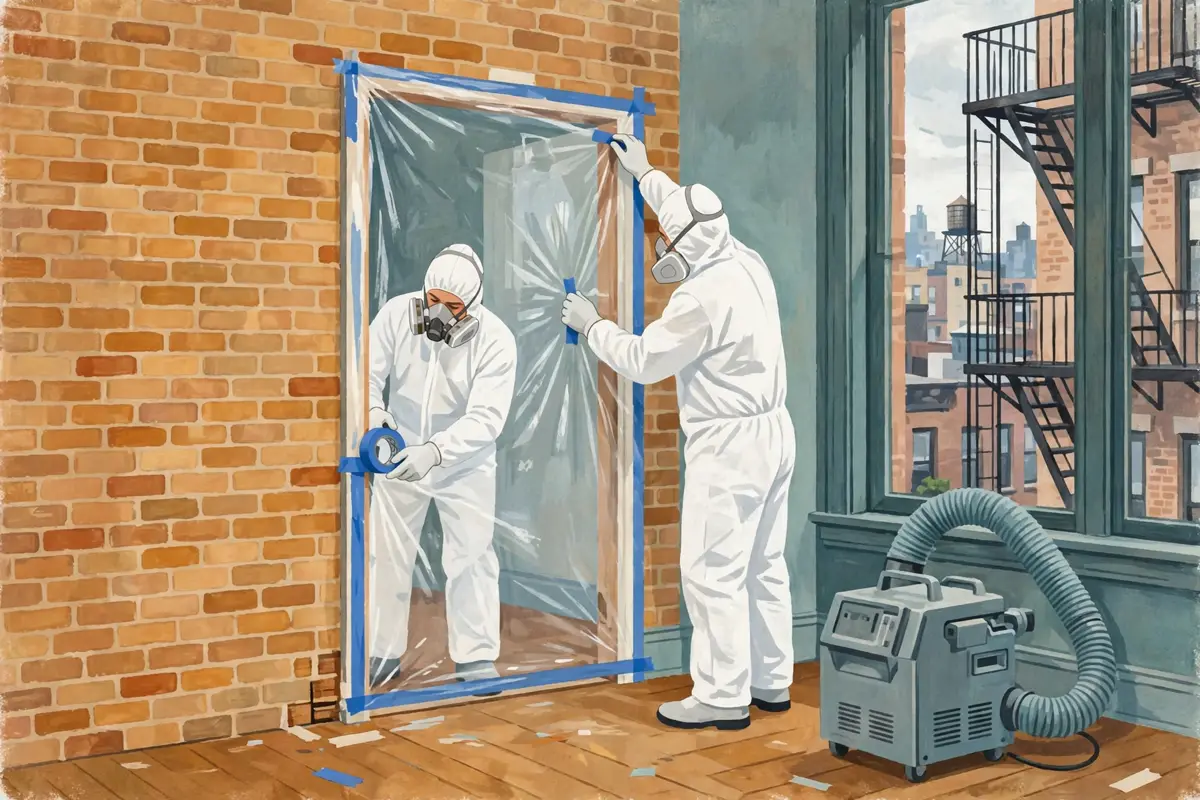
Every page on this site, in the order it was built. The other fifty-five each take one question, one place or one stage of the work. This page, the fifty-fourth, takes the mold that follows water: the drying clock, the licensed sequence under Article 32, and the city rules that make landlords move.
Home page for restoration help across New York
Borough page for Brooklyn homes hit by leaks and floods
Borough page for Queens homes, from Astoria to Far Rockaway
Borough page for Bronx homes and buildings
Borough page for Staten Island homes
Regional page for Nassau and Suffolk homes
Borough page for Manhattan apartments and buildings
How claims work in New York, step by step
Finding and fixing hidden water inside walls
Help after fire, smoke and the water that put it out
Cleanup after flood events, street water and storms
The remediation stage explained for city homes
Cleaning up after a fire, room by room
City page for Rochester homes
City page for Albany homes
City page for Buffalo homes
City page for Syracuse homes
City page for Yonkers homes
City page for New Rochelle homes
City page for Mount Vernon homes
City page for Schenectady homes
City page for Utica homes
City page for White Plains homes
City page for Troy homes
City page for Niagara Falls homes
City page for Binghamton homes
County page for Westchester homes
Regional page for Hudson Valley homes
Regional page for Capital Region homes
Regional page for the western end of the state
Regional page for Finger Lakes homes
Regional page for Central New York homes
Regional page for Southern Tier homes
The city hub page tying the borough pages together
The timeline of mold growth after water gets in
Removing mold from city homes, safely and legally
The whole restoration process, step by step
A plain definition of the whole trade
Licensed mold work under New York rules
Extraction only: pumps, vacuums and standing water
The broad city page for water problems at home
Cleanup help for Nyack homes in Rockland County
How to pick a restoration company you can trust
Water problems in shops, offices and buildings
Basement water problems, from seepage to floods
The repair stage that follows cleanup and drying
City page for Poughkeepsie homes
The emergency page: speed, safety and the first hour
The cleanup stage after water is out, room by room
The flood event page: storm water, basements, claims and rebuilding
How long each stage takes, from first call to dry rooms
Neighbourhood page for flood work in upper Manhattan
Whether insurance pays for water damage work, decided by cause
Compare the companies serving New York: national franchises, regional firms and local independents, and how to verify licences and certification before you hire.
Water damage from an upstairs neighbor in New York City: who pays, what to do in the first hour, and how to document, report and claim.