This is the fifty-first page of this site, and it owns one question the other fifty circle around: time. How long does water damage restoration take in a real New York home, stage by stage, material by material, with the official mold windows, the moisture readings that end the argument, and the city factors, boards, permits, neighbours and concrete, that stretch a three day drying job into a three week story. Every figure here carries its source, and every range is a range because the honest answer is one.
How long water damage restoration takes in New York City depends on the water, the materials, and the building, from a few days of drying for one small clean-water room to several weeks or months when wet walls, soaked floors, and permits slow the job down.
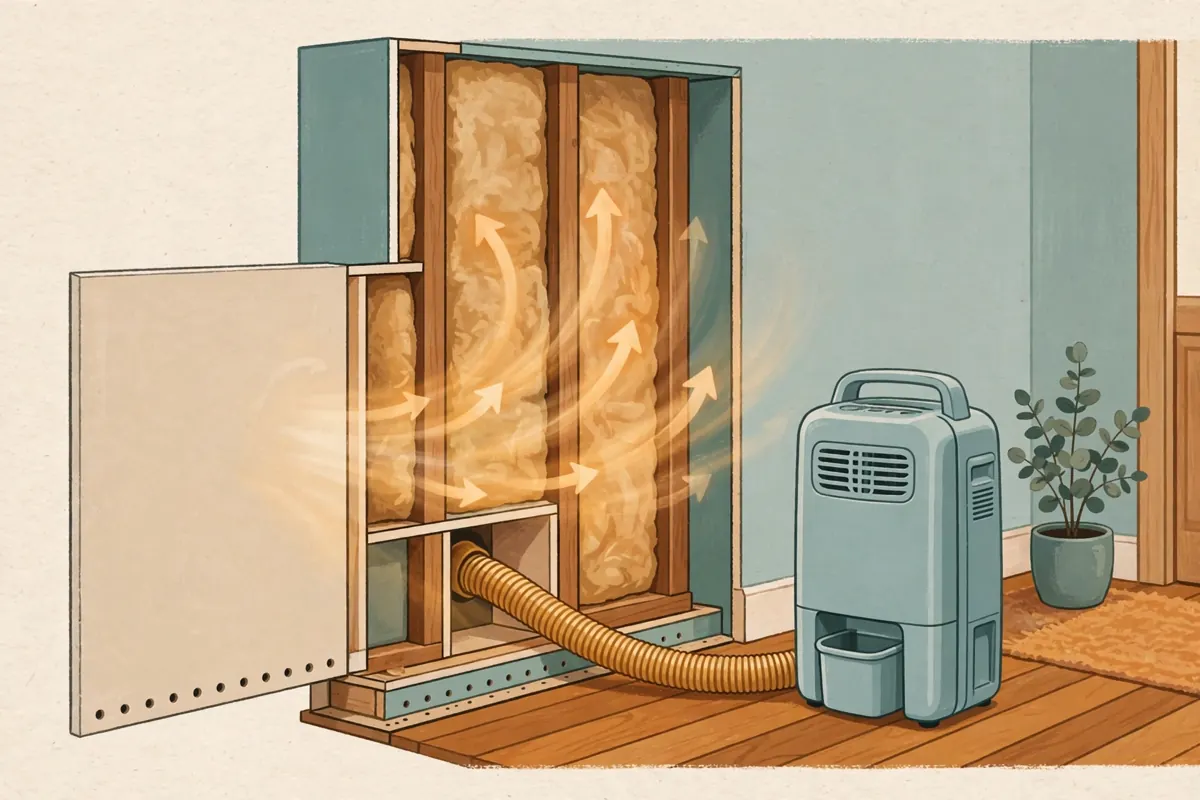
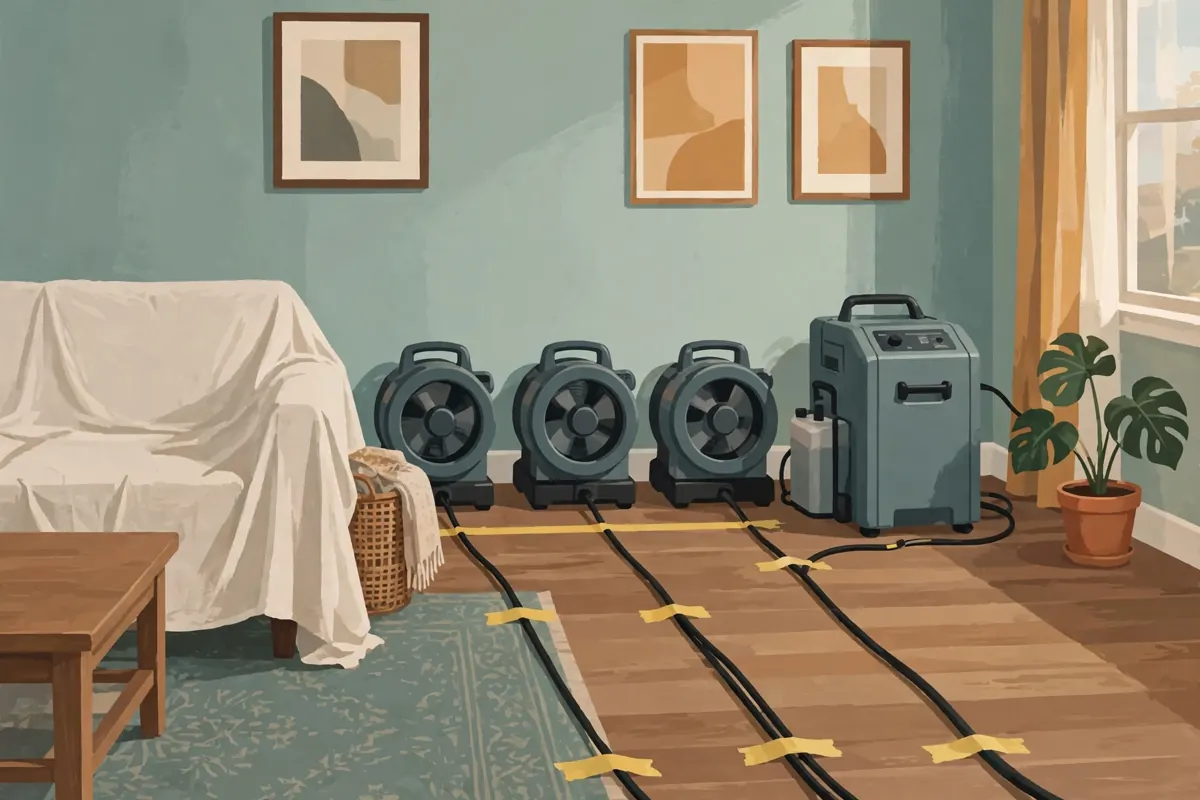
Drying in progress in a city apartment: air moving, water being pulled from the air, and a reading taken where the wall meets the floor.
The first two days decide the mold question, and the first reading decides the plan. Call (212) 555-0147, describe where the water came from and what it reached, and get extraction and real drying started while the windows on this page are still open.
Here is the honest answer in one breath. The drying at the heart of the job usually takes three to five days, with the equipment running day and night. A small, clean water job caught fast can be verified dry in two to three days. Saturated hardwood, plaster and concrete take seven to fourteen days. The whole job, from the first call to finished, painted rooms, runs from about two to three weeks for a small apartment job with no building approvals in the way, to several weeks or months when heavy removal, contaminated water, permits and ordered materials pile up. How long does water damage restoration take in your home sits somewhere on that line, and this page exists to show you exactly what moves a job along it, in which direction, and by how many days.
Notice that the answer has two clocks, and most confusion comes from mixing them. The first clock is drying: how long the structure itself takes to give up the water it drank. That clock is physics. It is set by the material, the temperature, the humidity and the amount of water, and no promise, discount or deadline can hurry it, because a wall releases moisture at the rate a wall releases moisture. The second clock is everything around the drying: the calls, the building approvals, the adjuster, the removal, the ordering of a floor that matches yours, the painter. That clock is administration, and it can be hurried, delayed, organised or wasted. When a neighbour tells you their job took six weeks and yours is quoted at ten days, you are usually hearing two different clocks quoted as if they were one.
This page keeps the two clocks separate on purpose. Sections below take the drying clock apart material by material, with a sourced table, then take the surrounding clock apart factor by factor, from co-op boards to city inspections. By the end you will be able to do what a good estimator does in the first ten minutes at your door: name the slowest material in the room, name the approval most likely to stall the rebuild, and add the two together into a range you can plan a life around. That estimate, a range with reasons, is the only honest form the answer takes. A single day count, offered before anyone has taken a reading in your home, is not an estimate. It is a guess wearing one.
One more distinction before the detail. Restoration time is not repair time alone, and it is not drying time alone. Searchers ask about water damage repair time as if the repair were the job, and ask about drying as if drying were the job. The job is the chain: stop, document, extract, dry, clean, rebuild, and the chain is only as fast as its slowest link on a given week. A crew can extract brilliantly and still hand you a six week job because the building board meets monthly. A board can approve in a day and the job still runs a month because the concrete slab is drinking from below. Reading this page with the chain in mind turns every section into a link you can check in your own home.
Stage one is the call and the arrival, and it is measured in hours. You describe the water: where it came from, when it started, what rooms it reached. That description is not small talk. A supply line that ran for twenty minutes and a sewer line that backed up during a storm are different jobs with different timelines before anyone leaves the depot, and the crew that hears the difference arrives with the right equipment the first time. On this stage the only number that matters is how long the water kept running before the call, because every running hour is water inside walls and floors that the later stages have to find, dry or remove.
Stage two is documentation, and it is measured in minutes that protect weeks. Photographs of every room, the water line on the walls, the belongings, the serial numbers. A moisture map of the wet area, with the first readings and a baseline from dry material elsewhere in the building. It feels slow to stand in a wet room taking pictures, and homeowners itch to start moving furniture. Resist it. The claim file built in these minutes is what the adjuster will read in week three, and the baseline taken now is what proves, on day five, that the wall is actually dry. Jobs that skip this stage do not finish faster. They finish argued about.
Stage three is extraction, the removal of standing water, and it is the fastest heavy stage: hours on most jobs, inside the first visit, and up to a day or two when a basement is holding deep water. Pumps bring deep water down, extraction wands pull water out of carpet and across hard floors, and the room goes from flooded to damp. Homeowners often feel the job is nearly done at this point, because the visible water is gone. It is not. The water you could see was the easy water. The water inside the drywall, the subfloor, the insulation and the framing is the job, and it does not respond to a pump. How long does water damage restoration take is decided almost entirely after this stage, in the drying that follows.
Stage four is drying, the longest stage and the subject of most of this page. Air movers and dehumidifiers are placed by the moisture map, not by habit: so many machines, in these positions, aimed at these materials. The equipment then runs around the clock while the crew returns to take dated readings. Three to five days is the typical run. The range moves with the materials table in the next section: carpet at the fast end, concrete at the slow end, and any wall with wet insulation inside it jumping the queue from the fast end to the slow one. Drying ends by measurement. The day the wet readings match the baseline is the day the machines leave, and not a day before, whatever the calendar says.
Stage five is cleaning and sanitizing, usually a day or two, running partly alongside the drying. Hard surfaces are scrubbed and then treated, contents are cleaned or set aside for the claim, and anything the water carried is dealt with as what it is. On clean water jobs this stage is light. On gray water and sewage jobs it is a stage in its own right, with removal of porous material, disposal and disinfection sequenced before drying can even be trusted. This is one of the quiet reasons two jobs with the same wet square footage carry different timelines: the category of the water rewrites stage five completely, and stage five sits in the middle of the chain.
Stage six is the rebuild, and it is the stage with the widest spread of all: days for a patch, prime and paint; weeks for floors, cabinets and tile; months when the removal was heavy, the materials are ordered, or the building and the city have approvals to give. The rebuild cannot start before the dry readings, which is why a slow drying stage pushes everything behind it, and why a fast, well documented drying stage is worth money as well as days. When someone asks about water damage repair time, they are usually asking about this stage alone. It deserves its own question, because it obeys different rules: drying obeys physics, rebuilding obeys calendars, suppliers and other people.
Add the stages for three real shapes of job and the ranges stop looking vague. A burst supply line in one bathroom, caught in the hour, clean water: extraction the same day, drying three days, cleaning a day, a modest rebuild inside two weeks. A washing machine that flooded a finished basement over a weekend: extraction a day, removal of carpet pad and the base of the walls, drying seven to ten days with the open stairwell working against the machines, rebuild three to five weeks. A sewer backup across a ground floor: city inspection, decontamination and removal first, drying one to three weeks after that, rebuild six weeks and beyond. Same trade, same city, three different answers, each one honest. The shape of the water decides before the crew does.
If you remember one table from this page, make it this one. It comes from Bingham Restoration, a working restoration company that published its per material drying times on September 4, 2026, and it matches what New York crews describe from their own jobs. Read it as the drying stage only, with professional air movers and dehumidifiers running around the clock and readings checked daily. It is not the whole job time, and it is not a promise: it is the range each material needs when the drying is done properly, and it explains most of the spread in every estimate you will ever be given.
| Material | Typical drying time | What decides it |
|---|---|---|
| Carpet and padding | 1 to 3 days | Pad often removed and replaced; dirty water usually means both come out |
| Drywall, base intact | 2 to 4 days | Air reaching the base of the wall; jumps sharply when insulation behind it is wet |
| Framing lumber | 3 to 7 days | How much water the wood drank and how freely air moves across it |
| Subfloor, plywood or board | 4 to 8 days | Layered floors trap water between the finish floor and the subfloor |
| Plaster | 5 to 10 days | Thick pre-war plaster over lath drinks deeply and hides water |
| Hardwood flooring | 7 to 14 days | Dried in place with specialty mats when the floor can be saved |
| Concrete | 7 to 14 days and more | Drinks deep, dries only through its surface, can release moisture for weeks |
| Wet insulation | Removed, not dried | Holds water against framing and cannot be dried reliably in place |
Read the table the way an estimator reads a room: find the slowest material the water reached, and that material sets your drying floor. A kitchen with wet carpet over tile is a three day story. The same kitchen with water under the cabinets and into the subfloor is an eight day story wearing a three day disguise. This is the single most useful habit this page can give you. When a crew walks your home, ask which material they expect to finish last. If they can answer at once, with the meter readings to back it, you are hearing a drying plan. If they answer with the fastest material in the room, you are hearing a sales pitch.
Drywall deserves its own paragraph because it is the material people ask about most, in every wording they can find: how long does drywall take to dry, and how long does it take for drywall to dry after water damage are the two biggest variant searches behind this page, and the table answers both at two to four days for board that stayed intact. The fine print matters more than the headline. Drywall dries from its faces, so paint, vinyl wallpaper and cabinets against the wall all slow it. The base of the wall, where water wicks up from the floor, is the last part to dry and the part that decides. And the moment the insulation behind the board is wet, the honest answer leaves the table: the cavity has to be opened, the insulation comes out, and the wall joins the seven day club.

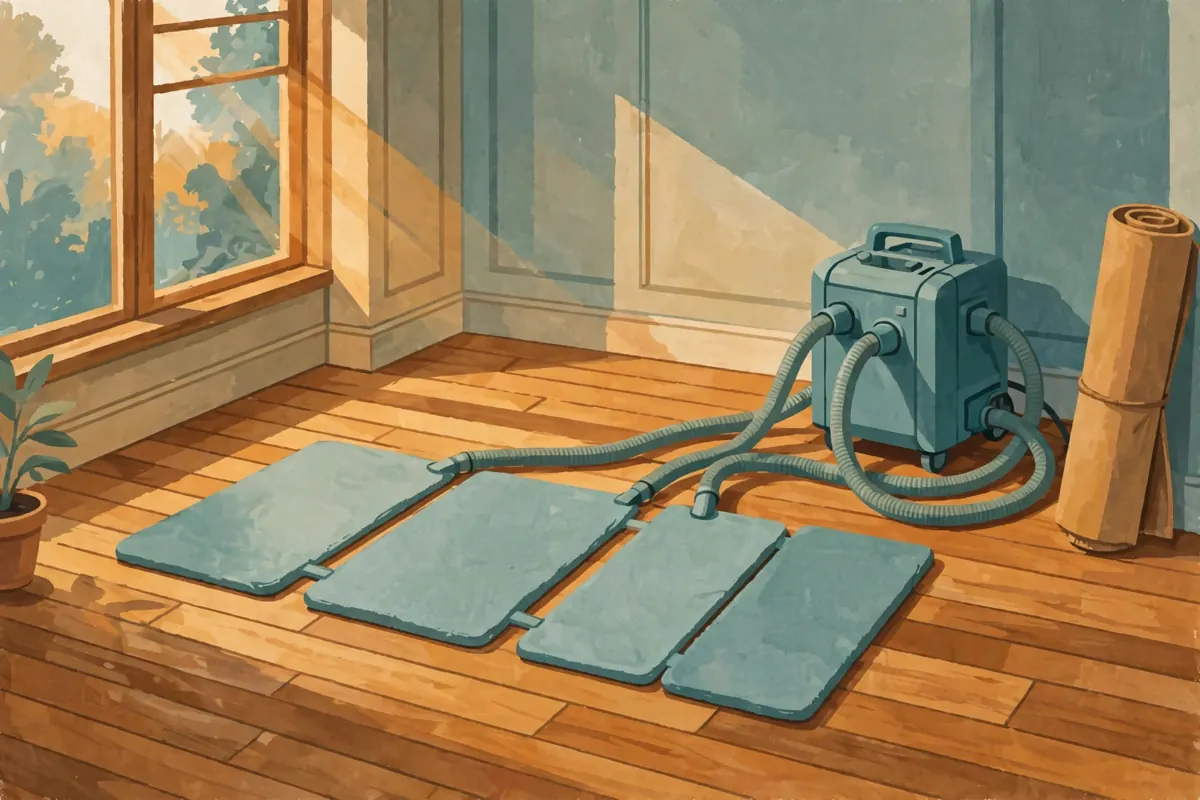
Hardwood sits at the slow end for a reason that surprises people: the floor is dried gently on purpose. Specialty mats sit on the boards and draw moisture up through the wood while the room air is kept dry, and the process is kept gradual because a floor dried violently cups, cracks and splits. Seven to fourteen days of patience is what saving the floor costs. The alternative is not a faster dry, it is a new floor, with its own ordering, acclimatising and fitting calendar that usually runs longer than the mats did. When a crew recommends the mats, they are not padding the job. They are choosing the shorter of the two real options, and the readings at the end will show whether the choice worked.
Concrete is the material that humbles schedules. A slab drinks water through its whole depth and can only release it through its top surface, so its drying is measured in weeks and verified, before any floor covering returns, by the moisture test the flooring maker specifies. Basements live on concrete, ground floors sit on it, and high-rise buildings are framed in it, which is why so many New York timelines end with the same sentence: waiting on the concrete. How long does it take for concrete to dry after water damage is the variant question with the least satisfying answer in this whole subject, seven to fourteen days and often more, and any crew that floors over a slab on a handshake is building you a second job.

Framing and subfloor, the bones between the finishes, dry in the middle of the table and decide more than they are credited with. Framing at three to seven days is the material the rebuild threshold actually measures, because it is the wood that gets covered. Subfloor at four to eight days is the layer that betrays haste: a finish floor laid over a damp subfloor fails from below, adhesive first, boards after. When you hear a job described as dry except for the subfloor, hear it correctly. The job is not dry. The slowest layer is the job, and the finishes everyone is impatient to see are exactly what must wait for it.
That is exactly what the first visit answers, with a meter rather than a guess. Call (212) 555-0147 and ask for a moisture assessment: the slowest material in your rooms, named, with its first readings written down.
Three official windows govern the first days, and this page attributes each one carefully because they are quoted loosely all over the internet. The Environmental Protection Agency says to dry water damaged areas and items within 24 to 48 hours to prevent mold growth, and adds that in most cases mold will not grow if the drying happens inside that window. The Centers for Disease Control and Prevention says to clean and dry wet items within 48 to 72 hours. The New York State Department of Health, writing for schools, says to clean and dry wet or damp spots within 24 to 48 hours, using fans and a wet dry vacuum. Different bodies, slightly different windows, one shared message: the first two days are not the start of the job. In mold terms, they are most of the job.
The Environmental Protection Agency adds the indoor air half of the rule: keep indoor humidity below 60 percent relative humidity, and ideally between 30 and 50 percent, because damp air feeds growth even on surfaces that feel dry. This is the quiet work a dehumidifier does that a fan cannot. A fan moves air across a wet wall and helps the wall give up its water; only the dehumidifier takes that water out of the room air and sends it down a drain. A room dried with fans alone in a humid New York summer can pass the touch test and fail the humidity test, and the mold window, which runs on moisture rather than on appearances, keeps running with it.
The same agency, in its flood guidance, stretches the window honestly for big water: after a flood, drying usually takes several days to weeks, and items that stayed wet for more than 48 hours and cannot be thoroughly cleaned and dried should be removed. Read the two EPA statements together and you get the real rule. The 24 to 48 hour window is the target for starting and for saving what can be saved; it is not a promise that a flooded structure will be dry in two days, and it is not a failure when a flood job runs three weeks. What the window decides is which materials are still saveable and whether mold gets its foothold while the drying proceeds.
Why does this matter to a page about time? Because the mold window converts delay into scope. A job that starts inside the window is a drying job. A job that starts a week late is a drying job plus a mold job, and the mold job in New York, past ten square feet, is licensed work under Article 32 of the Labor Law with its own assessment, work plan and clearance calendar. Nothing else in this subject turns a weekend of waiting into weeks of extra process that cleanly. When people ask how long does water damage restoration take, the first honest sub-question is when it started. The same water, the same rooms, a different week: a different job.
Two popular shortcuts deserve a plain warning here, because both circulate in how-to advice and both work against drying. The first is the humidifier mistake: one widely read how-to page tells readers, in a step heading, to run a humidifier alongside fans. A humidifier adds moisture to room air. It is the opposite of the machine this job needs, and following that heading in a wet room feeds the exact damp the drying exists to remove. The machine is a dehumidifier. The second is the air purifier mistake: purifiers clean air, they do not dry anything, and a purifier humming beside a wet wall changes the wall not at all. Fans move air, dehumidifiers remove water, purifiers filter air, humidifiers add water. Four machines, four different jobs, and the timeline only respects two of them.
Every professional timeline starts with a sorting, and the sorting has two axes. The category axis asks what the water is: category 1 is clean water from a sanitary source, category 2 is gray water carrying significant contamination, category 3 is the grossly contaminated water of sewage and flooding. The class axis asks how much of the building the water took and how hard it will be to dry. Category decides what may be dried and what must be removed. Class decides how long the drying of what remains is likely to run. An estimate given before this sorting is not an estimate at all, which is why the first visit takes the time it takes.
The class ranges used on this page come with their label attached. The IICRC S500, the trade standard for this work, is a paid document that the research for this page did not access in full, so the ranges here are a secondary summary of the standard, published by Opora Supply on June 25, 2026, and they are presented as a summary rather than a quotation. Class 1, the least water, part of a room, little evaporation load: about two to three days. Class 2, a whole room or more, water up the walls: three to five days. Class 3, water from above, ceilings, walls and insulation wet: five to seven days. Class 4, water deeply bound in dense materials like hardwood, plaster and concrete: seven to fourteen days and more. The summary also states the standard drying goal: return materials to their pre-loss moisture content, or to the content of similar unaffected material in the same building, which is the baseline method the next section explains.
Categories move through time in a way classes do not, and the movement is a trap for slow starters. Category 1 water does not stay category 1. Left standing, clean water picks up whatever it touches, building materials, dust, the contents of the rooms it crosses, and the secondary summary puts the escalation plainly: category 1 water can become category 2 in 48 to 72 hours. A supply line flood dried on day one is a drying job. The same flood discovered after a holiday weekend is a removal job with a drying job inside it. The water did not change its source. It changed its category while it waited, and the timeline changed with it, by days and by whole stages.
Golden Touch Restoration, the New York City company with the strongest timeline page found in this research, sorts its published ranges by category, and its numbers are worth setting beside the class summary. Category 1, one room: three to five days of drying. Category 2, several rooms: five to ten days. Category 3, after decontamination: seven to twenty-one days. Two different sortings, one by class and one by category, landing in the same place: clean and small is days, dirty and large is weeks. When your job is being estimated, ask which sorting the estimator is using and which box your job fell into. The answer tells you more about your next month than any single date could.
There is a third clock hiding inside the standard that homeowners rarely hear about: the daily log. Drying under the standard is not set the machines and leave. Conditions are recorded, in the trade language psychrometric readings, temperature and humidity and the moisture content of materials, day by day, and the plan is adjusted from the record. Optimal drying conditions in the summary sit around 70 to 80 degrees Fahrenheit, warm enough for materials to give up water readily, which is one reason a January job in an unheated building runs longer than the same job in May. How long does water damage restoration take is therefore partly a weather question, and the log is where the weather gets its say, in writing, one day at a time.
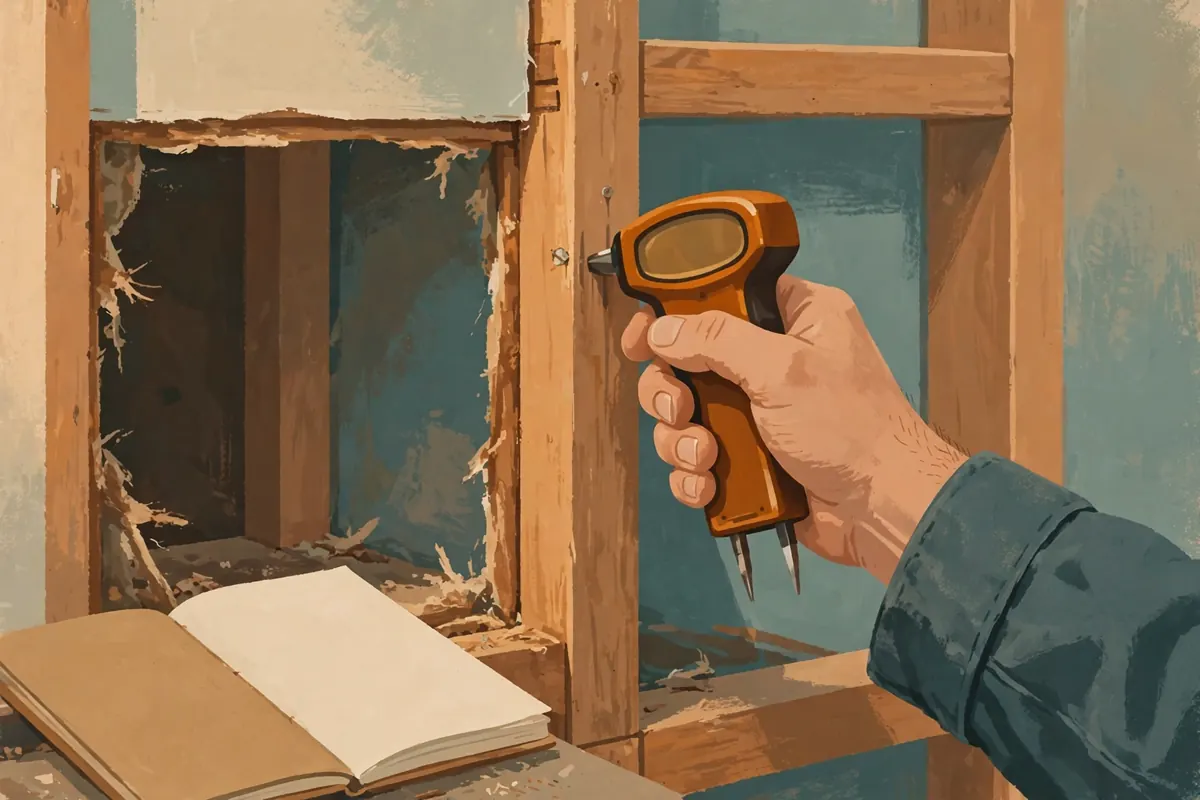
Dry is a measurement, not a feeling, and the whole credibility of a timeline rests on that sentence. A wall that feels dry to a palm can read wet at its base. A floor that looks finished can be sitting on a damp subfloor. The palm is a fine tool for finding a hot pipe and a poor one for signing off a rebuild, so the trade uses meters: pin meters whose probes enter wood and drywall and read the moisture inside the material, and pinless meters and thermal cameras that scan for the cool, damp patches where hidden water is still sitting. The readings, dated, are the drying log, and the log is the document that ends arguments, with insurers, with buildings, and with the calendar.

The number that matters most belongs to wood, because wood is what gets covered. North Dakota State University Extension, in its flood recovery guidance reviewed in April 2023, states it as a rule: wood should have a moisture content of less than 15 percent before drywall, paneling or other coverings are placed on the wood. Note the attribution, because this figure is often credited to the wrong source online. It is a university extension rule, not a line from the trade standard. Beside it sits a second figure: building guidance from the Building America Solution Center, citing the Environmental Protection Agency, holds that framing lumber and sheathing should not exceed 18 percent moisture before being enclosed. Two thresholds, 15 and 18, from two sources, both pointing the same way: there is a line, it is measured, and covering wood above it is how a drying job becomes a mold job.
Restoration and Remediation Magazine, the trade journal, filled in the picture in June 2021 with the concept this page keeps returning to: acceptable dryness is relative to the building itself. At 70 degrees Fahrenheit and 50 percent relative humidity, softwood framing sits at about 9.2 percent moisture on the wood moisture equivalent scale, and a dry standard is commonly set within about ten percent of the readings of similar unaffected materials. In plain terms, your wall is dry when it reads like your other walls. That is the baseline method in one sentence, and it is why a crew takes readings in a dry room on the first visit, before a single machine is placed: they are writing down the finish line while everyone can still see where it is.
DryEase, a New York City company whose practitioner writes its own timeline guidance, works by exactly that method and gives the baseline figures it usually sees: dry material in the buildings it dries commonly reads around 15 to 20 percent on its instruments at the start, and equipment comes out only when the wet readings have come down to match the dry ones. The same source carries the warning that should be printed on every estimate: the most expensive mistake on a water job is equipment that comes out while the material still reads above that baseline. How long does water damage restoration take, asked honestly, is answered by this comparison and no other. The job takes until the wet side of the log reads like the dry side, and the log, not the brochure, says when.
What should you, the homeowner, actually do with all this? Three things. Ask for the baseline readings and the daily log, in writing, and keep them with your claim file. Ask which material is expected to finish last, and watch its readings across the week; a material improving a little every day is drying, and a material flat for two days is being fed by water nobody has found yet. And refuse, politely and completely, any rebuild that starts over materials nobody has read. Every horror story in this trade, the floor that cupped in a month, the wall that bloomed behind new paint, begins with a covering placed over an unread or unheeded number.
Humidity is the first brake, and New York summers press it hard. Drying is evaporation into room air followed by removal of that moisture from the air, and when the air arrives already laden, in August, off the harbour, through an open window, the whole exchange slows. This is why the same job dries faster in a sealed, dehumidified room than in a larger, airier one, and why a crew that closes and conditions the drying space is not being fussy. They are defending the schedule. A homeowner who opens windows to help, on a humid day, can add days to a job with the kindest intentions in the world.
Temperature is the second brake. Cold materials hold water tightly and give it up slowly, and the drying summary behind the class ranges puts the productive band at roughly 70 to 80 degrees Fahrenheit. Winter jobs in buildings where the heat is off, damaged or kept low fight this the whole way: the machines move air faithfully over cold plaster that simply will not release at a summer rate. Heat, used carefully and safely, is a drying tool in its own right, and its absence is a line item in the timeline whether anyone writes it down or not.
Hidden water is the third brake, and the most common. Water does not stay where it lands. It wicks up drywall well above the visible line, runs along the tops of ceilings, pools under tubs and cabinets, and sits inside wall cavities and under flooring where no air mover reaches it. A room can be dried to a beautiful log on every surface a meter can touch while a cavity behind the baseboard stays wet for weeks. This is why moisture mapping, meters and thermal imaging at the start, and readings at the base of walls rather than the middle, are timeline tools and not theatre. Every pocket of hidden water found on day one is days saved. Every pocket found on day nine restarts the clock in that corner of the home.
Wet insulation deserves its own place on this list because DryEase, from its own New York jobs, names it the most common reason its jobs run long. Insulation inside a wall cavity holds water like a sponge pressed against the framing, it blocks the air that would dry the cavity, and it cannot be dried reliably in place. The fix is mechanical and unglamorous: open the base of the wall, take the wet insulation out, dry the open cavity, and rebuild. Homeowners understandably resist opening walls, and a crew that dries around wet insulation to spare the drywall is choosing a longer, riskier job to avoid a smaller, honest one. How long does water damage restoration take with wet insulation in the walls? Seven days and beyond is the realistic answer, and the opening of the wall is usually what keeps it at seven.
Layered construction is the fifth brake, and old buildings are built of layers. A finish floor over a subfloor over joists, with water trapped between the layers. Plaster over lath over framing. Tile over backer board over plywood. Each layer boundary is a place water can sit out of the air stream, and each has to dry through or be opened. Finished basements add a sixth brake of their own: the open stairwell. A basement open to the house is not one room of air but the whole building breathing down the stairs, and the dehumidifiers are effectively drying the home, not the basement, until the space is contained. Buckled flooring is the seventh brake and a message in itself: boards buckle when the subfloor under them is saturated, so a buckled floor announces that the layer nobody can see has set the finish date.
The last brake is not physical at all: equipment that does not run. Machines switched off at night because they are loud, unplugged for a party, or run daytime only because nobody explained the rule, do not pause the job, they reverse it nightly, as cooling materials and still, wet air hand moisture back and forth. Homeowners online confess to unplugging the fans, and the replies from restorers are weary and unanimous. If the noise is unbearable, talk to the crew about placement, timing of the loudest stage, or a few nights elsewhere. Those are real solutions. The switch is not one, and the mold window does not care why the room sat wet.
Begin with the walls themselves. A large share of this city was built before drywall existed, in lath and plaster, and those walls drink deeply, dry slowly at five to ten days on the Bingham table, and hide water behind a surface that feels like stone. Brownstones add masonry that was built to breathe: their basements and ground floors dry best in a breathable way, and a rushed, sealed finish over damp masonry traps the moisture the wall was trying to release. High-rises add the opposite material, concrete everywhere, in floors, in shafts, in the slab your neighbour below calls a ceiling, drying at seven to fourteen days and more. Three building stocks, three different slow materials, one city. The age and bones of your building are in your timeline before the first machine arrives.
Then the neighbours. In a detached house, your water is your problem. In a New York apartment, water respects no lease lines: it arrives from the unit above, leaves through the unit below, and its timeline runs through other people's homes, schedules and willingness to open a door. The Reddit condo case in a later section is the cautionary tale: ceiling opened, fans running, and the job unfinished months later because the source, a bathroom in the unit above, had not been fixed. A drying crew can dry your ceiling every week for a year and the job will not end until the leak above does. Access, coordination and the super's calendar are not paperwork around a New York timeline. They are the timeline.
Then the building as an institution. Co-ops and condos govern work inside their walls: alteration agreements before walls open or finishes change, certificates of insurance from every trade, elevator reservations for equipment and debris, and restricted work hours that can cut a drying or rebuild day to a fraction of its length. Golden Touch Restoration, writing about where city timelines diverge from suburban ones, puts board approval at the head of the list, and gives the comparison that makes it concrete: a category 1, single room apartment job with no board approval needed runs about two to three weeks in total, while the same water in a house answers to nobody's board. How long does water damage restoration take in a co-op is therefore partly a question about a meeting schedule, and the crews who work this city ask about the board on the first call, not the fifth.
Then the city itself, in three specific, checkable ways. Where a permit is needed for the rebuild, the Department of Buildings is on the clock. Before a permit, an asbestos assessment is required: buildings built before 1987 may contain asbestos containing material, and buildings constructed after April 1, 1987 are exempt from asbestos certification under Section 28-106.1 of the Administrative Code, a primary source checked directly for this page. Emergency work runs through a Department of Environmental Protection emergency notification. And where the water came from the city's own systems, the Department of Environmental Protection has response clocks of its own, covered in the insurance and sewer sections: inspection within 6 hours of a 311 sewer backup complaint, and response within 8 hours to a water main break. What the research did not find matters as much: no Department of Buildings or Housing Preservation and Development rule setting a drying or rebuilding deadline exists in the sources checked, and this page does not invent one.
Housing Preservation and Development enters the timeline by a side door worth knowing. Where a landlord leaves a hazardous condition uncorrected, the department's Emergency Repair Program can correct immediately hazardous, class C, violations and bill the owner through the Department of Finance, with charges that can become a tax lien. That is violation correction, not a drying service, and it does not shorten a restoration. It changes who is doing the work and why, usually in a rental where the ordinary route, owner first, then 311, has already failed. For tenants reading this page with a wet ceiling and an absent landlord, the sequence matters more than any drying figure: document, report to the owner, then report to 311 and keep the number.
Put the city factors together and a pattern emerges that explains most of the gap between New York timelines and national ones. The national pages in this research, written from Florida, Utah, Texas and Virginia, quote drying and rebuild ranges for houses whose owners answer to no board, no super, no elevator schedule and no house rules, in buildings of drywall and slab. Their numbers are not wrong. They are answers to an easier question. The New York answer adds the building, the neighbours and the city to the physics, which is why this page, and the two working city companies it cites, keep landing a week or two beyond the national ranges for the same water.
The bathroom is where city water jobs are born, and its timeline is set by what the water reached. A supply line or a wax ring caught early wets tile and the subfloor beneath it, and tile over a wet subfloor is a layered problem: the surface reads dry while the sandwich below is still wet. Drying runs to the subfloor's four to eight days, and a tub or shower that has to come out to reach the water turns a drying job into a rebuild with plumbing in it. Bathrooms also carry the upstairs problem in its purest form. Half the bathroom timelines in this city are really two bathrooms, yours and the one above it, and the job ends when the slower of the two is fixed and dry.
The kitchen hides its water better than any room in the home. Cabinets are boxes against the wall, and water that reaches them pools underneath, wicks into the cabinet bases and the wall behind, and announces itself weeks later as a smell. Dishwashers and refrigerator lines leak slowly, which means kitchen jobs are often discovered late, with the category clock already run and the subfloor already saturated. Expect the moisture map to matter more here than anywhere, expect cabinet removal to be discussed, and expect the drying to run to the subfloor and wall figures rather than the floor surface figure. A kitchen that smells musty after a leak is not being dramatic. It is reporting a reading your nose took before a meter did.
The living room and bedrooms are usually the honest rooms: carpet or hardwood over a subfloor, drywall walls, contents that can be moved. Their timelines follow the table cleanly, carpet at one to three days, hardwood at seven to fourteen with mats, and they are the rooms where a small clean water job earns its two to three week total. Their one trap is the wall they share with a bathroom or kitchen, which can be drying the living room's side while the wet side feeds it. Readings on both sides of a shared wall are the difference between a room that dries and a room that is dried at, repeatedly.

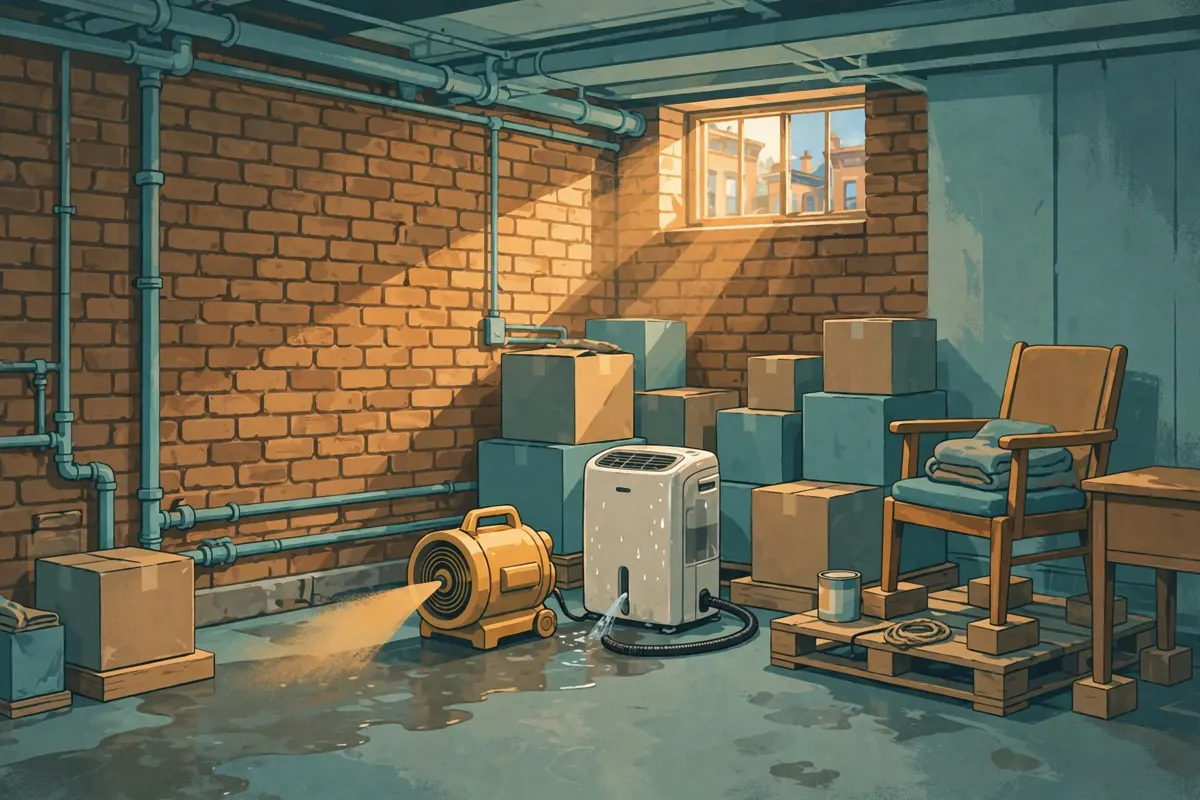
The finished basement is the room where timelines go to be humbled, and this page has already given it three separate mentions because it earns them. It sits below grade, on concrete, often with drywall and insulation over masonry, fed by an open stairwell, and it collects every kind of water the home can produce: groundwater, street water, sewer water and the home's own plumbing falling down. Its drying runs one to two weeks in most real cases, its category is the worst in the house when the water came from below, and its rebuild carries the flood questions, what goes back, at what height, in what materials, that other rooms never ask. If your water is in a finished basement, plan from the slow end of every range on this page and let the readings pleasantly surprise you.
The laundry corner deserves a sentence of its own because it produces the longest running leaks in the research: a washer or dryer misconnection in one homeowner account ran, on and off, through a seven month process before the drying argument even settled. Supply hoses fail, drains overflow, and the machines sit against walls in closets and corners where a slow leak can run for weeks unseen. The timeline lesson is the discovery lesson: in this subject, the date the water started matters more than the date the crew arrives, and half of what looks like a drying problem is a detection problem that happened earlier, quietly, behind an appliance.
Two clocks run on every insured job, and they do not drive each other. The drying clock runs on readings. The claim clock runs on documents: the report, the adjuster visit, the estimate, the proof of loss where one is required, the review, the payment. Homeowners feel them as one wait, and much of the frustration in this work is a fast drying job standing next to a slow claim, or the reverse. Keep them separate in your mind and in your questions. Ask the crew about readings. Ask the insurer about documents. Each can only answer for its own clock, and a crew that blames the adjuster for wet walls, or an adjuster blamed for a slow painter, is a sign the two clocks have been confused on purpose.
The sequence companies in this market describe, offered here as search level guidance because no primary source publishes an adjuster timetable, runs like this. Day one: report the loss and start mitigation at once; waiting for permission to dry is how a claim grows a mold problem the policy may not cover. Days one to three: the adjuster is assigned and the inspection is arranged. Days three to ten: mitigation and drying proceed with daily logs, which become claim documents as they are written. Days seven to fourteen: the dry standard is reached and released, the mitigation invoice is prepared. Weeks two to six: estimate review, any proof of loss, and the first payment. Treat the shape as typical, not promised, and notice what it rewards: the homeowner whose photographs, logs and records started on day one is the one whose weeks two to six go quietly.
New York law sets real clocks at the far end of that sequence, and they are worth stating exactly. Under Regulation 64, Section 216.6, once a proof of loss is received the insurer has 15 business days to accept or reject the claim, and, after agreement, 5 business days to pay. A separate, faster clock exists for declared disasters: Insurance Law Section 2618 provides for payment not later than four business days from the insurer's receipt of the agreement, and its scope is disaster only, a declared emergency arising from a natural disaster or terrorism. The two are often mashed together online into a single wrong sentence. Keep them apart: the 15 and 5 belong to Regulation 64, the four day disaster clock belongs to Section 2618, and neither excuses a slow start on the documents only you can start.
Flood claims carry their own calendar, stated here briefly because this site's flood pages own the subject in depth. The Proof of Loss for a National Flood Insurance Program claim is due within 60 days of the flood. FloodSmart gives the planning figure that a claim can take four to eight weeks to be finalized and paid. And the program's authority has a date every homeowner should know in its current form: under the federal statute as amended on February 3, 2026, no new contract for flood insurance under the program shall be entered into after September 30, 2026. That is a rule about new contracts. A policy already in force stays in force to the end of its own term. How long does water damage restoration take is a drying question; whether the money for it exists is a calendar question, and this is the calendar.
When the clocks stall, the state gives you two numbers, and they are printed here because a page about time should include the numbers that enforce it. The Department of Financial Services consumer line is (800) 342-3736, for questions about what an insurer owes you in process. The disaster hotline is (800) 339-1759, for declared disaster questions. Neither number dries a wall. Both have, on stalled files, done what weeks of polite emails could not. Keep every claim document, every 311 number, every reading and every photograph in one folder from day one, and the calls, when you need them, take minutes instead of afternoons.
Two real job videos are linked from this page, chosen because they show actual restoration work on actual homes rather than advertisements, and labelled with where they really are, because a timeline page that plays loose with places would play loose with days too. The first is by Instant Restoration, a small company channel, titled Water Damage Restoration, Step by Step: Real Jobs in Los Angeles. It runs three minutes and twenty-seven seconds, was posted in early November 2026, and walks through real jobs in Los Angeles, California. Watch it for the sequence and the equipment, the order of extraction, drying and checking that this page describes, and not for New York specifics, because there are none in it. Watch the Los Angeles real job video.
The second is by Sand Dollar Development, titled Massive Water Damage Restoration: Burst Pipe Destroys Home, a full walkthrough running six minutes and sixteen seconds, posted about a year ago. The job is a burst valve in a bathroom tub filler that leaked unnoticed for roughly two weeks, soaking ceilings and buckling floors, which makes it the most instructive kind of timeline video there is: a discovery story. The damage you see is what two hidden weeks do. The location tag on the video is East Hampton, on Long Island. That is not New York City, and this page will not call it that. Watch the East Hampton, Long Island real job video.
Now the honest gap, stated plainly because the research for this page looked hard. No real job case study video of a New York City water damage restoration, filmed on a city job and showing the work, was found. What exists for this city is short promotional clips, seconds long, made to advertise rather than to teach. This page links the two real job videos above, from Los Angeles and from East Hampton, and says what they are, rather than dressing a promo clip as a case study or dressing Long Island as the five boroughs. If a city crew publishes a genuine, full job walkthrough, this section is where it belongs, and the standard for adding it is the one applied here: real job, real place, stated honestly.
The research for this page read the threads where homeowners work this out in public, and three of them teach the timeline better than most company pages do. The first is from Reddit's r/homeowners, December 13, 2022, where a condo owner describes an upstairs neighbour's bathroom flood leaking into the living room below: ceiling exposed, fans and a dehumidifier running, and the neighbour's own unit, the source, not yet fixed. The replies split between practical drying advice, one owner noting a previous job took less than a week, and the harder truth that fans will not finish a job whose source is still leaking, alongside the suggestion to bring insurance in early. Read it as the access lesson: in attached housing, your timeline lives partly in someone else's bathroom.
The second thread is from r/HomeImprovement, September 3, 2021. A homeowner with about two inches of water in a finished basement after a hurricane, carpet already removed, concrete floor and standard drywall, had four industrial fans running and asked how long to keep them going now that the basement felt dry to the touch. The answers are the drying trade in miniature: three days, seventy-two hours, said one. Three to five days, said another, adding that high speed fans are needed and that mold was, in their view, already a certainty. A third advised buying a hygrometer, a small instrument that reads the air's humidity. Feel versus measurement, optimism versus caution, and the small tool that settles the argument: the whole philosophy of this page, in four comments.
The third thread, r/HomeImprovement again, October 21, 2022, is the equipment discipline lesson. A homeowner asked for a second opinion on a large national company's drying: about four fans and a dehumidifier, run daytime only, for about a week, with the company wanting a few more days, on a job whose wider process, a washer and dryer misconnection, had already stretched to seven months. The reply restorers quote is the one used in the questions below: normal dry outs are five days of all the equipment running around the clock. Daytime only running, whatever its reasons, is the difference between that norm and the job this homeowner was living. How long does water damage restoration take when the machines keep office hours? Ask the person who lived that thread.
The rest of the public record, checked for this page, deserves an honest line each. Quora offered nothing usable on drying times beyond generic pages. Behance offered designer profiles, not homeowner experience. Medium was blocked to the research and its content was not read, so nothing from it is used here. WikiHow, read carefully, is mostly sound on this subject: dry within 48 hours because mold starts, run the dehumidifier constantly, tear out soaked carpet, cut out waterlogged drywall and insulation, and expect damp walls to take weeks or even months in the worst cases. Its errors are the two named earlier on this page, the humidifier heading that would add moisture to a wet room, and an expert answer suggesting air purifiers help dry a wall cavity, which they do not. Read the good, skip the two errors, and the public record and the professional one agree: days of verified drying, weeks for the whole, and no shortcuts that survive a meter.
This page exists because people ask its question in search, in numbers worth stating exactly, with the two research tools reported side by side and never averaged, because they measure differently and their disagreement is itself information. SEMrush, checked on November 24, 2026, gives the question a United States search volume of 140 per month, a keyword difficulty of 11 percent, rated very easy, a cost per click of 17.56 dollars, and informational intent. The search results it sees carry an AI Overview, video results, reviews, People Also Ask and related searches, and notably no local pack: this is a question people ask the whole internet, not a search for a nearby company. The strongest page in its top ten carries a page authority score of just 13, and the largest national name in this trade does not appear in its top ten at all. It is, by the data, an open question waiting for a thorough answer.
Moz, checked the same day, tells a related but different story, as it often does. It gives a volume of 21, inside a range of 11 to 50, a difficulty of 35 rated low in its overview and 30 in its suggestions table, two figures from the same tool that this page reports as found rather than reconciling, a click through rate of 88 percent, and a minimum domain authority of 3 among ranking pages. Its results page, last updated November 2, 2026, shows eight organic results, with an AI Overview and People Also Ask, and its top result is a national company's page that the other tool does not rank in its top ten at all. Four of the People Also Ask questions Moz records appear, word for word, as the first four questions in the questions section of this page, because a timeline page should answer the questions the results page is actually asking.
The variant searches matter as much as the headline, because they show the question splintering by material and by stage, which is exactly how this page is organised. How long does drywall take to dry: volume 390, difficulty 6 percent. How long does it take for drywall to dry after water damage: volume 320, difficulty 10 percent. Water damage repair time: volume 110, difficulty 11 percent. How long does it take for concrete to dry after water damage: volume 90, difficulty 5 percent. Water damage restoration timeline: volume 50, difficulty 9 percent. How long does it take to dry out water damage: volume 30 by one tool, and a volume of 1 with difficulty 7 by the other. Two honest failures complete the record: one tool returned no data for the shortest wording of the drying question, and the other failed to load figures for two variants at all. Nothing in this section was smoothed over to fill those gaps, because a page that invents its research will invent its timelines too.
Plenty of small jobs are dried by the people who live with them, and done well: a clean water spill caught in the hour, a single room, hard floors or carpet lifted and dried with real air movement and a real dehumidifier, checked daily and given its full days. The homeowner tools that work are the same physics as the professional ones, at smaller scale. A wet dry vacuum for the standing water. Fans that actually move air across the wet surfaces, not a ceiling fan stirring the top of the room. A dehumidifier sized for the space, run constantly, with its bucket emptied or its hose draining, because a dehumidifier with a full bucket is a statue. And time, the full run of it, not the first dry feeling.
Where do it yourself drying stops is equally clear, and the threads in the readers section mark the border. It stops at dirty water, which needs removal and sanitizing, not fans. It stops at walls, because the water inside a cavity cannot be reached by air moving across its face, and the insulation inside changes the job entirely. It stops at scale, where the equipment count and the containment a crew brings are the difference between drying a room and humidifying a home. And it stops at proof: an insurer, a landlord, a co-op board or a buyer will ask for the log, and a memory of dry feelings is not one. None of this makes small, fast, clean jobs professional work. It makes the border visible, which is what a homeowner actually needs.
One purchase settles more arguments than any other in this subject, and it is the one a stranger recommended in a basement thread: a hygrometer, and beyond it a simple moisture meter. Together they cost less than a single day of the wrong decision, and they convert every question on this page from opinion to reading. Is the room air dry enough for the wall to give up water? Is the base of the wall improving day by day? Is the floor ready for the covering everyone wants to lay? How long does water damage restoration take in your home stops being a debate at the kitchen table the day the numbers start being written down. That, in the end, is the whole method of this page, and it fits in a drawer.
If you take one plan from this page, take this one. In the first hours: stop the water, photograph everything, start the claim, get the standing water out. In the first two days: get real drying running and keep it running around the clock, because the mold windows from the Environmental Protection Agency and the Centers for Disease Control and Prevention are open and closing. Across the first week: readings every day, against a baseline, with the slowest material named and watched. At the end of drying: a log that proves dryness before anything is covered. And through it all, one call that sets the professional version of the same plan in motion: (212) 555-0147. The plan is short. The days it saves are not.
Take one ordinary job and walk it slowly, because a single honest diary teaches the timeline better than a dozen ranges. The job: a two bedroom apartment in a pre-war building, where a radiator valve failed on a winter night and ran for hours before anyone woke. Water crossed the living room, took the hardwood with it, wicked up two plaster walls, and found the ceiling of the apartment below. Nothing exotic, no sewage, no storm. Just clean water, old materials, and a building full of neighbours. This is the shape of job this city produces every week of the heating season.
Day zero is the night itself. The valve is closed, the super is called, the standing water is mopped and vacuumed by whoever is awake, and the first photographs are taken by a tired owner in wet socks: the valve, the rooms, the water line on the baseboards, the neighbour's ceiling below. The restoration call goes out the same night. How long does water damage restoration take is not the question anyone asks at 3 a.m. The question is whether the water has stopped, and it has, and that single fact has already saved this job days, because a source stopped in hours is a drying job, while a source that runs all weekend is a different trade entirely.
Day one is measurement and machines. The crew maps the moisture: hardwood wet across most of the living room, plaster reading wet a foot above the floor line on two walls, the ceiling below damp around a light fitting. A baseline is taken from the dry bedroom's plaster and floor. Extraction pulls the remaining water from the boards, mats go down on the hardwood, two dehumidifiers and a row of air movers are set, and the downstairs ceiling is opened at its dampest point to let the sandwich dry. The owner is told the plan in the form this page recommends: the plaster and the floor will finish last, the readings will be checked daily, and the range is honest, about a week of drying if the walls behave.
Day two is the first reading, and the first surprise. The floor is improving exactly on schedule. One plaster wall is improving. The other is not: its readings at the base have barely moved, and the meter, pushed along the wall, finds the damp climbing in a column the eye cannot see. That flat reading is the log doing its job. Behind that section of wall, the crew now expects wet insulation or a hidden pocket, and the choice is the one this page described: open the base of the wall on day two, or discover the same fact on day six and restart that wall's clock with the equipment already half gone. The wall is opened. The insulation inside is soaked. Out it comes, and the cavity joins the drying properly, two days in instead of six.
Days three and four are the quiet middle that nobody photographs. The equipment runs through two nights, and the log fills: floor readings stepping down, the opened cavity drying fast now that air can reach it, the good plaster wall arriving at its baseline and being signed off, machine by machine. The downstairs ceiling, opened and aired, clears on day four. This is the stage homeowners describe as nothing happening, and it is the stage where the job is actually won, because every one of these dated lines is a day that will not have to be repeated. How long does water damage restoration take in the middle? Exactly as long as the readings say, and not an hour of it is wasted.
Day five brings the first finishes back within sight. The hardwood mats come up in sections where the boards read at baseline, and the floor, which cupped in the first days, has settled nearly flat as it dried evenly, the outcome the gentle mats exist to produce. One run of boards near the radiator has not recovered and will be replaced, a small, honest rebuild item discovered by measurement rather than by hope. The owner walks the room in socks for the first time in a week. The apartment is not finished. But the drying has a shape now, and the shape has an end.
Day seven is the plaster's day. The opened wall, insulated anew only after its cavity read dry, is closed and skimmed. The concrete question never arises in this apartment, there is no slab in play, and the job is spared the slowest material on the table. In the diary of a ground floor job, this is the week the concrete would still be reading wet, and the comparison is worth keeping: the same water, the same crew, the same care, and a different slowest material would have carried this diary to day twelve before the rebuild could start. Materials, not effort, write these middle chapters.
Day nine is the dry standard, signed. Every material on the log reads at its baseline: floor, walls, cavity, the ceiling below. The last dehumidifier leaves. The drying stage of this job has taken nine days against a first estimate of about a week, and the difference has a name and a date in the log: the hidden wet insulation found on day two. This is what a drying log is for. Without it, nine days against seven sounds like a broken promise. With it, the two extra days are a discovered fact, documented while there was still time to act on it cheaply.
Days ten to fourteen are the rebuild, running on the calendar clock rather than the physics one: the replaced boards fitted and finished to match, the skimmed wall painted, the downstairs ceiling made good, the radiator valve replaced and tested, the building's paperwork closed out. Nothing in this stage is dramatic, and its five days are mostly other people's schedules, the flooring finisher, the painter, the super's inspection, arriving in the right order because the drying log let everyone book with confidence. How long does water damage restoration take, whole, for this ordinary job? Fourteen days from a wet night to a finished apartment, nine of drying and five of rebuilding, and every day of it accounted for.
Hold this diary against the ranges and the ranges stop being abstract. The three to five day drying figure describes the bathroom version of this job, one room, modern board, no hidden insulation. The two to three week total describes this diary almost exactly. The several weeks to months figure describes this same night with sewage in the water, a board approval in the way, or a slab under the floor. One night of water, three different calendars, and the diary shows you the precise points, the flat reading on day two, the material under the floor, the paperwork at the end, where one calendar turns into another.
Can the crew come less often? The visits look brief, a meter, a notebook, a machine moved, and owners wonder what they are for. Each visit is the log being written, and the log is the job's memory and its proof. Readings taken daily catch the flat material on day two rather than day six, and they are the documents the insurer will read when the invoice arrives. Fewer visits do not shorten anything. They lengthen the time a hidden problem can hide, and they thin the file that gets the work paid for.
Why is one room dry and the next still wet? Because rooms are not dried, materials are, and the two rooms contain different ones. The bedroom's carpet gave up its water in two days while the living room's hardwood is on day six of fourteen, and both facts are normal in the same home on the same machines. Comparing rooms is the most common mid-job worry there is, and the log settles it in seconds: each material against its own baseline, each on its own clock. How long does water damage restoration take is a question with as many answers as the home has materials, all running at once.
The machines are loud. Can they move, or rest at night? They can move if the readings allow a better position, and a good crew will adjust placement for a bedroom door or a sleeping child where the drying pattern permits. Resting at night is the one adjustment that always costs days, for the reasons this page has given: still air, cooling materials, moisture handed back. The honest alternatives are placement, a different room to sleep in for the loudest nights, or a short stay elsewhere during the worst of it. What the crew cannot do is make the physics quieter.
A reading has stopped improving. Is the job stuck? A material that improves daily is drying. A material flat for two readings in a row is being fed, by a hidden pocket, a slow source, a layer nobody has opened yet, and the correct response is investigation that day: more meter work, a thermal scan, a small opening at the base of the wall. Flat readings are information, not failure, and they are exactly what daily checking exists to catch. The stuck job is not the one with a flat reading. It is the one where nobody took the reading.
Can painting start while the last wall finishes drying? Room by room, yes, where the room is signed off. Whole home, no, and the distinction matters because paint is a covering, and coverings over damp are this trade's original sin. A painter working the dry rooms while the last cavity finishes is good scheduling. A painter sealing the damp room because the schedule is tight is a failure being varnished. Ask which rooms are signed off, in the log, and let the painter work to that list and no other.
The floor looks flat again. Is it saved? Often, yes, and the mats earn their keep in exactly this moment: cupped boards that dry evenly, held flat and drawn dry gradually, commonly settle back. The meter still decides. A floor can look perfect and read wet in its core, and sanding or coating it then locks the story in. When the readings reach baseline and the boards sit flat, the floor is saved, and not before, however it looks at a glance across the room.
Why did the estimate change? Because the building confessed to something. Estimates change on discovery: insulation wetter than the surface promised, a subfloor soaked under a dry looking floor, a second source behind a wall. A changed estimate with a dated reading behind it is the process working. An estimate that never changes on a wet, old building is the suspicious document, because buildings always confess to something, and a crew that reports nothing new found nothing because it did not look. How long does water damage restoration take is re-answered at every discovery, and the log is where the new answers are written.
Can we use the room while it dries? Carefully, sometimes. A room with air movers and cables is a workplace: trip hazards, noise, dust where openings were made. Crews tape cables, place machines against walls and keep paths where they can, and a living room can often be crossed and partly used while a bedroom cannot sensibly be slept in beside a dehumidifier. Ask the crew to mark what is usable. The answer is usually more generous than owners fear and stricter than they hope, and it changes daily as machines leave.
What happens on the last day of drying? The final readings are taken against the baseline, the log is closed and copied for the claim file, the equipment leaves, and the rebuild is released, scheduled from that date rather than promised before it. Owners sometimes feel the last day is an anticlimax, a meter and a signature after a week of machinery. It is the opposite. That signature is the document the whole timeline was building toward, the proof that what gets covered is dry, and it is the page your insurer, your board and your future self will all be glad exists.
What if we find mold now? Then the job gains the second act this page has described, and the response depends on size. Small growth on a surface, found during drying, is dealt with as part of the cleaning stage. Growth past ten square feet in New York belongs to the licensed world of Article 32, with its own assessment and clearance, and the drying crew's job becomes to dry, document and hand over cleanly. Finding it during drying, with the log running, is the good version of that discovery. The bad version is finding it in a year, behind a wall that was closed on a feeling.
Winter is heating season, and the city's water calendar follows the radiators. Valves fail, pipes freeze and burst in cold snaps, and steam systems leak at their weakest joints. The drying itself fights the season in one way and is helped in another: cold rooms and cold materials dry slowly, but heated winter air indoors is dry air, and a warm apartment with the heat running is a better drying chamber than owners expect. The winter risk is discovery, because a slow heating leak can run for weeks behind a radiator before it announces itself, and by then the category clock and the floor have both been keeping time.
Spring is the season of thaw and rain, when the water arrives from outside and below: groundwater rising, drains overwhelmed, the first heavy rains finding every weakness a winter made. Basement jobs multiply, and with them the sewer and street water categories that carry the long timelines. Spring drying conditions themselves are kind, mild air and moderate humidity, and the spring delays are institutional instead: every crew in the city is busy at once, and the building and city clocks, inspections, boards, adjusters, all run on the same crowded calendar.
Summer presses the humidity brake hardest. The air off the harbour arrives loaded, an open window can undo a dehumidifier, and the mold window runs at its fastest in warm, damp rooms. Summer jobs are won on containment: the drying space sealed, the dehumidification sized honestly, the temptation to air the room resisted on the days the city itself is a swamp. Air conditioning, where it exists, is an ally, because it wrings moisture from air as a by-product. How long does water damage restoration take in August is the year's most elastic answer, and it is decided by how well the room is sealed against the season.
Autumn is the quiet season and the planning one. The storms of early autumn still arrive, and the city's flood memory is fresh, but the drying conditions are the kindest of the year and the trades are bookable. It is also the season this page's insurance calendar points at: flood cover, renewals and the paperwork of protection are fair weather work, and the waiting periods and authority dates in the insurance section reward the household that reads them before the forecast turns. The fastest restoration is always the one that was prepared for, and autumn is when preparation happens.
The brownstone and the small masonry townhouse dry the way they were built, slowly and breathably. Their walls are thick, their basements are concrete and old brick, and their timbers are old growth that reads differently from any modern baseline, which is why the baseline method matters so much in them: their dry is their own dry, learned from their untouched rooms. Expect plaster figures, concrete figures, and a crew that talks about breathability without embarrassment. Rushed, sealed finishes are the enemy in these buildings, and patience is a building material in them.
The pre-war walk-up and elevator building add the neighbour geometry in full: shafts, risers and stacked wet rooms, kitchens over kitchens, bathrooms over bathrooms, so that water travels in straight lines down a line of identical rooms. Drying one apartment in a stack is a negotiation with the stack. The super is a central figure, the riser shutoff is a building event, and the timeline of the lowest wet apartment is set by the highest leaking one. These buildings also hold the city's plaster, its lath, and a good share of its hidden insulation, all three slow entries in the table.
The high-rise runs on concrete and systems. Slabs dry at the concrete figure, seven to fourteen days and more, and water travels through penetrations, sleeves and shafts in ways that make the moisture map a genuine detective story. Against that, high-rises bring order: building staff, freight elevators, work rules, and management companies who have seen this before and process it at speed. How long does water damage restoration take in a high-rise is two answers added together: the slowest drying materials in the city, inside the most organised buildings in the city.
The detached and semi-detached houses of the outer boroughs are the closest this city comes to the national picture: drywall, slab or basement, an owner who answers to no board, and timelines that track the published ranges of the national companies most closely. Their own factors are space and exposure: more rooms to wet, roofs and siding in the weather, and basements that meet groundwater directly. A house job in this city is where the three to five day drying figure most often proves exactly right.
New construction dries fastest and surprises most. Modern materials, gypsum board, engineered floors, dry on the quick end of every range, and access is easy and documentation is clean. The surprise is sensitivity: engineered flooring and modern cabinetry tolerate water badly and briefly, swelling and delaminating on exposures that old solid materials would shrug off. The new building's timeline is a race won at the start, extraction and drying inside the first day, because its materials forgive nothing while its structure forgives everything.
Wait a day and the price is small but real: the category clock starts, clean water sitting in warm rooms begins its slide, and the wet area grows by wicking, up walls and along floors, so the drying map drawn on day two is larger than the one that would have been drawn on day one. Nothing on day two is yet irreversible. The job is the same job, a day older and a little bigger, and every professional range on this page quietly assumes you did not spend this day deciding.
Wait a weekend and the price jumps a class. Water found on Friday and dried from Monday has crossed the Environmental Protection Agency's 24 to 48 hour window and the Centers for Disease Control and Prevention's 48 to 72 hour window both, the category escalation the standard describes has had its 48 to 72 hours to work, and materials that would have dried are now candidates for removal. The weekend is the most expensive unit of time in this trade, and it is spent, usually, on hope that the problem is smaller than it looks.
Wait a week and the job changes trades. Mold past ten square feet is licensed work in New York, with assessment, a work plan and clearance, a second calendar laid over the drying one. Finishes that a week of damp has reached, paint, paper, the glues under floors, begin to fail on their own schedule. The insurer's questions change too, from what happened to why the mitigation waited, and the answers are read against the policy's duties. How long does water damage restoration take after a week of waiting is no longer a drying question at all. It is a remediation and documentation question with drying inside it.
Wait a month and the timeline belongs to the rebuild. Structural members that sat wet have their own story, odour has set into materials that will now be removed rather than cleaned, and the claim file opens with a gap that every later document has to explain. None of this is said to frighten. It is said because the arithmetic of this subject is unusually honest: in water work, time is not money in the vague way of proverbs. Time is scope, category, licence and law, each arriving on a dated schedule that this page has tried to give you in full, so that the cheapest decision in the whole subject, starting now, can be taken with open eyes.
The week after drying has its own small timeline. The rebuild runs, the paint cures, the replaced boards are finished, and the home returns in the order the log released it. Two habits protect the result. Keep the drying log and the claim file together and keep them for years, because they are the proof, for a future buyer, a future insurer or a future leak in the same wall, that this job was dried and not merely dried out looking. And watch the repaired rooms through their first season: a job dried to baseline stays quiet, and anything that speaks, a smell, a stain returning, a board lifting, is reporting early and cheaply, while the file is still open and the crew still answers the phone.
There is also a prevention week hidden inside the rebuild, and it is the cheapest week in this whole subject. The valve that failed is replaced. The hoses that aged are renewed, ideally for braided lines with a shutoff you can reach. The leak alarm that costs less than a pizza goes under the machine and behind the toilet. The sump and its backup are tested before the season that tests them. None of these appear on a restoration invoice unless someone asks, and asking is the owner's job. How long does water damage restoration take the second time, in a home that spent this week? Usually never, which is the best timeline of all.
And if the water comes back anyway, because buildings are buildings and the city is wet, the second job starts from a position the first one built: a homeowner who knows the order, owns a meter, keeps a file, and calls in the first hour with the source described and the photographs already started. Crews can hear that caller in the first sentence. The timeline that follows is the short end of every range on this page, not by favour, but because every early decision this page recommends has already been taken before the truck rolls.
A water heater that lets go in a utility closet. How long does water damage restoration take? The tank is drained and replaced in a day, the closet dries in three to five, and the job is a week unless the water reached the rooms beyond, which it usually has.
A fish tank that cracks in the night. The water is clean, the volume is real, and the floor beneath decides everything: tile forgives in days, hardwood answers in its usual seven to fourteen.
A bidet or toilet supply line spraying a tiled bathroom for an afternoon. How long does water damage restoration take? Extraction the same day, the grout and subfloor read over three to five days, and the room is commonly back inside a fortnight.
A window air conditioner draining into the wall all summer. This is the slow discovery job: the drying is ordinary once the cavity is opened, and the finding, as ever, is the timeline.
A sump pump that failed during one storm. How long does water damage restoration take? The basement dries in one to two weeks, the pump is replaced in an hour, and the backup pump is the line item that ends the story.
A dishwasher that leaked a cup a cycle for a year. The visible job is small and the hidden job is not: subfloor and cabinet bases, read honestly, will set a timeline the stain never suggested.
A steam radiator that hissed a fine spray onto plaster for a season. How long does water damage restoration take? The plaster dries in its five to ten days, and the paint waits for the reading, not the look.
A bathtub overflowed by a child, once, caught in minutes. The ceiling below is checked, the floor is extracted, and most such jobs dry in three to five days with no rebuild beyond a paint line.
A washing machine hose that burst on the top floor of a house. How long does water damage restoration take? Gravity is the multiplier: every floor below joins the map, and the house dries level by level over one to two weeks.
A refrigerator ice maker line pinhole behind the fridge. Small water, long time, hidden place: expect the wall and floor at that corner to need opening, and the drying to run a week from the opening, not the discovery.
A boiler feed line dripping into a basement ceiling all winter. How long does water damage restoration take? The ceiling sandwich dries in about a week once opened, and the lesson is the inspection nobody did in October.
A dog bath that overflowed a second floor tub. Clean water, fast discovery, wet ceiling below: the diary shape of the worked example on this page, compressed, with drying done inside the week in most cases.
A planter that overwatered a hardwood corner for months. How long does water damage restoration take? The boards at that corner answer honestly, and the answer is written by how deep a slow, small leak can go given a season.
A humidifier reservoir that tipped in a carpeted bedroom. One room, clean water, fast hands: the carpet dries in one to three days and the story ends, which is what catching water early buys.
A fire sprinkler head knocked during a move. How long does water damage restoration take? The volume surprises everyone, the water is clean, and a fast call keeps the job in the three to five day drying range.
A jacuzzi tub with a slow pump seal leak. The water lives under the tub, invisible, and the job starts with access: build the opening, then dry the hidden floor in about a week.
A terrace door threshold that failed in one driving rain. How long does water damage restoration take? The floor edge and the wall base dry in days, and the threshold repair, not the drying, is the appointment to chase.
A whole house humidifier flooding an attic duct run. Rare, hidden and high: the attic materials dry in a week once opened, and the insulation there is replaced, not dried.
A basement bar sink that backed up during a party. How long does water damage restoration take? Gray water rules apply, the bar's cabinets are the question, and a week of drying follows the cleaning.
A clawfoot tub with a failed overflow gasket in a pre-war bath. The ceiling below, the joists and the plaster all take readings, and the job runs the diary's shape: about two weeks, whole.
A pet water fountain that pumped itself dry onto a kitchen floor nightly. How long does water damage restoration take? Nightly small water is still water, the grout and subfloor will tell their age in readings, and the fix begins with the fountain.
A snow melt puddle tracked and mopped by a mudroom door all winter. The smallest job on this page: the mat, the floor edge and the baseboard dry in days, and a tray ends the series.
A toilet that ran over during a party and was caught within the hour. How long does water damage restoration take? Extraction that night, three to five days of drying, and a bathroom back in service inside two weeks in most cases.
A sump pit that overflowed silently behind stored boxes. The boxes are the loss and the concrete is the clock: a week and more of drying after the pit is made right.
A skylight that leaked through one storm onto a stairwell. How long does water damage restoration take? The stairwell wall dries in days once the flashing is fixed, and the fix, not the drying, is the appointment.
A dishwasher installed without its pan, found by the downstairs neighbour. Their ceiling and your subfloor share one timeline, and it runs about a week of drying from the day both homes open up.
A radiator air valve that wept onto hardwood all season. How long does water damage restoration take? The corner of floor answers in its seven to fourteen days, and the valve answers in an afternoon.
A washing machine drain that slipped its standpipe. Gray water, one room, fast discovery: cleaning first, then three to five days of drying, and the room returns inside a fortnight.
A waterbed that leaked in a second floor bedroom. How long does water damage restoration take? The ceiling below joins the job, both levels dry in about a week, and the bed is a claim conversation, not a drying one.
A pipe that froze in an unheated mudroom during one cold night. Burst at dawn, caught at breakfast: the room dries in three to five days, and the insulation that was missing is the real repair.
A tub filler valve that dripped inside a wall for a year. How long does water damage restoration take? The opening, the removal and a week of cavity drying, in that order, and the year is the lesson.
A backyard hose bib that split and sprayed a foundation wall for a weekend. The basement wall and its concrete read wet for a week and more, and the bib itself is a ten minute fix.
A coffee machine line that leaked in a small cafe overnight. How long does water damage restoration take? The floor decides, the health paperwork walks beside it, and the doors reopen on the readings, not the calendar.
A dehumidifier whose drain hose slipped in a finished basement. The machine made the water it was hired to remove: carpet and pad dry in one to three days, and the hose is clipped this time.
A burst washing machine hose in a ground floor laundry. How long does water damage restoration take? Gray water rules, cleaning first, then three to five drying days.
A leaking water softener in a suburban style basement. How long does water damage restoration take? The concrete reads for a week and more, and the brine tank is the culprit named in the log.
A failed expansion tank dripping over a boiler room floor. How long does water damage restoration take? Days for the room, an afternoon for the tank, and a season of warning signs explained.
A window well that filled and seeped through a basement window. How long does water damage restoration take? The wall below the window dries in about a week, and the well gets a cover and a drain check.
An aquarium filter that siphoned twenty gallons onto a parlor floor. How long does water damage restoration take? Clean water and fast hands keep it in the short ranges, floor permitting.
A steam pipe joint that opened in a crawl space in February. How long does water damage restoration take? Access is the first day, drying is the week after, and insulation decides the rest.
Forty common jobs, one line each, for the reader who arrived with a wet floor and a phone in hand. Find the line closest to your water, take its range as your planning figure, then read the sections above for the reasons, the readings and the proof. Every line assumes the work starts now. Starting later moves every line the way the waiting section describes.
The whole job in six steps, each with its time character stated beside it. Read it as the chain this page keeps describing: minutes, minutes, hours, days, daily, and then the calendar of the rebuild. A job that respects the order finishes once. A job that shuffles it, rebuilding before drying, documenting after cleaning, finishes twice, and the second finish is the expensive one.
Shut off the water at the fixture or the main if you can do it safely, and keep clear of any water that may be carrying electrical charge. Photograph the source before you touch it if that takes only a moment. Then call a restoration crew and describe where the water came from, how long it ran, and what rooms it reached, because those three answers set the first estimate of the timeline. Every hour the source runs adds drying days at the other end, so this step is measured in minutes, and it is the cheapest time on the whole job.
Photograph all the damage before anything is pumped, moved or thrown away: wide shots of every room, close shots of the water line on walls and furniture, and serial numbers on appliances and electronics. Keep damaged items until the adjuster has seen them, and keep samples of carpet, flooring and finishes even when the rest goes out. Take the first moisture readings the same visit and write down the baseline from a dry part of the building. These pictures, samples and first readings are the backbone of the claim and the drying log, and they take minutes before cleanup and cannot be retaken after it.
Pumps and extraction equipment take the standing water out, starting with the deepest areas and working toward the door. On most home jobs this stage is finished inside the first visit, in hours; severe flooding can take one to two days to bring down. Speed matters for two reasons: every hour of standing water is an hour of wicking into walls, floors and furniture, and the 24 to 48 hour mold window given by the Environmental Protection Agency is already running. What extraction cannot do is dry anything. It ends the flooding. The drying clock starts when the machines change.
Air movers push air across wet surfaces so moisture leaves the material, and dehumidifiers pull that moisture out of the air and drain it away. The equipment runs continuously, day and night, for a typical run of three to five days, and up to seven to ten days on severe jobs. Saturated hardwood, plaster and concrete run seven to fourteen days. Wet insulation inside a wall cavity is removed rather than dried, and openings at the base of a wall let the cavity dry directly. Turning equipment off at night stretches every one of these ranges, because still wet air gives moisture back to cooling materials.
Readings are taken every drying day and written in a drying log with dates: pin meters in wood and drywall, and readings compared against the baseline taken from the same material, dry, elsewhere in the building. The log is what turns drying from an opinion into a record the insurer, the building and the homeowner can all read. Wood is ready to be covered when it reads under 15 percent moisture, the North Dakota State University Extension rule, and in practice when the wet readings have come down to match the baseline. A material that stops improving for two readings in a row is telling you water is still feeding it, and the plan changes that day, not at the end of the week.
The rebuild puts back what was removed and repairs what was damaged: drywall and plaster, flooring, trim, paint and finishes. It starts only when the readings say the structure is dry, because closing a wall or laying a floor over damp material traps the moisture that starts the next problem. In a small clean water apartment job with no board approval needed, the whole arc from first call to finished rooms can run about two to three weeks; where permits, board approvals, ordered materials or heavy removal are involved, the rebuild runs weeks to months. The last reading in the log, matched to the baseline, is the signature that lets this step begin.
Every service on this page is a piece of the timeline, so they are listed here in the order the clock meets them, each with the time fact that defines it. None of them is a shortcut. The fastest honest job is the one where each of these is done in its turn, at its full length, and proved by readings before the next begins.
The full arc, timed stage by stage on this page, from the first call to the last reading.
Standing water out inside the first visit on most jobs, because every standing hour adds drying days.
Air movers and dehumidifiers run around the clock until the readings match the baseline.
Intact board dries in two to four days; soaked board and wet insulation behind it come out.
Specialty mats dry wood floors in place over seven to fourteen days where the floor can be saved.
Carpet dries in one to three days on clean water; pad is often removed and replaced.
The slowest material in the house, seven to fourteen days and more before anything goes over it.
Pre-war lath and plaster dries in five to ten days, with readings taken through the hard surface.
Meters and thermal imaging find the hidden water, and dated daily readings prove the drying.
Drying inside the 24 to 48 hour window is the prevention; speed is the whole treatment.
Furniture, rugs and belongings dried, cleaned and logged, with the claim file kept alongside.
Odor leaves when the moisture and its source leave; sealing over damp only hides it for a season.
Contaminated water work: extraction, removal and sanitizing before any drying clock starts.
Photographs, removal lists, drying logs and readings, kept from day one for the adjuster.
The flood event arc: decontamination, drying, the claim clocks and the flood aware rebuild.
Short answers for the leaks that start most jobs, each one a small timeline of its own. They are written to be found fast, in the first hour, when the only question that matters is what kind of clock has just started in your home.
Timing note on supply line leaks. A clean supply line caught within the hour is the fastest job in this trade, and how long does water damage restoration take on one is usually answered in days: extraction the same day, three to five days of drying, and a short rebuild list.
Timing note on washing machine overflows. A machine that empties itself onto a floor delivers a room of water in minutes, and the water runs under the nearest walls. Expect the wall bases and the subfloor, not the floor surface, to set the drying days.
Timing note on toilet overflows. Clean tank water and bowl water are different jobs. The first dries on the normal ranges. The second is treated as contaminated, and removal and sanitizing days arrive before the drying days.
Timing note on roof leaks. A roof leak has usually been running longer than its stain suggests, because the stain is the last stop of a slow journey through insulation and ceiling. Expect discovery, not drying, to hold the surprises.
Timing note on radiator and steam heat leaks. Old heating systems leak slowly and seasonally, and the damage is often found by smell or by a floor that has quietly cupped over a winter. The drying is ordinary. The discovery date is the story.
Timing note on holiday discoveries. Water found after a trip has run the category clock while the house was empty, and clean water may no longer be clean. How long does water damage restoration take on a holiday discovery is answered one category worse than the same leak found the same day.
Timing note on rentals. A tenant job adds the owner, the building and possibly the city to the schedule, in the order this page describes: document, tell the owner, then 311 if the building side stalls. The drying days are the same. The calendar around them is not.
Timing note on second floors. Water on an upper floor is also water in the ceiling below it, and both levels dry on their own clocks. The job ends when the slower level, usually the ceiling sandwich, reads dry.
Timing note on closets and small rooms. Small enclosed spaces dry slowly because air barely moves in them and their contents sit against wet walls. Contents out, door open or removed, and a share of the air movement: small rooms need deliberate drying, not leftover drying.
Timing note on paint. Fresh paint over a wall that read dry is a finishing step measured in days of coats and curing. Paint over a wall that only felt dry is a failure scheduled for next season, when the damp works back through it.
Timing note on flooring orders. A floor that cannot be saved starts a second calendar of choosing, ordering, delivery and acclimatising that runs beside the rebuild. Ask about it in week one, not week four, because it is often the longest single wait in the job.
Timing note on the last reading. Every timeline on this page ends the same way, with a dated reading that matches the baseline. When a crew tells you the job is done, that reading is what done means, and it should exist on paper with your address on it.

The equipment looks simple, and its logic is worth one paragraph of its own. An air mover does not dry a wall by blowing on it, exactly. It keeps a thin layer of moving air against the wet surface so the surface can keep evaporating into it, the way wind dries washing. The dehumidifier then takes that evaporated water out of the room and sends it down a drain, so the room air arrives at the wall thirsty again. Break either half and the system idles: fans without dehumidification recirculate damp, and a dehumidifier in still air dries the metre around itself. Placed together, run together, around the clock, they are the reason the ranges on this page are days rather than weeks.
Placement is a reading, not a routine. Machines are aimed by the moisture map: along the walls that read wet, across the floors that drank deepest, into the cavities that were opened. A crew that sets the same pattern in every home is decorating. A crew that moves a machine on day two because a reading moved is drying, and the log will show the difference by day three. When you watch a job, watch for that: equipment positions that follow readings are the visible signature of the method this whole page describes, and they are the strongest early sign that the promised timeline is a plan rather than a hope.
Thirty questions, in the order this page's research found them asked, from the search results pages themselves, from the drying tables, and from the threads where homeowners compare notes. Four of them are the People Also Ask questions recorded by Moz for this exact search. The cost question is answered without figures, as every page on this site answers it.
Work it in order, and let the clock for each stage be set by readings rather than hope. Stop the water and make the rooms safe. Photograph everything before anything is moved. Extract the standing water. Set air movers and dehumidifiers and dry the structure, checking moisture readings every day. Clean and sanitize what the water touched. Rebuild only when the readings say the materials are dry. How long does water damage restoration take when the order is followed? Drying alone usually runs three to five days on a typical job, and the full arc from first call to finished rooms runs from days on a small clean water job to several weeks or months when removal, permits and rebuilding pile up.
This page publishes no prices, and it answers this question the way the honest companies in this search do: the figure depends on the job in front of you, not on a chart. What decides it is plain. How much water came in and how far it spread. Which materials it touched, and whether those materials can be dried or have to come out. Whether the water was clean, gray or sewage. Whether mold work is needed. How much structure has to be rebuilt, and which finishes go back. How long the drying equipment runs, because that is part of how long does water damage restoration take in your home. The fair route to a real number is an on site inspection with moisture readings, then an itemized written estimate, with your insurer confirming coverage. Call (212) 555-0147 and describe the water, and the first visit can be scoped from there.
Sometimes, and this answer is brief on purpose, because this page is about homes, not handsets. A phone that went under water is a race against corrosion: power it off, do not charge it, dry the outside, and get it to a repair shop quickly, because every hour wet works against the board inside. Whether it survives depends on how long it sat wet and what was in the water, which is the same lesson this whole page teaches at house scale. How long does water damage restoration take for a phone is measured in hours at a bench. For the rooms the phone was sitting in, the timeline on this page, days of drying verified by readings, is the one that matters.
Split it into two clocks. The drying clock comes first: the ceiling material and whatever sits above it, insulation, framing and the floor sandwich of the room overhead, have to reach dry readings, and wet insulation above a ceiling usually comes out rather than drying in place. On a small clean water stain that can be a few days of drying. The repair clock follows: patching or replacing the damaged section, taping, skimming, priming with a stain blocking primer and repainting, which is days of work spread over drying time between coats. How long does water damage restoration take for a ceiling, start to finish? Commonly one to two weeks for a contained leak, and longer when the source above is a neighbour bathroom that has to be fixed first, because your ceiling cannot stay dry while water is still arriving from upstairs.
Bingham Restoration, in its per material drying table published September 4, 2026, puts intact drywall at two to four days of drying with air movers and dehumidifiers running. That is the clean case: the base of the wall got wet, the board stayed sound, and air can reach it. The slow case is the one DryEase, a New York City drying company, names as the most common reason its jobs run long: wet insulation sitting behind the drywall inside the wall cavity. With soaked insulation behind it, the same wall can run seven days and beyond, and often the honest fix is to open the base of the wall, remove the wet insulation, and dry the cavity directly. How long does drywall take to dry is therefore really two questions: what the board reads, and what is hiding behind the board.
Concrete is the slowest common material in the house. Bingham Restoration, in its per material drying table published September 4, 2026, puts concrete at seven to fourteen days and often longer, written as 7 to 14 plus days, because concrete drinks water deep and gives it back slowly through a small surface. A slab that looks dry on top can still be releasing moisture from below for days after the surface feels hard and pale. That is why the question how long does it take for concrete to dry after water damage matters so much before new flooring goes down: flooring laid over a slab that is still releasing moisture fails from underneath, with adhesive letting go and boards cupping. The check is a moisture reading taken the way the flooring maker requires, not a hand pressed to the floor.
Three authorities give three windows, and this page keeps them separate because they are not the same sentence. The Environmental Protection Agency says to dry water damaged areas and items within 24 to 48 hours to prevent mold growth, and that in most cases mold will not grow if materials are dried inside that window. The Centers for Disease Control and Prevention says to clean and dry wet items within 48 to 72 hours. The New York State Department of Health, in its schools guidance, says to clean and dry wet or damp spots within 24 to 48 hours. Read together, the practical rule is simple: the first two days decide the mold question. How long does water damage restoration take to start mattering? About a day. A home that is extracted and drying inside the first day usually skips the mold chapter entirely.
Add the stages together and be honest about the spread. Extraction is usually done the day the crew arrives. Drying runs three to five days on a typical job, longer on saturated hardwood, plaster and concrete. Cleaning and sanitizing take a day or two. Then comes the rebuild, and the rebuild is where the calendar stretches: a small clean water job in a New York City apartment that needs no board approval can run about two to three weeks in total, a figure Golden Touch Restoration gives for that exact case, while a severe job with heavy removal, permits and ordered materials runs several weeks to months. How long does water damage restoration take from first call to move back? Days for the drying, weeks for the whole story, and anyone who gives you a finish date before the first moisture reading is guessing.
Extraction is the fastest stage, and it should start the same day you call. Paul Davis, in its published timeline, puts extraction at a few hours on a contained job and up to one to two days when flooding is severe. 1-800 Water Damage, in its timeline, puts the extraction stage at one to three days, with minor jobs finished within hours. In practice the pump and vacuum work itself is measured in hours for most rooms; what stretches it is volume, a basement holding deep water takes longer to bring down than a bathroom floor, and access, because hoses, stairs and elevators all add minutes that add up. How long does water damage restoration take to get the standing water out? Usually inside the first visit. The days on this page belong to drying, not to pumping.
Continuously, around the clock, until the readings say stop. The typical run is three to five days, and severe jobs run seven to ten days, with the equipment working day and night the whole time. Air movers push air across wet surfaces so moisture leaves the material, and dehumidifiers pull that moisture out of the air so it cannot settle back. Turning the equipment off at night or while you are out does not pause the job, it stretches it, because the materials cool, the air re-wets, and the next day starts from a wetter place. Homeowners comparing notes online make the same point from the other side: normal dry outs are five days of all the equipment running, all day and all night. How long does water damage restoration take when the machines rest at night? Longer, every time.
The list is physical, not mysterious. High indoor humidity, because wet air cannot take more water from a wall. Low temperature, because cold materials dry slowly. Hidden water, behind baseboards, inside wall cavities and under flooring, where no air reaches it. Dirty water: with category 2 and category 3 water, porous materials are removed rather than dried, which adds removal and rebuilding days. Wet insulation inside wall cavities, which holds water like a sponge against the framing. Layered floors, where water sits trapped between the finish floor and the subfloor. Finished basements with open stairwells, where the whole house breathes into the drying space. And buckled flooring, because a swollen floor means the subfloor beneath it is wet, and the subfloor sets the finish date. Every item on this list is a reason how long does water damage restoration take changes from one room to the next in the same house.
When the readings match the building, not when the surface feels dry. North Dakota State University Extension, in its flood recovery guidance, gives the wood rule this page uses: wood should have a moisture content of less than 15 percent before drywall, paneling or other coverings are placed on the wood. Building guidance from the Building America Solution Center, citing the Environmental Protection Agency, puts the enclosure line for framing lumber and sheathing at no more than 18 percent. Working crews use a third check beside those numbers: the baseline method. Readings on the wet material are compared against the same material, dry, elsewhere in the same building, and the room is dry enough when the wet readings have come down to match. How long does water damage restoration take to reach that point is exactly what the daily readings exist to answer.
A baseline is the moisture reading of the same material, dry, in the same building: the framing in an untouched wall, the hardwood in a room the water never reached. DryEase, a New York City drying company, describes the method it works by: take the baseline first, then take dated readings on the wet materials every drying day, and take the equipment out only when the wet readings match the baseline. It matters because buildings differ. Old framing that has sat in a heated apartment for decades reads differently from new lumber in a house by the shore, and a single universal number cannot tell you whether your wall is dry, only whether it is average. How long does water damage restoration take in your home is answered against your baseline, and a crew that cannot show you both sets of readings is asking you to take dryness on faith.
Hardwood is slow, and it is dried in place with special equipment when it can be saved at all. Bingham Restoration, in its per material drying table published September 4, 2026, puts hardwood at seven to fourteen days, dried with specialty mats that pull moisture up through the boards while air moves across the surface. Cupped boards, where each board edge has lifted, often flatten back as the floor dries evenly; crowned or buckled boards, and floors that sat in dirty water, are a harder call, and some come out. The mistake that ruins hardwood is haste in either direction: sanding or refinishing before the readings are dry locks the remaining moisture in, and tearing out a floor on day one throws away a floor that two weeks of mats would have saved. How long does water damage restoration take for a wood floor? Plan on the two week end of the drying range, and let the meter argue otherwise.
Bingham Restoration, in its per material drying table published September 4, 2026, puts plaster at five to ten days. In New York that number carries extra weight, because so much of the city is pre-war lath and plaster: a thick, dense wall built over wood lath, which drinks water deeply and can hide it. A plaster wall can feel hard and dry at the surface while the lath behind it is still wet, which is why plaster readings are taken with care and why old walls get extra drying days rather than fewer. How long does water damage restoration take on a pre-war plaster wall? Longer than the same wet patch on modern drywall, and the difference is the wall itself, three coats of plaster and a century of paint slowing every day of it.
Carpet is the fastest material on the table, with a catch. Bingham Restoration, in its per material drying table published September 4, 2026, puts carpet and padding at one to three days. The catch is the pad underneath: carpet pad holds water, breaks down, and in many jobs it is removed and replaced while the carpet itself is lifted, cleaned and dried. With clean water caught fast, carpet often survives. With dirty water, or water that sat, carpet and pad usually come out, because what is inside them cannot be cleaned to a safe standard. How long does water damage restoration take for a carpeted room is therefore decided less by the carpet than by the water: clean and quick, days; dirty or late, the room joins the removal and rebuild schedule instead.
The classes describe how much of a room the water has taken, and a widely used secondary summary of them, published by Opora Supply on June 25, 2026, ties each class to a drying range. The standard itself, the IICRC S500, is a paid document, so treat these as a summary, not a quotation. Class 1, the least water, a small area, dries in about two to three days. Class 2, a whole room with water up walls, three to five days. Class 3, water from above, ceilings and walls wet, five to seven days. Class 4, deeply bound water in hardwood, plaster and concrete, seven to fourteen days and more. Beside the classes sit the categories of water, and category 1 clean water can escalate to category 2 in 48 to 72 hours as it sits. How long does water damage restoration take starts with this sorting: class sets the drying range, category sets what may be dried at all.
Longer, because drying is not the first job. Category 3 water, sewage and floodwater, is contaminated, so the order reverses: decontamination and removal come first, and porous materials the water touched, carpet, pad, soaked drywall and insulation, are removed and discarded rather than dried in place, which is the Centers for Disease Control and Prevention position for material contaminated with sewage or floodwater. Golden Touch Restoration, a New York City company, gives the category 3 drying range after decontamination as seven to twenty-one days. Then the rebuild of everything removed begins. How long does water damage restoration take when the water was dirty? Weeks, not days, and the honest reason is that the job is no longer only drying. It is making the rooms safe, then drying what remains, then putting back what had to go.
On a small clean water job, usually yes, and people do it every week: the equipment is loud, the affected room is out of use, and the rest of the home carries on. There are three common reasons to stay elsewhere. The water was sewage or otherwise contaminated, and the affected area is sealed until it is cleaned. The job is large enough that the home has no working bathroom or kitchen, or the power and heat are off. Or the rebuild stage, dust, demolition and trades working restricted hours in a co-op or condo building, makes the home hard to live in even though the drying stage was manageable. How long does water damage restoration take is only part of the decision; the other part is which stage you are living through, and a good crew will tell you plainly which stages are stay-at-home stages.
Drying that protects the home from further damage is core mitigation work, and the paperwork clock runs beside it. No primary source publishes an adjuster timetable, so treat this sequence as search level guidance, the shape companies in this market describe: report the loss on day one and start mitigation at once; the adjuster is assigned and inspects in the first days; drying runs with daily logs; the dry standard is released and invoiced around the end of drying; estimate review and payment follow over the next weeks. New York law sets two clocks once a proof of loss is in. Under Regulation 64, Section 216.6, the insurer has 15 business days to accept or reject, and 5 business days to pay after agreement. Separately, Insurance Law Section 2618 gives a four business day pay clock that applies only to declared disasters, and it belongs to that statute, not to Regulation 64. One habit helps every claim: the date of loss is the day the water came in, as DryEase notes in its own guidance. If a claim stalls, the Department of Financial Services consumer line is (800) 342-3736, and the disaster hotline is (800) 339-1759.
The building and the city, more often than the water. Golden Touch Restoration and DryEase, the two New York City companies with real timeline pages, name the same list. A co-op or condo board alteration agreement before work that opens walls or changes finishes. Department of Buildings permits where the rebuild needs them. Restricted work hours in managed buildings, which cut every drying and rebuild day short. Pre-war materials that dry slowly. And asbestos: before a permit, an asbestos assessment is required, buildings built before 1987 may contain asbestos containing material, and buildings constructed after April 1, 1987 are exempt from asbestos certification under the Administrative Code. One thing does not belong on this list: no Department of Buildings or Housing Preservation and Development drying or rebuilding deadline was found in the research for this page, and this page will not invent one. How long does water damage restoration take in this city is partly a question about your building paperwork, and the crews who work here plan for it from day one.
A burst pipe is the simpler clock: stop the water, extract, dry, and the drying ranges on this page apply. A sewer backup adds work before drying can even start. The Department of Environmental Protection inspects a sewer backup within 6 hours of a 311 complaint, though heavy rain or snowmelt can delay that, and you should keep the 311 tracking number with your claim file. Everything the sewage touched is treated as contaminated: extraction with protective gear, removal of porous materials, disposal, and sanitizing all happen before the drying clock starts. For a broken city water main, the Department of Environmental Protection responds within 8 hours. How long does water damage restoration take after a backup, compared with a clean pipe break of the same size? Add the decontamination and removal days on top of the same drying days, and expect the rebuild list to be longer, because more material had to go.
Longer than the same amount of water upstairs, and homeowners online say so plainly. In a Reddit r/HomeImprovement thread from September 3, 2021, a homeowner with about two inches of water in a finished basement, carpet removed, concrete floor and standard drywall, was told by commenters to run high speed fans and a dehumidifier for three to five days, with one answer putting it at three days, seventy-two hours, and another warning that mold was likely already present. DryEase adds the structural reason finished basements run long: an open stairwell connects the basement to the whole house, so the drying equipment is fighting the air of the entire home, not one closed room. Add concrete at seven to fourteen days and more from the Bingham table, and a finished basement is a one to two week drying job in most real cases. How long does water damage restoration take below grade? Longer, and the readings, not the calendar, close the job.
All day and all night, for the full drying run. In a Reddit r/HomeImprovement thread from October 21, 2022, a homeowner asked for a second opinion after a large company ran about four fans and a dehumidifier, daytime only, for about a week and wanted a few more days. The answer that restorers quote from that thread is blunt: normal dry outs are five days of all the equipment running twenty-four hours a day, seven days a week. Daytime only running is the quiet way a five day job becomes a ten day job, because materials give up moisture slowly and take it back from still, wet air at night. How long does water damage restoration take when the fans rest? Roughly twice the calendar for the same dryness, and the mold window does not rest at all.
You pay for the same job twice, and the second time it is worse. DryEase puts it in the words this page keeps coming back to: the most expensive mistake on a water job is equipment that comes out while the material still reads above its baseline. The surface feels dry, the room looks finished, the equipment leaves, and the moisture trapped in the wall cavity, the subfloor and the framing keeps working: mold establishes itself where no one can see it, hardwood cups as it dries unevenly, paint and plaster fail over damp, and when the wall is finally opened the rebuild starts from further back than it would have on the drying days. How long does water damage restoration take when it is done twice? The first drying, the weeks of hidden damage, and then the second, larger job. The readings are cheaper.
Not until the structure reads dry, and after a flood that test is strict. North Dakota State University Extension states the rule plainly: do not rebuild until wood moisture is 15 percent or less, checked with a moisture meter. The Environmental Protection Agency, in its flood drying guidance, says drying usually takes several days to weeks, and warns that it may take weeks for wood to be adequately dry before a wall can be closed. Flood homes add two more delays before the rebuild: contaminated material has to be removed and the structure cleaned and sanitized first, and flood resistant choices, where the water line falls, what materials go back below it, are made before anything is closed. How long does water damage restoration take after a flood, before the first new board goes up? Weeks is the honest planning answer, set by the meter.
Yes, in three ways. First, floodwater is category 3 water, contaminated, so decontamination and removal come before drying, and the drying range after that work is seven to twenty-one days on the Golden Touch figures. Second, flood homes carry materials other water jobs do not: silt, soaked insulation and debris that all leave before drying starts. Third, a second paperwork clock runs beside the work. For a National Flood Insurance Program claim, the Proof of Loss is due within 60 days of the flood, and FloodSmart gives the planning figure that a claim can take four to eight weeks to be finalized and paid. Note the program rule that changed recently: under the federal statute as amended, no new contract for flood insurance under the program shall be entered into after September 30, 2026, while policies already in force stay in force to the end of their own term. How long does water damage restoration take after a flood is therefore two answers: the drying weeks, and the claim weeks, running side by side.
Start with the slowest material in the room. A flooded basement sits on concrete, and concrete runs seven to fourteen days and more in the Bingham per material table, before flooring or finishes can go back over it. Brownstone basements add their own rule: their old masonry has to dry in a breathable way, sealed coatings and rushed finishes trap moisture in walls that were built to breathe. A finished basement, with drywall, insulation and an open stairwell feeding it the air of the whole house, runs longer than an unfinished one. One honest gap: the research for this page found no specific drying time figure for basement apartments, and this page will not invent one. How long does water damage restoration take in a city basement? One to two weeks of verified drying is the planning range, and the meter, not the calendar, ends it.
Call when any of these are true. The water is dirty, or you cannot be sure it is clean. The wet area is large, or water reached inside walls, under floors or into insulation. Your own fans and a rented dehumidifier have run for two days and the materials still feel wet, or a meter reads above the dry parts of the same room. The building is pre-war plaster, where water hides behind a hard surface. You live in a co-op, condo or rental, where building rules, the unit above or below, and documentation duties are part of the job. A Reddit r/homeowners thread from December 13, 2022 makes the point from a condo: an upstairs neighbour bathroom leak, the ceiling opened, fans and a dehumidifier running, and the drying still not finished months later, because the source upstairs had not been fixed. How long does water damage restoration take when the source is still leaking? Forever, until the source is fixed. That is a professional call.
Briefly, because this page owns the timeline and the licensed process belongs to another page of this site. When mold work passes ten square feet in New York, it falls under Article 32 of the Labor Law, with licensed assessment and licensed remediation done by separate licensees, and that licensed sequence, assessment, work plan, the work itself, and clearance, has its own calendar that this page will not compress into a drying figure. What this page owns is the window that decides whether that calendar ever starts: the Environmental Protection Agency window of 24 to 48 hours to dry, and the Centers for Disease Control and Prevention window of 48 to 72 hours to clean and dry wet items. Dry inside the window and remediation is usually a page you never need. Miss it, and how long does water damage restoration take gains a whole second act, with its own licensed cast.

Every page on this site, in the order it was built. The other fifty each take one question, one place or one stage of the work. This page, the fifty-first, takes the clock that runs through all of them.
Home page for restoration help across New York
Borough page for Brooklyn homes hit by leaks and floods
Borough page for Queens homes, from Astoria to Far Rockaway
Borough page for Bronx homes and buildings
Borough page for Staten Island homes
Regional page for Nassau and Suffolk homes
Borough page for Manhattan apartments and buildings
How claims work in New York, step by step
Finding and fixing hidden water inside walls
Help after fire, smoke and the water that put it out
Cleanup after flood events, street water and storms
The remediation stage explained for city homes
Cleaning up after a fire, room by room
City page for Rochester homes
City page for Albany homes
City page for Buffalo homes
City page for Syracuse homes
City page for Yonkers homes
City page for New Rochelle homes
City page for Mount Vernon homes
City page for Schenectady homes
City page for Utica homes
City page for White Plains homes
City page for Troy homes
City page for Niagara Falls homes
City page for Binghamton homes
County page for Westchester homes
Regional page for Hudson Valley homes
Regional page for Capital Region homes
Regional page for the western end of the state
Regional page for Finger Lakes homes
Regional page for Central New York homes
Regional page for Southern Tier homes
The city hub page tying the borough pages together
The timeline of mold growth after water gets in
Removing mold from city homes, safely and legally
The whole restoration process, step by step
A plain definition of the whole trade
Licensed mold work under New York rules
Extraction only: pumps, vacuums and standing water
The broad city page for water problems at home
Cleanup help for Nyack homes in Rockland County
How to pick a restoration company you can trust
Water problems in shops, offices and buildings
Basement water problems, from seepage to floods
The repair stage that follows cleanup and drying
City page for Poughkeepsie homes
The emergency page: speed, safety and the first hour
The cleanup stage after water is out, room by room
The flood event page: storm water, basements, claims and rebuilding
Flood cleanup help for Washington Heights homes in upper Manhattan
Whether insurance covers water damage restoration, explained plainly, by cause and New York rule.
Mold that grew after a leak or flood, remediated the New York way, by licensed assessor and remediator.
Compare the companies serving New York: national franchises, regional firms and local independents, and how to verify licences and certification before you hire.
Water damage from an upstairs neighbor in New York City: who pays, what to do in the first hour, and how to document, report and claim.