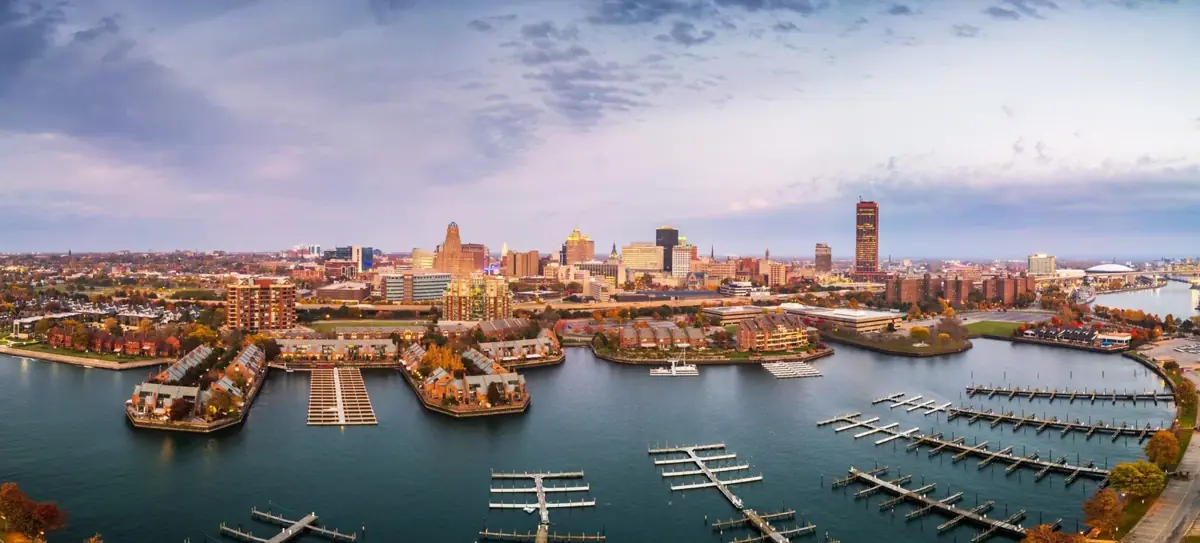
The Region
Eight Counties, Two Great Waters, One Western New York
This is the thirtieth page of this site, and the fourth of seven region pages. It is the hub that joins the Buffalo page and the Niagara Falls page, and the only page here that treats the whole eight county region as one water problem.
Western New York, as this page uses the name, is the eight county Buffalo Niagara region: Allegany, Cattaraugus, Chautauqua, Erie, Genesee, Niagara, Orleans and Wyoming. That definition comes from Invest Buffalo Niagara and the University at Buffalo Regional Institute, and it held 1,557,319 people at the 2020 Census. Buffalo sits in Erie County. Niagara Falls sits in Niagara County. Lake Erie feeds the Niagara River, the river feeds Lake Ontario, and almost every flood story in these eight counties starts with one of those three waters.
The work follows the water. A crew doing water damage restoration western new york has to think in watersheds, not zip codes: the Tonawanda Creek basin that floods Batavia and Amherst, the Cayuga and Ellicott creek corridors in Erie County, the Buffalo River and its First Ward flats, the Scajaquada and Cazenovia creeks inside the city, and a river shoreline from Grand Island to the falls where ice, wind and high lake water set the terms. Streets flood in one county and the calls come from the next one over, because the storm never read the map.
This page is built to be used in two ways. In an emergency, the Quick Answers, the first hour guide and the phone number at the top are the whole page, and everything else can wait. On a quiet day, the dated flood cases, the county by county notes and the insurance clocks are here so a homeowner in Hamburg or a landlord in Lockport can understand their own risk before the next band sets up over the lake. Either way, the standard is the same: extraction first, measured drying second, and a claim file that starts in the first hour.
That is the working geography of water damage restoration western new york: eight counties, three great waters, and one standard of proof.
The hub exists so that a reader in any of the eight counties lands on water damage restoration western new york once, and finds their own water named.
Key Takeaways
Seven Facts That Shape Western New York Water Work
Seven sourced facts explain most of the water damage in this region. Each one is stated with its source, because a fact you cannot trace is just a rumour with good posture.
Lake Erie is the shallowest Great Lake
At an average depth of 62 feet and a maximum of 210 feet, Lake Erie warms fastest of the five lakes, and that warm shallow water is the fuel of the lake effect machine (pack geography, from Lake Erie reference figures).
The region is eight counties, 1,557,319 people
The Buffalo Niagara definition used on this page covers Allegany, Cattaraugus, Chautauqua, Erie, Genesee, Niagara, Orleans and Wyoming counties, population 1,557,319 at the 2020 Census (Invest Buffalo Niagara; University at Buffalo Regional Institute).
Buffalo recorded 49.2 inches in the December 2022 blizzard
The National Weather Service blizzard total at Buffalo airport was 49.2 inches, with 37.5 consecutive hours of blizzard conditions, the longest in Buffalo history (NWS Buffalo). Niagara Falls recorded 18.9 inches in the same storm. The two figures are never swapped on this page.
Snowvember dropped 65 inches on South Cheektowaga
The first November 2014 lake effect event peaked at 65 inches in South Cheektowaga, with snow rates of 3 to 6 inches per hour and 13 fatalities in the Buffalo area event (NWS Buffalo lake effect summary).
The October Surprise killed the power, then flooded the basements
In October 2006, 24 inches of wet snow on fully leafed trees left 400,000 customers without power, and runoff plus dead sump pumps flooded thousands of basements (NWS and AMS accounts of Lake Storm Aphid).
Tonawanda Creek at Batavia crested at 14.5 feet in March 1942
That crest is the highest in Batavia history, and the creek flood of record at Hopkins Road followed on March 31, 1960, at 7,980 cubic feet per second (gauge records in the pack research).
The Niagara River drops about 326 feet between the lakes
Lake Erie water falls about 326 feet on its way to Lake Ontario, the same difference the Welland Canal climbs, and up to three quarters of the river can run beneath the falls to hydroelectric tunnels (pack geography, treaty and canal references).
Read those seven together and the regional pattern is plain. The water here arrives as snow that melts, as creek water that rises, as river water pushed by wind and ice, and as groundwater that finds a basement when the power dies. The restoration response has to match all four, which is why this hub page exists alongside the two city pages it joins.
Hold those seven facts together and water damage restoration western new york stops being a slogan and becomes a map of where the water comes from.
AEO Quick Answers
Quick Answers for a Western New York Water Emergency
Short answers, written to be read aloud by a phone on a wet kitchen floor. Each one stands alone.
Water is in my basement now. First move?
Keep clear of water near outlets or the panel, shut off the source if it is a pipe, and call (716) 555-0147 (placeholder). Extraction in the first hours decides how much of the room survives, so the first move is the call, not the mop.
How fast can mold start?
Mold can begin growing on wet drywall, wood and paper within 24 to 48 hours in warm indoor conditions. That is why drying starts the same day, with daily moisture readings, not when the schedule opens up next week.
Creek water in the house: is it dangerous?
Yes. Creek and river floodwater is treated as contaminated. Porous materials it soaked are usually removed, hard surfaces are cleaned and disinfected, and children and pets stay out of it entirely until the crew clears the space.
Does insurance cover a flooded basement?
A burst pipe is commonly covered by a homeowners policy. Rising creek or river water is flood damage and needs a separate flood policy. Sewage backup is usually an added endorsement. Your declarations page, not a website, settles your claim.
The power is out and my sump stopped. Now what?
Treat the rising water as dirty, stay out of it where power is involved, and call for extraction. In October 2006 exactly this failure flooded thousands of basements across the region. A battery backup pump is the fix, fitted before the next storm.
Which counties does this page cover?
Eight: Allegany, Cattaraugus, Chautauqua, Erie, Genesee, Niagara, Orleans and Wyoming, the Buffalo Niagara definition, with crews staged for the fifteen places listed in the gazetteer below, from Buffalo and Niagara Falls to Jamestown and Batavia.
If you only remember one line from this section, make it this one: in water damage restoration western new york, the first hour is worth more than the first week. Everything after it is repair of a decision made, or not made, in that hour.
Quick answers exist because water damage restoration western new york is usually searched from a wet floor, one handed, with the other hand holding a towel.
Key Facts
Western New York Water Damage Key Facts, With Sources
The numbers this page stands on, in one table. Where two sources disagree, the disagreement is printed, not averaged away.
| Fact | Figure | Source |
|---|---|---|
| Region definition used | 8 counties: Allegany, Cattaraugus, Chautauqua, Erie, Genesee, Niagara, Orleans, Wyoming | Invest Buffalo Niagara; UB Regional Institute |
| Region population | 1,557,319 | 2020 Census |
| Buffalo population | 278,349; second most populous city in New York State | 2020 Census |
| Niagara Falls population | 48,671 | 2020 Census |
| Lake Erie size | 241 miles long, 57 miles wide, 9,910 square miles; average depth 62 feet, maximum 210 feet | Lake Erie reference figures |
| Niagara River drop | About 326 feet between Lake Erie and Lake Ontario | River reference figures |
| December 2022 blizzard, Buffalo airport | 49.2 inches; 37.5 consecutive blizzard hours | NWS Buffalo |
| December 2022 blizzard, Niagara Falls | 18.9 inches; 1 fatality in Niagara County; 46 in Erie County | NWS; county reports |
| November 2022 lake effect | 81.2 inches in Hamburg | Storm reports, Buffalo pack |
| Snowvember November 2014 | 65 inches South Cheektowaga; 13 fatalities, Buffalo area event | NWS Buffalo |
| October Surprise 2006 | 24 inches in Amherst; 400,000 customers without power | NWS; AMS |
| Tonawanda Creek at Batavia | March 1942 crest 14.5 feet, highest in history | Gauge records |
| Cayuga Creek, Erie County | June 1937 flood of record, about 18,000 cubic feet per second below Bowen Road, Lancaster | Gauge estimates |
| Ellicott Creek | March 1960 flood of record, about 3,220 acres inundated, most in Amherst | Flood records |
| Area code | 716 across the region | Numbering plan |
Sources are named per row. County populations other than the 2020 Census figures are recent estimates and are labelled as such where they appear in the text. Damage figures for dated storms are historical facts, spelled out in words in the case sections, and attributed there.
A key facts table is only useful if it can be checked, and every figure above is printed so a reader of water damage restoration western new york can trace it home.
Every row in the table is a promise the rest of the page keeps, because water damage restoration western new york stands or falls on traced numbers.
Voice Answers
Ask Out Loud on the Niagara Frontier: Voice Answers for Wet Homes
People ask voice assistants questions while standing in water. These answers are written the way a good dispatcher talks: short, ordered, and safe.
Hey, my basement is flooding in Cheektowaga, what do I do? Stay out of the water if it is anywhere near outlets or your panel. If a pipe burst, shut the main valve. Then call (716) 555-0147 (placeholder) for extraction. Take photos while you wait, and lift what you can carry to a dry floor.
How long does drying a house take in Buffalo? Most structural drying runs three to five days, checked daily with moisture readings. Hardwood, plaster and water that sat for days take longer. The readings, not the calendar, say when a house is dry.
Is Tonawanda Creek flooding dangerous? Yes. Creek floodwater is treated as contaminated, it rises faster than people expect, and flooded roads can hide washed out pavement. Move early, never drive through it, and call for cleanup after the water drops.
Who does water damage restoration western new york in the middle of the night? Crews on this page answer around the clock, every day, across the eight counties. The number is (716) 555-0147 (placeholder). Ask for a real arrival window for your town, and ask who is actually coming.
Voice answers follow the same rule as the dispatch board for water damage restoration western new york: short, ordered, and safe to act on half heard.
Start Here
The First Hour After Water Reaches a Western New York Floor
The first hour sets the size of the loss. These moves are ordered the way a dispatcher gives them, and they hold for a pipe burst in Amherst and a creek flood in Batavia alike.
Minute one is safety. Water and electricity are the dangerous pair in every loss, so keep people and pets out of any water that touches outlets, cords, a panel or appliances, and never reach for a breaker while standing in water. If the water came from a creek, a river or a sewer, treat it as contaminated from the first step: boots on, hands washed, children out of the room entirely.
Minute five is the source. A burst pipe, a failed water heater, a washing machine hose: shut the main water valve and the loss stops growing. A sump failure during an outage is different, because the source is the ground itself; there, the move is to call for pumping and to protect what the water has not reached yet. Creek and river water cannot be shut off at all, which is why rising water means moving people and belongings early, while the stairs are still dry.
The rest of the hour is evidence and extraction. Photograph and film the water, the source and every damaged item before cleanup, because the first hour is the only time the loss looks like the loss. Then get a water damage restoration western new york crew moving: pumps and extractors remove in minutes what evaporation would take days to shift, and every gallon out early is a gallon that never reaches the wall cavities. Write down the time you called. Insurers ask, and the note takes ten seconds.
- People and pets out of water near anything electrical
- Source shut off at the main valve, if the source is plumbing
- Photos and video of water, source and damage, before cleanup
- Belongings lifted to dry ground, heaviest and most loved first
- Extraction crew called, arrival window asked for and noted
- Insurer notified, with the date and time of the loss written down
Print the first hour list on the inside of a kitchen cabinet, because water damage restoration western new york always begins before anyone feels ready.
Keep the list and the number together, because the first hour of water damage restoration western new york is no time to search for either.
Water in the house right now?
Skip the history and make the call. Extraction in the first hour is the cheapest decision in any loss.
Dated Cases
21 to 26 December 2022: The Blizzard That Buried Buffalo
Winter Storm Elliott was a snow event that became a water event, as Buffalo blizzards so often do: first the pipes froze, then the thaw arrived all at once.
The National Weather Service blizzard total at Buffalo airport was 49.2 inches. Snyder recorded 56.5 inches over five days, while Niagara Falls recorded 18.9 inches, and this page keeps those figures on their own sides of the region, because a Buffalo number hung on Niagara Falls helps nobody. Blizzard conditions ran 37.5 consecutive hours, the longest stretch in Buffalo history, with zero visibility from 9 a.m. on December 23 until 1 a.m. on December 25, and again on the morning of December 26. At least 100 people died across the United States and Ontario; 46 of the deaths were in Erie County and 1 in adjacent Niagara County.
The restoration work started before the snow stopped. Frozen and burst pipes were the first wave, in houses that lost heat and in buildings left empty over the holiday. The second wave came with the thaw: roof loads, ice dams forcing meltwater under shingles, and sump systems meeting a sudden river of snowmelt over frozen ground. Crews triaged by life safety first, then by active water, exactly the order this page teaches in its first hour section.
The lesson Elliott burned into this region is that a blizzard is a plumbing event with a delay fuse. Pipes freeze during the cold, split quietly, and announce themselves at the thaw, sometimes days later and sometimes in a house whose owners are still digging out. After any deep freeze, walk the house as the temperature climbs: listen for running water you cannot see, check the meter, and look at ceilings below bathrooms. The cheapest burst pipe is the one found in its first hour.
Elliott also reset the region's pipe habits: after December 2022, water damage restoration western new york winter calls start with the meter and the ceilings, not the mop.
Dated Cases
17 to 20 November 2022: The Lake Effect Band That Parked Over the Southtowns
One band, four days, and a Southtowns snowpack measured in feet. The November 2022 storm is the modern textbook case of lake effect concentration.
Hamburg recorded 81.2 inches in the November 17 to 20, 2022 lake effect storm, as a single band stalled over the Southtowns and refused to move. Roads closed, roofs groaned, and the snow that fell in four days spent the rest of the winter deciding when to become water. The full storm record lives on the Buffalo page of this site, and this region page keeps the one line that matters here: a band that parks over one set of towns can deliver a season of snow, and a season of meltwater risk, to the same streets.
For homeowners under a parked band, the water risks arrive in sequence. First, ice dams as heat escapes through roofs buried in snow. Second, foundation pressure and sump load at the first thaw. Third, the long spring, when a deep dense pack releases water over still frozen ground for weeks. Shovelling a path for meltwater, away from the foundation, is unglamorous work that outperforms most equipment. Gravity is the oldest pump in Western New York, and it never loses power.
A parked band is a forecast with an address, and water damage restoration western new york planning in the Southtowns now treats a named band like a named creek.
Dated Cases
Snowvember, November 2014: Seven Feet Over the Southtowns
The November 2014 lake effect event is still the region's benchmark for what snow does to houses: roofs first, then everything under them.
The National Weather Service Buffalo summary of the first event, November 17 to 19, 2014, records a maximum of 65 inches in South Cheektowaga, 63 inches in Lancaster, 60 inches in Gardenville, 57 inches in West Seneca, 51 inches in Elma and 48 inches in Hamburg, against 6.2 inches at Buffalo airport. Snow fell at 3 to 6 inches per hour. The NWS summary counts 13 fatalities with the storm. A second event on November 19 to 20 dropped another 1 to 4 feet over nearly the same ground, storm totals peaked at nearly 7 feet, and a 132 mile section of the Thruway closed along with I-190, I-290 and Route 400. The National Guard response took more manpower than any other snowstorm in New York State history, and snow remnants were still on the ground in Buffalo eight months later.
Other counts exist and this page does not hide them: the state climate assessment cites 11 deaths per the CDC and damages of over forty six million dollars, spelled out here in words, and a whole continent storm count runs higher still because it covers other states. The figure used on this page is the NWS Buffalo figure of 13, attributed, for the Buffalo area event. Scope is not a detail in storm numbers. Scope is the number.
For water damage, Snowvember's signature was structural: hundreds of major roof collapses and structural failures under dense snow, and each collapse became an open roof over a heated house, which is to say a water loss waiting for the thaw. The restoration lesson is blunt. Snow load is a water risk before a single flake melts, and a roof that survives the storm can still leak for weeks as dams form and refreeze. After any multi foot lake effect event, the attic and the top floor ceilings deserve the same inspection as the basement.
Snowvember is why water damage restoration western new york counts roof load as a water risk months before the first meltwater reaches a foundation.
Roof first, basement second, claim third: Snowvember taught water damage restoration western new york to inspect a storm from the top down.
Dated Cases
The October Surprise of 2006: Snow on Full Leaves
Lake Storm Aphid, October 12 to 13, 2006, is the storm this region tells strangers about, because it broke the rule that October snow is a curiosity.
The maximum snowfall was 24 inches in Amherst, and Buffalo airport recorded 22.6 inches, the sixth greatest snowfall at any time of year in Buffalo history, against a previous October record of 6 inches set in 1909. In the century before it, only four Octobers had brought even 2 inches. The snow fell on fully leafed trees, and the leaves held it. Thirteen people died. About 90 percent of the trees in the city of Buffalo were damaged, worst of all in the historic Olmsted parkways and parks, and the Governor declared a disaster emergency in Erie, Genesee, Niagara and Orleans counties, followed by a federal major disaster declaration for the same four.
The water story is in the power numbers: 400,000 customers without power, some for as much as two weeks, and almost a million residents of the Niagara Frontier lost power at some point. Nearly 3 inches of water swelled area streams. The streams stayed within their banks, but runoff plus no electricity for sump pumps flooded thousands of basements. Damage estimates from a late December 2006 AMS conference paper run from one hundred fifty million to two hundred million dollars, spelled out in words and attributed here, and this page uses that range rather than a higher figure that circulates elsewhere.
Every sump pump lesson on this page descends from those two weeks. A pump without backup power is a fair weather promise, and October 2006 was not fair weather. Battery backup, a high water alarm, and a neighbour who knows where your main valve is: Aphid made that trio standard advice across the eight counties, and it still is.
Ask any veteran of water damage restoration western new york about backup sump power and October 2006 will enter the conversation within a minute.
Aphid's second lesson lives in the generator: water damage restoration western new york trucks carry their own power because the grid has failed this test before.
Dated Cases
21 January 1959: The Michigan Avenue Bridge Ice Jam
The Tewksbury Disaster began with a winter so cold it made the thaw dangerous. It remains the region's defining ice jam flood.
The winter of 1958 to 1959 was very cold, with heavy snow and bitter temperatures. On January 21, 1959, an unseasonable thaw, a 50 degree day combined with a wind storm, broke up the sheet of ice along Cazenovia Creek around 6 p.m. and pushed the ice into the Buffalo River. The jam ran up against the hull of the ship MacGilvray Shiras at the Michigan Avenue Bridge, and the backed up water caused intense flooding in the First Ward. The event is remembered by the bridge name; the bridge was where the jam caught, not a claim that the bridge failed.
The same night, the quick thaw and rain produced one of the worst flooding events in metropolitan Buffalo history. Tonawanda and Amherst flooded along Ellicott Creek. Delaware Park lake, now Hoyt Lake, rose several feet and closed Delaware Avenue. New York Central Railroad tracks between Forest and West Delevan were washed out by flooding on Scajaquada Creek, and Smokes Creek flooded an area of 2 square miles, causing a state of emergency in Lackawanna. One weather break, five waterways, four communities: that is the ice jam pattern, and it has never left this region.
Ice jam floods still set the terms along the Niagara River and the Buffalo River system. They rise fast, they carry debris and slab ice, and they flood streets that sit outside the mapped floodplain because the dam is made of ice, not geography. The defence is information and timing: river watches during a thaw, belongings lifted early, and no faith placed in a dry January creek staying dry through a 50 degree wind.
The 1959 jam is the founding lesson of water damage restoration western new york on the rivers: ice, wind and a thaw can outflood a rainstorm.
Dated Cases
Tonawanda Creek: Batavia 1942 and the Flood of Record in 1960
Tonawanda Creek is the longest flood memory in the region, a Genesee County story and an Erie County story in the same channel.
At Batavia, the March 1942 crest of 14.5 feet is the highest in the city's history and its worst flood. A large snowstorm on March 15 added to snow already on the ground; temperatures rose quickly on March 16, the snow changed to rain, and meltwater poured in from Alexander and the hills near Attica. Damage ran to about five hundred thousand dollars, in the words this page uses for historical figures, and the Red Cross helped 225 families find safe and dry lodgings. Flood control works authorized in the Flood Control Act of 1948 and completed in late 1955 widened the creek to upwards of 100 feet, with a retaining wall, a cleared channel, bank protection and drainage improvements.
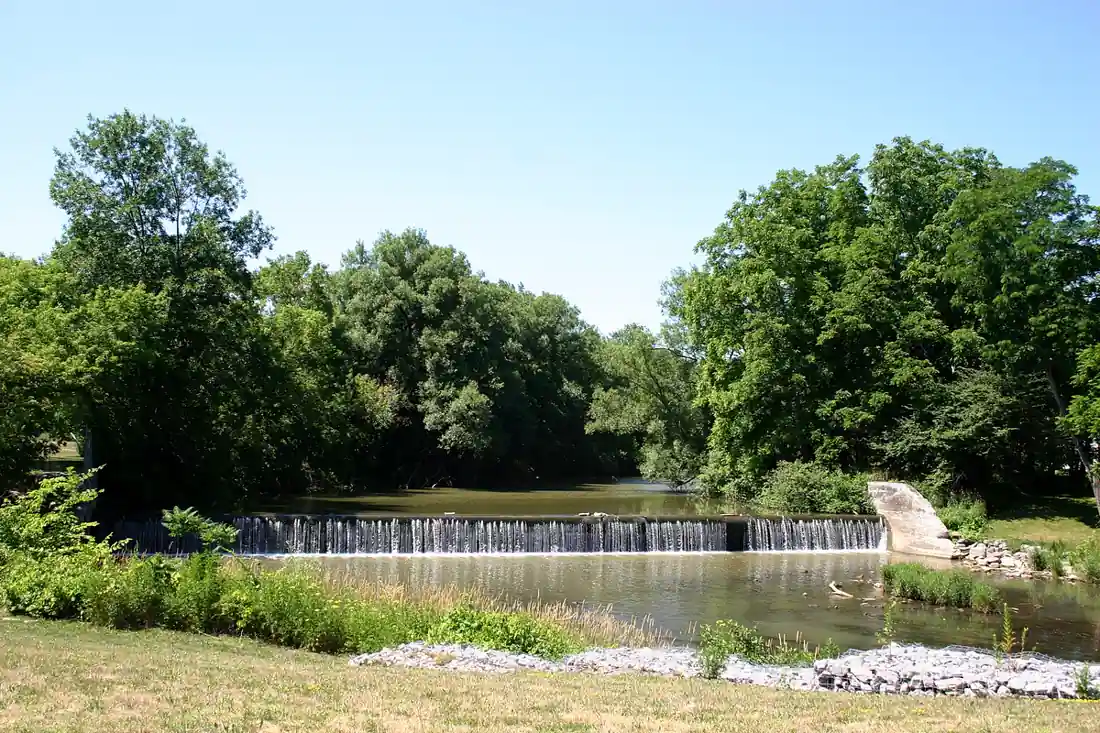
The flood of record on this creek at the Hopkins Road gauge, just outside the east town line, came on March 31, 1960, with a peak discharge of 7,980 cubic feet per second, estimated as a 10 year recurrence interval event. The longer record is a rhythm of March: large floods in March 1902, March 1916, March 1956 and January 1957; a December 2013 crest of 11.94 feet, eighth highest in history, against a major flood level of 12 feet last exceeded in 1998 at 12.44 feet; and more than 10 feet on 24 occasions in more than 60 years of National Weather Service measurement.
A creek with that record teaches a specific habit: respect March. Snowmelt, rain on snow and ice in the channel stack up in the same weeks almost every decade, and a water damage restoration western new york crew working the Batavia reach plans its spring around this creek the way a lake shore crew plans around a storm watch. Homes along the creek should hold the same habit: sump tested in February, belongings stored off the floor, and the gauge bookmarked before the thaw, not during it.
On Tonawanda Creek, water damage restoration western new york is a March discipline, rehearsed in February while the creek still looks innocent.
Batavia's 1942 families were rehoused by the Red Cross; Batavia's modern answer is the same creek met by water damage restoration western new york with gauges bookmarked.
Dated Cases
Cayuga Creek in Erie County: The June 1937 Flood of Record
Two creeks in this region share the name Cayuga. This is the Erie County one, in Lancaster and Depew, and confusing it with the Niagara County creek is an error this page refuses to make.
The Erie County Cayuga Creek flood of record came in June 1937, with a peak discharge estimated at 18,000 cubic feet per second downstream of Bowen Road in the Town of Lancaster, upstream of the Village of Depew. Major flooding on the same creek followed in March 1942, March 1955, March 1956, January 1959, March 1972, June 1972 and August 1975. The pattern in the record is runoff speed: ground still frozen in the spring events, rapid runoff in the summer ones, and ice jams aggravating flooding by obstructing flow through bridge openings whenever the season allows ice to form.
Lancaster and Depew sit in the creek's working path, which is why both towns appear in this page's service list and gazetteer with this flood named. A homeowner along Cayuga Creek in Erie County should read the 1937 figure the right way: it is not ancient history, it is the measured capacity of the creek that runs past the subdivision. Flood insurance, a tested sump and belongings stored off the basement floor are the three answers a creek like this one earns.
The naming trap deserves one plain sentence. The Niagara County Cayuga Creek, near the falls, is a different waterway, and the June 1937 flood belongs to Erie County. Pages that import this flood into a Niagara Falls story are inventing a disaster for a city that has its own real ones, several of them told on this page.
Cayuga Creek teaches water damage restoration western new york its naming discipline: two creeks, one name, and no excuses for mixing their records.
Dated Cases
Ellicott Creek: March 1960 and the Amherst Acres Under Water
Ellicott Creek drains the northern suburbs, and its flood of record is a suburban story: thousands of acres, most of them in the Town of Amherst.
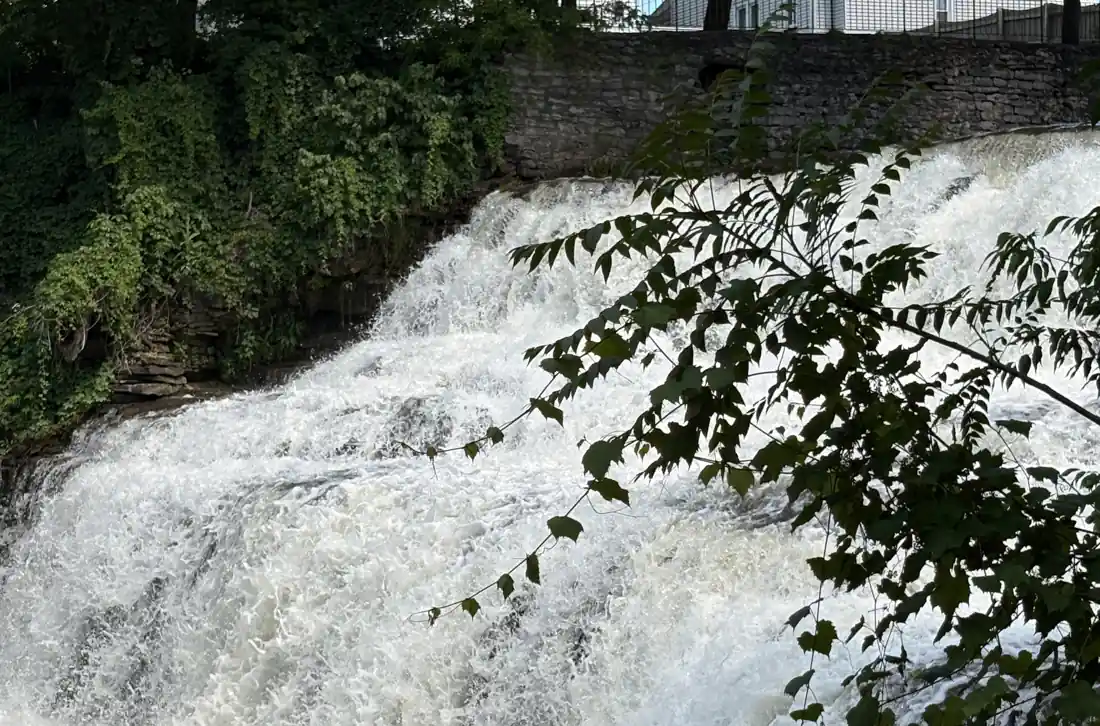
The Ellicott Creek flood of record came in March 1960 and inundated approximately 3,220 acres, most of them in the Town of Amherst. The damaging floods around it in the record run March 1916, January 1929, March 1936, June 1937, March 1940, March 1954, March 1956, January 1959 and March 1963, a list that reads like a calendar of late winter. Amherst was farmland and new subdivisions then; today the same creek corridor runs past dense suburbs, a university campus and some of the most valuable housing in Erie County, all of it built in full knowledge of, or in cheerful ignorance of, the 1960 acres.
The January 1959 thaw that jammed the Buffalo River also flooded Amherst along Ellicott Creek the same night, which is the regional point: Ellicott Creek rarely floods alone. It answers the same thaw, the same rain on snow and the same ice that move every waterway in this region at once. A water damage restoration western new york dispatch board on a March thaw night shows Ellicott Creek calls beside Tonawanda Creek calls beside Niagara River calls, because the weather system, not the creek, is the event.
For Amherst homeowners, the practical inheritance of March 1960 is a short list. Know whether your street sits in the creek corridor. Keep the basement's lowest storage above the historical water line, not above the floor. Test the sump before the thaw and back it with battery power. And when Ellicott Creek is named in a flood watch, believe it early. The creek has been making the same point since 1916.
Ellicott Creek's 1960 acres sit under modern Amherst, which is why water damage restoration western new york reads old flood maps as current documents.
Dated Cases
The Niagara River: March 1955, the February 2019 Watch and FEMA 1985
River flooding here is a wind and ice problem. The Niagara River does not need rain to rise; it needs a hard west wind and a river full of Lake Erie ice.
In March 1955, high water plus an ice jam caused extensive damage. Grand Island flooded near Ferry Village and on Baseline Road between East River Road and Hutch Road, and flooding in the City of Tonawanda near the mouth of Tonawanda Creek forced the closing of an industrial plant. The cause, then as now, was wind setup from high westerly or southwesterly winds across Lake Erie combined with large ice jams, and the flat slopes of the upper river mean high water spreads through Tonawanda and across Grand Island rather than running off.
On February 24, 2019, the National Weather Service issued a Flash Flood Watch at 4:44 p.m. Eastern time, and this page calls it what it was: a watch, not a flood that happened. Winds of 40 to as high as 70 miles per hour shoved Lake Erie ice over the ice boom and down the Niagara River, threatening ice jam flooding from Grand Island to the shallows approaching Niagara Falls, with the susceptible ground named plainly: the Grand Island shoreline, Cayuga Island in Niagara Falls, and the river shoreline between North Tonawanda and Niagara Falls. A watch honoured early is belongings lifted and cars moved. A watch ignored is a claim.
The federal record carries the same lesson. FEMA declaration 0734-DR-NY covers snow melt and ice jams in the Buffalo and Niagara Falls area, declared March 22, 1985, with an incident period of March 22, 1985, and long since closed. Between 1955, 1985 and the 2019 watch, the river's message has not changed in seventy years: when the wind stands up over Lake Erie in ice season, the shoreline from Tonawanda to the falls should act first and check the gauge second.
On the Niagara River, water damage restoration western new york watches the wind forecast as closely as the rain forecast, and February 2019 is the reason.
The Definition
Which Western New York? Eight Counties, Not Seventeen
Two definitions of Western New York exist, and pages that blur them send Rochester readers to Buffalo crews and Buffalo readers to the wrong facts. This page names its choice and keeps it.
The eight county definition used here is the Buffalo Niagara region: Allegany, Cattaraugus, Chautauqua, Erie, Genesee, Niagara, Orleans and Wyoming, population 1,557,319 at the 2020 Census, within 500 miles of 40 percent of the United States population. A broader 17 county definition also exists, adding Chemung, Livingston, Monroe, Ontario, Schuyler, Seneca, Steuben, Wayne and Yates. This page does not use it. Monroe County is Rochester, and Rochester and the Finger Lakes get their own page on this site; Chemung, Steuben, Schuyler and Yates are not Western New York for the purposes of a crew dispatch or a flood history.
The older geography still shows under the modern one. The region is the historic Holland Purchase and Phelps and Gorham Purchase country, its eastern boundary the Preemption Line from the December 16, 1786 settlement between New York and Massachusetts. Inside it sit the Seneca Nation territories at Cattaraugus, Allegany and Oil Spring, and the Tuscarora Nation in the Town of Lewiston and the City of Niagara Falls area. The subregions have their own names: Greater Niagara for Niagara and Erie with parts of Genesee and Wyoming, the Chautauqua Allegheny country of the southwest, sometimes called the Western Southern Tier, and a Western Finger Lakes edge that other maps count as Central New York.
Why does a restoration page spend words on a definition? Because water damage restoration western new york is a promise about who answers, how fast, and under which county's ground truth. A page that quietly means 17 counties promises Jamestown response times it cannot stage and quotes Rochester facts it has not checked. Eight counties, named, is a promise that can be kept, and the gazetteer below holds this page to it, town by town.
Definitions are dispatch decisions: water damage restoration western new york means eight counties here, and the promise is kept to those eight.
The Waters
Lake Erie: The Shallow Lake That Runs the Weather
Every water story in this region starts with the lake. Lake Erie is 241 miles long and 57 miles wide, covers 9,910 square miles, and is the fourth largest, southernmost, shallowest and warmest of the five Great Lakes.
The numbers explain the behaviour. An average depth of 62 feet and a maximum of 210 feet make Erie the smallest Great Lake by volume, and shallow water changes temperature fast: first to warm in summer, which loads the air with moisture, and quick to cool and ice over in winter. Its mean elevation is 571 feet above sea level, and it drains through one door, the Niagara River. When cold air crosses that warm shallow water in November and December, the lake effect machine starts, and the Southtowns and the Tug Hill fringe learn again why this lake, of the five, writes the region's weather.
The lake is also a flood actor in its own right. High westerly winds set the water up against the eastern shore, raising levels at Buffalo and pushing water and ice into the Niagara River, the mechanism behind the March 1955 damage and the February 2019 watch told earlier on this page. Seiche, the sloshing of the lake after wind, can move levels feet in hours. A region page that treated Lake Erie as scenery would miss the point: the lake is the reservoir, the weather factory and, on the wrong wind, the flood.
For the homeowner, the lake's lesson is seasonal honesty. Autumn means the lake is warm and the air is turning: lake effect season. Winter means ice cover decides how much snow the machine can make. Spring means the pack the lake built becomes meltwater over frozen ground. A sump tested in October, a roof checked before the bands set up, and a basement stored for thaw: that is the Lake Erie calendar, and it has not changed in living memory.
Lake Erie is the employer of water damage restoration western new york: it makes the snow, raises the river and sets the calendar for both.
The Waters
The Niagara River: 326 Feet of Falling Water
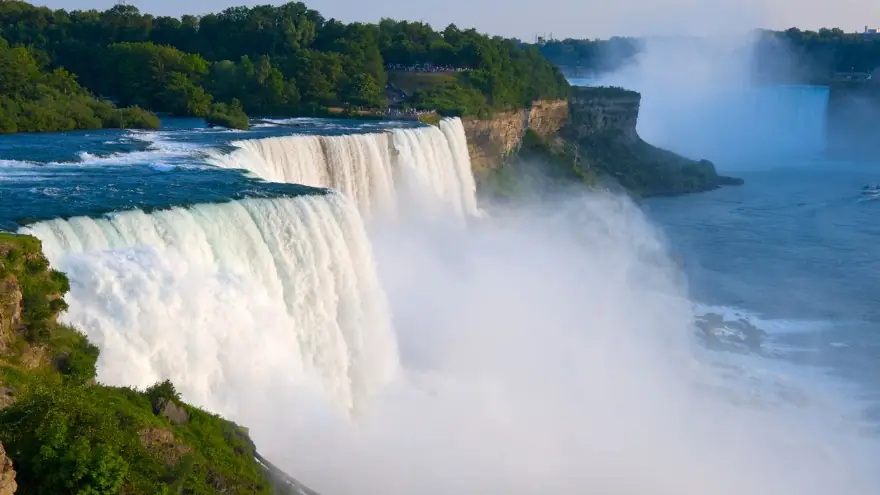
The Niagara River carries Lake Erie to Lake Ontario, dropping about 326 feet between the two lakes, and forms both the western edge of Niagara Falls city and the border between the United States and Canada.
The falls are the famous part of the drop: the American Falls and Bridal Veil Falls on the United States side, Horseshoe Falls mostly on the Canadian side, Goat Island standing between them, and the Niagara Gorge and Whirlpool Rapids below. The working part of the river is less visible. Under the 1950 treaty between the United States and Canada, 50 percent of the water is diverted to hydroelectric turbines during peak tourist hours, and at night the flow over the falls is cut in half again; up to three quarters of the river can run beneath the falls through tunnels to the Robert Moses Niagara Power Plant and the Lewiston Pump Generating Plant. The Welland Canal climbs the same 326 feet on the Canadian side, from Port Colborne to St. Catharines, so ships can do what the river does in a single gorge.
For water damage, the river's moods are wind and ice. The upper river, from Buffalo past Tonawanda and Grand Island to the falls, is wide, flat and shallow at its edges, which is why wind setup and ice jams spread water across Grand Island shorelines, Cayuga Island and the Tonawanda waterfront instead of carving a channel. Below the falls, the gorge takes the water away fast, and the city of Niagara Falls drains toward a river that is, most days, the best storm drain in the region. The bad days are the ice days, and this page's dated cases mark them: 1955, 1985, and the watch of February 2019.
The river also draws the service line. Crews on this page work the New York shore: Buffalo, Tonawanda, North Tonawanda, Grand Island, Niagara Falls and the Lewiston edge. The Ontario shore is a different country's insurance, licensing and dispatch, whatever the weather is doing. The water is one river. The paperwork is two nations, and a claim file has to know which bank it stands on.
The river's 326 feet of fall powers cities and, on ice days, floods them, which is the whole Niagara chapter of water damage restoration western new york.
The Cities
Buffalo: Brick, Basements and the Lake at the Door
Buffalo, population 278,349 at the 2020 Census, the second most populous city in New York State and the seat of Erie County, is the region's largest water damage market and its oldest flood classroom.
The city grew 6.5 percent in population in 2020, reversing decades of decline, and its metro area holds 1,125,637 people. Its housing is the region's drying challenge in one inventory: brick doubles and wood frame homes from the streetcar era, deep basements under almost everything, combined sewers in the old districts, and four working waterways inside the city limits, the Buffalo River, Cazenovia Creek, Scajaquada Creek and Smokes Creek, each with its own flood record on this page. The Erie Canal's western terminus made Buffalo a grain and freight port, and the flat warehouse ground along the river is the same ground the January 1959 ice jam flooded in the First Ward.
Buffalo's water losses follow its seasons with unusual honesty. Winter is burst pipes and ice dams. Spring is snowmelt against frozen ground and creeks at their March worst. Summer is the cloudburst that finds the combined sewer. Autumn is the lake warming up for the next round. A water damage restoration western new york crew based in Buffalo plans the year in those four movements, and stages pumps, generators and drying kit against the calendar, not against the phone call.
The full Buffalo treatment, neighbourhood by neighbourhood and storm by storm, lives on the Buffalo page of this site, and this hub page will not repeat it. What belongs here is the regional fact: Buffalo is the staging ground. Crews, equipment and the airport at Cheektowaga radiate from this city, and when Buffalo's own creeks rise, the whole region's response slows with them. That is why the call order in a region wide event is triage, and why this page teaches the first hour so hard.
Buffalo is where water damage restoration western new york keeps its deepest bench: the crews, the kit and the staging that serve the other seven counties.
When Buffalo's creeks rise, the region feels it within hours, which is why water damage restoration western new york triage starts with the city's own board.
The Cities
Niagara Falls: Two Falls, One River Town
Niagara Falls, population 48,671 at the 2020 Census, the largest city in Niagara County, whose seat is Lockport, is a city of about 14 square miles, ZIP codes 14301 to 14305, with a July 1, 2025 population estimate of 47,255.
The city's water geography is the river at its western edge and a set of smaller waters with real records: Gill Creek, Bergholtz Creek and the Little Niagara River, with Cayuga Island in the river off the LaSalle shore. The flood risks are the regional ones with a local accent: ice jam water on the river shoreline and Cayuga Island, creek flooding after hard rain, and the ordinary northern city diet of burst pipes, failed sumps and aging plumbing in a housing stock built for a bigger city. The falls themselves are not a flood source; the river above and below them behaves, and the danger days are wind and ice days, exactly as the March 1955 case on this page records.
One basement note belongs to LaSalle and nowhere else on this page. Love Canal, the 36 block area around 99th Street and Read Avenue in the city's far southeast, is where Hooker Chemical buried about 21,000 tons of toxic waste between 1943 and 1952 and sold the site to the school board in 1953 for one dollar. Evacuation came in 1978, cleanup ran 21 years, and the site was deleted from the Superfund list on September 30, 2004. That is contamination history, not a flood case, and this page never treats it as one. The working rule is narrow: in LaSalle, basement water carrying black sludge or a chemical smell is not an ordinary leak. It needs testing and reporting, not mopping.
Niagara Falls has its own full page on this site, with its own storms, its own creeks and its own figures, kept separate from Buffalo's on purpose. The December 2022 blizzard makes the point in one line: 18.9 inches and 1 Niagara County fatality belong to this city and county, while 49.2 inches and 46 Erie County fatalities belong to Buffalo. A region page earns its keep by never blurring that line.
Niagara Falls keeps its own figures, its own creeks and its own page, because water damage restoration western new york is local or it is nothing.
The Towns
The Tonawandas and Lockport: Canal Towns on Low Ground
Tonawanda, North Tonawanda and Lockport stand where Tonawanda Creek meets the Niagara River and the Erie Canal, and their flood records are the region's oldest continuous argument with water.
The City of Tonawanda flooded near the mouth of Tonawanda Creek in March 1955, when ice jam water closed an industrial plant, and the flat ground at the creek mouth still sets the terms: when the river is up and the creek is up, this corner has nowhere to drain. North Tonawanda, across the creek, shares the shoreline the February 2019 watch named, the stretch between North Tonawanda and Niagara Falls where ice jam flooding threatens first. Both cities carry the canal era building stock, brick commercial rows and frame houses with deep basements, that dries slowly and punishes delay.
Lockport, the Niagara County seat, stands on the canal and the escarpment, and its water story is elevation in two directions: canal and creek water in the low ground, and escarpment runoff and spring flow in the high. A water damage restoration western new york crew working Niagara County stages for both, because a Lockport call can be a flooded basement on the flats or a burst pipe in a stone house on the ridge, and the kit for the two jobs shares a truck but not a plan.
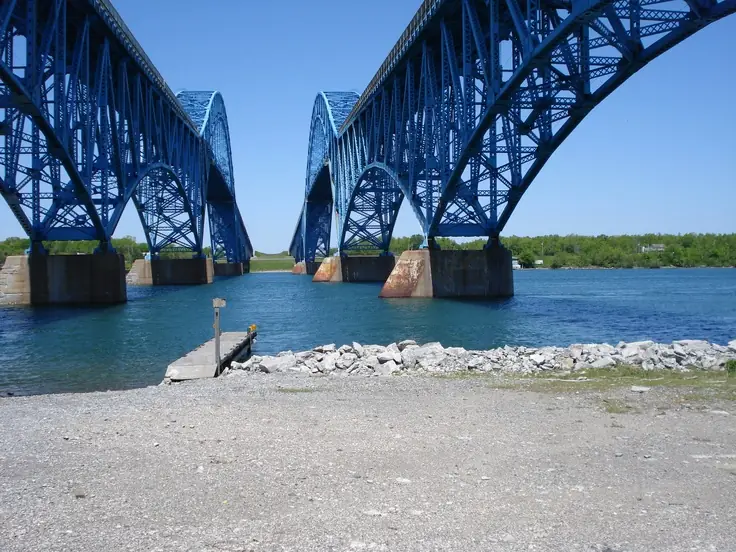
The three towns also teach the region's plainest lesson about shared water. Tonawanda Creek does not know which Tonawanda it is flooding, the river does not check a city line at Grand Island's bridges, and a storm that closes a plant in one town is drying basements in the other two by morning. County staging, mutual honesty about arrival times, and one dispatch board for the creek corridor: that is how this corner gets served, and it is how this page is organized.
Three canal towns, one creek mouth, one river: the Tonawandas and Lockport are water damage restoration western new york in its oldest working landscape.
Not sure which water you have?
Creek, pipe or sewage changes everything: the job, the cleaning and the claim. One call classifies it.
The Towns
Amherst, Cheektowaga and West Seneca: The Suburban Sump Belt
The inner suburbs hold the region's densest basement inventory, and their water losses are the sump pump economy in its purest form: thousands of pits, thousands of pumps, one power grid.
Amherst carries Ellicott Creek through its middle and the March 1960 flood of record in its history, and its subdivisions filled in around a creek that had already shown its acres. Cheektowaga holds Buffalo Niagara International Airport, some of the region's heaviest suburban density, and the Snowvember maximum: 65 inches in its southern half in November 2014. West Seneca, 57 inches in the same storm, drains toward Cazenovia and Buffalo river ground. In all three towns the housing is postwar and later: ranches, splits and raised ranches on slabs and shallow basements, with finished lower levels that turn a sump failure into a flooring, drywall and contents loss in a single night.
The failure pattern is so regular it has a season. Pumps die in March, when snowmelt runs for weeks and a tired pump cycles itself to death; they die in October style storms, when the power dies first; and they die quietly in August, discovered when the carpet squelches. A water damage restoration western new york dispatcher can map the week's calls by which of the three is running. The prevention is equally regular, and this page repeats it without apology: a primary pump in good order, a battery backup, a high water alarm, and a homeowner who tests the pit before the thaw instead of after the flood.
Finished basements deserve one hard paragraph. A finished lower level in Amherst or Cheektowaga concentrates value exactly where the water goes: flooring, wallboard, a bathroom, a furnace, stored everything. Drying one properly means opening the bottom of wet walls, because the cavity behind a finished basement wall is where mold writes its first chapter. Homeowners who resist the flood cut in week one meet the remediation crew in month two. The cut is cheaper. It is not close.
The sump belt is where water damage restoration western new york does its quietest, most repeatable work: one pit, one pump, one alarm, thousands of times.
A finished basement in the sump belt is a promise the ground tests every March, and water damage restoration western new york keeps the test results.
The Towns
Hamburg, Orchard Park and Lancaster: Southtowns Snow Country
South and east of Buffalo, the land rises toward the snowbelt, and the region's deepest snow, and its longest melt, belong to these towns.
Hamburg holds the November 2022 record on this page, 81.2 inches in four days, and 48 inches in the first Snowvember event. Orchard Park, southeast of the city, is Snowvember country and lake band country, with housing that runs from village streets to large lot subdivisions, each with its own sump and septic edge cases. Lancaster carries both Cayuga Creek, with its June 1937 flood of record below Bowen Road, and a Snowvember total of 63 inches, a combination that makes it the region's quiet overachiever in water risk: creek in the summer record books, snow in the winter ones.
The Southtowns pattern is load and release. Load: multi foot snowpacks, roof loads that collapsed hundreds of structures in 2014, ice dams on every shaded roofline. Release: thaws that run for weeks, creeks that answer in March, and ground that stays frozen long after the air warms, so meltwater travels on the surface until it finds a foundation. Drying work here skews seasonal in a way a Buffalo city crew never sees: whole streets calling in the same thaw week, each with the same wet basement line at the same height.
If you own a house in the Southtowns, your water calendar is written by the lake. October: roof, gutters and sump before the bands. November through February: snow load watched, dams treated early, pipes kept warm. March: the thaw drill, belongings up, pump tested, creek gauges bookmarked. A water damage restoration western new york crew would rather meet you in October with a checklist than in March with a pump, and this page is written to arrange the October meeting.
In the Southtowns, water damage restoration western new york is scheduled by the lake band first and the calendar second, in that order, every winter.
The Towns
Depew, Grand Island, Jamestown and Batavia: The Edge Towns
The four corners of the service map could hardly differ more: a creek village, a river island, a Chautauqua Lake city and a Genesee County creek town. One dispatch standard covers all four.
Depew sits in the path of the Erie County Cayuga Creek, downstream of the Bowen Road reach where the June 1937 flood of record was measured, and its village streets carry that creek's whole history in their basements. Grand Island is the Niagara River made into a town: an island between the two channels, bridged north and south, with shoreline on every side and the March 1955 Ferry Village and Baseline Road flooding in its record, plus a named place in the February 2019 watch. Island staging is its own discipline, because every truck crosses a bridge and every storm that closes a bridge closes the schedule with it.
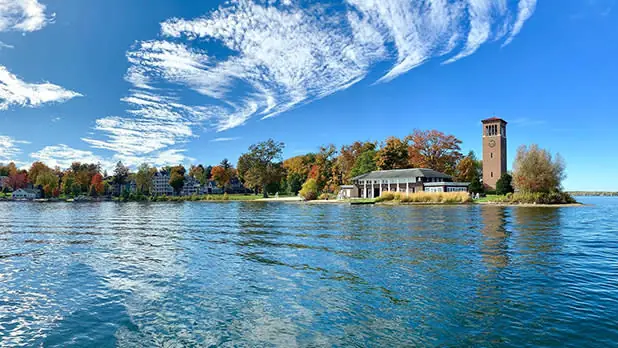
Jamestown, at the foot of Chautauqua Lake in the southwest corner, is the region's far run: a furniture and manufacturing city on its own lake and river outlet, with older brick industry, frame housing and a water calendar set by Chautauqua Lake levels and hard southern tier rain. Batavia, in Genesee County, answers to Tonawanda Creek, with the March 1942 crest of 14.5 feet, the worst flood in its history, and the 1960 flood of record at Hopkins Road. A water damage restoration western new york page that listed these towns without their waters would be a directory, not a guide; each name above carries its creek, lake or river with it, on purpose.
Distance is the honest problem at the edges, and this page names it rather than papering over it. Jamestown and Batavia runs are longer, island runs depend on bridges, and in a region wide event the edges wait longer than the core. What a crew owes the edge towns is not a promise it cannot keep; it is a true arrival window, a dispatcher who answers, and first hour instructions good enough to hold the loss until the truck crosses the county line.
The edge towns test a region page's honesty, and water damage restoration western new york passes only if Batavia and Jamestown get true windows, not slogans.
The Causes
The Six Ways Water Gets Into a Western New York House
Every call in the eight counties resolves into one of six sources. Naming the source correctly in the first phone call decides the crew, the kit and the claim.
1. Lake effect snowmelt
Deep dense packs release water over frozen ground for weeks each spring. Foundations, window wells and sump pits take the flow. Snowvember's pack was still on Buffalo ground eight months after the storm.
2. Creek and river flood
Tonawanda, Cayuga, Ellicott, Scajaquada and Cazenovia creeks, the Buffalo River and the Niagara River. Contaminated water, fast rises, and a record book of March floods going back to 1902.
3. Ice jam flood
Broken ice dams a channel and water rises behind it, sometimes outside the mapped floodplain. January 1959 in the First Ward is the type case; the Niagara River repeats the pattern.
4. Burst and frozen pipes
The blizzard special. Pipes freeze in the cold, split silently, and announce themselves at the thaw. December 2022 filled the region's drying schedule for weeks on this source alone.
5. Sump failure and power loss
The pump stops, the ground does not. October 2006 flooded thousands of basements this way while the streams stayed in their banks. Backup power is the whole cure.
6. Sewage and appliance failure
Backups, water heaters, washing machine hoses and dishwasher lines. Smaller areas, dirtier water, and a cleaning standard that treats every porous item it touched as a decision, not a default.
Two of the six, snowmelt and ice jam, barely exist outside the lake effect north. Two more, creek flood and sump failure, are the region's weekly bread. A crew that cannot tell you which of the six it is looking at, and what that changes, is not ready to dry your house. The source is the diagnosis. Everything else is treatment.
Six sources, six different jobs: naming yours correctly is the first skilled act in any water damage restoration western new york call.
If a caller can name their source from the six, the water damage restoration western new york dispatcher can name the crew, the kit and the claim in one breath.
The Housing
Drying Western New York Housing: Brick Doubles, Farmhouses and Slab Ranches
A region's water damage is written by its housing stock. Western New York dries in four dialects, and a crew fluent in one can still fail in another.
The Buffalo dialect is the brick double and the wood frame streetcar house: plaster and lath, hardwood over sleepers, a deep stone or block basement, and a century of plumbing repairs stacked inside the walls. Plaster dries slowly and forgives little; a wall that reads dry at the surface can hold moisture at the lath for days, which is why readings in this stock are taken in grids and logged, not waved at. The Niagara Falls and Lockport dialect adds stone: escarpment stone foundations that weep groundwater in spring and dry on a geological schedule, arguing with every deadline an insurer sets.
The suburban dialect, Amherst to Lancaster, is the postwar ranch and split level: drywall, fiberglass, finished basements, and carpet over padding over slab or crawl. This stock dries fast when it is opened fast and molds fast when it is not, because its materials are food and shelter for growth in one package. The rural dialect, the farmhouses and small town stock of Allegany, Cattaraugus, Wyoming and Genesee counties, adds wells, septics, oil tanks and long driveways: extraction is the same science, but power, access and water supply all arrive with asterisks, and a crew plans for them before the truck rolls, not at the gate.
Across all four, the discipline is identical and it is the spine of water damage restoration western new york on this site: map the moisture, open what the map condemns, dry to a measured standard, and write down every reading. Housing changes the tactics. It never changes the standard.
Four housing dialects, one drying standard: that sentence could stand as the whole housing policy of water damage restoration western new york.
Mold
Mold on the Lake Effect Clock: Two Days to Growth, One State Law
Mold is the second loss inside every water loss, and in this region it runs on the same clock as everywhere else: 24 to 48 hours on wet material, in warm indoor air.
The regional accelerant is the basement. Western New York basements are deep, cool and, after any of the six sources on this page, damp for weeks if the drying is casual. Stored cardboard, leather, wood furniture and the paper face of drywall are a stocked pantry at exactly the temperature growth likes. That is why the drying standard here is measured, not felt: a basement that feels dry to a hand on the wall can still read wet at the bottom plate, and the bottom plate is where the growth starts and where the meter has to go.
New York law gives the mold half of the job a structure other states lack. Since January 1, 2016, Labor Law Article 32 has required licensing for mold assessment and remediation statewide. For work over 10 square feet, the assessor who writes the plan and the remediator who does the work must be separate, licensed roles, and the assessor returns to check the work. A company that offers to assess its own remediation is offering to mark its own homework, and the law exists because that arrangement failed homeowners for years. Ask for both licence numbers. It takes one minute and it is the law.
The honest sequence after any flood on this page is therefore: dry first, assess what grew, remediate under a written plan, and verify. Skipping to bleach and paint is how a Buffalo basement becomes a three visit story. The mold questions in the FAQ section below answer the ones residents actually ask, including the two this region asks most: whether it comes back, and how anyone finds it inside a wall.
Mold work in water damage restoration western new york is drying work with a licence attached, and the licence split is the homeowner's protection.
Two days is the clock, Article 32 is the law, and measured drying is the method: the mold chapter of water damage restoration western new york in one line.
Commercial
Offices, Warehouses and Landlords: Water at Work on the Niagara Frontier
Commercial water loss in this region runs from Tonawanda warehouse ground to Buffalo office towers to the rental stock of two cities, and its rules differ from the house rules in one way that matters: more people can be hurt by a slow decision.
Warehouses and light industry along the river and canal corridors carry the floodplain risk in commercial form: slab floors, stored inventory at floor level, and loading ground that drains toward the building in a thaw. The October 1955 style lesson, restated from the March 1955 case on this page, is that an industrial plant at the Tonawanda creek mouth closed for water, not for drama. Inventory lifted on racking, floor drains kept clear, and a flood plan that names who moves what at which gauge reading are the commercial version of the homeowner's first hour, and they are just as cheap before the event.
Landlords carry a legal duty alongside the practical one. New York's warranty of habitability, Real Property Law 235-b, is not waivable: a rented home must be fit to live in, and a flooded unit that is not dried, cleaned and repaired is a legal problem compounding a water problem. Tenants, for their part, should report water immediately, photograph everything, and keep the paper trail this page's insurance sections describe. A water damage restoration western new york crew working a rental documents for both sides whether it means to or not, because the drying log is the record everyone later reads.
Offices, schools and institutions get their own section below. The commercial rule that covers all of it is sequencing: life safety, source, extraction, drying, documentation, in that order, at building scale. A business that reopens a wet building on a hope and a carpet cleaner buys its mold problem at commercial scale.
Commercial losses scale everything except the order of operations, which stays safety, source, extraction, drying, documentation across water damage restoration western new york.
Insurance
Insurance Clocks After a Western New York Loss: The New York Rules That Run Your Claim
New York insurance law runs on clocks, and a flood does not stop them. These are the rules that decide claims in the eight counties, stated as the pack research verified them.
Start with what a common rule does not do. Insurance Law 3420(d), the timely disclaimer rule, covers liability claims for death and bodily injury; it does not apply to property damage, and any page that waves it at a flooded basement is selling you a rule that is not yours. The clocks that are yours come from Insurance Law 2601 and Regulation 64, 11 NYCRR 216: after you file, the insurer must acknowledge, begin investigation, and accept or reject within 15 business days after proof of loss, and pay within 5 business days of settlement. After a declared natural disaster, Insurance Law 2618 shortens the pay clock to 4 business days. Note the number: 4, not the 3 that circulates online.
Two more numbers belong in every claimant's notebook. The standard suit limit is 24 months from the date of loss, under Insurance Law 3404, and a public adjuster's fee is capped at 12.5 percent under 11 NYCRR 25.7, so any contract asking more is asking against the regulation. Help has phone numbers: the Department of Financial Services answers at (800) 342-3736, and the separate disaster hotline is (800) 339-1759. A water damage restoration western new york claim file built the way this page teaches, photographs from the first hour, daily drying logs, final readings, exists precisely because these clocks reward the claimant who can prove the loss and the timeline without a memory contest.
The practical order of operations is: notify early, document everything, mitigate honestly, and keep every letter. Insurers in a region wide event, a blizzard or a creek flood, are triaging thousands of files; the file that reads cleanest gets read first. That is not cynicism, it is queue management, and your drying log is the cleanest page in it.
The clocks do not pause for weather, which is why water damage restoration western new york builds the claim file from the first hour, not the first meeting.
Write the two hotline numbers inside the policy folder, because water damage restoration western new york claims move faster for the claimant who can dial and document.
Insurance
Flood Insurance in Western New York: The 30 Day Wait and the 60 Day Proof
Creek and river water is flood, and flood lives in a separate policy with its own calendar. In a region with this page's flood record, that calendar is not fine print.
Most flood cover in the eight counties runs through the National Flood Insurance Program. Its clocks: a 30 day wait before a new policy takes effect, so the week the creek is rising is a week too late to buy; a Proof of Loss due in 60 days after the loss; an appeal window of 60 days; and suit within 1 year of the first denial. Miss the proof of loss deadline and the claim can fail on the calendar alone, with the water damage undisputed. Homeowners along Tonawanda Creek, Cayuga Creek and Ellicott Creek should read that paragraph twice, because their creeks have been making the same argument since 1937, 1942 and 1960 respectively.
One deadline hangs over the programme itself. NFIP authorization, as rechecked in this site's research on 19 November 2026, runs through 11 December 2026 at 11:59 p.m., with no extension found at that check. That date is the authorization deadline, not a policy expiry: policies in force stay in force to their own terms. It is flagged here because a page that teaches flood calendars should keep its own, and because anyone buying or renewing near that date should confirm the programme's status at the time, not from a page written in November.
The buying advice is the same as the drying advice: early beats sorry. If your street is in a creek corridor, if your basement has taken water once, or if your lender's map and your own eyes disagree about your risk, shop for a policy in a quiet month. Thirty days of waiting is nothing in October. It is everything in March.
In creek country, flood insurance is not an upsell; it is the policy that matches the water, and water damage restoration western new york says so plainly.
Decisions
River Flood, Burst Pipe or Sewage: The Western New York Decision Tables
Three losses can put the same inch of water on the same floor and demand three different jobs. This table is the page's whole decision method on one screen.
| Question | River or creek flood | Burst pipe | Sewage backup |
|---|---|---|---|
| Water category | Contaminated; treat as dirtiest class | Clean at the source; degrades with time | Contaminated from the first minute |
| First move | Move people early; never drive through it | Shut the main valve | Keep out; protect skin and lungs |
| Porous materials | Usually removed | Often dried and saved if fast | Usually removed |
| Insurance home | Flood policy, usually NFIP | Homeowners policy, commonly | Often a backup endorsement |
| Proof burden | Gauge, photos, proof of loss in 60 days | The failed part, photos, drying log | Photos, scope notes, disposal record |
| Regional example | Tonawanda Creek, March 1960 | December 2022 blizzard thaw | Combined sewer surcharge, Buffalo |
Read down the column that matches your water before you read anything else on this page. The wrong column is how a clean water job gets scoped like a sewage job, and how a flood claim gets filed against a homeowners policy that never covered rising water. Category is destiny in this trade, and the first phone call is where it gets set.
One row deserves emphasis because money hides in it: the insurance home. The same wet basement is a homeowners claim, a flood claim or an endorsement claim depending only on where the water came from, and the crew's first hour notes, source identified, photographed and timed, are the evidence that sorts it. That is why this site's pages photograph the source before they touch it. The picture of a split pipe and the picture of a creek at the door are worth more than any paragraph written later, including this one.
Keep the table on the refrigerator: in water damage restoration western new york, the right column chosen early is worth more than any machine.
Choosing Help
The Call Center Trap: Telling a Real Western New York Crew From a Lead Seller
At 2 a.m. with water rising, the first voice you reach may not belong to anyone who will ever stand in your basement. The region's search results include lead sellers and even a site for sale page ranked as if it were a restorer. Here is the tell list.
- Ask who is coming: a real crew names the company, the town it stages from, and a true arrival window
- Ask about readings: a real crew talks moisture meters, drying logs and daily checks unprompted
- Ask about the water: a real crew asks your source, your creek, your street, before it quotes anything
- Ask for the licence path on mold: a real crew knows Article 32 keeps assessor and remediator separate
- Beware the page with no business name, no phone and a promise to sell you the website itself
The research behind this page read the region's search results the way a homeowner would, and the traps are not hypothetical. Directories wear the clothes of companies. A referral platform presents as a single restorer. One high ranking page in this market is a lead generation site that openly offers itself for booking, with no business name and no phone at all. None of that makes the voice on the phone a liar; it makes the questions above necessary. A water damage restoration western new york call should end with a named crew, a named town and a window in writing or text, or it should end.
The reverse test also works. A real local crew will happily tell you when it should not come: when the job is a mop and a fan, when the water is a city main break that belongs to the municipality first, or when the address is on the Ontario side of the river and outside its licence and insurance. Honesty about the jobs it cannot do is the strongest signal a crew can send about the jobs it can.
The two minute question drill is the cheapest protection in water damage restoration western new york, and it works at any hour, on any phone.
A named crew, a named town and a window in writing: accept nothing less when you hire water damage restoration western new york at 2 a.m.
ZIP Codes
ZIP by ZIP: Fifteen Postal Areas From 14020 to 14701
The fifteen places in this page's service list, with the ZIP code a dispatcher will ask for first. In the 716 area, the ZIP is the fastest route to the right staging point.
| Place | ZIP | County | Water to know |
|---|---|---|---|
| Buffalo | 14201 | Erie | Buffalo River, Scajaquada, Cazenovia and Smokes creeks |
| Niagara Falls | 14301 | Niagara | Niagara River ice, Gill and Bergholtz creeks |
| Tonawanda | 14150 | Erie | Tonawanda Creek mouth, river wind setup |
| North Tonawanda | 14120 | Niagara | Tonawanda Creek, river shoreline |
| Lockport | 14094 | Niagara | Canal ground, escarpment runoff |
| Amherst | 14226 | Erie | Ellicott Creek, flood of record March 1960 |
| Cheektowaga | 14225 | Erie | Scajaquada headwaters, sump belt density |
| West Seneca | 14224 | Erie | Cazenovia Creek, Buffalo River ground |
| Hamburg | 14075 | Erie | Lake effect maximums, snowmelt |
| Orchard Park | 14127 | Erie | Snowbelt load, sump and septic edges |
| Lancaster | 14086 | Erie | Cayuga Creek, Erie County |
| Depew | 14043 | Erie | Cayuga Creek corridor |
| Grand Island | 14072 | Erie | Niagara River on every side; ice jam shore |
| Jamestown | 14701 | Chautauqua | Chautauqua Lake outlet country |
| Batavia | 14020 | Genesee | Tonawanda Creek, crest of record 14.5 feet, 1942 |
Buffalo alone spans ZIP codes 14201 to 14280, and Niagara Falls runs 14301 to 14305; the table prints the primary ZIP for each place, the one a caller is most likely to mean. Give the dispatcher the ZIP and the nearest creek or cross street, and a water damage restoration western new york crew can stage against your actual ground instead of your town's name, which in this region can cover two watersheds at once.
A ZIP code and a creek name will route a water damage restoration western new york crew faster than a long description of the street.
Fifteen ZIPs anchor the map, and the counties fill the spaces between them, which is how water damage restoration western new york staging actually works.
Mistakes
Six Western New York Mistakes That Turn a Wet Basement Into a Gutted One
None of these mistakes is exotic. Each one is made weekly in the eight counties, usually by sensible people in a stressful hour.
Waiting for the weekend, the adjuster or the thaw
Water wicks, swells and feeds mold on its own schedule. A loss reported Monday and dried Friday is a bigger loss, counted accordingly, with the same water bill of regret.
Running a fan and calling it drying
Air movement without dehumidification moves moisture from materials into the air and back onto colder surfaces. Drying is a measured balance of evaporation and extraction of water from the air, verified by readings.
Throwing away the evidence
Damaged items hauled to the curb before photographs, and the split pipe tossed before the adjuster sees it, are claim value in a landfill. Photograph first, keep the failed part, release items only when told.
Closing a wall that still reads wet
New drywall over a wet cavity is a mold terrarium with a paint finish. Final readings exist so the rebuild starts on a proven dry structure, and any crew that skips them is skipping the job.
Trusting the sump because it worked last spring
Pumps age in dog years during a thaw. A pump that has never been tested under load is a hypothesis, and March is when hypotheses flood basements from Hamburg to Batavia.
Hiring the first voice, whoever it belongs to
The call center trap section above exists because the first answer is not always a crew. Two minutes of questions at 2 a.m. is the cheapest due diligence in the whole loss.
Read the list again and notice what is missing: bad luck. Every item is a decision, which is the good news hidden in a grim list. Decisions can be made differently next time, and in this region there is always a next time. The thaw sees to that.
Every mistake on this list is a decision, and decisions are the one part of water damage restoration western new york a homeowner fully controls.
Prevention
A Niagara Frontier Prevention Walk: Sumps, Slopes, Sewers and Snow Load
One hour, twice a year, walking your own property with this list will prevent more water damage than any product you can buy. Do it in October, before the lake wakes up, and again in February, before the thaw.
- Test the sump pump under load, then test the battery backup by pulling the plug
- Fit a high water alarm that reaches your phone, not just the basement stairs
- Walk the grading: soil should fall away from the foundation on every side
- Clear gutters and extend downspouts well past the foundation line
- Know your main water valve, tag it, and show one other person where it is
- Move stored value off the basement floor: shelves and pallets, never cardboard on concrete
- Check the roof before snow season and plan for ice dams on shaded rooflines
- Photograph every room, annually, for the claim you hope never to file
Two items on that walk are regional, not generic. The sump drill matters here because October 2006 proved what a dead pump does at scale, and the snow load item matters because Snowvember proved what a parked band does to a roof. A water damage restoration western new york prevention walk is a generic checklist retuned by two storms, and that retuning is the difference between advice and local knowledge.
Renters should walk too, with a shorter list: know the main valve if your lease allows, keep belongings off the basement floor, photograph your rooms, and report the first stain, drip or musty smell in writing the day you notice it. The warranty of habitability protects tenants who document; it cannot help a tenant whose first report is the flood itself.
Twice a year, one hour: the prevention walk is the highest value hour in water damage restoration western new york, and it happens before any water.
The walk is boring on purpose: water damage restoration western new york prevention is a checklist, and boring is what working safety feels like.
Seasons
Western New York Water Damage by Season: Freeze, Thaw, Storm and Ice Jam
The region's water year has four acts, and a homeowner who knows which act is playing knows which risk to watch.
Freeze, November to February. Lake effect builds the pack, pipes freeze in cold snaps and split at thaws inside the season, and ice dams work on every roof that leaks heat. The December 2022 blizzard is the act's modern peak: 49.2 inches at Buffalo airport, 37.5 hours of blizzard, and a pipe burst harvest that ran into January. Keep heat on in empty houses, let vulnerable faucets drip in extreme cold, and walk the ceilings after every deep freeze breaks.
Thaw, March to April. The region's flood act. Tonawanda Creek's record book is a March calendar, Cayuga and Ellicott creeks made their records in March floods, and the 1959 and 1955 ice events both turned on sudden warmth. Snowmelt over frozen ground, rain on snow, ice in the channels: March stacks all three. This is sump season, gauge season and belongings off the floor season.
Storm, May to September. Hard rain, cloudbursts over combined sewers, creek flash flooding like Cayuga Creek's June 1937 record, and the summer discovery of every slow leak winter hid. Humidity peaks, so drying fights the air itself and mold runs its fastest clock of the year. Ice jam, whenever winter breaks. The fourth act has no fixed dates: a 50 degree wind in January did 1959's damage, and a February wind built the 2019 watch. The season system on this page is a planning tool, not a promise; the lake keeps its own calendar.
Learn the four acts and you will never be surprised by the season your basement floods in; water damage restoration western new york runs on this calendar.
March is the region's examination month, and water damage restoration western new york revision is a tested sump, lifted storage and a bookmarked gauge.
Field Notes
Field Notes From Scajaquada, Cazenovia and Smokes Creeks
Three smaller Buffalo waterways, three shorter records. They rarely make national news, and they flood city basements with complete reliability.
Scajaquada Creek floods on excessive precipitation, generally in its low lying areas, with a recorded history in February and July 1945, January 1946, August 1963, September 1967 and August 1975. Its January 1959 appearance in the Tewksbury night, washing out railroad tracks between Forest and West Delevan, is its place in the region's big story; its ordinary story is Cheektowaga and Buffalo basements along a creek most drivers cross without learning its name. A creek does not need fame to need respect; it needs a watershed, a storm and a row of houses graded toward it, and Scajaquada has all three.
Cazenovia Creek is the ice courier of the system: it was Cazenovia ice, breaking up on the evening of January 21, 1959, that rode into the Buffalo River and built the jam at the Michigan Avenue Bridge. West Seneca and the city's south side drain through it, and its banks carry the same March rhythm as the bigger creeks. Smokes Creek, in Lackawanna, flooded 2 square miles in that same 1959 emergency and declared its own state of emergency inside the region's. Three creeks, one thaw, three emergencies: the field note that matters is that in this region the small waters move together, and a dispatcher watching only the famous rivers will miss half the board.
The homeowner's version of this section is one sentence long. If a creek of any size crosses your neighbourhood, your basement plan should name it, gauge it and respect its worst month, whether or not it has ever made a headline. The creeks on this page have flooded in every decade since the records start. Fame is not a variable in hydrology.
Small creeks, long records: Scajaquada, Cazenovia and Smokes are the footnotes of water damage restoration western new york that flood like headlines.
Case Studies on Video
Two Drying Jobs on Film: Case Studies From the Niagara Frontier
Two filmed case studies, linked as text only, the way this site handles video on every page. No embeds, no players, just the work.
The first study follows a full structural dry out after a burst pipe: extraction, a flood cut where readings demanded it, air movers and dehumidifiers placed by a moisture map, and daily readings until the structure met its dry standard. Watch it for the order of operations and for how much of the job is measurement rather than machinery. Watch the first case study on YouTube.
The second study works a basement after groundwater and a failed sump, the October 2006 pattern in miniature: pumping, contents triage, padding out, drying with generator support during an outage, and the claim file built alongside the work. Watch the second case study on YouTube. Both films reward the same habit this page teaches in print: ask of every scene, what is the reading, and notice how rarely the answer is a guess.
A note on method, because this page checks its own figures in public below: video on this site is a teaching aid, never evidence. The dated cases in the sections above stand on the National Weather Service, gauge records and the other named sources in the key facts table. A film can show you how drying looks. It cannot tell you what happened in Batavia in March 1942. For that, this page uses records, and says so.
Watch the films with a notebook: the readings, the order and the paperwork are the curriculum of water damage restoration western new york in moving pictures.
Choosing Help
How to Choose a Water Damage Restoration Company in Western New York
Strip the logos away and five questions separate a drying company from a phone number. Ask all five before you give an address.
Who answers, and who comes?
A company, a town and a window, or a call center and a callback. The call center trap section above gives the full tell list.
How do you prove dry?
The answer should contain the words moisture readings, drying log and final readings without you supplying them. If proof is a hand on the wall, keep dialling.
What is your plan for my water?
Creek water, pipe water and sewage are three jobs. A company that quotes before it classifies is guessing with your house.
How is the claim file built?
Photos from the first hour, daily logs, scope notes and a final reading set are the file an insurer can pay against. Ask to see the shape of it.
What do you not do?
Honest limits, Ontario addresses, city main breaks, jobs too small to need a crew, are the signature of a real operator. Unlimited yes is a sales script.
Money is deliberately not among the five, and this page carries no figures at all, by design, because it is a call led page: the honest sequence is classify the water, scope the work, then talk. A water damage restoration western new york company that survives the five questions has earned the site visit. One that fails two has told you everything, free of charge.
Five questions, two minutes, one address withheld until they are answered: that is how water damage restoration western new york should be hired.
A company that survives the five questions has earned the visit; water damage restoration western new york hiring should be exactly that unsentimental.
Reading this before the thaw?
That is exactly when this page works best. Book the prevention walk, test the sump, and keep our number where the water cannot reach it.
Services
The Full Western New York Service List, Written Plainly
Fifteen services, the same fifteen named in this page's structured data, each described the way it would be explained at a kitchen table.
Emergency Water Extraction
Pumps and extractors on site fast, removing standing water before it spreads. The service every other service waits for.
Structural Drying and Dehumidification
Air movers and dehumidifiers placed by a moisture map and run to a measured dry standard, checked daily.
Lake Effect Snowmelt Flood Cleanup
The spring specialty: thaw water out, sump systems assessed, basements dried against a pack that melts for weeks.
Ice Jam Flood Cleanup
Cold, debris laden river water handled as contaminated, with shoreline and island staging experience behind it.
Niagara River Flood Cleanup
Wind setup and ice water along the Grand Island, Tonawanda and Niagara Falls shorelines, New York side.
Creek Flood Cleanup
Tonawanda, Cayuga, Ellicott, Scajaquada and Cazenovia creek water: extraction, removal of soaked porous material, cleaning and drying.
Sewage Cleanup and Sanitizing
Contaminated water protocol: protection, removal, cleaning and disinfection, with a disposal record for the claim.
Burst Pipe Water Damage Repair
The winter staple. Source isolated, water out, cavities opened where readings demand, dried and documented.
Basement Flood Drying
The region's most common room, dried properly: bottom plates read, wall bases opened when wet, humidity controlled.
Mold Prevention and Remediation Support
Prevention by speed and measured drying; remediation under New York's Article 32 licensing split where growth is found.
Water Removal and Pumping
Deep water out of basements, crawl spaces and low commercial ground, including generator supported work in outages.
Moisture Mapping and Drying Logs
The paper spine of the job: where the water is, how it is leaving, and the daily numbers that prove both.
Hardwood Floor Drying
Specialty mats and controlled drying that give real hardwood its best chance of surviving a loss flat and fastened.
Commercial Water Damage Restoration
Warehouses, offices, rentals and institutions dried at building scale, sequenced for safety and reopening.
Insurance Claim Documentation
Photographs, logs, scope notes and final readings assembled as a file an adjuster can pay against without a second visit.
One list, one standard: every service above ends in readings and records, or it does not end. If a quote you receive names a service from this list without naming how dry will be proven, the quote is missing its most important line.
Fifteen services, and every one of them ends in readings and records, or it has not ended: that is the service standard of water damage restoration western new york.
If a service on this list is quoted to you without a drying proof attached, you are hearing half of water damage restoration western new york.
The Process
Six Steps From Flooded to Dry, the Western New York Way
The process is the same six steps in a Buffalo double and a Batavia farmhouse. What changes is the water, the building and the road to the door.
Call and dispatch
One call to (716) 555-0147 (placeholder), day or night. The dispatcher classifies the water, names the staging county and gives a true arrival window.
Stop the source and make safe
Main valve shut for plumbing losses; power, gas and contamination checked before anyone works wet. Rising creek and river water is monitored, never fought.
Pump out and extract
Submersible pumps for depth, extractors for floors and carpets. Extraction removes in minutes what evaporation needs days to move.
Open, map and dry
Wet cavities opened where readings demand, moisture mapped across every affected material, air movers and dehumidifiers placed against the map.
Daily readings and mold watch
Every day, the map is read again. Drying that stalls gets changed, not admired, and any growth found is handled under the Article 32 split.
Final readings and the claim file
The structure meets its dry standard on paper: final readings, photographs, logs and scope notes, assembled for the insurer and the rebuild.
Six steps, and the region writes its weather across all of them: a dispatch board in a blizzard, a bridge crossing to Grand Island in an ice watch, a generator in an October outage. The steps do not bend. The staging does, and a water damage restoration western new york crew is, in the end, a staging decision with drying equipment attached.
The six steps travel well: they hold in a Buffalo double, a Grand Island ranch and a Batavia farmhouse, which is the point of water damage restoration western new york process.
Steps one and six are the paper steps, and they are why water damage restoration western new york claims read clean: the file opens and closes the job.
Coverage
Where Western New York Crews Roll: Fifteen Places on One Map
The service footprint in one paragraph per direction, so a caller at the edge of the map can see themselves in it.
The core is Buffalo and its inner ring: Amherst, Cheektowaga, West Seneca, Tonawanda and North Tonawanda, where staging is densest and arrival windows shortest. The river line runs north through Grand Island to Niagara Falls and Lockport, bridge dependent and ice aware. The snow line runs south and east through Hamburg, Orchard Park and Lancaster, where the calls follow the bands and the thaw. The far points are Depew in the Cayuga corridor, Batavia on Tonawanda Creek and Jamestown on Chautauqua Lake, served on longer, honestly stated windows.
Fifteen places are named because a region page should be countable. The eight counties hold far more towns than fifteen, and a caller in a village between Lancaster and Batavia is not outside the map for lacking a line in the gazetteer; the named fifteen are the staging anchors, and the counties are the promise. What the list refuses to do is borrow other regions' towns to look bigger. Rochester is not here. The Finger Lakes are not here. A water damage restoration western new york footprint that respected its own definition was the assignment, and the gazetteer below is the proof, town by town.
Fifteen anchors, eight counties, no borrowed towns: the coverage promise of water damage restoration western new york is drawn to be kept.
Gazetteer
A Western New York Gazetteer: Fifteen Places and Their Water
Every place on the service list, with the water that defines its risk. Read your town's line before you need it.
Buffalo, 14201
Four waterways, combined sewers, the 1959 First Ward ice jam and the 2022 blizzard. The staging ground of the region.
Niagara Falls, 14301
River ice on Cayuga Island, Gill and Bergholtz creeks, and figures kept strictly its own: 18.9 inches in December 2022.
Tonawanda, 14150
Creek mouth and river shore in one small city; the 1955 ice jam closed a plant here.
North Tonawanda, 14120
Between the creek and the river, named in the 2019 watch shoreline.
Lockport, 14094
County seat on canal and escarpment; low ground water and high ground runoff in the same call day.
Amherst, 14226
Ellicott Creek's 3,220 flooded acres of March 1960 run through its subdivisions.
Cheektowaga, 14225
Airport town, sump belt heartland, and Snowvember's 65 inch maximum in its southern half.
West Seneca, 14224
Cazenovia Creek ground, 57 inches in Snowvember, first ring basements.
Hamburg, 14075
81.2 inches in November 2022. The lake band's favourite address.
Orchard Park, 14127
Snowbelt load and long melts; sump and septic country.
Lancaster, 14086
Cayuga Creek's home town and a 63 inch Snowvember total: creek risk and snow risk in one ZIP.
Depew, 14043
Village in the Cayuga Creek corridor, downstream of the 1937 flood of record reach.
Grand Island, 14072
A town made of shoreline. Ferry Village and Baseline Road, 1955; the whole island, 2019 watch.
Jamestown, 14701
Chautauqua Lake's outlet city, the far southwest run, on its own lake calendar.
Batavia, 14020
Tonawanda Creek's hardest lesson: 14.5 feet in March 1942, the highest crest in its history.
Fifteen places, fifteen waters, one standard of proof. If your town reads like a postcard in this list and a problem in your basement, the postcard is the before picture. Call early and keep it that way.
Read your town's line twice, once for the water and once for the date, because in water damage restoration western new york the date is the warning.
Fifteen lines, fifteen waters: the gazetteer is the coverage map of water damage restoration western new york written as prose instead of pins.
Dispatch
How a Western New York Call Is Handled: Staging by County, Not by Hope
Behind the phone number is a board, and the board is organized by county and watershed, because that is how the water organizes the work.
A call opens with classification: source, category, safety. A burst pipe in Amherst and creek water in Batavia may carry the same depth and nothing else in common, and the board treats them as different species from the first minute. Staging follows the classification: Erie County crews take the core and the Southtowns, Niagara County staging covers the river line and Lockport, and the far runs to Genesee and Chautauqua counties are dispatched with travel time stated, not wished away. In a region wide event the board triages openly: life safety, active water in occupied homes, then standing water in empty ones, and the dispatcher tells you your tier. A queue you can see is a queue you can plan around.
Weather is a standing input, not an excuse. Lake effect bands close roads in ribbons, a bridge wind restriction changes Grand Island arithmetic, and an ice watch on the river moves shoreline calls up the board before the water moves at all. A water damage restoration western new york dispatch that watched only the phone would be surprised by this region every month of the year. The board watches the lake, the gauges and the sky first, and the phone second, which is why the arrival window it gives you is worth writing down.
The last piece is the file. Every dispatch opens the claim record at the call, not at the door: time, source as reported, address, tier. By the final readings, that record holds the photographs, the map, the daily logs and the scope. Insurers read files in order. A file that starts at minute one reads like the truth, because it is.
A dispatch board that watches the lake before the phone is not a luxury; in water damage restoration western new york it is the difference between a window and a wish.
Staging by county and watershed, never by hope, is the quiet machinery behind every promise water damage restoration western new york makes.
Equipment
The Western New York Drying Truck: What the Kit Does and Why
The equipment list is short enough to memorize and specific enough to matter. Everything on the truck exists to move water in one of three states: standing, held in materials, or riding in the air.
Standing water leaves by pump and extractor: submersible pumps for basement depth, truck mounted and portable extraction for floors, weighted tools that press water from carpet and pad. Water held in materials leaves by evaporation under control: air movers that sweep wet surfaces, specialty mats that draw hardwood dry from above, and cavity drying systems that move air inside a wall without demolishing it. Water in the air leaves by dehumidification, refrigerant units for warm wet rooms and desiccant units where cold or deep drying demands them, sized to the room and the load, not to the truck's inventory.
Around the movers sits the measurement kit, which this page insists is the senior partner: pin and pinless moisture meters, thermo hygrometers that log the room's grains per pound, and thermal imaging that finds the cool signature of wet material behind a finished surface. Equipment without measurement is weather making. A homeowner touring a drying job should ask one question per room: what is this piece doing, and what reading will tell us it has finished? A water damage restoration western new york crew that answers both halves, room by room, is a crew whose final readings you can believe.
Generators close the list, because this region's signature losses arrive holding hands with outages. October 2006 is the standing proof: drying that waits for the grid is drying that starts days late, in exactly the losses that can least afford it. A truck that can power its own pumps and dehumidifiers through a two week outage is not a luxury in the eight counties. It is the local definition of equipped.
Ask of every machine on the truck what it does and which reading dismisses it: water damage restoration western new york equipment answers both halves.
Generators close the kit list because October 2006 closed the argument: water damage restoration western new york dries through outages or it dries late.
Asked Online
Questions Niagara Frontier Residents Ask Online, Answered Straight
The real questions this region types into search boxes and community pages, gathered in the research behind this page, answered without a sales paragraph attached.
What services are included in water damage restoration? Extraction, drying, cleaning and sanitizing, mold prevention, contents care and claim documentation, in that order, detailed in the service list above. How do I choose the best services in Buffalo? By the five questions in the choosing section: who comes, how dry is proven, what is the plan for your water, how the file is built, and what the company will not do. How long does restoration take? Days of drying, proven by readings; weeks when rebuild follows. Anyone who answers with a date before a reading is performing, not informing.
What should I do immediately after water damage occurs? The first hour section is the long answer; the short one is safety, source, photographs, extraction, in that order. Does homeowners insurance cover it? For sudden plumbing failures, commonly; for rising water, that is flood cover; for sewage, usually an endorsement. The community questions behind this page, five of them from Buffalo's own question pages, cluster exactly here, which tells you where the region's uncertainty lives: not in how drying works, but in who pays and how fast to move. This page's answer to both is documentation and speed, because those are the two variables a homeowner actually controls.
One question from the research is answered by its absence. The money question appears in the tools and the competitor pages, and this page does not publish figures, because this is a call led site and because a number printed without a classification of your water would be a guess wearing a uniform. The five questions above will get you a real scope. A scope gets you a real number, from a person standing in the room, which is the only kind worth having.
The region's real questions are practical, not theoretical, and water damage restoration western new york answers them in the order residents ask them.
After Drying
After the Crew Leaves: The Rebuild Half of a Western New York Loss
Drying ends with readings. The loss ends when the rooms come back. The rebuild half has its own traps, and they are mostly made of patience running out.
Sequence is the whole discipline: no drywall over an unverified cavity, no flooring over a slab that still reads wet, no paint over plaster that has not finished giving up its water. Each material returns on its own evidence, and the final readings document is the gate. Rebuild choices are also the one chance a loss offers to lower the next loss: backwater valves where sewers surcharge, sump upgrades with battery backup, water resistant materials at the basement's bottom foot, storage lifted onto shelving. A water damage restoration western new york rebuild that restores the exact pre loss basement, pump for pump and cardboard box for cardboard box, has spent the insurance money to buy the same flood twice.
Choose rebuild hands the way you chose drying hands: named company, written scope, and a moisture gate before finishes. Where mold was part of the loss, the Article 32 order still governs: assessment, plan, remediation, clearance, then rebuild, never rebuild over an uncleared remediation. The patience is annoying and the alternative is worse, because the only thing more expensive than doing a flood right is doing it twice in one year, and this region's creeks have never once promised not to return.
Keep the file after the paint dries. The drying log, the final readings and the rebuild invoices are your proof at resale, at refinance and at the next claim, where the first question will be what happened last time. A house with a documented, verified dry loss is a house with a story that ends. A house with a rumour of a flood is a negotiation that never does.
The rebuild is where a loss becomes a decision about the next loss, and water damage restoration western new york argues for believing the first flood.
Warnings
Reading a Lake Effect Warning Like a Local: Watch, Warning, Emergency
The National Weather Service speaks in three registers, and the region's losses are full of people who heard the wrong one. Here is the translation this page uses.
A watch means conditions favour the event: prepare. The February 24, 2019 Flash Flood Watch for ice jam flooding is this page's type case: issued at 4:44 p.m., naming Grand Island, Cayuga Island and the North Tonawanda to Niagara Falls shoreline, hours before any water moved. A watch is when belongings lift, cars move and sump pits get tested, because a watch takes an afternoon and buys the whole first hour back. A warning means the event is happening or imminent: act now, move people, do not drive through water. An emergency, the rarest register, means a catastrophic, life threatening event is under way: the July style flash flood emergencies and the worst lake effect paralyses live here, and the only correct response is the one emergency management gives, immediately.
Lake effect has its own dialect inside the registers. A lake effect snow warning with a named band location is a street level forecast in this region: the difference between Hamburg's 81.2 inches and a few inches at the airport in November 2022 was the band's address, not its strength. Read the band's named towns the way you would read your own street in a flood warning, because that is what it is. When the band is named over your town in November, the Snowvember chapter of your year has opened, and the roof, the sump and the pipes should all hear about it the same day.
Watch, warning, emergency: three registers, three different afternoons, and water damage restoration western new york plans a different one for each.
A watch honoured early buys back the whole first hour, and in water damage restoration western new york the first hour is the most valuable one.
Basements
Finishing a Western New York Basement After It Floods Once: The Honest Options
The question every flooded basement owner eventually asks deserves a straighter answer than it usually gets: should this room be finished again at all?
Option one is the honest utility basement: painted masonry, sealed concrete or tile, everything stored on shelving, nothing porous below the historical water line, a floor drain and a sump that could run a small navy. It floods, when it floods, as a cleaning job, not a demolition. Option two is the engineered finish: water resistant board and flooring at the bottom of the wall, removable panels, no carpet, no pad, finishes chosen to be hosed and dried rather than replaced. It asks more than gypsum and regret and less than one full re flood. Option three is the full refinish, drywall, carpet and a sofa at the water line, which this page will describe plainly: it is a bet that the creek, the sump and the lake will all behave for the life of the finishes, placed in a region whose own page of dated cases runs from 1937 to 2022 without a quiet decade.
Whichever option you choose, two upgrades are not optional in this region's arithmetic: a backwater valve where the sewer has ever surcharged, and sump backup power, battery at minimum. Both are cheaper than the deductible on the claim they prevent. A water damage restoration western new york crew sees the aftermath of every option, every spring, and the pattern never varies: the basements that flood cheaply are the ones that were finished by people who believed the first flood. Believe yours.
Finish a basement for the flood it has already met, not the one you hope for: that is the finishing rule of water damage restoration western new york.
Institutions
Schools, Hospitals and Border Crossings: The Buildings That Cannot Flood Quietly
Some buildings in the eight counties do not get to close for a wet week. Their water planning is a public service, and its rules are worth a homeowner's attention because they are the house rules with the excuses removed.
Hospitals and schools dry on a life safety clock: water near electrical and medical systems, air quality for vulnerable occupants, and containment that keeps a remediation zone sealed from a working corridor. Their plans name, in advance, who decides, who extracts and which rooms empty first, because a committee cannot be convened at the speed of a burst riser. The region's colleges, including the campuses in Amherst and Buffalo, carry the same duty across dormitories full of other people's children and other people's property, which is why their facilities teams keep drying contractors on standing arrangement rather than on search.
The border adds a building type no other region page on this site can claim: crossings, inspection facilities and the bridge infrastructure at Buffalo and Niagara Falls, where a water shutdown is an international event. Their lesson for the rest of us is redundancy as a design principle: backup pumps, backup power, and a second way to do every critical thing, tested on a schedule. A homeowner cannot build a Peace Bridge in a basement, and does not need to. The scaled down version is this page's prevention walk: a tested pump, a battery behind it, an alarm behind that, and a valve you can find in the dark. Institutions are just houses that wrote the walk down and signed it.
Institutions write the prevention walk down and sign it; water damage restoration western new york asks homeowners to do the same at kitchen table scale.
Claims Worked Slowly
Three Western New York Claims, Worked Slowly: A Pipe, a Creek and a Sewer
Three composite claims, built from the region's common patterns, showing where each one is won or lost. No real customer's name or address appears; the mechanics are the point.
The pipe. A Cheektowaga split level, a January thaw, a supply line split in an exterior wall. The owner shut the main in minutes, photographed the split pipe before touching it, and kept the failed section. Extraction the same day, a flood cut where the wall read wet, four days of drying with daily logs, final readings on paper. The claim turned on two artifacts: the pipe section, which proved sudden failure, and the drying log, which proved the scope. Both existed because the first hour was worked in order. The loss was a repair, not a renovation, and the file is why.
The creek. A Batavia home in the Tonawanda Creek corridor, a March rise, fourteen inches of creek water in the basement. The claim's home was a flood policy, not the homeowners policy, and its life was a calendar: proof of loss inside 60 days, photographs taken before cleanup, the crew's contaminated water scope matching the adjuster's own categories. The near miss was timing: the file was assembled in week one by a crew that knew the NFIP clocks, rather than in week seven by an owner learning them. Creeks do not grade on effort. The calendar is the claim.
The sewer. A Buffalo rental, a combined sewer surcharge in a summer cloudburst, sewage across a finished basement. Three systems met in one room: the restoration protocol for contaminated water, the endorsement question on the landlord's policy, and the warranty of habitability clock for the tenant, whose belongings were photographed and whose temporary housing receipts were kept from day one. The drying log served all three files. One water damage restoration western new york job, three paper trails, and the job was only finished when all three could be read without a phone call. That is what documentation means at full size.
A pipe, a creek and a sewer walk into three different policies: water damage restoration western new york documentation is what sorts them without a fight.
Three files, one drying log each: the worked claims show why water damage restoration western new york treats documentation as a trade skill, not paperwork.
Sources and Method
Checking This Page in Public: Sources, Disagreements and Limits
This page's research method, in the open, including the disagreements it refused to average away.
The published search data for this exact phrase is thin. The keyword research behind this page found very little published data to work from, and nothing solid enough to quote as a figure. This page does not rest on that data. Its value is simpler: it is the hub that joins the Buffalo page and the Niagara Falls page, and it treats the whole eight county region as one place with one water problem, so a reader in any county can start here and reach the city page they need.
Competitor structured data was tested live, page by page, in the Schema.org Validator: twelve of fifteen pages loaded, all with zero errors, and the set's best FAQ count was 11 against this page's 30, its best how to count was zero against this page's six steps, and its largest service catalogues ran to 18 and 20 offers against this page's 15, a gap this page notes rather than hides. One highly ranked result in this market is a lead generation page offered for sale, with no business name and no phone; it is named here as a warning, never as a company. No competitor's phone, address, rating or review appears on this page as this site's own, and no rating is claimed here at all, because ratings require real reviews and this page has none to publish.
Local facts were verified against the named sources in the key facts table, with three standing cautions the research enforced: Buffalo figures and Niagara Falls figures are never interchanged; storm death counts are printed with their scope and source, because the counts differ by scope; and historical damage figures are printed in words, attributed, using the lower sourced range where two circulate. Where a fact could not be verified, this page does without it. The map of what is not known is part of the page's honesty, and it is drawn in the same ink as the rest.
Last updated: November 2026. Research for this page was completed on 20 November 2026, and the flood insurance authorization note in the insurance section carries its own recheck date, because calendars are facts too.
A page that prints its disagreements can be trusted with its agreements, and water damage restoration western new york would rather be checked than believed.
The Whole Site
The Rest of This Site: Twenty Nine Pages of Cities, Regions and Topics
This hub page is one of thirty. Every other page of the site is listed here, because a region page that hides its neighbours is a dead end wearing a map.
Start with the two cities this hub joins: the Buffalo page and the Niagara Falls page carry the deep local record for the region's two anchors, and this page deliberately does not repeat them. The topic pages, insurance claim, behind walls, remediation, flood cleanup and the two fire pages, carry the statewide method in full. The other region pages, Westchester County, Hudson Valley and Capital Region, are built to this same pattern, so a reader crossing the state can navigate by water the whole way.
Water Damage Restoration New York
The state hub: the home page for the whole of New York, its research and its full service map.
Water Damage Restoration NYC
All five boroughs, the Hudson and East rivers, one fast response.
Water Damage Restoration Brooklyn
The Brooklyn page: brownstones, basements and the borough's own flood record.
Water Damage Restoration Queens
The Queens page: the borough's neighbourhoods, housing and water risks, street by street.
Water Damage Restoration Bronx
The Bronx page: river ground, old housing stock and the borough's dated flood cases.
Water Damage Restoration Staten Island
The Staten Island page: an island borough's storm, surge and basement record.
Water Damage Restoration Long Island
The Long Island page: Nassau and Suffolk, coast, creeks and sump country.
Water Damage Restoration Manhattan
The Manhattan page: high rise water, old pipes and vertical drying.
Water Damage Behind Walls NYC
The hidden water page: leaks inside walls, the signs, the meters and the fix.
Water Damage Insurance Claim New York
The claim page: New York insurance clocks, documents and deadlines in full.
Fire Damage Restoration NYC
The fire restoration page: fire, smoke and the water that follows the hoses.
Flood Cleanup NYC
The flood cleanup page: city flood water, cleanup order and drying proof.
Water Damage Remediation NYC
The remediation page: what remediation means, and how it differs from drying.
Fire Damage Cleanup NYC
The fire cleanup page: debris, soot and water after a fire, handled in order.
Water Damage Restoration Rochester
The Rochester page: Monroe County and the Lake Ontario shore, on its own figures.
Water Damage Restoration Albany
The Albany page: the capital city, the Hudson and its river record.
Water Damage Restoration Buffalo
The Buffalo page: this region's largest city in full, storm by storm and creek by creek.
Water Damage Restoration Syracuse
The Syracuse page: Central New York's snow capital and its water record.
Water Damage Restoration Yonkers
The Yonkers page: Westchester's largest city, its rivers and its housing.
Water Damage Restoration New Rochelle
The New Rochelle page: Sound shore water and suburban basements.
Water Damage Restoration Mount Vernon
The Mount Vernon page: a small city with a full size water record.
Water Damage Restoration Schenectady
The Schenectady page: the Mohawk at the door of the Stockade.
Water Damage Restoration Utica
The Utica page: the Mohawk Valley's city and its creek record.
Water Damage Restoration White Plains
The White Plains page: the Westchester county seat and its water risks.
Water Damage Restoration Troy
The Troy page: collar city streets above a tidal Hudson.
Water Damage Restoration Niagara Falls
The Niagara Falls page: this region's second city in full, on its own figures.
Water Damage Restoration Binghamton
The Binghamton page: the Southern Tier's river confluence city.
Water Damage Restoration Westchester County
The Westchester County page: the first region page of this site, county wide.
Water Damage Restoration Hudson Valley
The Hudson Valley page: ten counties of river towns and their flood record.
Water Damage Restoration Capital Region
The Capital Region page: Albany, Schenectady and Troy joined by two rivers.
Water Damage Restoration Finger Lakes
Eleven lakes, Genesee River floods and canal towns across the fourteen county region.
Water Damage Restoration Central New York
Syracuse and Utica, Oneida Lake and the Mohawk River, across two state regions.
Water Damage Restoration Southern Tier
Binghamton and Elmira, Susquehanna and Chemung rivers, across eight counties.
How Long Does Mold Take to Grow After Water Damage?
The 24 to 48 hour mold timeline, warning signs, and what stops it.
Water Damage Restoration Process
The full restoration process, step by step, from first call to dry home.
What Is Water Damage Restoration?
What restoration really is, what it includes, and when to call.
Mold Remediation New York
New York's licensed remediation system, from assessment to clearance.
Water Removal NYC
Standing water pumped out fast, then dried safe, for every NYC home.
Water Damage NYC
Water damage in NYC explained plainly, with fast help for every home.
Water Damage Cleanup Nyack NY
Water damage cleanup in Nyack explained plainly, with fast help for every home.
How to Choose a Water Damage Restoration Company in New York
How to choose a water damage restoration company in New York, with every check that protects your home.
How to Choose a Water Damage Restoration Company in New York
Commercial Water Damage Restoration NYC | 24/7 Emergency Help
Commercial water damage in NYC explained plainly, with fast help for every business.
Commercial Water Damage Restoration NYC | 24/7 Emergency Help
Basement Water Damage Restoration NYC
Basement water damage in NYC explained plainly, with fast help for every basement.
Water Damage Repair New York
Water damage repair in New York explained plainly, with fast help for every home.
Water Damage Restoration Poughkeepsie New York
Water damage restoration in Poughkeepsie explained plainly, with fast help for every home.
Emergency Water Damage NYC
Emergency water damage in NYC explained plainly, with fast help when every minute counts.
Water Damage Cleanup in NYC
Water damage cleanup in NYC explained plainly, from torn-out materials to dry rooms again.
Flood Damage Restoration NYC
Flood damage restoration NYC explained plainly, from flood events and NFIP claims to dry rooms and a flood-resistant rebuild.
How Long Does Water Damage Restoration Take
How long water damage restoration takes explained plainly, from the first call and drying days to fully dry rooms and rebuild.
Flood Damage Cleanup Washington Heights
Flood damage cleanup in Washington Heights explained plainly, with fast help for every home.
Does Insurance Cover Water Damage Restoration
Whether insurance covers water damage restoration, explained plainly, by cause and New York rule.
Water Damage Mold Remediation
Mold that grew after a leak or flood, remediated the New York way, by licensed assessor and remediator.
Water Damage Restoration Companies New York
Compare the companies serving New York: national franchises, regional firms and local independents, and how to verify licences and certification before you hire.
Water Damage From Upstairs Neighbor
Water damage from an upstairs neighbor in New York City: who pays, what to do in the first hour, and how to document, report and claim.
Thirty pages, one method: water damage restoration western new york is the hub, and the twenty nine doors above all open from it.
FAQs
Western New York Water Damage Questions, Answered Straight
Thirty questions, the ones this region actually asks, answered in the same words the structured data on this page carries.
Water is coming into my Western New York home right now. What do I do first?
Stay out of any water that touches outlets, a panel or appliances, and do not wade through water you cannot see the bottom of. If the source is a pipe or an appliance, shut the water off at the main and turn off power to the wet rooms if you can do it dry. Move what you can lift to dry ground, photograph everything before you move it, and call a water damage restoration western new york crew at (716) 555-0147 (placeholder). Extraction in the first hours is what keeps a wet floor from becoming a gutted room.
What services are included in water damage restoration?
A full job runs in order: emergency call and dispatch, stopping the source, pumping and extraction, opening wet cavities where readings demand it, moisture mapping, structural drying with air movers and dehumidifiers, daily moisture readings, cleaning and sanitizing of affected surfaces, mold prevention, and a final set of readings with a documented claim file. Contents work, such as pack out and cleaning of salvageable items, sits inside the same visit plan. On this page, water damage restoration western new york means that whole sequence, not just a pump and a fan left running.
How do I choose the best water damage restoration services in Buffalo and across the region?
Ask who actually answers the phone, because a local crew and a national call center sound alike at 2 a.m. Ask whether the company writes daily moisture readings and hands you the drying log, whether it opens wet wall cavities when readings stay high, and whether its documentation is built for an insurance claim from the first hour. Check that the crew knows the water in front of you, creek water, lake effect snowmelt and clean pipe water are three different jobs. A water damage restoration western new york crew should be able to explain its drying plan for your street, not just for the region.
How long does it take to restore water damage?
Extraction usually happens the same day you call. Structural drying most often runs three to five days, checked with daily readings, and longer where water sat for days, where hardwood or plaster holds moisture, or where a creek flood soaked wall cavities. The rebuild half, drywall, floors, paint, trim, comes after the structure reads dry, and its length depends on the size of the loss and your insurer. Anyone who promises a finished date before the first moisture reading is guessing. The honest answer is a drying plan with daily numbers, then a rebuild schedule once the building reads dry.
Does homeowners insurance cover water damage restoration?
It depends on where the water came from, and that one fact decides most claims. A sudden burst pipe or a failed water heater is commonly covered under a homeowners policy. Rising water from a creek, a river or surface flooding is flood damage, and that sits under a separate flood policy, usually through the National Flood Insurance Program. Sewage backup is often an added endorsement, not a standard cover. Document everything from the first hour, keep receipts, and read your own policy declarations. The water damage restoration western new york crews on this page build the claim file as they dry, but only your policy wording settles what is paid.
Can I clean up water damage myself?
A small clean water spill caught in minutes, a sink overflow on tile, for example, is often a do it yourself job with towels, a wet vacuum and airflow. The line is crossed when water reaches wall cavities, hardwood, carpet padding or insulation, when the source is a creek, a sewer or a sump that ran for hours, or when the area is large. Hidden moisture is the failure point of most home cleanups: surfaces feel dry while the wall plate stays wet, and mold follows. If you are unsure, get a moisture reading before you decide. Readings are cheap. Regret is not.
Is it safe to stay in my home during water damage restoration?
Often yes, with conditions. Clean water losses in part of the house usually let a family stay, working around drying equipment, noise and lifted flooring. Sewage, creek water with silt and debris, or any loss where the electrical system got wet can make staying unsafe until cleaning and an electrician say otherwise. Young children, anyone with asthma, and anyone with a weakened immune system should be more careful around mold growth and demolition dust. Ask the crew lead directly, room by room, and get the answer in the job notes. If a room is closed for drying, treat the plastic seal as a door that stays shut.
How can I prevent mold growth after water damage?
Speed is the whole answer. Mold can begin growing on wet drywall, wood and paper within 24 to 48 hours in warm indoor conditions, so extraction and drying need to start the same day, not the same week. Remove materials that cannot dry, such as soaked carpet padding and wet insulation, keep indoor humidity down with dehumidification, and ask for daily moisture readings that prove the structure is actually drying. Antimicrobial treatment helps on cleaned surfaces, but it never replaces drying. In New York, mold work over 10 square feet needs licensed assessors and remediators under Labor Law Article 32, kept as separate roles.
Can you clean and sanitize my home after a flood or sewage backup?
Yes, cleaning and sanitizing are a standard part of the work after extraction and drying begin. Sewage and creek water are treated as contaminated: affected porous materials such as carpet, padding and soft furnishings are usually removed, hard surfaces are cleaned and disinfected, and the area is dried before any rebuild. The crew should tell you plainly what can be saved and what cannot, item by item, because that list also feeds your insurance claim. Do not let anyone fog a room and call it sanitized while the wall cavity behind it is still wet. Cleaning follows drying science, not the other way round.
Do I need a professional for water damage restoration?
For anything beyond a small, clean, surface spill, yes, and the reason is measurement. A professional crew carries moisture meters and thermal imaging that find water inside walls, under hardwood and inside ceiling cavities that look dry to the eye. It also carries extraction and drying capacity a rental shop cannot match, and it writes the readings and photographs your insurer will ask for. Water that is missed in week one becomes mold, swollen floors and a denied portion of claim in month two. The water damage restoration western new york standard on this page is simple: if you cannot prove it is dry, it is not finished.
How fast can a crew respond in Western New York?
A local crew stages by county, so the honest answer depends on where you are and what the weather is doing. Buffalo and its inner suburbs are the shortest runs. Grand Island depends on the bridges, the Southtowns depend on the lake effect band, and Jamestown and Batavia are longer rural runs from the metro core. During a region wide event, a blizzard or a creek flood that hits whole streets at once, every crew in the eight counties is triaging, and the dispatcher should tell you your place in the queue honestly. Call (716) 555-0147 (placeholder) and ask for a real arrival window, then hold them to it.
How do I know if my home has water damage?
Start with your nose and your eyes. A musty smell that was not there last month, paint that bubbles or peels, baseboards that swell or separate, floorboards that cup or crown, stains that grow on a ceiling, and a water bill that climbs with no new use are all early signs. In Western New York basements, check the corners after snowmelt and after heavy rain, and look for efflorescence, the white mineral crust that shows water moving through masonry. A moisture meter reading settles arguments that eyes cannot. Hidden leaks behind walls are covered in depth on the water damage behind walls page of this site.
Does water damage require immediate action?
Yes. Water keeps moving after the visible spill stops: it wicks up drywall, spreads under flooring, and swells wood framing, and mold can start within 24 to 48 hours. Every hour of delay widens the area that must be opened and dried, and insurers expect reasonable steps to limit further loss. Shut off the source, protect what you can, photograph the scene, and get extraction started the same day. That is true for a burst pipe in Amherst and for Tonawanda Creek water in a Batavia basement. The clock does not care which street you live on.
Can electronics be salvaged after water damage?
Sometimes, and speed plus power discipline decide it. Do not switch on wet electronics, and do not charge them. Unplug them if you can do it with dry hands from a dry floor, remove batteries where that is simple, and let the crew and, for valuable items, an electronics restoration specialist assess them. Clean water caught fast gives the best odds. Sewage or creek water, corrosion and powered on wet circuits give the worst. Photograph serial numbers for your claim before anything is moved, and keep failed items until your insurer says you can release them. Sentimental data, photos and drives, is often recoverable even when the device is not.
What does water damage restoration include, step by step?
Six steps, in order. One, call and dispatch, with the source identified and safety first. Two, stop the source and make the scene safe, power, gas and contamination checks included. Three, pump out and extract standing water. Four, open, map and dry: wet cavities opened where readings demand, moisture mapped, air movers and dehumidifiers placed. Five, daily readings and mold watch until the structure reaches its dry standard. Six, final readings and the claim file, photographs, logs and scope notes your insurer can read. The water damage restoration western new york pages of this site use these same six steps, and the HowTo schema on this page lists them in the same words.
How can I tell if my property has hidden water damage?
Look where water would go, not where it was seen. Check the wall behind a shower for soft spots, the cabinet under every sink, the ceiling below every upstairs bathroom, and the bottom plate of basement walls after snowmelt. A pinless moisture meter swept across a wall tells you in seconds whether one patch reads wetter than the rest, and thermal imaging shows the cool signature of evaporation. Musty odor with no visible source is a finding, not a mystery. If readings stay high and no source shows, a licensed mold assessor and a plumber with leak detection are the next two calls.
How does a restoration crew remove water?
In layers. Submersible pumps take the deep standing water out of basements first. Truck mounted and portable extractors then pull water from floors and carpets, with weighted extraction tools that press water out of carpet and padding. After extraction, the job turns to evaporation and dehumidification: air movers drive moisture out of materials, and refrigerant or desiccant dehumidifiers pull it from the air so it cannot settle back. Squeegees, wet vacuums and, in crawl spaces, careful hand work finish what machines cannot reach. Extraction removes far more water, far faster, than drying alone, which is why it always comes first.
Can water damaged materials be salvaged?
Often, and the water category decides. Hardwood dried fast with specialty mats can frequently be saved. Solid wood furniture usually survives cleaning and drying. Drywall that stayed wet briefly may dry in place when readings prove it, while drywall soaked by sewage or creek water is cut out. Carpet can sometimes be cleaned and dried, but its padding almost never survives a flood and is replaced. Insulation that got wet is removed. The crew should test and read each material rather than guessing, and your claim file should list what was saved, what was removed, and why, material by material.
Can mold come back after removal?
It can if the moisture that fed it is still there, which is why mold work and drying work are the same conversation. Mold spores are everywhere in ordinary air; they grow where water lets them. A proper job removes the growth, cleans the surfaces, and, most important, fixes and verifies the dry conditions that stop regrowth. In New York, jobs over 10 square feet require a licensed mold assessor to write the plan and a separate licensed remediator to do the work, under Labor Law Article 32. If a company offers to assess and remediate the same job itself, that is a warning sign, not a convenience.
How do professionals detect hidden mold?
With moisture first and eyes second. Crews trace the water path with meters and thermal imaging, because mold grows where materials stayed wet: inside wall cavities, under flooring, behind cabinets and inside ductwork near a leak. An assessor may take surface or air samples where the plan calls for it, but sampling without a moisture survey is guesswork with a lab coat. musty odor, visible spotting at baseboards and ceiling corners, and a history of leaks or floods at that address all point the search. The finding that matters is the wet material, and once it is found, dried or removed, the mold question mostly answers itself.
What are the first signs of mold growth?
A persistent earthy or musty smell, especially in a basement, a bathroom or a room that flooded earlier, is usually first. Then come visible signs: spotting at the bottom of drywall, dark staining at ceiling corners, white or green growth on joists, stored cardboard or leather goods in a damp basement, and paint that keeps failing on one wall. Health complaints that ease when you leave the house are a softer sign worth respecting, not proof on their own. Mold follows water, so the practical move is to find the moisture with a meter and fix that. The growth is the symptom. The leak is the disease.
My sump pump stopped when the power went out. What happens next?
This is one of the most common Western New York losses, and October 2006 proved it at scale, when runoff plus dead sump pumps flooded thousands of basements across the region. Treat the water as dirty even if it looks clear, keep out of it if power and water are anywhere near each other, and call for extraction. Once power is back, the crew pumps, extracts, removes soaked padding and insulation, and dries with generator support if the outage continues. Then fix the cause before the next storm: a battery backup pump, a water powered backup where pressure allows, and a high water alarm that reaches your phone.
How does lake effect snowmelt flood a basement in spring?
Lake effect snow piles up deep and dense in the Southtowns and east of Lake Erie, sometimes several feet of water heavy pack. When a warm spell or rain on snow arrives, that pack releases its water fast, over ground that is often still frozen and cannot absorb it. The water runs to foundations, fills window wells, overwhelms sump pits and footing drains, and pushes through floor cracks and the cove joint where wall meets floor. Snowvember left snow on Buffalo ground eight months after November 2014. The practical defences are graded soil, clear drains, a tested sump with backup power, and snow moved away from the foundation before the thaw.
What is an ice jam flood, and why does the Niagara River get them?
An ice jam forms when broken river ice piles up at a bridge, a bend or a shallow reach and dams the flow, so water rises behind it, sometimes within hours and sometimes in places that rarely flood. The Niagara River is built for it: Lake Erie ice is pushed by high westerly winds over the ice boom and down the river, exactly the setup behind the February 2019 Flash Flood Watch for Grand Island and Cayuga Island. The January 1959 jam on the Buffalo River flooded the First Ward, and March 1955 ice jam flooding hit Grand Island and Tonawanda. Ice jam water is cold, fast and full of debris. Never walk or drive into it.
Tonawanda Creek is rising near my street. What should I do?
Move early, while the move is easy. Get people, pets, medicines and documents upstairs or out, lift what you can off the basement floor, and shut off power to basement circuits if you can do it without standing in water. Never drive through flooded roads, because the road bed may be gone under the surface. Tonawanda Creek has a long memory: Batavia crested at 14.5 feet in March 1942, its highest in history, and the flood of record at Hopkins Road came on March 31, 1960. When the water drops, call (716) 555-0147 (placeholder) for extraction and drying, and photograph everything before cleanup for your claim.
A pipe burst in the cold. What should I do before the crew arrives?
Shut the water off at the main valve first; every Western New York homeowner should know where that valve is before January, not during it. Open a faucet low in the house to drain pressure, turn off power to wet areas if you can do it dry, and move belongings, rugs and anything paper or fabric out of the wet zone. Mop or wet vacuum what you safely can, and put foil or blocks under furniture legs. Do not rip out walls yourself and do not throw damaged items away before photographing them. Then call a water damage restoration western new york crew and keep the broken pipe section. Insurers often want to see it.
Is creek water or river water in my basement dangerous?
Treat it as contaminated, because it is. Creek and river floodwater carries soil bacteria, road runoff, heating oil from neighbours tanks, pesticides and sewage where systems surcharge. The restoration standard treats it as the dirtiest category of water loss: porous materials it soaked are usually removed, hard surfaces are cleaned and disinfected after drying begins, and protective equipment is worn during cleanup. Keep children and pets out of it entirely, wash any skin contact well, and never eat food it touched. The creeks in this region, Tonawanda, Cayuga, Ellicott, Scajaquada and Cazenovia, all carry the same warning after a flood.
My home is near the border in Niagara Falls. Does it matter which side of the river I am on?
For restoration and insurance, yes. This page covers the New York side: Niagara Falls, New York, in Niagara County, under New York insurance law, New York mold licensing and United States flood insurance through the NFIP. The Ontario side works under different insurers, different rules and different contractors, and a New York crew cannot simply carry its drying plan across the Peace Bridge. The water, of course, ignores the line: the Niagara River is one river, the 1950 treaty splits its flow for power, and ice jams threaten both shores. If your loss is on the New York side, call (716) 555-0147 (placeholder) and say so plainly.
How long does mold remediation take after a flood?
It depends on the area and the materials, and any honest answer starts with an assessment. Small, contained jobs can run a few days including drying verification. Large jobs, a flooded basement with growth across framing and drywall, run longer, with containment, removal, cleaning and clearance steps in sequence. New York law adds structure, not delay: for more than 10 square feet, a licensed assessor writes the remediation plan, a licensed remediator does the work, and the assessor checks it after. Drying the structure to its standard comes first, because remediation on a still wet building is money spent twice.
What records should I keep for my insurance claim?
Keep everything, in one folder, from the first hour. Photographs and video of the water, the source and every damaged item before cleanup. The broken pipe or failed part, if there is one. Receipts for pumps, fans, motels, meals and emergency repairs. The crew drying log with daily moisture readings, the moisture map, and the final readings. Your policy declarations page, every letter and email from the insurer, and a dated note of every phone call with the name of who you spoke to. File your proof of loss on time, 60 days under NFIP flood policies, and keep copies of anything you send. Paper wins claims.
Still standing in water?
The FAQ can wait. The extraction cannot. Call now and ask the questions from a dry floor.