Flood Cleanup NYC: 24/7 Emergency Service
Last updated: November 2026
Seven facts that decide most flood cleanup NYC jobs, each stated with the authority behind it.
Start Here
If you are standing in water right now, skip to the first hour checklist below and call. If the water is out and you are deciding what happens next, read on: this page walks the whole job the way a good crew runs it.
New York floods in its own particular ways. A summer cloudburst parks over one neighborhood and drops inches of rain in an hour, and the combined sewers, which carry storm water and household sewage in the same pipes across much of the city, surcharge and push water back up through basement drains. A coastal storm drives Jamaica Bay or the East River over the bulkheads in the Rockaways, Gerritsen Beach, Coney Island, Howard Beach and the Staten Island shore. A sump pump gives up at 3 in the morning in southeast Queens or on Long Island. A washing machine hose lets go on the sixth floor and rains through five apartments below it. Different doors, same water, and the same first truth: flood cleanup NYC jobs are won or lost in the first day.
Here is why the clock runs so fast. Water does not sit still in a flooded room. It wicks upward through drywall at a steady climb, so a two inch flood on the floor can be a foot of wet board by tomorrow. It runs along the top of subfloors and under flooring you cannot see getting wet. It soaks insulation inside wall cavities, where no home fan will ever reach it. And within 24 to 48 hours, per EPA guidance, mold begins growing on the wet paper backing of drywall and on damp wood. Every one of those problems is cheap to prevent on day one and expensive to fix on day six. Flood cleanup is, at heart, a race run with pumps, meters and drying equipment.
This page is the full map of that race, written for New York homes specifically: the first hour checklist, the water categories that decide what can be saved, the eight step process from safety check to rebuild handover, sections on basements, sewer backups and storm flooding, who pays in rentals, co ops and condos, the claim clocks, three real job walkthroughs, borough by borough notes, a prevention list that works in this city, and thirty eight frequently asked questions at the end.
One honest note before we start. This page carries no prices, on purpose: the work is priced from what the meter finds, and anyone quoting a firm number for a flooded home they have not walked is guessing. The sequence we promise in writing is the inspection for free, every wet material mapped, the exact quote on site before work begins, and the drying log to the end.
Do not wait for the water to go down on its own. Pump out and drying started today is the cheapest version of this job you will ever be offered.
Direct Answers
Short, complete answers first, with the full detail in the sections and FAQs that follow. Each answer below stands on its own, in the words a homeowner actually uses when they search.
Pump out and extraction usually take hours on day one. Drying then runs 3 to 5 days for most clean water losses in an NYC home. Flooded basements often need 7 to 10 days. Larger or sewage losses can take 5 to 10 days for mitigation, and rebuilding follows as a separate phase after verified dry readings.
Yes. Flood water can carry sewage, bacteria, chemicals and sharp debris, and it can hide live electrical risk. Treat outside flood water and any water from a drain as Category 3 until a crew grades it on site. Wear boots and gloves for any contact, keep children and pets out, and wash skin that touched it.
Stay out of the water until power to the wet area is off from a dry spot. Stop the source if a valve controls it. Photograph every room and the water line before moving anything. Move dry belongings up, call 311 for city help, submit a report at reportdamage.nyc.gov, and call a flood cleanup NYC crew for pump out.
Usually not when water came from outside the home, such as street flooding, surge or groundwater. Standard homeowners policies treat outside water as flood, which needs its own flood policy. Cover often applies when water came from inside, such as a burst pipe. Sewer backup usually needs a separate add on endorsement, so check your declarations page.
Mold can begin growing on wet drywall, wood and paper within 24 to 48 hours, per EPA guidance. Growth starts on hidden faces inside walls and under floors, so you may smell it before you see it. Extraction and drying inside the first two days is mold prevention. Drying that starts later often becomes mold remediation.
Call 311 first to reach DEP pump out services and to report a sewer backup, which DEP aims to inspect within 6 hours. Then submit a damage report at reportdamage.nyc.gov, because that is a separate city record. For the cleanup itself, call a private flood cleanup NYC crew to pump, extract, dry and document the loss for your claim.
| Fact | Short answer |
|---|---|
| Mold start window | Mold can begin growing on wet materials within 24 to 48 hours, per EPA guidance. |
| Drying, clean water | Most clean water losses dry in 3 to 5 days, verified by daily moisture readings taken against the ANSI/IICRC S500 dry standard. |
| Wood dry target | Wood framing and flooring should read at 15 percent moisture or less before finishes go back on, the field target under the ANSI/IICRC S500 ceiling of 19 percent. |
| Pump out pace, deep basement | A deep basement over saturated ground is pumped gradually, about 1 foot of water per day, the pace FEMA and Red Cross guidance gives for a deep basement. |
| City pump out help | Call 311 for DEP pump out services. DEP aims to inspect a reported sewer backup within 6 hours. |
| Claim against the city | A notice of claim against the city must reach the NYC Comptroller within 90 days of the loss, under General Municipal Law (GML) 50-e. |
| New flood policy wait | A new National Flood Insurance Program (NFIP) flood policy has a 30 day waiting period before cover starts, with limited exceptions, per the Federal Emergency Management Agency (FEMA). |
| NFIP Proof of Loss | An NFIP Proof of Loss is due within 60 days of the flood, per FEMA. |
After The Latest Storms
After a New York storm flood, the order that protects both the home and the claim is safety first, then the two city reports, then pump out and monitored drying, all inside the first 48 hours. New York has had a hard storm season, and the homes that came out of it best were not the ones with the least water. They were the ones whose owners did the right things in the right order during the first two days.
Start with what just happened, because the facts of your storm become the facts of your claim. On 12 November 2026 a nor'easter dropped record rain on the city: the National Weather Service final figure for JFK Airport was 3.56 inches, after early reports put it at just over 3.32 inches, and Sheepshead Bay recorded 3.55 inches. A tornado warning was issued for southern Queens, though no tornado was confirmed inside the city, and flooding closed stretches of the JFK Expressway and I-678 and left a car stuck on Beach Channel Drive. Six weeks earlier, the nor'easter of 25 to 28 September 2026 brought 2.5 to 3.8 inches of rain by NYC Emergency Management figures, with the worst flooding in the Rockaways, on City Island and in Howard Beach, where Hamilton Beach sat under more than 30 inches of water for over 10 hours and Jamaica Bay reached 8.95 feet. If your home took water in either storm, those dates, those rainfall figures and your own photographs of the water line are the opening page of every report that follows.
On 5 November 2026, Governor Hochul announced that New York State is asking for federal help with coastal storm damage: the Department of Environmental Conservation was directed to seek US Army Corps of Engineers rehabilitation help for four projects, at Rockaway Beach, at Long Beach, from Fire Island to Montauk Point, and at Fire Island Inlet, alongside a separate Major Disaster Declaration request for Nassau and Suffolk counties. Read that list carefully. It names Long Island and Rockaway projects. It does not name a Manhattan project, and it does not name Staten Island, and as of this writing no grant from that request has been announced. Federal help after a storm is a slow road with no promised end, which is why the steps below matter more than any announcement: they are the steps that pay, document and protect while Washington decides.
Homeowners lose help every storm by doing one of these and assuming it covered the other. Step one: call 311. A 311 report is how the Department of Environmental Protection learns your block flooded, how a sewer backup gets an inspection, and DEP aims to inspect a reported sewer backup within 6 hours. DEP also offers pump out services for standing water, and you reach them through 311 as well. Step two: submit a damage report at reportdamage.nyc.gov. That report feeds the city's damage assessment, the record the city uses when it argues for federal disaster help, and it is a different system from 311. Do both, the same day, and keep the confirmation numbers with your photographs.
If you believe city negligence played a part in your flood, a failed main, a catch basin reported and never cleared, there is a third clock, and it is short: a notice of claim against the city must reach the NYC Comptroller within 90 days of the loss, under General Municipal Law 50-e. The claim clocks section below lays out every deadline in one place. You do not need to decide today whether the city was at fault. You need the 311 record, the damage report and your photographs dated today, so the decision is still yours to make on day eighty.
Photograph the water line on the wall before it fades, with something in the frame that shows the height. Photograph every damaged item where it sits. Before anything goes to the curb, cut and keep a small sample of the carpet, the flooring and the window blinds: adjusters price from samples when the material itself is gone, and the FEMA and Red Cross guidance says the same. Keep every receipt, for the pump you rented, the fans you bought, the hotel nights, the meals out while the kitchen was down.
Two safety rules belong in this first 48 hours and nowhere near the bottom of the page. A generator never runs inside a home, a garage or a basement, and never within 20 feet of a door, window or vent, per EPA guidance: carbon monoxide is the quiet killer of every flood season. And a flooded electric vehicle, e-bike or scooter battery is not a cleanup item: do not try to charge it or restart it, because a water damaged lithium battery can catch fire days later. The saltwater, oil and battery section below covers that risk in full.
You are still inside the window where fast extraction saves the most material and the strongest claim. Free inspection, moisture map and a written quote on site.
The First Hour
In the first hour after a basement floods, the order is power off from a dry spot, the source stopped, every room photographed, and pump out called, before anything is thrown away. The first hour of a flood feels chaotic, and chaos makes people do the two things that hurt them most: wade in without thinking about power, and throw damaged things away before anyone photographs them. This order fixes both.
If the water came up through a floor drain or toilet, treat the whole loss as sewage, however clean it looks. Combined sewers mean storm water and sewage travel together in much of this city, and water that entered through the drainage system has been in contact with both. Stay out of it, keep the door closed, and let the crew in protective gear make the first entry. The sewage section below explains how that job runs.
Free inspection, moisture map and a written quote on site. If the water is shallow and clean, we will tell you honestly and leave you the drying checklist instead.
How This City Floods
New York City floods in four ways, named by the Department of Environmental Protection: street flooding, coastal flooding, groundwater flooding and sewer backups. Every flooded home in this city is one of the four, or two of them arriving together, and naming yours correctly is the first step of an honest cleanup.
Street flooding is rain that cannot get into the drains fast enough: it ponds at low corners, tops the curb and walks through ground floor doors and basement windows. Coastal flooding is the tide arriving as a flood: surge and high water pushing into shore neighborhoods from Jamaica Bay, the East River, the Hudson and the ocean itself. Groundwater flooding never makes the news: the water table rises under the house and presses up through the floor slab and the cove joint until the basement floor is wet from below. Sewer backups are the city's own plumbing running in reverse, covered in their own section below. The city's climate panel adds a fifth pattern worth knowing, compound flooding, where heavy rain and coastal surge arrive in the same storm and each one makes the other worse. Sandy was compound. So are most nor'easters.
The numbers explain why the system loses. About 60 percent of the city's sewers are combined sewers, carrying household sewage and street storm water in the same pipe. In heavy rain the treatment plants at the end of those pipes are overwhelmed at over 2 times their design capacity, and the pipes themselves were designed to carry about 1.5 to 1.75 inches of rain per hour. Ida fell at up to 3.5 inches per hour. No maintenance program closes a gap like that: when rain falls at twice the design rate, the excess water goes into streets, drains and basements, and it does so in the neighborhoods whose pipes are oldest and whose ground is lowest. This is not an excuse a crew hides behind. It is the reason the defense has to be built at your house, valve by valve and pump by pump, rather than waited for at the curb.
Some of the defense is genuinely yours to run. DEP cleans and maintains about 150,000 catch basins across the city, and a basin choked with leaves and trash is a street flood waiting for rain: report a clogged catch basin to 311 before the storm, not during it. Downspout disconnection is mandatory in this city, and the rule has a number on it: roof water must be redirected at least 6 feet from the foundation, because a downspout dumping at the wall is a private flood system aimed at your own basement. And for the surcharge blocks, the backwater valve on the house drain, promoted through the city's FloodHelpNY resources, remains the single device that refuses the sewer's return visit. FloodHelpNY.org is the city's own flood help hub, and Rainfall Ready NYC is the DEP preparedness program built around exactly these steps.
Homeowners mix these two up constantly, and the mix up matters because one decides your insurance and the other decides your safety. Flood zones come from FEMA maps and use letters. Zone AE is the floodplain with a 1 percent chance of flooding in any year, mapped with a Base Flood Elevation, the height flood water is expected to reach. Zone VE is the coastal high hazard zone, where waves of 3 feet or more ride on top of the surge. Zone X shaded is the moderate risk band, with a 0.2 percent annual chance, and Zone X unshaded is minimal risk. Evacuation zones are the city's hurricane evacuation map and use numbers, 1 to 6, and they answer a different question: not how likely is water here, but in what order should people leave when a storm is coming. A home can sit in a modest letter zone and an early evacuation zone at the same time. Know both of yours before storm season, not during it.
Words That Matter
Flood cleanup is the emergency phase that ends at verified dry, water damage restoration is cleanup plus the repair that follows, and remediation is the targeted removal of a contaminant such as mold. Homeowners collecting quotes after a flood hear three phrases used as if they were interchangeable. They are not, and the difference decides what a quote actually includes.
Flood cleanup is the emergency phase. It starts with standing water and ends with a structure that is clean, sanitized and verified dry. Pump out, extraction, debris and damaged material removal, washing, antimicrobial treatment and monitored drying all live here. When people search for flood cleanup NYC after a storm, this phase is what they need first, and it is time critical in a way the rest of the work is not.
Water damage restoration is the whole arc, cleanup plus repair. Restoration takes the dried structure and returns the home to its pre flood condition: new board and paint where board came out, flooring repaired or replaced, trim, doors and finishes made good. A restoration quote that skips the cleanup phase is not a quote, it is a paint estimate over a wet wall.
Remediation is the targeted removal of a contaminant, most often mold. Mold remediation runs under containment with negative air, and in New York, larger jobs run through licensed assessors and remediators under state law, Article 32, with city rules under Local Law 55 for covered buildings. Remediation sometimes follows flood cleanup when drying started late. It never replaces drying: you cannot remediate a wall that is still wet and expect the result to hold.
| Phase | Starts when | Main work | Ends when |
|---|---|---|---|
| Flood cleanup | Water is standing or materials are wet | Pump out, extraction, removal of unsalvageable material, washing, sanitizing, monitored drying | Moisture readings verify the structure dry |
| Water damage restoration | Structure is verified dry | Board, paint, flooring, trim and finish repairs | The home is back to pre loss condition |
| Mold remediation | Growth is found or suspected in wet material | Containment, removal of growth and its moisture source, licensed process on larger jobs | Source fixed, growth removed, clearance where required |
The practical rule: cleanup first, always, and drying verified before anyone talks about paint. Most established flood cleanup NYC companies run all three phases under one contract so nothing falls between two firms.
One more phrase matters, because insurers use it: mitigation, the emergency work that limits further damage. Your policy does not merely allow it, it expects it, and waiting a week to start can be used against a claim. Documented mitigation, with dates, photos and readings, is both your drying record and your proof that you did what the policy asked.
How Crews Judge Water
Every flood is graded on two ANSI/IICRC S500 scales: a category for how contaminated the water is, from Category 1 clean to Category 3 black, and a class for how much of the building is wet. Two flooded basements can look identical and be completely different jobs. The difference is what the water carries and how much of the building it has soaked. The industry sorts both, and the sorting decides what gets saved.
Category 1, clean water, comes from a sanitary source: a burst supply pipe, a failed water heater, an overflowing sink that was running clean. It carries no meaningful contamination at the start. It does not stay Category 1. Left sitting, clean water picks up whatever it touches and degrades, which is one more reason the first day matters.
Category 2, grey water, carries enough contamination to matter: washing machine and dishwasher discharge, toilet water with urine but no feces, sump and groundwater that has crossed soil and storage. Gloves and boots, washing and antimicrobial treatment, and more material judged unsalvageable.
Category 3, black water, is grossly contaminated: sewage, sewer backups, street flood water that has crossed roads, yards and drains, and any water that entered through the drainage system. Category 3 changes everything about a flood cleanup NYC job. Porous materials it touches come out rather than get cleaned. The crew works in protective gear. Disinfection is a protocol, not a spray. If anyone quotes you a light cleaning for a sewage loss, they are quoting the wrong job.
Class runs from 1, a single room with a little water in porous material, up to 4, deep water standing in materials that dry slowly, like plaster, masonry, hardwood over concrete and wall cavities packed with insulation. Class decides how much drying equipment the job needs and how many days it runs. A Category 1, Class 2 loss, a clean pipe burst in two rooms, is the friendly end of flood work. A Category 3, Class 4 loss, a sewage backup in a finished basement with plaster walls, is the other end, and honest crews price and schedule them very differently because they are different work.
| Category | Typical NYC source | What it means for your things | Crew protection |
|---|---|---|---|
| 1: Clean | Burst pipe, water heater, supply line | Most materials can dry in place if work starts fast | Standard work gear |
| 2: Grey | Appliance discharge, sump water, groundwater | Pad and porous soft goods usually come out, hard surfaces wash and treat | Gloves, boots, eye protection |
| 3: Black | Sewer backup, street flooding, drain surcharge | Porous materials the water touched are removed, no exceptions for carpet | Full protective gear, containment, disinfection protocol |
Why should a homeowner care about these labels? Because they explain every line of the quote you are about to receive. When a crew says the carpet pad cannot stay, that is a category call. When they set six air movers instead of two, that is a class call. A flood cleanup NYC estimate that never mentions category or class is a number without a diagnosis behind it, and you should ask for the diagnosis before you sign anything.
| Category | New York example | Default handling |
|---|---|---|
| 1: Clean | A burst supply pipe in a pre war riser, a failed water heater, a sink left running | Most materials dry in place when work starts the same day |
| 2: Grey | Washing machine discharge, a sump pit that overflowed, groundwater pressing through a basement slab | Pad and porous soft goods usually come out, hard surfaces are washed and treated |
| 3: Black | A sewer backup through a floor drain, street flood water, storm surge, any water that entered through the drainage system | Porous materials the water touched are removed, and the loss runs a full disinfection protocol |
Two honest footnotes belong on this table, because the standard itself carries them. ANSI/IICRC S500, the rulebook crews work to, treats floodwater from outside as Category 3 by default, and that default protects you. But the IICRC's 2026 position statement adds a nuance: weather water is not automatically Category 3. Rain that comes in from above, through a roof or a window, or wind driven rain that never crossed soil or a drain, may grade lower, and the restorer decides on inspection, not from a slogan. The other direction matters just as much: water that starts as Category 1 does not stay there. Left standing in warm conditions for 24 to 48 hours, clean water degrades as bacteria multiply and materials break down, and a friendly pipe burst becomes a grey or black water job while the homeowner waits for the weekend. One public health page, from the Louisiana Department of Health, argues that fears of floodwater illness are largely unfounded in industrialised countries because the organisms are heavily diluted. Read that as a narrow reassurance about outbreak risk across a population, not a safety clearance for your basement. The Centers for Disease Control and Prevention (CDC) and S500 framing governs the work: floodwater can carry sewage, chemicals and sharp debris, and nobody wades in it unprotected.
The source tells the category, and the category tells the job. The free inspection sorts it on site, with meters, before you commit to anything.
How The Work Runs
A professional flood cleanup job runs eight steps in a fixed order: safety and source control, documentation, pump out and extraction, removal of what cannot be saved, washing and sanitizing, the drying system, daily monitoring, and the final clean with rebuild handover. Every honest flood cleanup NYC job runs the same sequence, because the sequence is set by physics and by what insurers require. If a crew wants to skip a step, ask them which one of these they think your home does not need.
Power to wet circuits off from a dry panel, a hard look for sewage, sagging ceilings, buckled floors and anything structural, then the water stopped at its source. No extraction starts in a room that is not safe to stand in.
Photos and video of every room, the water line marked and measured, damaged items logged. This record is created once, on day one, and it is what your claim, your landlord or your neighbor's insurer will pay from.
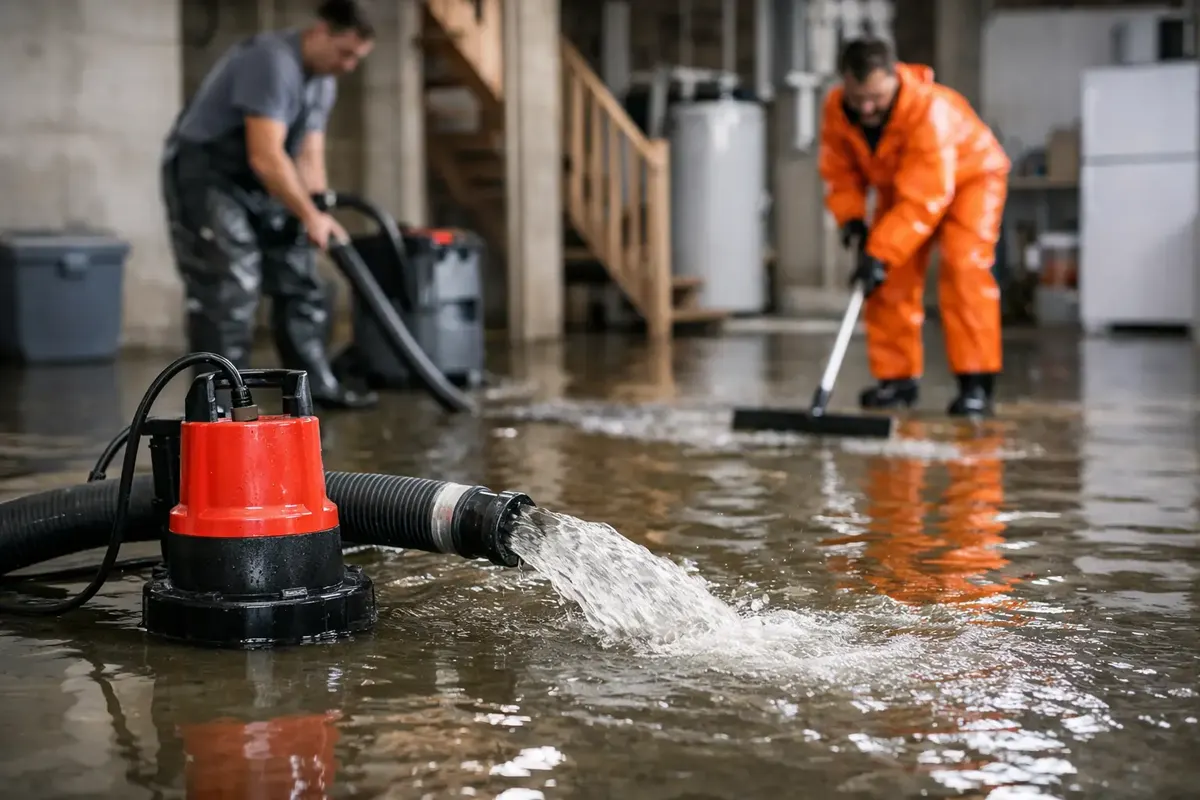
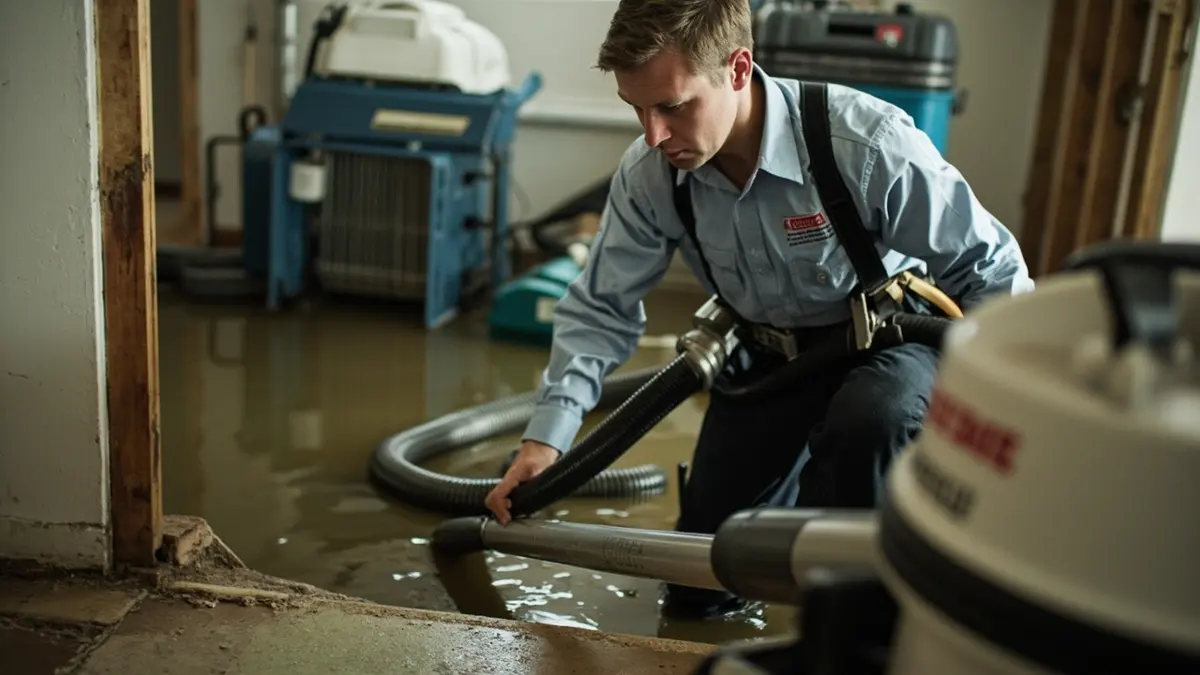
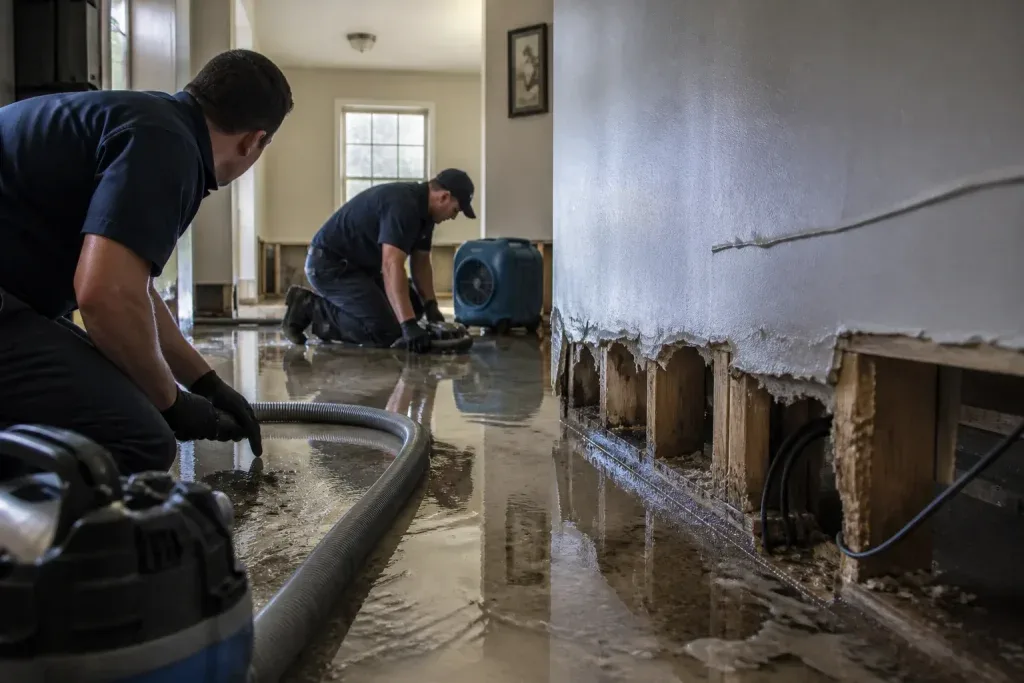
Submersible pumps take out the deep water. Then extraction wands, including weighted tools that squeeze water out of carpet and pad, pull out what pumps cannot reach. Water removed mechanically never has to be evaporated, and evaporation is the slow part.
Sodden pad, soaked insulation, swollen particle board, contaminated soft goods. The calls are made material by material using the category of the water, and everything removed is photographed first and bagged on site.
Silt and residue washed off every hard surface, then antimicrobial treatment matched to the water category. Sewage losses run the full disinfection protocol under protective gear. Disinfectant never goes on top of dirt: clean first, then treat.
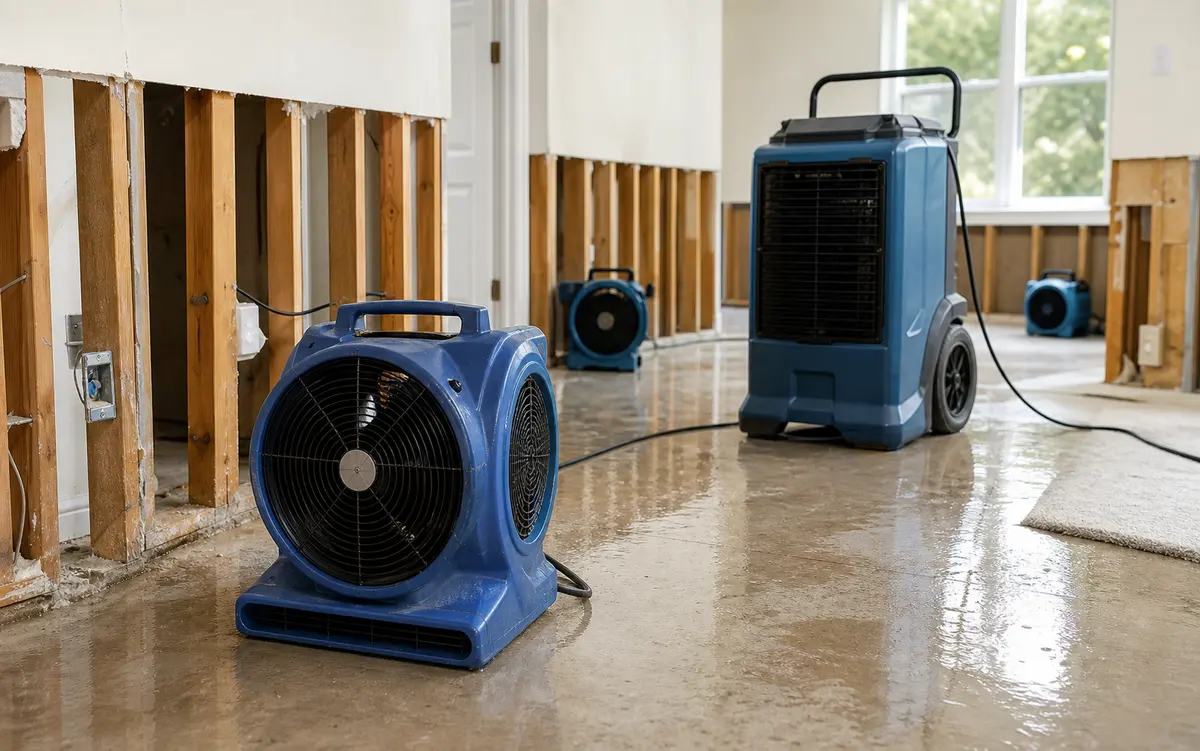
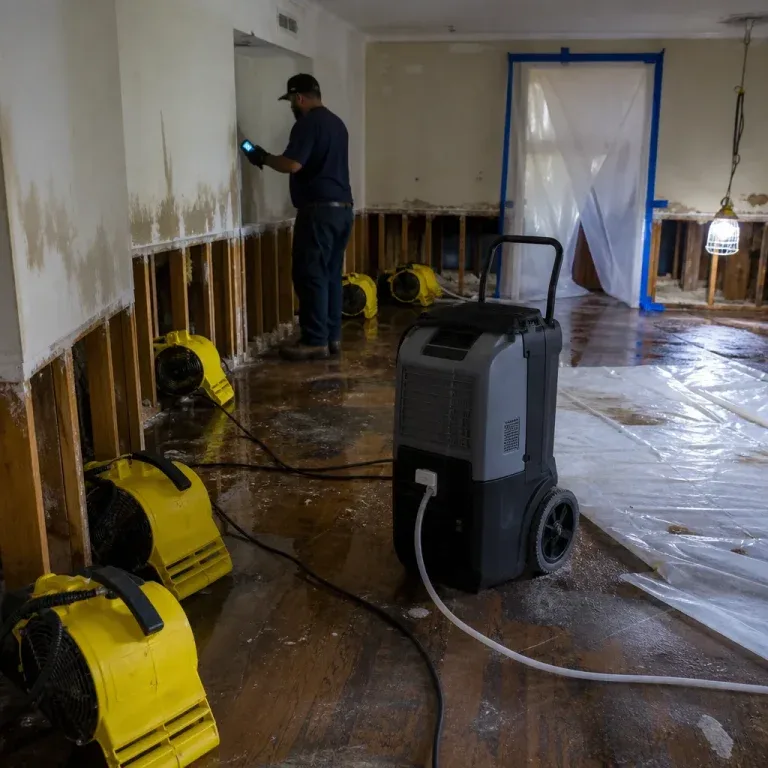
Air movers push air across wet surfaces to drive evaporation, low grain dehumidifiers pull that moisture out of the air and drain it away. Equipment count is sized to the class of the loss and the materials involved, and wall cavities get their own directed air where they are wet.
A technician returns each day, takes moisture readings at the same marked points, adjusts or removes equipment, and logs the trend. The job ends when readings at the wettest points match a known dry area of your building, not when the room feels dry to a hand.
Surfaces get a final clean, equipment comes out, and you receive the full documentation file plus a rebuild list: board, paint, flooring, trim, in the order the work should run. Restoration can follow under the same contract or with your own contractor.
Notice what is not on that list: guesswork. Meters decide what is wet, the map decides what opens, the log decides when drying is done. That is why the same flooded basement can come back with two very different quotes: the cheaper one is often the same job with steps 2, 6 and 7 quietly missing, and those are the steps that protect your home and your claim.
Free inspection first: source confirmed, wet materials mapped, written quote on site. Then the pumps, the same day.
Stay Safe In Wet Rooms
The injuries on flood jobs come from three hidden hazards, live electricity in standing water, contamination the water carries, and structure the water has weakened, far more often than from the water itself. Flood water is the obvious problem. The injuries on flood jobs rarely come from the water itself. They come from what the water touches, hides and carries.
The sharpest risk in any flooded room. Appliances, outlets and baseboard heaters sitting in water can energize the whole puddle. Power off from a dry panel or not at all. Crews test before they extract, and any room that cannot be made safe waits for an electrician, full stop.
Street water and drain water carry bacteria, chemicals, fuel residue and whatever the neighborhood stored at floor level: paint, solvents, pesticides, heating oil. Skin contact gets washed, cuts get covered, and anything that went in a mouth, especially children's toys, gets judged hard before it is kept.
Water is heavy. A saturated ceiling can hold hundreds of pounds and let go without warning, so a bulging ceiling is a no entry sign, not a curiosity. Buckled floors, shifted stairs and a foundation wall that has moved are all stop and assess moments, not cleanup moments.
Add two quieter hazards. Gas appliances with flooded controls, water heaters and boilers most often, should not be relit until a technician has cleared them, because flooded valves and controls fail in ways that leak gas. And carbon monoxide: every flood season, people run gasoline generators and pumps in basements and garages and do not wake up. Combustion engines run outdoors, far from windows, or they do not run at all. A flood cleanup NYC crew brings electric equipment and, where a generator is unavoidable, keeps it outside with cables run in.
The Classic NYC Flood
Most flood cleanup NYC calls are basement calls. Basements sit at the bottom of every system that can fail: the roof drains toward them, the sewer runs under them, the water table pushes up at them.
Walk a flooded New York basement with a meter and a flashlight and the entry point usually announces itself. Water lines on the foundation wall point to groundwater coming through the cove joint, the seam where the floor slab meets the wall, the weakest line in any basement. A wet ring around the floor drain says the sewer surcharged and the drain ran backwards. A soaked patch under the water heater or the boiler is a mechanical failure, not a flood at all, until it has run for a weekend. Staining under a basement window well tells a grading story: soil and gutter water aimed at the house for years, waiting for one hard rain.
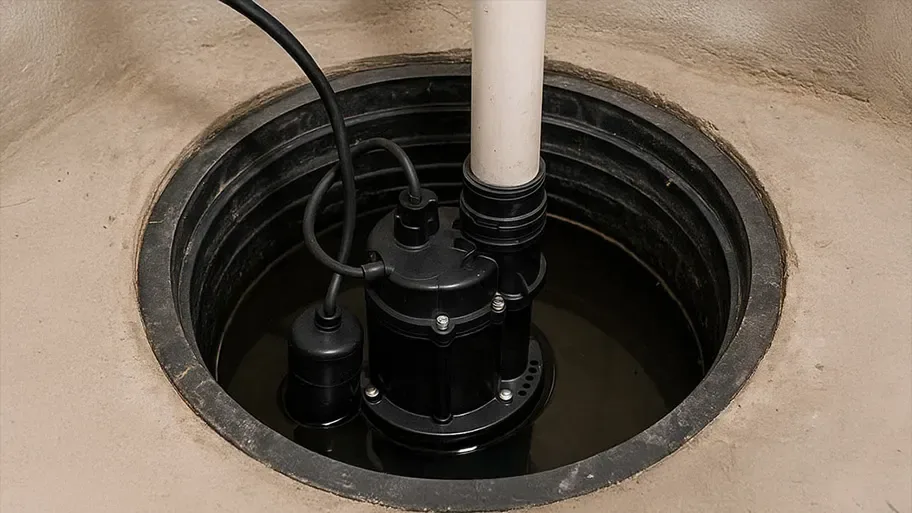
Sump pumps deserve their own paragraph, because so many New York and Long Island basements depend on one small machine. A sump pump sits in a pit, waits for groundwater to rise, and pumps it out before it spreads. The failure modes are boring and deadly to basements: the power dies in the same storm that brings the water, the float switch sticks on a pit wall, the discharge line freezes or clogs, or the pump simply wears out mid storm after a decade of faithful service. If your home takes groundwater, a battery backup pump and a high water alarm are the two upgrades that turn the next storm into a non event, and any good flood cleanup NYC crew will raise both before they leave.
Cleanup below grade runs the standard eight steps with a few basement twists. Deep water in a basement often has to be pumped in stages, about 1 foot of water per day, the gradual pace FEMA and the American Red Cross set for a deep basement, because the water outside in saturated soil presses inward and a fast full pump out can, in rare cases, stress a weak wall. Contents in basements are the saddest part of the job: the storage boxes, the photo albums, the holiday decorations that lived at floor level. Crews work through them item by item with you, photographing everything, saving what can be cleaned and documenting what cannot. Finished basements add the wall problem: board and insulation behind paneling hold water invisibly, which is why the moisture map matters more below grade than anywhere else in the house. Our page on water damage behind walls goes deep on finding and drying exactly that hidden water.
Pump out today, and leave with the entry point named and the fix listed, so this is the last time we meet over this basement.
Basement Apartments: Safety And The Law
A flooded basement apartment is the deadliest room in a New York rain flood: the NYC Health Department counts 14 deaths in Hurricane Ida, and 10 of them were in unregulated basement apartments. Ida's hardest number is not a rainfall figure. It is this: most of the people who died were at home, below grade, in apartments the city had never approved for living in. This section exists so that sentence is never abstract again.
The safety rules come first, and they are absolute. Never enter a flooded basement while the power may still be live, and never step into standing water to reach a breaker panel: if the panel is in the water, the water wins, and you call the utility from upstairs. Never run a gasoline pump or generator in a basement. In a flash flood emergency, the instruction is to get to high ground, not down to the basement to rescue belongings: Ida's basement deaths happened in rooms that filled in minutes, through drains, windows and doors, faster than a person inside could understand what was arriving. If you live below grade, your flood plan is an exit plan, and it should be rehearsed the way a fire plan is.
The legality question is real, and the numbers honestly conflict, so here they are with their measures attached. Estimates of unapproved basement apartments in this city run from about 30,000 in a Pulitzer cited count, to at least 50,000 in a city figure, to about 100,000 in Pratt and CHPC research. A separate figure of 144,000 counts all basement apartments, legal and otherwise, which is a different measure and not an illegality count. The Department of Buildings (DOB) recorded more than 14,000 illegal conversion violations between 2015 and 2024, and DOB can order a building vacated when conditions pose an imminent danger to the people inside. Two definitions do most of the work in these cases: living in a cellar, the level more than half below ground, is not permitted at all, and a legal basement living space must meet the ceiling height rule of 7.5 feet, among other requirements for light, air and a second way out.
What this means in practice, for tenants and owners alike: a landlord's duty to return a flooded apartment to livable condition does not shrink because the apartment was questionable, and a tenant in a below grade unit that floods should photograph everything, notify the landlord in writing the same day, file the 311 complaint and the city damage report, and take the safety question as seriously as the money question. The who pays section below covers the money. This section covers the part money cannot fix: below grade rooms flood first, fill fastest and forgive least, and no cleanup crew, however fast, is a substitute for a legal, escapable place to sleep.
The Dirty End Of The Work
A sewer backup is Category 3 black water under ANSI/IICRC S500, grossly contaminated from the moment it enters, and it is cleaned as a contaminated loss at every step. Of all the calls a flood cleanup NYC crew takes, the sewer backup is the one where the rules change completely. This is Category 3 water, and it is handled as contaminated from the first boot through the door.
New York sets this trap with its combined sewers. Across much of the older city, one pipe carries both household sewage and street storm water. In a hard rain the pipe fills beyond capacity, and the pressure has to go somewhere: it goes to the lowest opening it can find, which is very often a basement floor drain, a basement toilet or a laundry sink in neighborhoods like southeast Queens, East Flatbush, the South Bronx waterfront and the low ground around Newtown Creek and the Gowanus. Homeowners describe the same scene every time: the drain starts to gurgle, the toilet bubbles, and then water with a smell nobody mistakes comes up and keeps coming until the rain lets up.
The cleanup runs differently at every step. The crew enters in protective gear, respirators included, and the work area is contained so nothing tracks through the rest of the home. Standing sewage is extracted and disposed of properly. Every porous material the water touched is removed and bagged: carpet and pad, the lower run of drywall where wicking carried contamination upward, soaked insulation, upholstered anything. There is no cleaning protocol that makes a sewage soaked sofa safe, and any crew that offers one is selling you a risk. Hard surfaces, concrete, tile, sealed wood, are washed and then disinfected, and the structure is dried and verified like any other loss. The smell leaves with the material and the disinfection, not before, and any lingering odor after a sewage job means something wet or contaminated is still in the building.
Then comes the question that decides whether you do this again next storm: why did it back up, and what stops it? Sometimes the answer is in your own line, tree roots, grease, a collapsed section of house drain, and a camera inspection finds it. Sometimes the answer is the city main surcharging, and the defense is a backwater valve on your house drain, a device that lets your water out and refuses the street's water entry. It is not glamorous plumbing and it is not free, but homeowners in surcharge neighborhoods who fit one describe the next cloudburst as the storm they watched from the window instead of mopping. A flood cleanup NYC crew should leave you with that diagnosis in writing, because drying the same basement every September is a business model for us and a misery for you, and only one of those should win.
Stay out, keep children and pets away, and let the crew in protective gear make the first entry. This is the one flood you should never mop yourself.
When The Sky Does It
Storm flood water is treated as Category 3 until a crew grades it on site, because water that crossed streets, soil and drains on its way in carries whatever it crossed. Storm floods arrive dirty, hit whole neighborhoods at once, and come with a second problem nobody warns you about: every crew in the city is booked at the same moment.
New York has lived its storm lessons in public, and the Sandy and Ida section below tells both stories with their numbers and sources. The short version: Sandy taught the coast what surge means, Ida taught the inland neighborhoods that rain alone, falling faster than the sewers can carry it, fills below grade homes in under an hour, and the flash flood emergencies that now arrive most summers keep repeating the Ida pattern.
Storm water is Category 2 at best and Category 3 wherever it has crossed streets, soil and drainage, which in this city means treat it as black water until proven otherwise. It carries silt that gets into everything, grit that scores floors as you walk, and a film on every surface that has to be washed, not just dried. Salt water from surge adds its own chapter: salt corrodes wiring, appliances and heating equipment, and salt left in masonry keeps pulling moisture from the air long after the wall should be dry, so surge losses get extra washing and honest conversations about electrical inspection.
The practical storm advice is about timing. When a storm floods a whole neighborhood, the homeowners who call in the first hours get the pumps in the first days. The ones who wait join a queue measured in weeks, with wet homes sitting and growing the whole time. Save the number before the rain starts, not during it.
While the street is still a river, your moves are small and useful: keep the curb drain outside your home clear of leaves and trash if you can do it safely from the sidewalk, get belongings up off the basement floor, photograph the street and the water line on your building as the event unfolds, and note the times. Those timestamps, matched against the city's own records when you file with 311, are the backbone of both flood claims and the city damage reports that follow big storms.
The two floods a New York home meets most often look alike on the floor and differ in almost everything that decides the flood cleanup NYC job and the claim.
| Question | Storm flood | Burst pipe |
|---|---|---|
| Where the water starts | Outside the home: street water, coastal surge, groundwater, a surcharging sewer | Inside the plumbing: a pipe, a hose, a water heater, an appliance |
| Water category | Category 2 at best, Category 3 wherever it crossed streets, soil or drains | Category 1 clean at the start, degrading if it stands in warm conditions |
| What comes out | Porous materials the water touched, plus the silt and sand it carried in | Only what cannot dry: carpet pad, swollen board, soaked insulation |
| Sanitizing | Full washing and disinfection protocol, under protective gear where sewage is involved | Washing and antimicrobial treatment matched to a clean water loss |
| Which policy answers | A flood policy, NFIP or private, because standard homeowners policies exclude outside water | The homeowners policy, as sudden and accidental water damage from inside |
| First calls | 311 and a damage report at reportdamage.nyc.gov for the city record, then your crew | The main shut off valve, then your crew and your insurer |
The Two Storms That Wrote The Rules
Sandy in October 2012 was a surge storm that came from the ocean, and Ida in September 2021 was a rain storm that came from the sky, and a New York home can meet either one. Every flood crew working in New York today was trained, one way or another, by two storms fourteen years apart in method and nine years apart in fact. One came from the ocean. The other came from the sky. Your home can meet either one.
Hurricane Sandy drove a storm tide of 14.06 feet at the Battery, put about 17 percent of the city under water and left near 2 million people in the city without power. The death figures deserve care, because sources count differently and this page will not merge them: the commonly cited city figure is 43 deaths in New York City, while a Queens restoration guide citing city data gives 52 injury deaths. The NYC Department of Health and Mental Hygiene recorded 9 people who drowned in basements at home, and one referral guide calculates that 44 percent of Sandy's injury deaths took place on Staten Island, which is why the island's shore neighborhoods plan for water the rest of the city only reads about. At Breezy Point, fire followed the flood and burned more than 100 homes. Surge water is its own cleanup problem: it is Category 3 by default, it carries sand and silt that have to come out before drying starts, and the salt it leaves behind corrodes wiring, appliances and heating equipment and keeps pulling moisture back into masonry for months. The saltwater section below covers that chemistry in full.
The remnants of Hurricane Ida taught the inland city the opposite lesson: you do not need to live near water to drown in it. The NYC Health Department figures put the storm at about 9 inches of rain in total, falling at up to 3.5 inches per hour at the peak, against a sewer system designed for 1.75 inches per hour, and the city declared its first ever flash flood emergency that night. The Health Department counts 14 deaths, 10 of them in unregulated basement apartments, about 71 percent of the total. Other city offices have given a count of 13. Both numbers appear here with their sources because the difference is a counting method, not a fact anyone should smooth over, and because the basement figure is the one that should change behaviour: the deadliest room in a New York rain flood is the below grade apartment, filled through its own drains and windows faster than anyone inside expects.
Put the two storms side by side and the working rules of this page stop sounding like sales talk. From Sandy: treat outside water as contaminated, expect salt to keep working after the water leaves, and know that coastal rebuilding runs under flood zone rules that rain flooded homes never meet. From Ida: rain alone, falling faster than the sewers were built to carry, floods homes miles from any shoreline, and the first safety question in a hard rain is not how to save the basement but whether anyone should be in it at all. The storms since, including the September and November 2026 nor'easters covered in the first 48 hours section above, have repeated the Ida pattern far more often than the Sandy one. Most New Yorkers preparing for the last war should, in fact, prepare for both.
The free inspection names which of the four flood types your home keeps meeting, and what would stop the next one. That diagnosis is the most valuable page of the file.
Room By Room
Each room in a flooded home is judged on its own rules, set by the category of the water, the materials in the room and the moisture readings underneath them. A flooded home is not one job, it is a row of smaller jobs, and each room has its own rules. Here is how a crew reads yours.
Cabinets are the fight. Particle board and MDF cabinet boxes swell and come apart, and those go. Solid wood boxes often dry in place with the toe kick space opened for air. Appliances that sat in water need electrical checks before they run again, and the floor under them is always wetter than the floor you can see.
Tile forgives a lot, grout and subfloor forgive nothing. Water that reached the subfloor through grout lines and the toilet flange keeps traveling sideways under tile that looks perfect. The toilet seal gets replaced on any flood that reached it, and vanity cabinets made of board get the same judgment as kitchen cabinets.
Carpet is the category call: clean water and fast work can save it, pad almost never survives, sewage ends the discussion. Hardwood gets drying mats and a subfloor verdict from the meter. Upholstered furniture that soaked through is documented and removed, solid wood furniture usually cleans up and stays.
The contents triage lives here: cardboard storage is almost always lost, plastic bins wash clean, and paper, photographs and fabric are judged piece by piece. The structure gets the full map, because finished basement walls hide the worst water in the house.
The room that causes floods also suffers them. Hoses, pans and drains get inspected as part of cleanup, water heaters and boilers with flooded controls wait for a technician, and the replacement conversation always includes a pan, a drain and braided steel hoses.
Concrete washes and dries well, which makes the garage the forgiving room. The losses are what garages hold: tools, chemicals, paint and stored paper. Flood water that carried garage chemicals across the floor upgrades the washing for the whole level.
Across every room, one habit separates good flood cleanup NYC work from fast looking work: nothing gets judged by its surface. Floors are read through the subfloor, walls through the cavity, cabinets through the box behind the door. The meter and the thermal camera do that reading, and the map they produce is the document your insurer, your landlord or your co op board will ask for when the bills arrive.
How Long It Takes
Most clean water flood losses in a New York home dry in 3 to 5 days and flooded basements in 7 to 10 days, and dry is proven by moisture meter readings, never by the calendar. Homeowners ask two timeline questions: when can we use the room again, and when does this end. Honest answers run on readings, but the shape of the week is predictable.
Competitor pages quote one drying number as if it fit every flood. It does not. The honest answer is a range with a phase attached, because extraction, drying and rebuilding are different clocks. The ranges below follow the phases New York crews and guides report for these losses: muck out and extraction first, then monitored drying to the ANSI/IICRC S500 dry standard, then rebuild as its own phase.
| Situation | Typical time | What drives it |
|---|---|---|
| Contained clean water leak, one room | 2 to 3 days | Small wet area, materials that release water quickly |
| Standard clean water loss, several rooms | 3 to 5 days | The normal run of a monitored drying system |
| Flood muck out and extraction | 1 to 2 days, then drying of 3 to 5 days | Debris and unsalvageable material leave before drying can start |
| Flooded basement | 7 to 10 days | Below grade air, concrete that holds water, hidden wall cavities |
| Larger or contaminated loss, mitigation phase | 5 to 10 days | Removal and disinfection run ahead of the drying clock |
| Severe sewage loss | 7 to 14 days | Containment, removal to the wick line, full disinfection, then drying |
| Extensive flooding | 2 to 4 weeks | Whole structure losses with slow materials throughout |
| Reconstruction | A separate phase, adding weeks | Board, floors, paint and finishes, after verified dry |
| Material | Typical drying | Note |
|---|---|---|
| Carpet over pad, clean water | 2 to 3 days | The pad is usually replaced even when the carpet is saved |
| Drywall | 3 to 5 days | Faster with cavity air directed into the wall |
| Hardwood over a wood subfloor | 5 to 10 days | Drying mats and subfloor readings decide the finish work |
| Concrete slab | 1 to 3 weeks | A soaked cellar slab is the slowest part of most basement jobs |
| Pre war plaster on lath | 3 to 6 weeks | Plaster holds water far longer than board and dries on a trend, not a promise |
And the number that ends every argument about whether a room is dry: wood framing and flooring should read at 15 percent moisture or less before finishes go back on, the field target crews dry to, under the ANSI/IICRC S500 ceiling of 19 percent. Dry is that reading, taken at the wettest marked point and matched against a dry area of the same building. It is never a date on a calendar and never how the surface feels to a hand.
What stretches a timeline is rarely the water you saw. It is the water you did not: the cavity full of wet insulation, the subfloor soaked under intact tile, the second room the water reached through a shared wall. This is why a flood cleanup NYC crew maps before it quotes a schedule, and why the drying log, with its daily numbers at the same points, is the only timeline document worth trusting. If readings stall for two days, something is still wet somewhere, and the job changes. A crew that reports a stall and a plan is doing its job. A crew that stops visiting is not.
Every timeline above starts at the first call. The inspection is free and the clock argument is free too: we will show you the readings either way.
The Mold Question
Mold can begin growing on wet drywall, wood and paper within 24 to 48 hours after a flood, per EPA guidance, and it starts on the hidden faces inside walls and under floors. Ask flood veterans what they fear and few say water. Water is visible, pumpable, finite. Mold is the flood that keeps happening after the water leaves.
The biology is not complicated. Mold spores are already in every home, floating in the air and settled in the dust, waiting for the one thing they lack: sustained moisture. A flood delivers it everywhere at once, on the paper backing of drywall, on wood framing, on the dust inside wall cavities, on carpet pad and cardboard. EPA guidance puts the start of growth at 24 to 48 hours on wet materials. The growth starts where you cannot see it, on hidden faces inside assemblies, which is why a home can smell musty a week after a flood that looked fully cleaned. That smell is the building reporting that somewhere, something is still wet and growing.
Winning the race is the entire design of professional flood cleanup NYC work: extraction that removes water mechanically instead of waiting for evaporation, removal of the materials that hold water longest, air movement and dehumidification sized to the loss, and daily readings that catch a stalled wall before it becomes a grown wall. Antimicrobial treatment supports that system. It does not replace it, and any product sprayed onto a still wet wall is perfume on a problem.
If the race is already lost, if the water sat for a week, if growth is visible or the smell is established, the job changes names and rules. Mold remediation runs under containment with negative air pressure so spores are not spread through the home during removal. In New York, larger areas of growth run through the licensed process: a licensed assessor defines the work, a licensed remediator does it, under state Article 32, and city Local Law 55 sets owners' duties in covered multiple dwellings. The moisture source gets fixed as part of the same story, because remediation over a live leak is money burned. Our water damage behind walls page covers the hidden growth version of this problem in full, including how meter testing finds it before the paint shows it.
One honesty rule: no crew can name a mold species or diagnose a health effect from looking at a wall, and color tells you almost nothing. The remedy is always the same shape: stop the water, dry or remove the material, clean what remains. Where identification or clearance paperwork is needed, a licensed assessor is the right call, and we will tell you when your job has reached that line.
New York does not leave post flood mold to good intentions, at least not in the buildings where most New Yorkers live. Local Law 55 obliges owners of buildings with 3 or more units to investigate mold and the moisture behind it, and it grades the work by size. Class A, under 10 square feet of growth, carries a 90 day correction window. Class B, 10 to 29 square feet, carries 30 days. Class C, 30 square feet or more, carries 21 days, and mold is the exception to the usual 24 hour rule that applies to other Class C conditions, a detail that matters when a landlord or a tenant reads the violation and panics in the wrong direction. Local Law 61 and state Labor Law Article 32 add the licensing layer: in buildings with 10 or more units, mold work over 10 square feet runs through an independent licensed assessor who defines the job and a separate licensed remediator who does it, with filings to the DEP. The practical translation for a flooded rental or co-op is simple. The clock and the paperwork start at the flood, not at the first complaint, and the drying log your crew leaves behind is the document that proves the response was prompt, measured and complete.
That smell is a meter test waiting to happen. The inspection is free, and if the wall is dry we say so in writing and nobody cuts anything.
Before Any Demolition
Before any flood demolition in a New York home, test first: moisture readings decide what opens, and a building from before 1987 needs an asbestos survey under DEP Rule 56 before anything is torn out. The most expensive sentence on a flood job is "just rip it all out." The second most expensive is "it feels dry, close it up." Testing sits between those two mistakes, and in New York's old housing stock it is not optional.
Start with the simplest test in the trade, the one good video teachers demonstrate for homeowners: the wet test. Press a screwdriver into the wall at and above the water line. Sound drywall resists. Wet drywall is soft, and the blade sinks with a crumble that tells you the board has lost its strength and its argument for staying. Work up the wall until the blade meets firm board, and you have found the height the water reached inside the material, which is often higher than the line it left on the paint. Where board must come out, the flood cut is the standard move: a clean horizontal cut, often run at doorknob height so full sheets patch back in neatly, with the wet board and soaked insulation below it removed and the cavity dried open. Readers who want to see a flooded basement cleanup run in the right order, safety and power first, then extraction, drying, disinfecting and the salvage calls, will find the sequence taught plainly in this flooded basement cleanup walkthrough.
Two warnings ride on that paragraph, and both are New York warnings. A flood cut is a drywall technique. Pre war plaster on lath does not cut, patch or price like board, it is heavier, slower to dry and often worth drying in place, and cutting it on a drywall schedule is how a two week job becomes a two month argument. And in a co-op or condo, opening walls is building work: board approval, contractor insurance and work hour rules apply before the first cut, not after the first complaint.
Then comes the test that outranks all the others in an old building: what is in the wall. Homes built before 1978 carry lead paint risk, and renovation on them runs under lead safe rules. Asbestos is the bigger flood demolition hazard in this city: pipe insulation, floor tile, mastics and old plaster systems in pre war buildings can all carry it, and New York City requires an asbestos survey before demolition work in buildings from before 1987, under DEP Rule 56, filed on the ACP-5 and ACP-7 forms, with licensed abatement where the survey finds it. Flood water does not make asbestos safer to disturb; it makes the demolition messier and the containment more important. The order taught by testing led restorers is the order this page follows: extract and dry, test, then mitigate, then clearance testing where the job calls for it, then rebuild. It is laid out as teaching in this test before you tear walkthrough, and its closing lesson is the one printed on every drying log we hand over: looks dry is not dry. Readings are dry. Nothing else is.
Meter first, test where the age of the building demands it, and cut only where the readings say the wet ends. The inspection is free and the diagnosis comes before the demolition, in writing.
The Floods With A Second Problem
Saltwater adds corrosion that keeps working after the room reads dry, a heating oil leak turns flood water into a spill, and a flooded lithium battery can catch fire days later: three passengers that each change the cleanup order. Some floods are only water. These three are water plus a chemistry problem, a fuel problem or a fire problem, and each one changes the cleanup order.
Surge water and bay water are not fresh water with a smell. Salt is corrosive and hygroscopic, which is a formal way of saying it eats metal and then keeps pulling moisture out of the air back into your walls. The cleanup order changes accordingly: sand and silt come out first, because they hold salt against every surface; framing and masonry get rinsed to pull chlorides out, not just dried with the salt left in; and anything electrical the water reached, outlets, panels, appliance motors, heating controls, gets an electrician's verdict before it runs again, because salt corrosion keeps working inside a switch or a motor long after the room reads dry. A surge flooded wall that was dried but never rinsed can fail its moisture readings for months, passing on a dry afternoon and failing on a humid one, and homeowners blame the crew when the real culprit is chemistry. Rinse first, then dry, then verify: that order is the whole section.
| Question | Saltwater flood | Freshwater flood |
|---|---|---|
| Where it comes from | The sea, the bays and tidal rivers, arriving as surge or tide | Pipes, appliances, rain and groundwater from inside or above the home |
| Water category | Category 3 by default under ANSI/IICRC S500 | Category 1 at the start, degrading toward Category 2 or 3 if it stands for 24 to 48 hours |
| What it leaves behind | Salt and silt held against every surface it touched | Water alone, unless it crossed soil or a drain on the way in |
| Extra step | Sand and silt out first, then a rinse to pull chlorides out of framing and masonry before drying | No rinse: extract, wash, sanitize, dry |
| Electrical | An electrician's verdict on outlets, panels, motors and heating controls before anything runs, because salt corrosion keeps working inside them | A standard safety check before power returns to the wet rooms |
| Drying behaviour | Salt left in masonry pulls moisture back from the air, so readings can fail for months if the rinse is skipped | Dries on the normal monitored schedule, proven by daily readings |
Thousands of New York and Long Island homes still heat with oil, and a flooded basement meets the tank, its lines and its fill pipe at exactly the wrong height. Tanks can shift or float when empty and surrounded by water, lines crack, and a slow leak turns flood water into an oil spill inside your own home. The smell is the alarm: if flood water carries a fuel smell or a rainbow sheen, stop treating it as a water job. The New York State Department of Environmental Conservation publishes oil cleanup guidance for homeowners and insurers, and its Spill Hotline, 1-800-457-7362, is the call that starts the right process. One rule admits no exceptions: contaminated water is never pumped onto the ground, into a garden or down a storm drain. It is contained and disposed of as the contaminated material it is, and the cleanup crew and the DEC guidance, not urgency, set that sequence.
The newest passenger arrived with the battery era. A flooded electric vehicle should not be charged or restarted: city recovery guidance says so plainly, because damaged battery systems can fail violently when power is pushed back into them. The EPA's flood guidance adds the household version of the same rule: flooded lithium batteries should be taken out of the home or garage, because a water damaged battery can catch fire days after the water leaves, and it must never go into regular trash or recycling, where it endangers the crews who handle it. New York households now hold these batteries everywhere, in e-bikes, scooters, tools and toys, and a flooded basement full of them is a fire watch, not a storage problem. Move them out if it is safe to do so, keep them away from the house, and use the battery take back routes, including Call2Recycle collection, rather than the curb. Tell the cleanup crew on the first call that batteries were in the water. It changes where they stand, what they touch first and what nobody plugs in.
From The Field
Most flood cleanup NYC jobs take one of three shapes: the cloudburst basement filled through its own drain, the appliance flood falling through a tower, and the sump failure that fills a basement overnight. Patterns teach better than promises. These three walkthroughs are the shapes flood cleanup NYC work actually takes, with the details changed and the lessons intact. They follow the same case study approach you will see in restoration walkthrough videos on YouTube, written out here so nothing is lost to a skipped timestamp. If you watch video walkthroughs of this craft, watch for the meter readings and the drying logs, because that is where real crews separate from performers.
A summer storm dropped its rain in about an hour, the street drain surcharged, and a finished basement in a one family home took several inches of water through the floor drain while the family was at work. They came home to a living space underwater and did the two things that saved the job: they kept the door closed once they smelled what the drain had delivered, and they photographed everything before touching it. The water was Category 3, so the carpet, pad and the lower run of board came out under containment, the slab and framing were washed and disinfected, and the drying ran five days with readings logged twice at the start when the slab was slow to release moisture. The lesson this job teaches in every telling: the drain told the truth about the water. Clean looking water that arrives through a sewer is not clean, and treating it as clean to save the carpet would have left a contaminated room under a family home.
Not every flood comes from the sky. A supply hose let go behind a washing machine in a sixth floor co op, ran for the length of a work day, and rained down a chase through the apartments below. By evening, five homes had wet ceilings, walls and floors, and the building had one very popular super. The cleanup ran as a building job: the source fixed first, then each unit mapped and dried in sequence, with the moisture readings and photos filed per unit so the building's insurer and the unit owners' insurers could divide the story without a fight. The case study lesson, and it is the one the video walkthroughs of apartment floods repeat constantly: in a stacked building, water is a vertical problem. The unit that looks driest can sit under the wettest chase, and nobody's cleanup is finished until the whole column reads dry.
A nor'easter knocked out power across a South Shore neighborhood in the small hours, the sump pump died with the power, and groundwater did what groundwater does, rising through the pit and across a finished basement until it found the bottom of everything the family stored there. The pump out waited for the power question to be settled safely, then ran in the morning. The structure dried in four days. The belongings were the real loss: decades of stored paper and fabric at floor level, photographed box by box for the claim. The family left the job with two upgrades, a battery backup pump and a water alarm that now texts three phones, and with their storage rebuilt on shelving a foot off the slab. The lesson: on groundwater streets, flood cleanup NYC and Long Island work is half drying and half engineering, and the second half is what makes it the last flood instead of the latest one.
Free inspection, moisture map, written quote. The walkthrough of your job starts with one call.
Asked Online, Answered Plainly
The questions below are the ones that fill the forums after every New York storm, in the words homeowners use at midnight. Short answers here, full answers in the sections and FAQs around them.
For a shallow, clean water spill in one room, that is a reasonable start. For a real flood it fails at the hidden water: fans dry surfaces while cavities, subfloors and pad stay wet, and the mold clock keeps running in the dark. The forums are full of the sequel to this question, posted about ten days later, asking about the smell.
Usually, yes, if the water came from outside the home. Standard homeowners policies exclude flood, which is why flood insurance exists as its own product. What is worth checking is the source: if a pipe inside the home contributed, or you carry a water backup endorsement, parts of the loss may sit under the homeowners policy after all. Our water damage insurance claim guide walks the coverage map line by line.
In New York, the building and its systems belong to the landlord, and that includes cleaning and repairing the structure after a flood and fixing the failure behind it. Your belongings are your side of the line. Notify in writing, photograph everything, and keep copies: written notice is the version of this conversation that works.
Because the water you can see is the minority of it. The majority hides in cavities, under floors and inside materials, and drying is the metered process of getting that water out before it grows anything. The drying log is the receipt: if a crew cannot show falling readings, ask what exactly you are paying for.
Only if the invitation stays open. Every repeat flood has a named cause: the dead sump, the missing backwater valve, the gutter dumping at the foundation, the soil sloping home. A good flood cleanup NYC job ends by naming yours in writing. Fix the invitation and the next storm becomes weather again, not a recurring appointment.
Apartments, Co Ops, Condos, Rentals
Who pays for flood cleanup in a New York home depends on where the water came from and what kind of home it entered, rental, co-op, condo or one family house, and the matrix below maps it by cause. In a city where most people live stacked on top of each other, flood water rarely respects property lines. Here is how responsibility usually divides, and how to protect your side of it.
Homeowners carry their own structure and belongings, split between two policies that do not overlap the way people expect: homeowners cover for water that came from inside the building's plumbing, flood cover for water that came from outside. The section below maps that line in detail.
Renters own their belongings and their displacement, not the building. The landlord is responsible for the structure, the systems and the cleanup of the apartment itself, and New York habitability law stands behind that. The renter's tools are written notice the same day, dated photographs, copies kept, and 311 if the response stalls. Renters insurance, bought before the flood, is what pays for the tenant's own things and hotel nights.
Co op and condo owners live in the three policy world: your own policy for your finishes and belongings, the building's master policy for shared structure, and often a neighbor's liability policy when the water started upstairs. The proprietary lease or bylaws draw the line at the walls, which is why the same flood produces three adjusters. Buildings also control the logistics: certificate of insurance for the crew, freight elevator booking, work hour windows. A flood cleanup NYC crew that works in managed buildings carries that paperwork as standard kit, and jobs stall when it is missing, so ask about it on the first call.
Landlords and property managers own the cleanup duty and the clock. Local Law 55 obliges owners of covered buildings to investigate mold and the moisture behind it, and a flooded unit left wet becomes a mold case, a record with the Department of Housing Preservation and Development (HPD), and a habitability argument in sequence. Fast, documented cleanup is not a favor to the tenant, it is the cheapest legal position available. Keep the moisture map and drying log with the building file: they are the proof the response was prompt and complete.
Whichever chair you sit in, the moves that protect you are identical. Notify in writing the same day. Photograph before anything moves. Get the cleanup documented with readings, not adjectives. Keep every paper in one folder. Floods divide bills between parties who mostly agree about the water and argue about the record, so build a good record and the argument shrinks.
No competitor page prints this table, because it is easier to say "it depends" and stop. It does depend, but it depends in patterns, and the patterns fit on one page. Find your row by where the water came from, then read across to your kind of home. General information, not legal advice: your lease, proprietary lease or bylaws can move a line, and the documents win.
| Cause of the flood | Rental | Co-op | Condo |
|---|---|---|---|
| Burst pipe in a riser or other building pipe | The landlord and the building: the pipe and the structure are theirs | The corporation: riser equals building, and the master policy responds first | The association: risers are common elements under most bylaws |
| Burst pipe in a branch line inside the unit | The landlord for the structure and the repair, the tenant for belongings | The shareholder: branch equals unit, and a shareholder answers for leaks from plumbing inside the unit | The unit owner, through their HO-6 policy for the interior |
| Upstairs neighbour leak or overflow | The landlord restores the unit; the neighbour's liability is chased by insurers, not by you | The negligent neighbour if negligence is shown; your own insurer usually pays first, then subrogates | Same pattern: neighbour liability, your HO-6, and the master policy can all be in one claim |
| Sewer backup from the street main | The building owner for the cleanup; a claim against the city needs negligence shown, not just a backup | The corporation, with any city claim filed on the 90 day Comptroller clock below | The association for common drains, the owner for the unit interior |
| Sewer backup from the building's own lateral | The owner: the line from the building out to the street main belongs to the property | The corporation, for the same reason: the lateral is the building's pipe | The association where the lateral serves common lines |
| Storm surge or street flood through the ground floor | The landlord for the structure; the tenant's belongings ride on renters insurance alone | Flood cover answers, not the homeowners policy: the building's flood policy and your HO-6 flood cover if you bought it | The association's flood policy for structure, the owner's flood policy for the interior and contents |
| Rain through the roof | The landlord: the roof is the building's skin and the building's bill | The corporation: the roof is a common element | The association for the roof, the owner for the interior damage below it |
| Water up through a basement drain in a cloudburst | The landlord for cleanup and for the backwater valve conversation that follows | The corporation for building systems; unit damage splits between master policy and HO-6 | The association for the drain system, the owner for finishes and contents |
Two cases teach the city row better than any summary. In Wohl v City, a Bronx home took 6 feet of sewer water during Irene and the court still granted the city summary judgment: a backup alone does not prove negligence. In Pickersgill v City, a Staten Island home took 2 feet of backup water that destroyed the furnace, and the court allowed an inference of negligence to stand. Same city, opposite outcomes, decided by evidence. That is why the 311 record, the DEP inspection and your dated photographs matter more than the argument you plan to make later. And in the neighbour rows, expect three carriers in one loss, yours, the neighbour's and the building's, with your own insurer usually paying first and recovering from the negligent side afterwards. Document the source and the water path, and let the carriers divide a record instead of a rumour.
Certificates of insurance, elevator bookings and board approvals are routine for us. Tell us the building rules on the first call and we will match them.
Claims After A Flood
More flood claims are lost on a definition than on damage. Insurers draw one bright line: water that came from outside the home is flood, water that came from inside the plumbing is a homeowners loss. Everything else follows from which side your water started on.
A standard homeowners policy in New York covers sudden and accidental water damage from inside: the burst pipe, the failed water heater, the split washing machine hose, the overflowing tub. It excludes flood: water that rises outside and comes in, storm surge, overflowing bodies of water, groundwater pressing through the foundation. Between the two sits sewer and drain backup, which most policies exclude by default and sell back as an endorsement, sometimes with a sump overflow clause beside it. If you take one action from this section, take this one: find your declarations page and search it for the words flood, water backup and sump. Know your position before the sky does something, not after.
Flood insurance, through the National Flood Insurance Program or a private carrier, covers the outside water: cleanup and repair of the building, and contents if you bought that half. Know its limits too. NFIP policies do not pay for temporary housing, they treat basements narrowly, and a new NFIP policy carries a 30 day waiting period before cover starts, per FEMA, which is why flood cover is bought in the spring and cursed in the storm. None of that makes it a bad product. On a coastal street or a surcharge block, it is the only product that answers the phone after the big one.
Whichever policy responds, the claim is paid from documentation, and flood cleanup NYC crews build that file as part of the job: dated photographs before anything moves, the water line measured, the inventory of losses with labels and serials where they exist, the failed part kept if a machine or pipe caused the loss, the moisture map and the daily drying log, and a scope of work written in the line item language adjusters use. File promptly, keep copies of everything you send, and do not discard damaged property until the adjuster has seen it or released it in writing. Our dedicated guide to filing a water damage insurance claim walks the full sequence, from first notice to a denied claim appeal, and it is worth the read before your adjuster visit.
One more line matters in this city: the neighbor case, covered row by row in the who pays matrix above. Start the drying without waiting for the insurers to agree among themselves. A dry home with a paper trail beats a wet home with a perfect argument, every single time.
We meet adjusters on site with the moisture map and drying log in hand. Book the free inspection and the file starts building itself.
Deadlines, Corrected
New York flood claim clocks run in business days under Regulation 64 and Insurance Law 2618, and the 15 business day figures do not come from Insurance Law 3420(d), whatever other guides say. Flood claims in New York run on clocks most guides state wrongly, including one error repeated so often it has become folklore. This section states the clocks from the statutes themselves, corrects the famous error, and puts every deadline in two tables.
Most claim deadlines come from Regulation 64, 11 NYCRR Part 216, issued under Insurance Law 2601, the unfair claims settlement practices law. They run in business days, and they bind your insurer from the day you report the loss.
| Insurer duty | Clock |
|---|---|
| Acknowledge your claim | 15 business days |
| Reply to your communications | 15 business days |
| Begin the investigation | 15 business days |
| Accept or reject in writing, after proof of loss and the items they asked for | 15 business days, with a status letter every 90 days while the claim stays undecided |
| Pay after settlement is agreed | 5 business days |
| Respond to the Department of Financial Services (DFS) | 10 business days |
Two footnotes keep this table honest. Regulation 64 gives you no private right of action on its own: enforcement runs through the Department of Financial Services, which is why a DFS complaint is a real lever and not a formality. And DFS Circular Letter No. 13 of 2011 confirms these rules apply in full to NFIP Write Your Own insurers, the private companies that sell and service federal flood policies, so a flood claim does not escape the clocks by being federal.
After a declared natural disaster, Insurance Law 2618 tightens the end of the process: the insurer must accept or reject a non commercial claim within 15 business days after proof of loss and the requested items, or 30 business days if arson is suspected, with one further 15 business day extension, and must pay within 3 business days of settlement. Now the correction. Many New York guides, and earlier versions of pages like this one, state that Insurance Law 3420(d) requires a 15 business day acknowledgement. It does not. Section 3420(d)(2) says a disclaimer of coverage must be given "as soon as is reasonably possible", and it is a timely disclaimer rule for death and bodily injury claims under liability policies. It does not apply to property damage claims at all, and it contains no 15 day figure of any kind. The 15 business day clocks live in Regulation 64 and Insurance Law 2618, above. If another guide shows you 3420(d) as the source of a property claim deadline, it is showing you the error this paragraph exists to retire.
The remaining clocks, briefly. The suit limit on a standard fire policy is 24 months from the date of loss, under Insurance Law 3404. Under Bi-Economy v Harleysville and Panasia v Hudson, decided by the Court of Appeals on 19 February 2008, consequential damages can be recovered when an insurer wrongfully delays or denies a claim, which is why a documented delay is worth more than a loud one. A licensed public adjuster may charge no more than 12.5 percent of the recovery. The Department of Financial Services answers at (800) 342-3736, Monday to Friday, 8:30 AM to 4:30 PM, with complaints also taken at dfs.ny.gov, and the separate disaster hotline is (800) 339-1759. One proposed law deserves a flag rather than a promise: FISPA, Senate bill S166, was proposed and not law as of mid 2026, so no deadline from it appears in these tables.
| NFIP flood claim step | Clock |
|---|---|
| Waiting period on a new policy before cover starts | 30 days, with limited exceptions |
| Proof of Loss filed after the flood | 60 days from the loss, extendable by FEMA in major disasters |
| Appeal to FEMA after a denial | 60 calendar days from the denial letter |
| Lawsuit after the first written denial | 1 year, and an appeal does not extend it |
NFIP basement cover is narrow by design: installed systems such as the furnace, water heater, electrical panel and washer and dryer can be covered, while finished walls and floors and most contents below grade are not, which is why the save or replace table below matters before you finish a basement again. Appraisal and a FEMA appeal cannot run together, so choose with advice, not by habit. The NFIP help line is 877-336-2627. For a claim against the city itself, the sequence is 311 first, with DEP aiming to inspect a sewer backup within 6 hours, then a notice of claim to the Comptroller within 90 days under General Municipal Law 50-e, then a 30 day wait, with suit inside 1 year and 90 days. Ida is the standing warning on that road: the Comptroller denied all 4,703 Ida claims, citing Holzhausen v City of New York from 1907. File the city claim correctly and on time, and hold no illusions about how it usually ends.
General information only, drawn from the statutes and agency guidance named above. It is not legal or financial advice, and a claim with real money at stake deserves a licensed professional reading your actual policy.
The documentation file is the claim. Free inspection today means dated photos, a moisture map and a drying log that meet the deadlines above with room to spare.
Borough By Borough
The water is the same. The buildings, the soil and the sewers are not. Pick your borough for the flood patterns we see there, and the full local page for your area.
Flood cleanup sits inside a bigger service family, and most flooded homes need a neighbor page before the job is fully done. Start from the water damage restoration New York home page for the full service map. If the water hid inside your walls, read water damage behind walls. If a claim is forming, the water damage insurance claim guide is the step by step. And because floods and fires share buildings and sometimes share weeks, our fire damage restoration NYC page covers the other emergency. Borough depth lives on the local pages: Brooklyn, Queens, Bronx, Staten Island, Long Island and Manhattan.
What Stays, What Goes
The save or replace order after a flood is photograph everything in place, remove health hazards at once, and keep samples of carpet, flooring and blinds for the adjuster. Every flooded home asks the same question item by item, and two rules govern every answer: photograph it first, and never let claim paperwork delay removing a health hazard.
The CDC guidance is blunt about the discard side: throw away anything you cannot clean or dry quickly. Mattresses, carpeting and carpet padding, rugs, upholstered furniture, cosmetics, stuffed animals, baby toys, pillows, foam rubber items, books, wall coverings and paper products head that list, and drywall and insulation contaminated by floodwater or sewage come out with them. Food, cosmetics and medicine that touched flood water always go, with no exceptions made for sealed packaging pride. Against that sits the FEMA claims rule, which sounds like a contradiction until the order is stated: do not discard anything before the adjuster sees it, unless it is a health hazard or the law requires removal, and keep samples of carpet, flooring and blinds. The order that honours both rules is the one used on every job in this page: photograph everything in place, remove and bag the health hazards at once, keep the samples, and let the rest wait for the adjuster with its photograph already taken.
| Judgment | Items | Why |
|---|---|---|
| Discard after photographing | Food, cosmetics and medicine the water touched; mattresses and pillows; carpet pad; soaked insulation; drywall contaminated by floodwater or sewage; swollen particle board; stuffed toys and soaked paper | Porous, contaminated or impossible to dry and disinfect to a safe standard |
| Usually cleanable | Metal, glass and china; hard plastics; solid wood furniture; sealed tile and concrete after washing and disinfection | Non porous surfaces can be washed clean, then disinfected, then dried |
| Judged on site | Carpet, hardwood floors, upholstered furniture, appliances, books and documents | The water category, the time wet and the meter readings from underneath decide, item by item |
Clean first, with soap and hot water, because disinfectant does not work through silt and dirt. Then disinfect. Then dry completely. Wear the gear while you do it: an N-95 respirator, rubber boots, rubber gloves, long sleeves and trousers and eye protection, per CDC and city guidance, and keep children, pets and anyone with a weakened immune system out of the work area. On bleach, this page will not give you one ratio as if it were universal, because the authorities do not agree on one. The Minnesota Department of Health advises 1 cup of household bleach per 5 gallons of water for general disinfection, and 1 cup per 1 gallon where mold growth is present, left to sit about 30 minutes before rinsing. New York community recovery guidance advises 1 cup per gallon after cleaning with soap and water first. Presenting those side by side is the honest answer: follow the product label and the authority you are working under, ventilate the room, and never, under any circumstances, mix bleach with other cleaning agents. One professional conflict deserves naming outright: PuroClean advises against using bleach on mold at all, arguing it kills live mold but not spores and that household detergent is preferable. Where mold is the problem rather than flood disinfection, that caution is worth hearing, and growth over about 10 square feet belongs to a professional in any case.
The judgment calls in the middle row of that table are what the free inspection is for: category, time wet and readings, item by item, with photographs for the claim either way.
Before The Next Storm
The prevention that works in New York homes is short and mechanical: a battery backup sump pump, a backwater valve on surcharge blocks, roof water aimed away from the foundation, and storage raised off the basement slab. No prevention list stops a hurricane. The honest goal is smaller: turn the floods you can prevent into non events, and shrink the ones you cannot.
Myths That Cost Money
The puddle will. The cavity, the subfloor and the pad will not, and they are where the mold and the rot live. Verified dry is a meter reading, not a calendar date.
Bleach on a dirty, porous surface treats the top of the problem and leaves the wet root growing. Cleaning first, the right antimicrobial second, drying always: that order is the fix.
Sewer water that has settled can look like rain water. The source decides the category, never the appearance, and the category decides what can stay in your home.
Policies cover named kinds of water from named directions. Flood from outside is the famous gap. Read the declarations page in a calm month and know which water is yours.
Speed matters for drying, not for evidence. Ten minutes of photographs before the first bag is tied protects the claim value of everything you discard.
Fans move air across surfaces. Drying is a system: evaporation driven by air movement, moisture removed by dehumidification, progress proven by readings. One third of the system is not the system.
Plain Words
A one way gate on a house drain that lets your water out and blocks the sewer pushing back in during a surcharge. The signature defense of low lying NYC blocks.
The seam where a basement floor meets the foundation wall, and the line groundwater chooses when the water table rises. A wet ring there is a groundwater story, not a plumbing one.
The moisture reading of a known dry area of the same building, used as the target for wet materials. Drying ends when the wettest points match it.
When a sewer pipe fills beyond capacity in heavy rain and pressure pushes water back toward homes through their own drains. The mechanism behind most NYC basement backups.
Work carried out under the licences and insurance the job and the building require, with certificates produced for co op and condo boards on request.
Add licence details hereCrews trained in water damage restoration practice: category judgment, metered drying, containment and disinfection protocol for contaminated losses.
Add certifications hereEvery job leaves a file: photos, moisture map, daily readings and scope. The same file serves your insurer, your board and your own records.
Sample report on requestDispatch across Manhattan, Brooklyn, Queens, the Bronx, Staten Island and Long Island, with building access rules handled as standard.
Add service area details hereWhere We Work
Dispatch for flood cleanup NYC runs across all five boroughs and Long Island, and the neighborhoods below are the ones whose names fill the call log after every hard rain.
Gerritsen Beach, Coney Island, Brighton Beach, Sheepshead Bay and Canarsie flood from the water side and the sewer side, sometimes in the same storm. Flood cleanup NYC work here runs surge protocol on the shore blocks and surcharge protocol a mile inland.
Howard Beach, the Rockaways, Broad Channel, Rosedale, Springfield Gardens and the blocks around Jamaica Bay sit at the center of the borough's flood map. Flood cleanup NYC calls here pair groundwater and drain backups more often than anywhere else we work.
Hunts Point, Mott Haven, Soundview and the river edges of the borough take street water early, while the pre war stock uphill floods from its own roofs and risers. Flood cleanup NYC in the Bronx is two crafts sharing one dispatch board.
Midland Beach, South Beach, New Dorp Beach, Tottenville and the island's low interior valleys carry the deepest water memory in the city. Flood cleanup NYC work here starts with surge and ends with groundwater, and the prevention conversation is a local institution.
Manhattan's floods hide in cellars, vaults, ground floor shops and the service levels of towers from Battery Park to Inwood. Flood cleanup NYC in Manhattan is logistics as much as drying: access, elevators, boards and columns of units read as one system.
Freeport, Long Beach, Massapequa, Lindenhurst and the bay side blocks of Nassau and Suffolk flood with the tide behind the rain. Flood cleanup NYC dispatch extends across the island, where the sump pump is the hardest working appliance in the house.
Choosing Your Crew
The questions that sort a real flood cleanup NYC company from a phone script are about the first visit sequence, moisture meters, the sewage protocol, building paperwork and who returns on day three. After a flood you will make one hiring decision under stress, with water in the house and every company in the city sounding identical on the phone. These are the questions that separate a real flood cleanup NYC operation from a voice, a van and a shop vacuum.
Ask what happens in the first visit. A serious flood cleanup NYC company describes a sequence without hesitating: safety check, source control, photographs, moisture mapping, then extraction. If the answer is a price per room quoted sight unseen, you are not talking to a crew, you are talking to a script. Flood cleanup NYC work is diagnosed before it is priced, the same way medicine is, and any company that skips the diagnosis is planning to sell you the treatment twice.
Ask about meters, and listen for specifics. The single clearest marker of a professional flood cleanup NYC crew is how it talks about moisture. Pin and pinless meters, a thermal camera, readings taken against a dry standard, a drying log updated daily: this vocabulary should arrive unprompted. A flood cleanup NYC company that dries by feel and by calendar will leave your wall cavities wet, and it will not be there when the smell arrives in week three to explain why.
Ask about contaminated water before you need the answer. Much of this city floods dirty. Ask directly how the company handles a sewage backup: protective gear, containment, disposal, disinfection protocol, and which materials it refuses to clean. A flood cleanup NYC company that treats Category 3 water like a mopping job is a health risk wearing a uniform, and sewage losses are exactly where cheap quotes do their quiet damage.
Ask the local questions. Flood cleanup NYC is building work in the most rule bound housing stock in the country. Can the company produce a certificate of insurance for your board today? Does it know your building's freight elevator and work hour rules? Has it dried pre war plaster before, and does it know why plaster changes the schedule? Does it know what Local Law 55 asks of your landlord, and what a backwater valve would do for your block? A flood cleanup NYC crew that answers these without blinking has done this work in this city. One that changes the subject has done it somewhere else.
Ask what happens on day three. Anyone can look heroic on day one with pumps running. Flood cleanup NYC jobs are won on the quiet days: the monitoring visit that catches a stalled wall, the equipment adjustment, the reading that says one more day instead of done. Ask how often a technician returns, what the log looks like, and who calls you with the numbers. If the answer is that nobody returns until pickup day, the drying half of your job does not exist, whatever the invoice calls it.
Every question above, answered on one free inspection call: sequence, meters, documentation, sewage protocol, written scope, building paperwork, day three plan.
The NYC Flood Calendar
New York flood cleanup follows a calendar: spring groundwater and sump failures, summer cloudbursts and sewer surcharges, autumn coastal surge, and winter pipe bursts that announce themselves at the thaw. Flood cleanup NYC work follows the calendar more honestly than the weather forecast does. Each season brings its own water, its own neighborhoods and its own failure modes.
Spring opens with melt and rain together: saturated soil, high water tables and the season's first sump pump funerals across Queens and Long Island. Spring is also when winter's hidden damage announces itself, the pipe that split in a January cold snap inside a wall and wept quietly until the paint gave up. A flood cleanup NYC spring call is as often a discovery as an emergency.
Summer is the cloudburst season, and the city's defining flood cleanup NYC season. Tropical air parks over the five boroughs, a cell drops inches in an hour on one neighborhood, and combined sewers surcharge across Brooklyn, Queens and the Bronx in the same evening. Summer also runs the appliance chapter: air conditioning condensate lines clog and overflow in towers, and washing machines work overtime in homes full of people. When the flash flood warning hits your phone in July, the flood cleanup NYC dispatch boards fill within the hour, which is why the prevention section begs you to save the number early.
Autumn belongs to the coast. Hurricane season peaks, nor'easters begin their run, and Staten Island's shores, the Rockaways, Coney Island and the South Shore of Long Island watch the tide gauges the way other neighborhoods watch the stock market. Autumn flood cleanup NYC work runs heavier on surge protocol: salt washing, electrical caution, and the long drying that masonry asks for after the ocean has visited.
Winter freezes first and floods second. Pipes in exterior walls and unheated spaces split during cold snaps, then announce themselves at the thaw, sometimes floors away from where anyone looks. Radiator and steam leaks run all season in pre war stock. Winter flood cleanup NYC jobs dry slower in cold buildings and faster in overheated ones, and the meter, as always, is the only honest narrator. The winter rule for homeowners is simple: a sudden drop in water pressure or a meter that moves with every tap closed is a flood clearing its throat.
Shops, Restaurants, Buildings
A flooded New York business loses twice, once to the damage and once to every day the doors stay closed, so commercial flood cleanup NYC work runs the same eight steps on a harder clock. A flooded business loses twice: the damage itself, and every day the doors stay closed. Commercial flood cleanup NYC work runs on the same physics with a harder clock.
Ground floor retail and restaurants take the city's street water directly, through the door, the cellar hatch and the drain in the floor that was supposed to protect them. For a restaurant, a flood is also a health department story: contaminated water in a food space ends the debate about what can be cleaned, and the documentation file becomes part of reopening, not just of claiming. For retail, the inventory triage mirrors the home version with higher stakes per shelf: what the water touched, what the category says, photographed before it moves, because the claim for stock is built from the same evidence as the claim for the floor under it.
Building managers run flood cleanup NYC at portfolio scale, and their version of the job is logistics: one storm, fourteen basements, three supers and a board asking for a plan by morning. The crews that serve buildings well bring the paperwork as standard kit: certificates of insurance filed before the truck rolls, unit by unit moisture maps, per unit photo files, and a drying log per address that a manager can forward without editing. A flood in a managed building also creates duties with clocks on them, habitability responses for tenants, Local Law 55 investigation where growth follows, and an insurance record that will be read by people who were not there. Documented flood cleanup NYC work is how a manager answers all of those readers at once.
One call starts the file: COI ready, per unit documentation, phased drying so doors reopen in sections, not all at once at the end.
The Full New York Library
This flood page is one of sixteen guides built on the same research standard. The others cover the city borough by borough and the claim, wall, remediation and fire work in the same depth.
The home page and state hub: the full New York water damage guide with the first 60 minutes checklist.
All five boroughs, the Hudson and East rivers, one fast response.
Stack leaks down the risers, co-op and condo board rules, pre war plaster and claim clocks.
Brownstone pipes, sewer backups, garden apartment flooding and coastal surge zones.
Flushing Creek, Jamaica groundwater, Ida lessons and surcharge blocks.
Pre war risers, steam heat, Co-op City and the oldest housing stock in the city.
Sandy surge, the seawall, raised houses and three source flooding on clay soil.
Nassau sewers against Suffolk cesspools, Sandy damage and split level basement traps.
Lake Ontario shoreline, Genesee River flooding and frozen pipes across Monroe County.
Hudson River flooding, frozen pipes and historic homes across the Capital Region.
Lake-effect snow, frozen pipes and basement floods across Erie County.
Lake-effect snow, frozen pipes and creek floods across Onondaga County.
Saw Mill River floods, burst pipes and pre-war buildings across Westchester County.
Long Island Sound storms, Hutchinson River floods and pre-1980 homes across Westchester County.
Hutchinson River floods, century-old sewers and basement backups in Westchester's most densely packed city.
Mohawk River floods, Stockade ice jams and frozen pipes across the Capital Region.
Mohawk River floods, Sauquoit Creek overflows and frozen pipes across Oneida County.
Bronx River floods, Mamaroneck River overflows and frozen pipes across Westchester County.
Hudson River floods, Poesten Kill overflows and frozen pipes across Rensselaer County.
Niagara River ice jams, Cayuga Creek floods and frozen pipes across Niagara County.
Susquehanna and Chenango River floods, burst pipes and frozen pipes across Broome County.
Mamaroneck River floods, Bronx River and Saw Mill River flash floods, frozen pipes across Westchester County.
Hudson River and creek floods, tidal surge, frozen pipes across the Hudson Valley.
Hudson and Mohawk floods, burst pipes, ice jams across the Capital Region.
Lake effect snowmelt, ice jams and creek floods across the eight county region.
Eleven lakes, Genesee River floods and canal towns across the fourteen county region.
Syracuse and Utica, Oneida Lake and the Mohawk River, across two state regions.
Binghamton and Elmira, Susquehanna and Chemung rivers, across eight counties.
Filing step by step, the corrected New York claim clocks, NFIP rules and the denial ladder.
Hidden moisture, meter thresholds, mold behind paint and the test before you tear method.
Soot, smoke, the S700 standard and fire claim clocks for New York homes.
Containment, removal and clearance when water damage has become a contamination job.
Debris, soot cleaning and odor removal after a fire, before the rebuild begins.
The 24 to 48 hour mold timeline, warning signs, and what stops it.
The full restoration process, step by step, from first call to dry home.
What restoration really is, what it includes, and when to call.
New York's licensed remediation system, from assessment to clearance.
Standing water pumped out fast, then dried safe, for every NYC home.
Water damage in NYC explained plainly, with fast help for every home.
Water damage cleanup in Nyack explained plainly, with fast help for every home.
How to choose a water damage restoration company in New York, with every check that protects your home.
How to Choose a Water Damage Restoration Company in New York
Commercial water damage in NYC explained plainly, with fast help for every business.
Commercial Water Damage Restoration NYC | 24/7 Emergency Help
Basement water damage in NYC explained plainly, with fast help for every basement.
Water damage repair in New York explained plainly, with fast help for every home.
Water damage restoration in Poughkeepsie explained plainly, with fast help for every home.
Emergency water damage in NYC explained plainly, with fast help when every minute counts.
Water damage cleanup in NYC explained plainly, from torn-out materials to dry rooms again.
Flood damage restoration NYC explained plainly, from flood events and NFIP claims to dry rooms and a flood-resistant rebuild.
How long water damage restoration takes explained plainly, from the first call and drying days to fully dry rooms and rebuild.
Flood damage cleanup in Washington Heights explained plainly, with fast help for every home.
Whether insurance covers water damage restoration, explained plainly, by cause and New York rule.
Mold that grew after a leak or flood, remediated the New York way, by licensed assessor and remediator.
Compare the companies serving New York: national franchises, regional firms and local independents, and how to verify licences and certification before you hire.
Water damage from an upstairs neighbor in New York City: who pays, what to do in the first hour, and how to document, report and claim.
Questions And Answers
Thirty eight questions about flood cleanup in this city, answered the way we answer them on site. Anything yours is missing, ask it on the inspection call: it is free, and so is the answer.
Flood cleanup covers the whole run from standing water to a dry, safe room: safety checks and source control, photo documentation, pump out and extraction, removal of materials that cannot be saved, washing and sanitizing, structural drying with daily moisture readings, and a final clean with a rebuild list. In New York homes it also means building paperwork, co-op and condo access rules, and a documentation file your insurer can work from.
The same day, and inside the first 24 hours if you can. Mold can begin growing on wet drywall and wood within 24 to 48 hours, per EPA guidance, and water keeps wicking upward through walls the whole time it sits. Every hour of pumping and drying you gain early is removal and repair you avoid later. If the water is already a few days old, start anyway: late cleanup still stops the damage from spreading.
A small, clean water puddle from a known source, yes, with boots, gloves and a wet vacuum, once you are sure the power is safe. A real flood is different: deep water hides electrical risk, sewage changes the job into protective gear work, and the drying half is where most home attempts fail, because surfaces feel dry while wall cavities and subfloors stay wet. If water crossed more than one room, touched the walls, or came up through a drain, get a crew and keep your own effort for photos and moving dry belongings out of the way.
Treat all of it as dirty until you know the source. Rain and groundwater pick up soil, chemicals and whatever was stored on the floor. Water that came through a sewer or a combined drain can carry bacteria and worse. The electrical risk is the sharpest one: never walk into standing water that may be in contact with live circuits or appliances. Boots and gloves for any contact, keep children and pets out, and wash skin that touched flood water.
Flood cleanup is the emergency first half: removing standing water, debris and unsalvageable material, then washing, sanitizing and drying the structure. Water damage restoration is the whole arc, cleanup plus the repair and rebuild that returns the room to how it was. People also use the words loosely, and most crews, us included, do both halves. What matters is not the label but the sequence: water out, wet material judged, structure dried to verified readings, then repairs.
The pump out and extraction on a typical basement or ground floor takes hours, not days. The drying that follows runs 3 to 5 days for most clean water losses, longer for plaster, masonry and sewage losses that need more removal first. Rebuild time depends on the finishes involved. Your crew should give you a drying log with daily readings, so the timeline is something you can watch moving rather than a promise you have to take on trust.
The puddle will shrink, and that is the trap. Concrete, subfloors, wall cavities and the bottom of drywall hold moisture long after the surface looks dry, and mold grows in exactly those hidden places. Basements also sit at the damp end of the house, so natural drying is slow even in summer. Verified dry means meter readings at the wettest points matching a dry area of the same building. Waiting gets you the appearance of dry, not the fact of it.
Three things, all unwelcome. Mold gets its start on wet board, paper and wood within days. Materials that could have dried in place cross the line into removal: carpet pad, swollen board, soaked insulation. And your insurance story weakens, because policies expect you to act promptly to limit damage. A late start is still far better than no start, and crews handle week old water regularly, but the job gets bigger with every day of waiting.
Usually not when the water came from outside the home: street flooding, storm surge, a swollen creek, groundwater through the foundation. Standard homeowners policies treat that as flood, and flood needs its own policy. Homeowners cover often does apply when the water came from inside: a burst pipe, a failed water heater, a split washing machine hose. Sewer backup sits in between and is usually an add on endorsement. Read your declarations page for the words flood, water backup and sump overflow before you assume either way.
A flood policy, whether from the National Flood Insurance Program or a private carrier, generally covers the cleanup and repair of flood damage to the building, and contents if you bought contents cover. It does not pay for living somewhere else while you dry out, in the NFIP case, and it has firm rules about basements and what counts as covered property below grade. The documentation file from your cleanup crew, photos, water lines, inventory and drying log, is what the adjuster builds the payment on.
Stay out of the water until you know the power is safe. If you can reach the panel without standing in water, shut off the circuits for the flooded area. Stop the source if it is a plumbing failure you can valve off. Then photograph everything before you move a single item, move dry belongings up and out of the wet zone, and call for pump out. Do not throw damaged items away until they are documented. That order, safety, source, photos, extraction, protects you, your claim and your home at the same time.
Yes, if you can do it from a dry spot. Water and live circuits are the one combination on a flood job that can kill, and appliances sitting in water can energize the whole puddle. If the panel itself is in the flooded area, or you would have to wade to reach it, stay out and let the utility or an electrician handle it. Crews will not start extraction in a room they cannot make electrically safe, and neither should you.
Sometimes, and the water decides. Carpet wet with clean water in the first hours can often be cleaned, extracted and dried, though the pad under it usually cannot and gets replaced. Carpet wet with storm water that crossed streets and soil is a judgment call made on site. Carpet wet with sewage comes out, full stop, because no cleaning makes that safe to live on. Delamination is the other limit: once the backing lets go, the carpet is done however clean the water was.
Often, if drying starts fast. Wood takes up water and cups as it swells; dried promptly and evenly with mats and dehumidification, many floors settle back and need only screening and recoating later. Floors that sat in water for days, or that were flooded from below through the subfloor, may need sections lifted so the structure underneath can dry. The meter readings from the subfloor, not the look of the boards, decide which road your floor takes.
As a contaminated loss, start to finish. The crew works in protective gear, the area is contained, standing water is extracted and disposed of properly, and porous materials the sewage touched, carpet, pad, board, insulation, come out in bags. Hard surfaces are washed and disinfected, then the structure is dried and verified like any other loss. Nothing from a sewage cleanup gets kept on the promise that it looks clean. If backups repeat, the drain itself needs a camera inspection and, in many NYC homes, a backwater valve.
Because the water has a standing invitation somewhere: a sump pump that is undersized, dead or missing, gutters dumping roof water against the foundation, soil graded toward the house, a blocked or undersized drain, or a high water table pushing up through the floor joint where wall meets slab. In much of New York the combined sewer surcharging in heavy rain is part of the story too. A good flood cleanup ends with the entry point named, because drying a basement that floods twice a year is a subscription nobody wants.
Fast. EPA guidance puts the start of growth on wet materials at 24 to 48 hours, and a flooded home offers mold everything it wants: wet paper backing on drywall, damp wood, dust and still air inside wall cavities. You will not see it at first, because it starts on hidden faces. This is why the cleanup sequence races the clock: extraction and drying inside the first two days is mold prevention. Drying that starts on day five is mold remediation waiting to happen.
Pumps for the deep water, truck mounted or portable extraction for floors and carpet, moisture meters and a thermal camera to map how far the water travelled, air movers and low grain dehumidifiers for drying, antimicrobial treatments, containment sheeting and protective gear for dirty water, and bags, bins and a plan for the debris. Just as important is the paperwork kit: the photo log, the moisture map and the daily drying readings your insurer will ask for.
Usually not for a clean water flood confined to a basement or one floor: the crew contains the work area and the rest of the home stays livable, though drying equipment is not quiet. Sewage losses, heavy mold findings, or a flood that took the only bathroom or the electrical panel can change that answer. If anyone in the home has asthma, a weakened immune system, or is very young or elderly, talk it through at the inspection and decide with the facts of your loss, not a rule of thumb.
In New York, the landlord owns the building and its systems, so cleanup of the structure, floors, walls and the plumbing or roof failure behind the flood, is the landlord's job, and habitability law backs that up. Your belongings are yours, and your renters insurance, if you carry it, is the route for those. Put the flood in writing to the landlord the same day, with dated photos, keep your own copy of everything, and if the response stalls, a 311 complaint creates the official record.
Usually several parties share it. The neighbor's liability cover responds for damage their leak or overflow caused, your own policy covers your belongings and finishes, and the building's master policy covers shared structure, with co-op and condo documents deciding where the walls and floors sit. Notify the building in writing the same day, photograph everything with dates, and get the cleanup documented with moisture readings. That paper trail is what the insurers divide the bill by, and starting the drying does not wait for them to agree.
A sump pump sits in a pit at the lowest point of the basement and pumps groundwater out before it can spread across the floor. They fail in familiar ways: the power goes out in the same storm that brings the water, the float switch sticks, the pump is undersized for the inflow, or it simply reaches the end of its working life mid storm. A battery backup pump and a water alarm are the two cheap answers, and both belong in the conversation after any basement flood cleanup in a home that takes groundwater.
Sanitizing comes after extraction and removal, never instead of them. Hard surfaces are first washed clean of silt and residue, because disinfectant does not work through dirt, then treated with an antimicrobial suited to the surface and the water category. Sewage losses get the full disinfection protocol under protective gear. Soft and porous items that flood water soaked are mostly not sanitized but removed, and that line, cleanable versus not, is drawn item by item at the inspection.
A single shallow flood that is cleaned up promptly rarely harms a sound foundation. The risks grow with depth, duration and repetition: water pressure against walls, soil washed out from under footings, freeze cycles in saturated masonry, and the slow rot of sill plates and framing that sit wet again and again. What flood water reliably damages is everything resting on the foundation: floors, board, insulation, wiring and stored belongings. Repeated flooding at the same address is a drainage problem to fix, not a cleanup to repeat.
Photograph it first, then let it go: mattresses and upholstered furniture that soaked through, carpet pad, soaked insulation and drywall, particle board that has swollen, stuffed toys, and any food or medicine the water touched. Sewage losses widen that list to nearly everything porous the water reached. Solid wood, metal, glass and hard plastics usually clean up fine. When in doubt, ask the crew before the bag is tied: the documentation photo takes ten seconds and protects the claim value of everything you discard.
Start before cleanup: video walk through every room, close photos of the water line on walls, and shots of each damaged item with any label or serial plate. Keep the failed part if a pipe or appliance caused it. Save receipts for pumps, fans, hotel nights and anything you buy because of the flood. Your crew adds the professional half: moisture map, readings log, scope of work and before and after photos. File promptly, keep copies of everything you send, and read our full guide to filing a water damage insurance claim for the step by step.
The cleanup craft is close cousins: extraction, drying and verification work the same way. The differences are contamination and coverage. Flood water arrives dirty, carrying soil, street runoff and sometimes sewage, so more material comes out and sanitizing runs heavier. A burst pipe starts as clean water and only turns dirty with time. For insurance the two live in different policies entirely: pipe bursts under homeowners cover, outside flood water under a flood policy. Naming the source correctly on day one shapes the whole claim.
Yes. We document the loss the way adjusters read it, share the moisture map and drying log, meet the adjuster on site when that helps, and scope the work in the line item format claims are written in. The contract and the decisions stay yours: we work for the homeowner, not the carrier, and the exact written quote is agreed with you before work beyond the emergency steps begins. If a claim is denied or underpaid, the documentation file we built is the evidence an appeal stands on.
We walk the wet area with you, find and confirm the source, test materials with moisture meters, scan with thermal imaging where hidden spread is suspected, and map exactly what is wet. You get the honest version of the job: what can dry in place, what has to come out, how long drying should run, and an exact written quote before any non emergency work starts. If the water turns out to be a small, clean, self manageable puddle, we will tell you that too and leave you the drying checklist.
Because no two floods price alike, and a number published before inspection would be a guess dressed as a promise. Depth of water, clean versus sewage, one room or five, materials that dry versus materials that come out: each one moves the scope more than the last. What we publish instead is the process: the inspection is free, every wet material is mapped, and the exact quote is written on site before work begins, with the drying log to follow. That sequence is the honest version of pricing for a job that starts underwater.
Two calls, and they are separate steps. Call 311 to reach DEP pump out services for standing water and to report a sewer backup, which DEP aims to inspect within 6 hours, then submit a damage report at reportdamage.nyc.gov, because the two systems feed different records. For the cleanup itself, a private crew pumps, extracts and dries under one contract and builds your claim file as it works, which a city pump out does not do. If a city failure may have caused the flood, the Comptroller notice clock of 90 days is also running from day one.
Category 3 is the top of the ANSI/IICRC S500 contamination scale: grossly contaminated water that can carry pathogenic and other harmful agents and cause serious reactions on contact. Sewage backups, exterior floodwater, storm surge and any water that has crossed soil or decaying material sit there by default. One nuance matters: the IICRC 2026 position statement says weather water is not automatically Category 3, and rain entering from above can grade lower. The restorer decides on inspection. What is never in doubt is the handling: porous materials it touches come out, and the crew works in protective gear.
Clean first with soap and hot water, because disinfectant does not work through silt, then disinfect, then dry completely, wearing an N-95 respirator, rubber boots and gloves and eye protection. There is no single bleach ratio every authority agrees on: Minnesota health guidance uses 1 cup of bleach per 5 gallons of water, or 1 cup per gallon where mold is present, while New York community guidance uses 1 cup per gallon. Follow the label and one authority consistently, ventilate well, and never mix bleach with other cleaners. Growth over about 10 square feet is a professional job, not a bigger bucket.
Gradually, when the basement is deep and the ground outside is still saturated. The working rule is about 1 foot of water per day, which FEMA and Red Cross guidance frames for a deep basement as about one third of the water per day. The reason is pressure: water inside the basement is partly balancing saturated soil pressing on the walls from outside, and draining the inside all at once can stress or crack a weakened foundation wall. Shallow water over a sound slab can come out in one session. Your crew judges depth, soil and wall condition before choosing the pace.
No, they are different maps answering different questions. Flood zones come from FEMA maps and use letters: AE is the 1 percent annual chance floodplain with a Base Flood Elevation, VE is the coastal high hazard zone with wave action, and X zones mark moderate to minimal risk. Your flood zone drives insurance requirements and rebuilding rules. Evacuation zones are the city's hurricane map and use numbers, 1 to 6, and they set the order in which neighborhoods leave before a storm. A home can be low risk on one map and early to leave on the other, so check both.
Sometimes, and less than most people hope. FEMA disaster assistance needs a federal disaster declaration for your county first, and it is designed to meet basic needs, not to restore a home to its pre flood condition: it is a grant program with limits, not insurance by another name. If assistance is denied or falls short, the appeal window is 60 days from the determination letter. Flood insurance exists precisely because the grant road is narrow, and it has to be bought before the storm, with a 30 day waiting period on a new NFIP policy. Treat any FEMA help as a supplement, never as the plan.
A backwater valve is a one way gate fitted on your house drain. Your water flows out through it freely, but when the street sewer surcharges in heavy rain and tries to push water back toward your home, the gate closes and refuses it. Homes on blocks where drains and toilets back up in cloudbursts, the surcharge neighborhoods named across this page, are the candidates, and the city's FloodHelpNY resources promote the device for exactly those streets. It needs the right house drain, a licensed plumber and a permit conversation, and it must be maintained to work. On the right block it converts the worst flood type into a non event.
Honestly, it depends, and anyone who gives you a flat answer is guessing. Premium effects vary by carrier, by policy, by your claim history and by whether the loss was a covered homeowners claim or a federal flood claim, which are priced in different systems. A single weather driven claim is treated differently from repeated water claims at the same address by many carriers, but the rules are theirs, not ours. Ask your own agent the question directly before you decide not to file, and weigh the answer against the documented size of the loss itself. Skipping a legitimate claim out of premium fear is usually the most expensive option on the table.
Emergency Contact
The inspection is free. The crew that answers runs pump out, extraction, sanitizing and metered drying across all five boroughs and Long Island, day and night, and the quote is written on site before work begins.