Water Damage Restoration in New York: Dry, Safe & Back to Normal, Fast
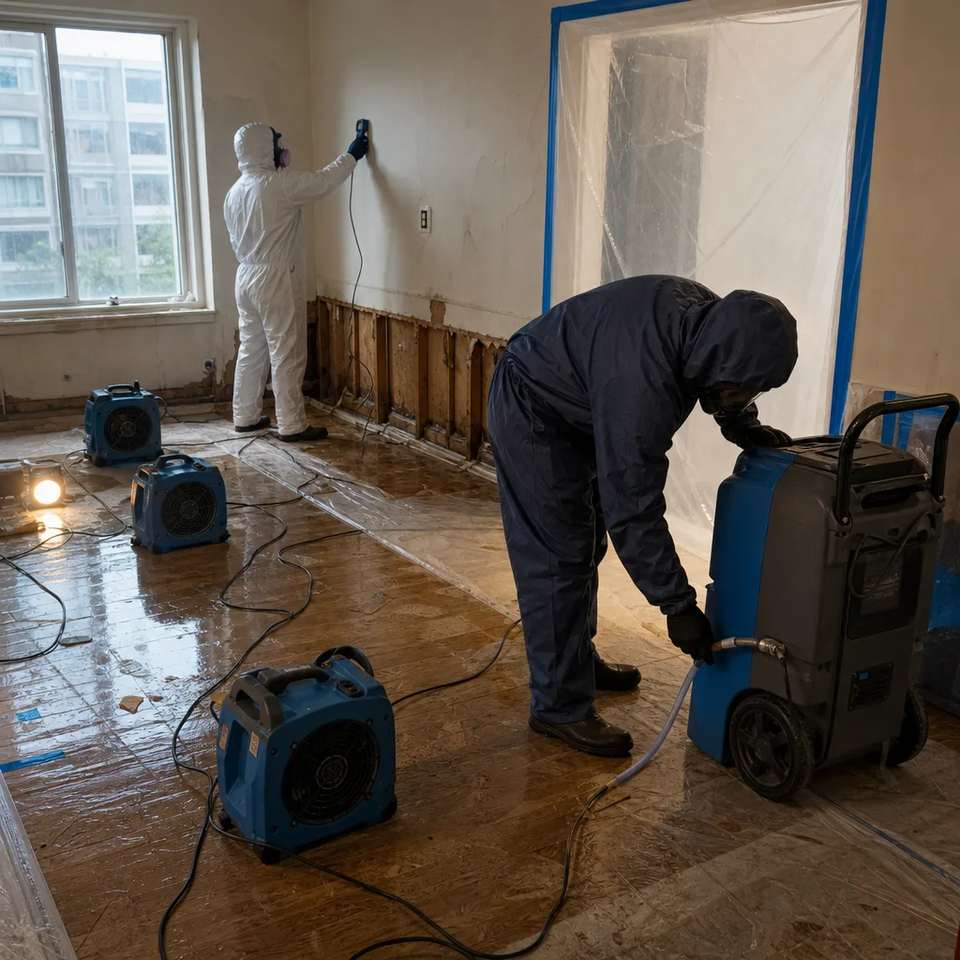
The short version, with sources
Key Takeaways
Seven facts decide most water damage restoration new york jobs, and each one below is stated with the source it comes from, so it can be checked and quoted exactly as it stands.
Last updated: November 2026
- Mould can begin growing within 24 to 48 hours on materials that stay wet, according to the U.S. Environmental Protection Agency (EPA), which is why extraction and drying start the same day the water is found.
- Professional water damage restoration follows ANSI/IICRC S500, the Standard for Professional Water Damage Restoration published by the Institute of Inspection, Cleaning and Restoration Certification (IICRC) with the American National Standards Institute (ANSI), which sorts every job by water Category and drying Class.
- A standard clean water job dries in 3 to 5 days with commercial equipment running continuously, per the published drying guidance of PuroClean and ServiceMaster.
- Under New York Insurance Law section 2601 and Regulation 64 (11 NYCRR Part 216), an insurer must acknowledge a claim within 15 business days of receiving notice of it, and after a declared natural disaster Insurance Law section 2618 requires payment of the agreed amount within 4 business days once the claim is settled.
- New York Insurance Law section 3420(d) is a timely disclaimer rule for death or bodily injury under liability policies only, and it sets no deadline at all for property damage claims.
- A lawsuit on a New York property policy must be started within 24 months after the loss, under the standard fire policy terms set by Insurance Law section 3404.
- Local Law 55 of 2018 requires owners of New York City buildings with three or more apartments to investigate mould and fix the moisture causing it, according to the New York City Department of Housing Preservation and Development (HPD).
Who stands behind the work
Standards You Can Check, Not Slogans You Have to Trust
Any company can claim to be New York's best. Far fewer can show you a standard, a licence and a paper trail. This is what this page commits to, and what you should demand from whoever you call, us included.
IICRC S500 method
Every job follows the IICRC S500 standard for professional water damage restoration, the same Category and Class system, moisture mapping and dry-standard verification explained in full on this page.
Licensed & insured in NYC
Certificates of insurance are sent to your co-op board, condo management or landlord the same day you call, before a single machine crosses your lobby.
Licence no.: add yours hereReviewed by a working technician
The guidance on this page is written from live NYC job experience, burst risers, sewer surcharges, pre-war plaster, and reviewed against EPA and IICRC guidance, not copied from a national template.
Expert name & cert.: add yours hereReviews you can verify
We would rather show you real, checkable reviews than a star graphic we drew ourselves. Read what past customers say on the public profiles before you decide.
Review profile links: add yours hereDo this first
The First 60 Minutes After Water Damage in NYC
Most of the damage is decided before any professional arrives. These five moves protect your home, your claim and your neighbours below you.
Stop the water
Burst pipe or leaking appliance? Shut your apartment valve. In a co-op or condo, call the super or doorman straight away, only building staff can close the riser, and every minute adds a floor of damage below you.
Cut power to wet rooms
If water is anywhere near outlets, a boiler or appliances, flip the breaker for that room. Never wade through water that may be live.
Get belongings up and out
Move rugs, electronics, documents and furniture off wet floors. Foil or wood blocks under furniture legs stop rust and dye stains bleeding into carpet.
Photograph everything
Wide shots, close-ups and one slow video walk-through of every affected room, before anyone mops. Insurers pay on documentation, not memory.
Call a crew, then your insurer
Extraction first, claim second, both today. Your policy expects you to mitigate further damage, and drying records from day one are what adjusters ask for.
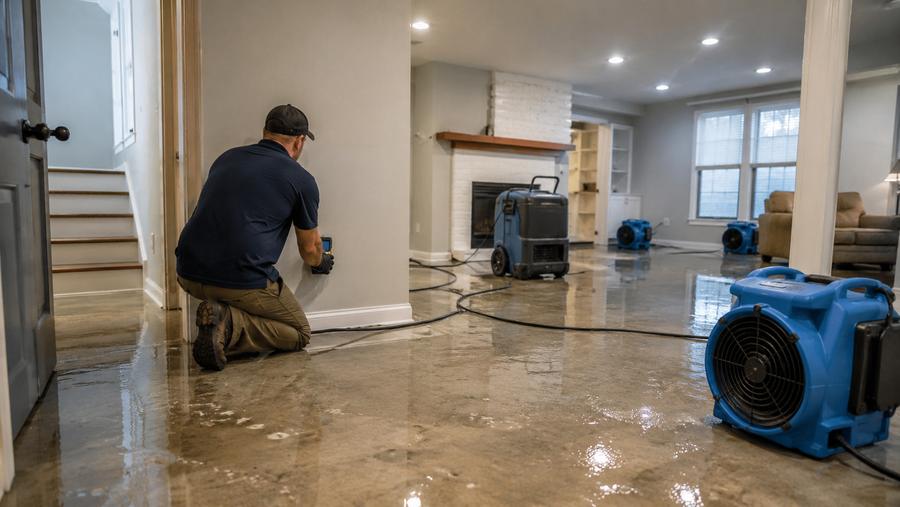
Building staff checklist (co-ops & condos)
- Super / doorman notified and riser shut-off located
- Neighbour below informed, ceiling leaks travel fast
- Elevator padded and booked for equipment and debris
- Certificate of insurance (COI) requested for the crew
- Building management given the drying plan and daily access times
After the first hour
The Rest of the First Day: Hours 2 to 24
The first-hour checklist above stops the bleeding. What you do with the rest of the first day decides how the next three weeks go, whether the claim runs smoothly, whether the drying starts on time, and whether small problems stay small. Here is the order that works, learned from watching the jobs that went well and the ones that did not.
Hours 2 to 4: pin down the facts
While the crew is extracting, or while you wait for them, write down the timeline while it is fresh: when the water started if you know, when you found it, what you did and when, who you called. Times matter, to your insurer, to your building, and to the neighbour below you, and memories blur within days. Photograph the source of the water if it is visible and safe to approach: the split hose, the failed valve, the overflowed drain. If a plumber repairs the source, keep the failed part and the invoice; a bagged, split hose is worth more in a claim argument than an hour of description. Notify your building management in writing, an email is fine, even if you have already spoken to the super in the hallway. Spoken notice starts the work; written notice starts the record.
Hours 4 to 8: open the claim properly
File with your insurer or broker and get the claim number before the day ends. Ask three questions on that call: what is my deductible, does my policy have any special limits that apply here, sewer backup limits and storm deductibles are the usual traps, and what do you need from me and the restoration company? Start the contents list while the damage is in front of you, room by room: item, rough age, what it cost. Photograph each damaged item before it is moved or thrown away, and do not throw anything away until the insurer agrees, adjusters have seen the photographs argument before, and the items themselves end it. If you cannot safely stay in the home, ask about additional living expense cover before booking anything, and keep every receipt from the first night.
Hours 8 to 24: set up the job, and your life around it
By now the drying plan should exist in writing: what was found wet, what comes out, what equipment goes in, when the monitoring visits happen. Read it. Ask what the readings were today and what they need to reach. Agree access arrangements, keys, alarm codes, the hours the crew can come in, because a missed monitoring visit is a day added to the job. In a co-op or condo, confirm the building has the crew's insurance certificate and that elevator and work-hour bookings are made; in a rental, confirm in writing that the landlord has been told and has the plan. Then sort the human side: which rooms are out of action, where everyone sleeps, what the pets do with the noise, which belongings you need rescued first, medicines, documents, work equipment, the things a week without would hurt. Crews prioritise what you point at; point early.
The mistakes of day one
They are nearly always the same. Waiting until Monday to call anyone, because the weekend felt like the wrong time, water does not observe weekends, and mould starts its 24-to-48-hour clock regardless. Turning the equipment off at night because it hums. Throwing away soaked belongings before photographing them, out of a fair desire to clean up. Painting, patching or closing anything before it has been metered dry. And signing a full contract for rebuild work while standing in the emergency, before the scope is known, the emergency work and the rebuild are two decisions, and a good company will happily let you make them separately. Avoid those five, and your job is already ahead of most.
Storm water: the first 48 hours
After a Coastal Storm: The First 48 Hours in New York
Storm flooding runs on a different clock from a burst pipe, because the whole neighbourhood is wet at once and every crew, adjuster and city office is busy. In November 2026 the scale of that problem made the news again: on 5 November 2026, Governor Hochul announced that New York State is requesting federal assistance for coastal storm damage on Long Island and in New York City, as set out in the Flood Cleanup NYC guide to the Brooklyn flooding of November 2026 (floodcleanupnyc.com, updated 12 November 2026). Whether or not help arrives from above, the first 48 hours are yours, and this is the order that protects your home and your claim.
The four reports and records that matter
- Photograph and video everything first, before cleanup starts: the water line on the walls, every affected room, damaged belongings, and the street outside if water came in from there
- Report the claim to your insurer the same day and get a claim number; storm claims are handled in the order they are opened, and late filers wait behind thousands of neighbours
- Report the damage to the City by calling 311 or filing at reportdamage.nyc.gov; city damage reports feed the disaster declarations that bring wider assistance to your area
- Keep every receipt from the first night onward: pumps, cleaning supplies, hotel nights, meals, laundry, and every invoice a crew hands you
Safety rules that outrank cleanup
Treat storm water in a basement as contaminated until its source is known, because combined sewers surcharge in exactly these events. Cut power to wet areas only from a dry place, and never stand in water near live electrics. If you use a generator, run it outside only, at least 20 feet from the building, because generator exhaust kills quietly and quickly in enclosed spaces. Then start the same sequence as any flood: extract, remove what cannot be saved, dry with commercial equipment, and read moisture daily until the structure tests dry. The storm sections of this page, on sewer backups, basement flooding and filing a claim, walk through each of those steps in full.
Storm water in your home right now?
Photograph first, then call. Extraction and a documented drying log started today are worth more than a perfect claim filed next week.
The basics, properly explained
What Water Damage Restoration Actually Is
Water damage restoration is the full sequence that takes a property from wet to verifiably dry and repaired: source control, water extraction, removal of unsalvageable material, structural drying, antimicrobial treatment, moisture verification and rebuild. It is not “a guy with a fan.” Professional work follows the IICRC S500 standard, which sorts every job by how contaminated the water is (Category) and how much material it has soaked into (Class). Those two labels drive the method and the timeline, so here they are, in plain English.
Category 1: Clean water
Water from a sanitary source: a burst supply line, a failed faucet, rain through a roof. It starts clean but does not stay that way, left sitting, it degrades to Category 2 within roughly 24 to 48 hours as it picks up bacteria from floors and walls.
Category 2: Grey water
Water carrying significant contamination: washing-machine and dishwasher discharge, toilet overflow with urine, sump-pump failure. It can cause sickness on contact, so crews use protective gear and antimicrobial treatment, and porous soft furnishings are usually discarded.
Category 3: Black water
Grossly contaminated water: sewage backups, rising flood water, seawater and river water. It carries pathogens and chemicals. Affected porous materials, carpet, pad, drywall, insulation, come out, and the space is disinfected before drying. This is the most expensive category, and the one where DIY is genuinely unsafe.
| Drying class | What it means | Typical NYC example | Drying time |
|---|---|---|---|
| Class 1 | Small area, low-porosity materials, little absorption | Tile bathroom, supply-line drip caught early | 1 to 2 days |
| Class 2 | Whole room affected, water wicked up walls 12 to 24 inches | Washing-machine overflow in a Queens semi | 2 to 4 days |
| Class 3 | Water from overhead; ceilings, walls and floors saturated | Upstairs neighbour’s pipe burst in a Manhattan co-op | 3 to 5 days |
| Class 4 | Deep pockets of trapped moisture in dense materials | Pre-war plaster-and-lath, hardwood over concrete, brownstone masonry | 5 to 10 days |
Classes and categories per the IICRC S500 Standard for Professional Water Damage Restoration. Drying times are typical ranges for NYC housing stock with commercial equipment running continuously.
Not sure which class your job is?
A moisture meter answers that in minutes, and the inspection is free. Call now and a technician will map exactly what is wet before you commit to anything.
Room by room
Water Damage in Each Room: What to Watch, What to Save
Water behaves differently in every room because every room is built differently. A kitchen hides water under cabinets for months. A bathroom is designed to get wet and still manages to rot. Here is what crews look for in each space, and what you should look for before they ever need to come.
Kitchens
The kitchen is the most common source room in the home and the best at hiding it. The dishwasher, the fridge water line, the sink trap and the waste disposal all live behind or under cabinets, and a slow drip there soaks the cabinet base, the subfloor and the ceiling below while the visible kitchen looks fine. The classic discovery is a toe-kick that feels soft, a cabinet floor that has swollen and lifted its covering, or a musty smell that only appears when the under-sink door opens. In a flood, kitchen cabinets are a judgement call: solid wood boxes often dry and survive; particleboard and MDF cabinets drink water, swell, and rarely come back, plan on replacement and be pleasantly surprised if the meter says otherwise. After any kitchen water event, drying must reach under the cabinets, which usually means the toe-kicks come off and air is pushed into the cabinet voids. A kitchen dried only from the middle of the floor is a kitchen still wet where it counts.
Bathrooms
Bathrooms are waterproofed at the surface and vulnerable everywhere else. The failures are at the edges: the seal where the tub meets the floor, the grout lines that cracked years ago, the wax ring under a toilet that has been weeping into the subfloor with every flush, the shower pan in an older building that finally rusts through. Bathroom water damage announces itself downstairs, the ceiling stain in the flat below is more often a bathroom than anything else, or as tiles that sound hollow, grout that stays dark, and a floor that feels springy by the tub. Because bathrooms are small and tiled, people assume they dry fast; in truth the water is usually under the tile, in the mud bed or the subfloor, and it dries slowly and needs metering, not patience. If you are renovating a bathroom, the waterproofing you cannot see is worth more than the tile you can, most bathroom leaks are born in a skipped membrane or a cheap seal years before they are discovered.
Basements and cellars
Everything a home sheds ends up in the basement: groundwater, storm water, sewer water, the water heater, the boiler, the laundry. It is also where belongings go to be forgotten, which is why basement losses carry the longest contents lists. The working rules: treat any basement water as suspect until its source is known, because sewer involvement changes the whole job; get stored items off the floor permanently, plastic bins on shelving, never cardboard on concrete; and remember that concrete itself wicks water upward into studs and stored wood long after the floor looks dry. A finished basement multiplies the work on the job, which is why the prevention section of this page talks about pumps, valves and grading with such feeling. New York also draws a legal line underground: cellars and basements are not the same thing in the housing code, and below-grade living space carries real risk in fast water, Ida taught that at a terrible price. If people sleep below grade in your home, their safety plan for a storm is not a restoration topic. It is the topic.
Bedrooms and living rooms
These rooms rarely start a water problem; they receive it, from the bathroom next door, the flat above, the radiator by the window, the roof two floors up. The damage pattern is ceilings and the tops of walls first, then floors: a ceiling that stains, sags or lets go entirely if plaster gets heavy with water, which is a genuine safety issue, a waterlogged plaster ceiling can come down in a sheet, and a bulging ceiling should be treated as a ceiling that is deciding when, not whether. Hardwood in these rooms is worth fighting for and usually winnable if drying starts fast, using floor mats that pull moisture through the boards. Carpets are a category question: clean water, quick response, and the carpet often cleans and dries; the pad underneath almost never survives and is cheap to replace. The belongings in these rooms, mattresses, upholstered furniture, books, electronics, are triaged on day one, because a mattress that sat in Category 2 or 3 water is not a cleaning project, whatever anyone tells you.
Closets, cupboards and the spaces nobody opens
Ask a crew where the worst hidden damage hides and they will say the same thing: the spaces nobody opens. The closet on the bathroom wall. The cupboard under the stairs. The storage room at the back of the basement. Water reaches these places quietly, the air never moves, and mould grows undisturbed for months, the discovery is often a smell traced, finally, to a door nobody had opened since spring. Build a habit: any closet that shares a wall with a bathroom, a kitchen or an exterior wall gets opened and looked into a few times a year, and anything stored on the floor of a damp-prone closet lives in a plastic bin, not a cardboard box. If you find growth in a closet, do not just clean the visible patch and close the door, find out what is feeding it, because a closet does not grow mould on its own. Something behind that wall is wet.
Hallways and stairwells in shared buildings
In apartment buildings, the shared spaces tell the building's water story in public: the stairwell wall with the stain that grows every winter, the lobby ceiling that has been patched four times, the basement corridor that smells of damp in August. These are not cosmetic issues. Recurring stains in common areas mean an unresolved leak somewhere in the stack, and they are the building's problem to fix at the building's cost, reported in writing, they become very hard for a managing agent to un-know. For residents, common-area water also matters practically: it is the route crews, equipment and debris will take to reach your flat, and the state of the service elevator and the building's work rules will shape your job's calendar more than the size of the job itself. Know your building before you need it. The time to learn who your super trusts, what the board requires and where the risers are is a dry afternoon, not a wet night.
Why it happens
What Causes Water Damage in New York Homes
Ask any crew that works this city and they will tell you the same thing: the water almost never comes from where people expect. It is rarely a dramatic flood. Far more often it is a pipe that has been thinning for years, a washing-machine hose one cycle away from splitting, or a drain that has been slowing down for months and finally gives up during a dinner party. Knowing the usual causes does two things. It tells you where to look in your own home before anything goes wrong, and it tells you how fast to move when one of them happens to you, because some causes give you a weekend to think, and some give you twenty minutes.
Burst and frozen pipes
This is the biggest single cause of serious water damage in New York, and winter is its season. When water inside a pipe freezes, it expands, and the pipe splits, often not where the ice is, but further along where the pressure builds. The real damage starts at the thaw, when the split pipe starts flowing at full pressure into a wall, a ceiling or a closet. Exterior walls, unheated crawl spaces, pipes near windows that do not seal properly and lines running to rooftop tanks are the usual weak points. In apartment buildings, one burst pipe on the ninth floor is a water problem for every flat down to the fifth. If you are travelling in winter, leave the heat on, open the cupboard doors under sinks on outside walls, and make sure somebody has a key and knows where your shut-off valve is. A burst pipe flowing for a weekend while a flat sits empty is how a contained job turns into a gut renovation.
Old plumbing in old buildings
A large share of this city was built before modern plumbing existed, and much of the original pipework is still in the walls. Galvanised steel pipes corrode from the inside out. After forty or fifty years the inside of the pipe narrows, the pressure rises, and the wall of the pipe gets thin enough to pinhole. Cast-iron drain stacks crack and rust through at the joints. Copper develops pinhole leaks where the water chemistry eats at it year after year. The warning signs are easy to miss because they look like nothing: a small brown spot on a ceiling, a patch of paint that bubbles and settles, water pressure that is not quite what it was, a faint smell in a cupboard under a sink. None of these fix themselves. Old plumbing fails slowly and then all at once, and the slow part is your cheap warning, if you act on it.
Appliances that let go
Washing machines, dishwashers, water heaters, fridges with ice makers and air-conditioning units all hold or move water, and every one of them has hoses, valves and seals that age. The rubber washing-machine hose is the classic: it sits under pressure day and night for years, hardens, and splits, usually, it seems, at 2 a.m. or while you are on holiday. A water heater rarely announces itself either; the tank corrodes at the bottom and starts with a slow drip into the pan, then a steady leak, then a split. Dishwasher leaks hide under the unit and soak the subfloor for months before the boards cup or the ceiling below stains. The fixes are dull and cheap: braided steel hoses instead of rubber, changed every five years whether they look tired or not, a pan and drain under the water heater, and a look under every appliance once or twice a year with a torch and a dry hand run along the pipes.
Roof, window and facade leaks
Rain gets in where buildings are supposed to keep it out: flat roofs with blocked drains, parapet walls with cracked coping, window frames whose sealant gave up years ago, and brickwork that has been drinking water every storm and finally lets it through to the plaster inside. These leaks are the hardest to trace because water travels. It enters at the roof, runs along a beam or inside a wall, and shows itself two floors down and six feet sideways from where it got in. That is why a ceiling stain is a clue, not a diagnosis. Top-floor flats and brownstone owners carry most of this risk, and the damage grows quietly, a roof drain cleared twice a year is a small job; a rotted roof deck and three ruined ceilings are a very big one.
Radiators and steam heat
Steam heating is a New York speciality, and so are its leaks. Radiator valves weep. Air vents spit. A radiator that has been painted ten times can rust through at a seam. Steam traps fail and hammer, and the condensate that should return to the boiler ends up in the wall instead. The damage pattern is different from a pipe burst: it is often hot water or steam, it happens in the same spot every heating season, and it quietly rots the floorboards around and under the radiator until they go soft. If the floor by a radiator feels spongy, or the paint on the wall behind it keeps blistering no matter how often you redo it, there is water in that story. Tell the super early in the season, not in February when the building's plumber has a three-week list.
Sewer and drain backups
Much of New York still runs on combined sewers, one pipe carrying both household waste and storm water. In a heavy storm that pipe can fill beyond capacity, and the water looks for the lowest way out, which is often a basement toilet, a floor drain or a tub in a garden-level flat. The result is Category 3 water: sewage in your home. It is the worst water to deal with and the most common in basement and ground-floor units in parts of Queens, Brooklyn and the Bronx. Street-level flooding gets the headlines, but plenty of backups happen on dry days too, when tree roots, grease or a collapsed section of house drain slows the line until it reverses. A backwater valve fitted on your drain line is the one device that stops the city side from becoming your problem, and after one backup, no homeowner ever regrets fitting one.
Storms and heavy rain
New York rain is not what it was. The storms that used to arrive once a decade now seem to arrive every couple of summers, and the city drainage system was not built for the amount of water that can fall in an hour. Hurricane Ida in 2021 made the danger plain, most of the people who died were in basement flats that filled faster than anyone expected. Even in homes where nobody is at risk, a hard storm finds every weakness: window wells, basement stair drains, cracks in the foundation wall, gutters that overflow straight down the facade. If your basement has ever taken water in a storm, assume it will again, and treat the fix, drainage, grading, a sump pump with a battery backup, a backwater valve, as a when, not an if.
Sprinklers, standpipes and building systems
In larger buildings, some of the biggest losses come from the building's own systems: a sprinkler head knocked during a move or a renovation, a standpipe valve opened by accident, a rooftop tank overflow, a pump seal that fails in the basement. These incidents release a lot of water very fast, and they often happen in stairwells, shafts and service rooms where nobody notices for hours. The lesson for residents is simple: know who to call in your building before it happens, because in a tower the first job is never the drying, it is getting building staff to the right valve.
Whatever the cause, the pattern afterwards is the same. Water spreads sideways and down, hides inside walls and under floors, and starts feeding mould within a day or two. The cause decides how dirty the water is and how much has to come out. The clock decides how big the bill gets.
No price lists: one call
Your Exact Price Comes From a Free Inspection, Not a Website
No honest crew can price a water job from a photo or a form. What looks like one wet room is often three once a moisture meter touches the walls, and the meter reading, not a guess, is what your quote and your insurance claim are built on. So we don’t publish prices. We come out free, map every wet material, and hand you a fixed written quote on site before any work starts. No obligation, no pressure, and if you want a second opinion afterwards, the moisture map is yours to keep.
☎ Call now: free inspection, 24/7Standing water right now? Skip the reading and call, extraction first, paperwork second.
How the work is done
Our Restoration Process: With the Paperwork to Prove It
Good restoration is measured, not guessed. Every job runs the same eight steps, and every drying job produces a daily log: moisture readings at mapped points, equipment counts, and humidity and temperature records. That log is what your insurer wants to see, and what protects you if a mould claim shows up later.
Inspection & moisture mapping
Thermal imaging and pin/probe meters find water you cannot see, inside wall cavities, under hardwood, behind tile. Wet points are marked and photographed.
Source control & safety
Leak stopped with building staff, power isolated where needed, Category 2/3 areas contained with plastic barriers and negative air.
Extraction
Truck-mounted and portable extractors remove standing water, extraction pulls out far more water than evaporation ever will, and it shortens drying by days.
Selective demolition
Only what cannot be saved comes out: swollen baseboards, saturated drywall (flood cuts at 2 or 4 feet), wet insulation, Category 3 carpet and pad.
Structural drying
Commercial dehumidifiers and air movers are placed by calculation, not by feel, and run continuously. This is the 3 to 5 day heart of the job.
Daily monitoring
A technician re-reads every mapped point daily, adjusts equipment, and records progress in the drying log you and your adjuster can see.
Cleaning & antimicrobial treatment
Surfaces are HEPA-vacuumed, cleaned and treated. Contents are cleaned, packed out if needed, and stored until rebuild is done.
Verification & rebuild
Work stops when readings hit the dry standard, the moisture level of unaffected material in the same building, not when the surface “feels dry.” Then drywall, floors, trim and paint are rebuilt.
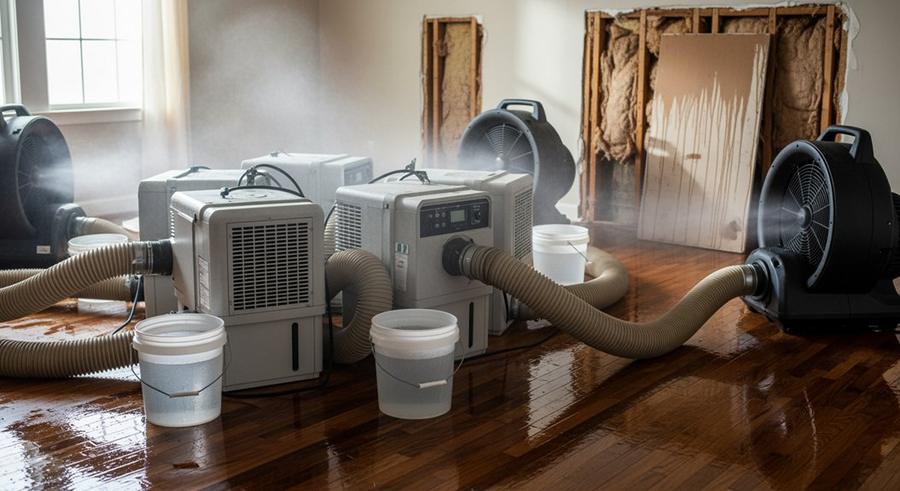
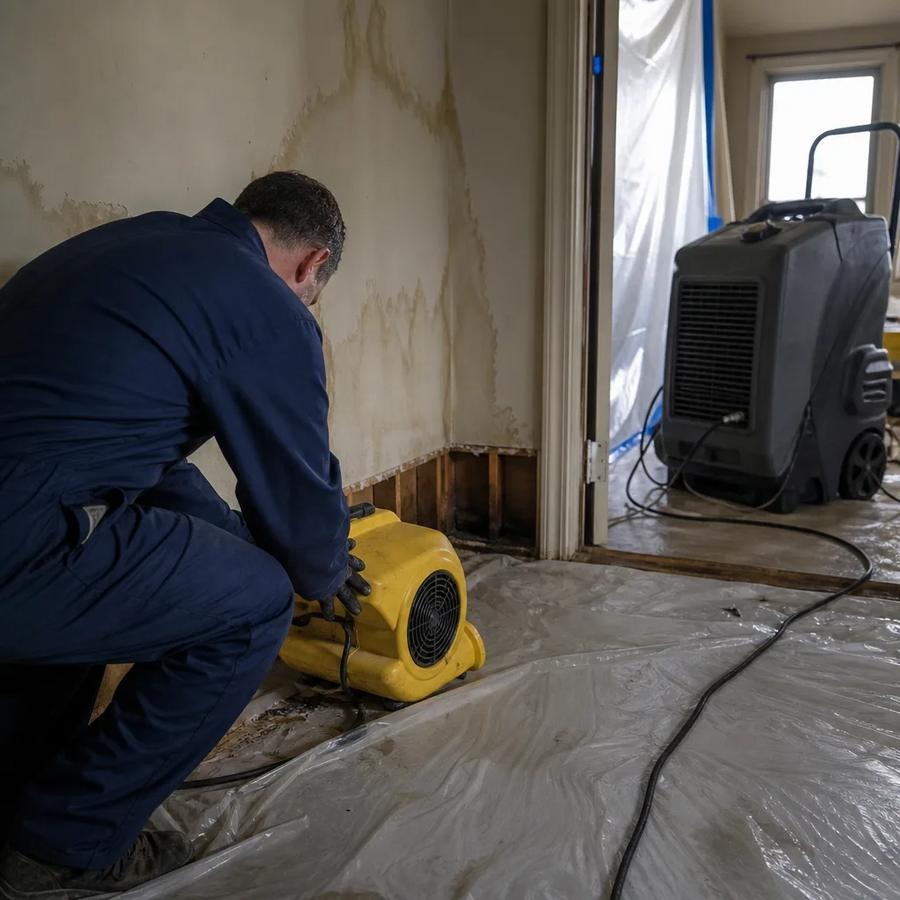
The equipment on a proper job, by name
Professional drying kit has names, and you are entitled to ask which ones are coming into your home. On a well equipped New York job you will see low grain refrigerant dehumidifiers from makers such as Dri-Eaz and Phoenix doing the heavy moisture removal, B-Air air movers sweeping air across wet surfaces, and Injectidry systems pushing dry air inside wall cavities and under floors, the places room air never reaches. Thermal imaging cameras and pin and probe moisture meters find and measure the water, and containment plastic with HEPA filtered air scrubbers keeps dust and spores in the work area on larger jobs. The kit is only half of it. The other half is the routine around it: every machine photographed in place with its hour meter, the same marked points read with the same meter in the same way each day, and every reading logged the same day it is taken, so your adjuster gets proof rather than promises. That daily log is the practice the best documented firms in this city, such as Floodline on the Upper West Side, are known for, and it is the standard to hold any crew to, ours included.
A realistic timeline
What the week actually feels like
A Drying Job, Day by Day
People picture restoration as a crew arriving, doing something loud, and leaving. The truth is less dramatic and more like a short, well-run hospital stay for your home: a busy first day, several days of machines doing quiet work while a technician checks the numbers, and a clear test at the end that says whether the patient is actually better. Here is how a typical clean-water job, say, a burst pipe that soaked two rooms of a flat, runs in practice.
Day one: noise, plastic and decisions
The first day is the disruptive one. Furniture is moved or lifted onto blocks. Wet carpet, if there is any, is lifted so the pad underneath can come out, pad holds water like a sponge and rarely survives. The crew meters every wall, marks the wet line with tape, and takes the photographs that will anchor your insurance file. Where drywall is saturated, the flood cut happens today: a straight cut, usually two feet up, the wet board and insulation bagged and removed, the inside of the wall suddenly visible for the first time. Baseboards come off so air can reach the bottom plate of the wall, the piece of timber that rots first and complains last. By evening the air movers and dehumidifiers are placed and running, the drying log has its first set of readings, and the flat sounds like a windy beach. That noise is normal, and yes, it runs all night, turning equipment off at night is the single most common way homeowners accidentally add two days to their own job.
Days two and three: the quiet middle
Nothing much seems to happen, and that is the point. The machines are pulling moisture out of the structure at a steady rate, and a technician visits each day to re-read the same marked points, empty or check the dehumidifiers, and move equipment as areas dry and others lag. This is where you learn to read your own job. Ask for the numbers. A wall that read 28% on day one should be falling, 22%, 18%, 15%, towards the dry standard, which might be 10 to 12% for timber in your building. If a reading is not moving, that is useful information, not failure: it usually means water is trapped somewhere, behind a vinyl wall covering, inside a double layer of drywall, under a tiled floor, and the crew changes approach, opening a small inspection hole or adding directed heat or a floor-drying mat. Honest crews like these questions. The drying log grows a page a day, and your adjuster will like it as much as you do.
Days four and five: the verdict
By now most clean-water jobs are close. The last readings decide everything. When every mapped point matches the dry standard, the moisture level of the same material in an unaffected room of your home, the equipment comes out, usually the same day. If one area is still holding out, the crew may leave one dehumidifier for another day rather than pull everything and hope. Hope is not a drying strategy. Before the machines leave, the space is cleaned: HEPA vacuuming of dust from the demolition, surfaces wiped down, antimicrobial applied where the category of water called for it. You get the completed drying log. Keep it. It is your proof, to your insurer, to your co-op board, and one day to a buyer, that the water was dealt with properly.
What can stretch the timeline
Plaster instead of drywall. Pre-war plaster-and-lath can hold two or three times the water of modern board and gives it up slowly. Five to ten days is normal, and rushing it by sealing the wall early just locks the moisture in.
Layers nobody knew about. A second floor laid over the first, tile over tile, drywall over plaster, every hidden layer is a sandwich that traps water in the middle. Crews find these with meters and small inspection cuts, and each one adds time.
Building rules. A co-op that allows work only on weekdays between 9 and 5 turns a five-day job into a calendar week and a half. The drying still takes five days of machine time; the calendar is what stretches.
Power. Drying equipment is thirsty for electricity. In older buildings with limited circuits, the crew may have to run fewer machines at once, or bring in a temporary supply, and the job slows accordingly.
The source is not fixed. Drying against an active leak is pointless. If the pipe above is still weeping, the clock does not start until the plumbing is repaired, one reason restoration and plumbing have to talk to each other from day one.
Life in the flat during drying
Most people stay in their homes through a drying job, and most manage fine once they know what to expect. The noise is a steady whoosh, roughly like a window air-conditioner on high, in the affected rooms only. The rooms being dried will feel warm, dehumidifiers put out heat as they work, and the air will feel dry. Keep the doors to the drying area closed and the rest of the flat's air-conditioning or heating running normally; the crew sets the space up as a sealed system and opening windows "to help" usually hurts, especially in a humid New York summer. Pets do fine with the noise after the first hour, but keep them out of any contained Category 2 or 3 area, full stop. If the kitchen or the only bathroom is the affected room, talk to your insurer about additional living expenses before you book a hotel, not after, a short stay nearby is commonly covered when the home is genuinely unusable, and the receipts are the claim.
How long drying really takes
The Drying Timeline, Job by Job
Ask five companies how long drying takes and you will hear five answers, because the honest answer depends on the material that got wet. Drywall gives water up quickly. Pre-war plaster holds it and releases it slowly, taking roughly two to three times longer than modern board. Here are the ranges professional crews work to, so you can judge any promise you are given, including ours.
| Type of job | What is wet | Typical drying time |
|---|---|---|
| Small contained leak, caught early | One wall or floor area, clean water, source fixed the same day | 2 to 3 days |
| Standard clean water job | One or two rooms, drywall and flooring, commercial drying running continuously | 3 to 5 days |
| Flooded basement | Open space pumped out first, then monitored drying of studs, concrete and remaining materials | 3 to 6 days |
| Pre-war plaster, contained leak | Plaster and lath walls in a pre-war apartment or brownstone | 5 to 10 days |
| Wet stack, multi-floor event | Water through several flats on one riser line, standard construction, until every unit tests at dry standard | 7 to 14 days |
Ranges reflect published professional guidance and documented New York practice: standard drying of 3 to 5 days (PuroClean and ServiceMaster guidance), small caught-early leaks in 2 to 3 days, flooded basements needing 3 to 6 days of monitored drying after pump out, and plaster timelines of 5 to 10 days for a contained leak and 7 to 14 days to dry standard on larger events (Floodline, Upper West Side). Rebuild time comes on top of drying, and building work rules can stretch the calendar without adding a single day of machine time.
Dry is a meter reading, not a feeling
Every range above ends the same way: when the readings say so. A wall can feel dry to your hand while the cavity behind it is still wet enough to grow mould, which is why crews judge a job by moisture readings taken inside the structure and compared against a dry reference, unaffected material in the same building. The working rule from professional drying walkthroughs is simple enough to quote: keep drying until the materials test dry, not until the air feels dry. If a crew packs up because the room feels fine, without showing you final readings at every mapped point, the job is not finished, whatever the invoice says.
What the clock is really counting
Drying time starts when the source is fixed and the equipment is running, not when the water first appeared. A leak that ran for a week before anyone called has already spent its easy days. Category matters too: clean water can often be dried in place, while sewage work removes contaminated porous material first and dries what remains. And mould sets the deadline over everything, because growth can begin within 24 to 48 hours on wet materials, per EPA guidance. The ranges on this page assume a prompt start. Every day of delay moves a job one row down the table.
Want the timeline for your job, in writing?
The free inspection ends with a moisture map and a drying plan with expected days, based on your readings, not a guess over the phone.
What we fix
Water Damage Services in New York City
Water damage restoration in New York City runs to nine core services, from emergency extraction to full rebuild, and every one of them starts the same way: stop the source, meter what is wet, and dry to a verified standard before anything is closed up.
Emergency Water Extraction
Standing water removed day or night, before it migrates into walls, subfloors and the ceiling of the unit below you.
Basement Flood Cleanup
NYC basements flood from storms, sewer surcharges and failed sump pumps. We extract, sanitise, dry, and flag the backwater-valve and drainage fixes that stop a repeat.
Burst & Frozen Pipe Repair Support
Winter pipe bursts are New York’s most common big loss. We dry the structure, document for the claim, and coordinate with your plumber on the repair.
Sewage Backup Cleanup
Category 3 work done properly: containment, removal of contaminated porous materials, disinfection and odour control, never just a mop and air freshener.
Leak Detection & Moisture Inspection
Stain on the ceiling but no visible leak? Thermal imaging traces the water path back to the source, so the repair fixes the cause, not the symptom.
Mould Remediation
Where water sat too long. Contained removal, HEPA filtration and clearance-minded documentation, handled to NYC Local Law 55 requirements where they apply.
Ceiling & Wall Water Damage
Sagging plaster, bubbling paint, brown ceiling rings, the classic upstairs-leak signature in NYC apartments. We open, dry and rebuild, and document who caused what.
Appliance Leak Cleanup
Washing machines, dishwashers, water heaters and AC condensate lines, slow leaks that rot subfloors quietly until the floor gives way. Fast drying saves the floor.
Reconstruction & Rebuild
Drywall, plaster, hardwood, tile, cabinets, trim and paint, one crew from first extraction to final coat, so nothing falls between two contractors.
The services, without the sales talk
Each Service, Explained Properly
Restoration menus all sound the same because the work follows the same standard everywhere. What differs is how each job actually runs in a New York home, the access, the building rules, the materials. Here is what each service above involves when it is done properly, what it cannot do, and the questions worth asking about it.
Emergency water extraction
Extraction is physics, not mopping. A truck-mounted or portable extractor with a weighted wand pulls water out of carpet and pad far faster than evaporation ever could, crews use the rule of thumb that removing water mechanically is many times more effective than drying the same water out with air. Every gallon extracted on day one is a gallon that does not wick up your walls overnight. On hard floors, squeegees and wet vacuums clear the surface, but the real target is the water you cannot see: under floating floors, inside the carpet sandwich, at the base of walls. Extraction is also the step that protects the flat below you. In a tower, the fastest way to limit a neighbour claim is to get the standing water up before it finds the next path down. Ask the crew how much water they removed, on a serious job they will know, because the tank gets emptied and counted.
Structural drying and dehumidification
Drying is a calculation. The technician works out the volume of the space, the class of the loss and the amount of water to be removed, and places dehumidifiers and air movers to match, commercial low-grain refrigerant or desiccant units that pull far more water per day than anything sold for home use. Air movers are angled to sweep air across every wet surface, breaking the thin layer of saturated air that clings to it and slows evaporation. Done right, the room becomes a system: warm dry air in, moisture captured, readings falling day by day. Done wrong, one fan in the corner of a wet room, the surface feels dry while the wall cavity stays soaked. That difference is the entire business. It is also why daily monitoring is part of the service and not an extra: without readings, nobody knows whether the system is working or just making noise.
Sewage backup cleanup
Sewage work runs under different rules because the water itself is the hazard. The crew seals the area, works in protective equipment, and removes every porous material the water touched, carpet, pad, drywall to above the water line, insulation, soft furnishings that cannot be disinfected. Hard surfaces are cleaned and disinfected, the space is dried, and odour treatment finishes the job. What cannot happen is the cheap version: extraction, a spray of something scented, and the carpet left down. Contamination does not evaporate. If your basement has had one backup, ask the crew about the two fixes that change the future, a backwater valve on the drain line and, where the layout allows, an overhead sewer conversion. The cleanup ends the incident; the plumbing ends the pattern.
Basement flood cleanup
Basements collect every kind of water: storm water through walls and window wells, sewer surcharges, sump failures, water-heater splits. The first decision is what the water is, because that decides what can be saved. The second is power, a flooded basement with live electrics is a job for the utility and an electrician before it is a job for anyone else. Once safe, the sequence is extraction, removal of soaked contents and materials, cleaning, disinfection where needed, and drying with equipment sized for a big open space. Finished basements are bigger jobs because there is more to lose: studs and insulation behind the panelling, flooring over concrete that traps moisture underneath, furniture and stored belongings. The honest conversation after a basement flood is about the next one, grading, drainage, sump pumps with battery backup, because a basement that has flooded once has shown you its weak point.
Leak detection and moisture inspection
Not every job starts with a flood. Some start with a stain, a smell, a floorboard that feels wrong. Leak detection is the detective work: thermal cameras that show cold wet areas as colour changes on a screen, pin meters that read moisture inside wood and drywall, probe meters that reach into wall cavities through tiny holes, and plain method, following the water uphill, because water stains appear downhill and downstairs from their source. A proper inspection ends with a map and a cause, not a shrug: the stain on your ceiling traced to the bathroom above, the soft floor traced to a dishwasher line that has been dripping for months. This service saves you twice, once by fixing the real cause instead of the visible symptom, and again because an early, small drying job is a fraction of the size of the late, large one.
Mould remediation
Mould work in New York is regulated work. Where Local Law 55 applies, larger jobs require a licensed assessor to define the scope and a licensed remediator to carry it out, with the two kept separate so the person checking the work is not the person who did it. The method matters more than the chemicals: containment sealed under negative air pressure so spores do not spread to clean rooms, HEPA-filtered air scrubbers, removal of mouldy porous material in sealed bags, HEPA vacuuming and damp wiping of hard surfaces. Bleach on a wall is not remediation, it wets the surface, leaves the roots in porous material, and does nothing about the moisture that caused the growth. Every mould job that lasts starts with the water source fixed and the structure verified dry. If a company quotes mould work without asking where the water came from, they are quoting you a job you will buy again.
Contents: your furniture and belongings
The building gets the attention, but it is your things you live with. Contents work starts with triage on day one: what is wet, what can be cleaned and dried, what cannot be saved. Upholstery that sat in clean water for a few hours often cleans up well; the same sofa in sewage water does not, and no honest cleaner will tell you otherwise. Wood furniture is dried slowly to stop it splitting. Papers, photographs and books are time-sensitive, freezing halts mould on paper and buys time for proper drying, a trick libraries use after floods. Everything unsalvageable is photographed and listed before disposal, because that list is your insurance claim. On larger jobs your belongings are packed out to storage and returned after the rebuild, which is slower but far better than living around stacked boxes in a damp flat for three weeks.
Reconstruction and rebuild
The rebuild is where jobs are won or lost twice: once in the drying, and again in how the home is put back. Drywall hung before the cavity is verified dry will grow mould behind fresh paint, it happens, and it is why verification readings come before board, always. A proper rebuild replaces what was removed to the same standard or better: insulation back in the wall, board taped and finished, trim matched, floors laid on a subfloor that has passed a moisture test, paint in the right order with stain-blocking primer where water marked the surface. In co-ops and condos the rebuild is also paperwork, alteration agreements, board approvals, work-hour rules, and a company that works in your building type will have that process ready before you ask. One crew from extraction to final coat means one phone number when anything is not right, and no gap where the drying company blames the builder and the builder blames the drying.
Local, not a call centre
Water Damage Restoration by Borough
Water damage restoration differs by borough because the housing stock differs: Manhattan towers leak down through stacks, Brooklyn brownstones wick water sideways, Queens basements take sewer surcharges first, and each pattern needs its own drying plan. Pick your borough below.
Crews cover all five boroughs: tonight
Manhattan towers, Brooklyn brownstones, Queens basements, Bronx pre-wars, Staten Island houses and Long Island. One call dispatches the nearest crew, 24/7.
The details behind the tabs
Borough by Borough: What Actually Goes Wrong, and Where
New York is five different housing stocks sharing one name. A drying plan that works in a Staten Island colonial fails in a pre-war Manhattan tower, and the failure points in a Queens basement flat do not exist in a Bronx walk-up. This is the longer version of the tabs above, the patterns crews see borough by borough, and what they mean if you live there.
Manhattan
Manhattan water damage is a vertical problem. In a borough of towers, water starts high and visits everyone below. The classic Manhattan loss is not in your flat at all, it is the flat two floors up, where a radiator valve, a washing-machine hose or a bathroom renovation went wrong, and your ceiling is simply where the water announced itself. That is why Manhattan jobs are as much about documentation as drying: moisture maps, photographs and timestamps that show whose water went where, because three households, two insurers and a managing agent will all read that file before anyone pays anyone. The buildings themselves set the rules. Co-op boards want alteration agreements and certificates of insurance before a crew crosses the lobby. Service elevators are booked in slots. Noisy work stops at 5 p.m. and does not happen on Sundays. A job that takes four days of drying can take nine days of calendar, and a company that does not know your building type will promise you the four and deliver the nine. The housing stock splits in two: pre-war buildings with plaster-and-lath walls that dry slowly and hide asbestos in old materials, and post-war towers with drywall that dries faster but stacks twenty flats above one riser. In both, the fastest thing you can do is know your super's number and your own shut-off valve, in Manhattan, minutes of flow are measured in other people's ceilings.
Brooklyn
Brooklyn is the brownstone borough, and brownstones fail in their own ways. The masonry party wall shared with the next house wicks water sideways, so your neighbour's leak can dampen your wall without a drop ever falling in your home, and your leak can do the same to them, which makes early, friendly documentation a gift to both sides. Garden-level and basement units in brownstones and limestone houses take storm water and sewer surcharges first, and their low ceilings and wood floors suffer for it. Brick and limestone also punish rushed drying: pull moisture out too fast and salts in the masonry bloom on the surface and finishes fail; the drying has to be steady and measured. Further out, in the detached and semi-detached neighbourhoods of southern and eastern Brooklyn, the pattern turns suburban: roofs, gutters, water heaters and finished basements. Across the borough, the other constant is renovation. Brooklyn renovates constantly, and a share of its water damage is construction water: a pipe opened at the wrong moment, a temporary cap that was not, a new bathroom tested into an old drain. If work is happening above you, a polite introduction to the contractor before the plumbing starts is worth more than any claim after it.
Queens
Queens carries the city's hardest water lesson. When Hurricane Ida's rain overwhelmed the drains in September 2021, it was Queens basement flats that filled, and Queens families who were lost. The borough's housing, one- and two-family homes, many with basement or ground-floor units, much of it served by older combined sewers, is simply the most exposed in the city to fast water from below. Sewer surcharge backups are a recurring fact in neighbourhoods across the borough, and they must be treated as what they are: Category 3 events, with contaminated materials removed and the space disinfected, not mopped. For homeowners, Queens offers one advantage the tower boroughs do not: you control your own shut-off, your own roof, your own drain line. That control is worth money if you use it before the storm, a backwater valve fitted, a sump pump tested, gutters cleared, the grading at the foundation checked so water runs away from the house instead of towards it. Queens jobs also skew towards the slow leak: water heaters in basements, ageing pipes in post-war homes, AC condensate lines dripping into ceilings all summer. The borough rewards the homeowner who looks in the basement once a month with a torch.
The Bronx
The Bronx is a borough of grand pre-war rental buildings, and its water damage runs through them in familiar channels. Steam and hot-water heating systems are the signature source: radiator valves, riser leaks, condensate where it should not be. In a rental building, the legal shape of the job matters as much as the technical one. Landlords carry the duty to repair and to deal with mould under rules including Local Law 55, which requires licensed assessment and remediation above set sizes in covered buildings; tenants carry the duty to report leaks promptly and in writing, because the clock on the landlord's duty starts at notice. Both sides are protected by the same thing, a dated paper trail and a proper drying log, and both sides are hurt when a super's mate with a fan is the whole response. Bronx buildings also hold some of the city's most beautiful and most fragile interiors: ornate plaster, original hardwood, terrazzo. Drying those materials well is slower and more skilled work than drying drywall, and it is worth insisting on, because replacement never matches what was lost. For owners, the maths is blunt: a documented, professional response to a leak is a fraction of the trouble of an HPD violation, a housing-court order and a mould claim built on months of delay.
Staten Island
Staten Island is the suburban borough, and its water problems are a homeowner's problems rather than a building's. Detached houses mean your roof, your gutters, your grading, your sump pump, and no super to call. The losses follow the pattern of any house: water heaters that split in the basement, washing machines on upper floors that should have had a drain pan, pipes in outside walls during a cold snap, and finished basements that turn a modest flood into a five-figure loss because everything in them, flooring, panelling, furniture, stored belongings, is finished and soakable. The island's low-lying and coastal areas add the storm dimension: Sandy rewrote the map here, and homes near the shore and the island's creeks sit in genuine flood territory where a separate flood policy is not fine print but the whole ballgame. The good news is access. Crews park at the door, equipment comes straight in, work runs without elevator slots or board approvals, and a drying job keeps the pace the machines set. Staten Island rewards the same habits as Queens, one house at a time: maintain the pump, fit the backwater valve, know the main shut-off, and never let a finished basement convince you the concrete below it cannot get wet.
Long Island
Long Island's market works differently from the city's, and homeowners there feel the difference in a good way. The work is dominated by local and regional specialists rather than national franchise hubs, finished basements are the most common big loss, and winter pipe bursts in unheated spaces run a close second. Nassau and Suffolk homes put their mechanicals in the basement, boiler, water heater, laundry, which concentrates the risk exactly where the finished rooms are. Slow leaks are the quiet speciality: a water heater weeping for a month into the subfloor, a condensate line dripping into a ceiling, a fridge line pinholed behind the unit. Because the homes are detached and access is easy, Long Island drying jobs usually run on the faster end of the timelines on this page, provided the call comes early. The island also has its storm geography: the South Shore's relationship with bay and ocean water is a flood-policy conversation every homeowner there should have before hurricane season, not during it. For Long Island readers of a New York City page, the standards are identical, IICRC method, moisture verification, written logs, and any company working on the island should be held to every one of them.
The full site, area by area
Every Area and Service Page on This Site
This home page is the state hub. Each borough, area and service below has its own full page, written for that place or that problem, with its own local detail, questions and guidance. Start from the page that matches your situation.
Water Damage Restoration NYC
All five boroughs, the Hudson and East rivers, one fast response.
Brooklyn
Brownstones, garden units, basement flooding and sewer backups across the borough.
Queens
Houses, basement apartments and combined sewer backups, from Astoria to Far Rockaway.
Bronx
Pre-war rentals, steam heat leaks, landlord duties and Local Law 55 in the Bronx.
Staten Island
Detached homes, finished basements and coastal flooding on Staten Island.
Long Island
Finished basements, burst winter pipes and slow leaks across Nassau and Suffolk.
Manhattan
Co-ops, condos and pre-war towers: upstairs leaks, risers and board paperwork.
Rochester
Lake Ontario shoreline, Genesee River flooding and frozen pipes across Monroe County.
Albany
Hudson River flooding, frozen pipes and historic homes across the Capital Region.
Buffalo
Lake-effect snow, frozen pipes and basement floods across Erie County.
Syracuse
Lake-effect snow, frozen pipes and creek floods across Onondaga County.
Yonkers
Saw Mill River floods, burst pipes and pre-war buildings across Westchester County.
New Rochelle
Long Island Sound storms, Hutchinson River floods and pre-1980 homes across Westchester County.
Mount Vernon
Hutchinson River floods, century-old sewers and basement backups in Westchester's most densely packed city.
Schenectady
Mohawk River floods, Stockade ice jams and frozen pipes across the Capital Region.
Utica
Mohawk River floods, Sauquoit Creek overflows and frozen pipes across Oneida County.
White Plains
Bronx River floods, Mamaroneck River overflows and frozen pipes across Westchester County.
Troy
Hudson River floods, Poesten Kill overflows and frozen pipes across Rensselaer County.
Water Damage Restoration Niagara Falls
Niagara River ice jams, Cayuga Creek floods and frozen pipes across Niagara County.
Water Damage Restoration Binghamton
Susquehanna and Chenango River floods, burst pipes and frozen pipes across Broome County.
Water Damage Restoration Westchester County
Mamaroneck River floods, Bronx River and Saw Mill River flash floods, frozen pipes across Westchester County.
Water Damage Restoration Hudson Valley
Hudson River and creek floods, tidal surge, frozen pipes across the Hudson Valley.
Water Damage Restoration Capital Region
Hudson and Mohawk floods, burst pipes, ice jams across the Capital Region.
Water Damage Restoration Western New York
Lake effect snowmelt, ice jams and creek floods across the eight county region.
Water Damage Restoration Finger Lakes
Eleven lakes, Genesee River floods and canal towns across the fourteen county region.
Water Damage Restoration Central New York
Syracuse and Utica, Oneida Lake and the Mohawk River, across two state regions.
Water Damage Restoration Southern Tier
Binghamton and Elmira, Susquehanna and Chemung rivers, across eight counties.
Insurance Claim
Filing a water damage insurance claim in New York, step by step, with the paper trail.
Behind Walls
Hidden water damage behind walls: signs, meter checks and black mold removal.
Fire Damage Restoration
Fire and smoke damage restoration, from board up to rebuild, in New York City.
Flood Cleanup
Flood cleanup after storms and sewer surcharges: extraction, disinfection and drying.
Water Damage Remediation
Water damage remediation explained: mitigation, drying, verification and rebuild.
Fire Damage Cleanup
Fire damage cleanup: soot, smoke odour, debris removal and contents care.
How Long Does Mold Take to Grow After Water Damage?
The 24 to 48 hour mold timeline, warning signs, and what stops it.
Water Damage Restoration Process
The full restoration process, step by step, from first call to dry home.
What Is Water Damage Restoration
What restoration really is, what it includes, and when to call.
Mold Remediation New York
New York's licensed remediation system, from assessment to clearance.
Water Removal NYC
Standing water pumped out fast, then dried safe, for every NYC home.
Water Damage NYC
Water damage in NYC explained plainly, with fast help for every home.
Water Damage Cleanup Nyack NY
Water damage cleanup in Nyack explained plainly, with fast help for every home.
How to Choose a Water Damage Restoration Company in New York
How to choose a water damage restoration company in New York, with every check that protects your home.
How to Choose a Water Damage Restoration Company in New York
Commercial Water Damage Restoration NYC | 24/7 Emergency Help
Commercial water damage in NYC explained plainly, with fast help for every business.
Commercial Water Damage Restoration NYC | 24/7 Emergency Help
Basement Water Damage Restoration NYC
Basement water damage in NYC explained plainly, with fast help for every basement.
Water Damage Repair New York
Water damage repair in New York explained plainly, with fast help for every home.
Water Damage Restoration Poughkeepsie New York
Water damage restoration in Poughkeepsie explained plainly, with fast help for every home.
Emergency Water Damage NYC
Emergency water damage in NYC explained plainly, with fast help when every minute counts.
Water Damage Cleanup in NYC
Water damage cleanup in NYC explained plainly, from torn-out materials to dry rooms again.
Flood Damage Restoration NYC
Flood damage restoration NYC explained plainly, from flood events and NFIP claims to dry rooms and a flood-resistant rebuild.
How Long Does Water Damage Restoration Take
How long water damage restoration takes explained plainly, from the first call and drying days to fully dry rooms and rebuild.
Flood Damage Cleanup Washington Heights
Flood damage cleanup in Washington Heights explained plainly, with fast help for pre-war homes and basements.
Does Insurance Cover Water Damage Restoration
Whether insurance covers water damage restoration, explained plainly, by cause and New York rule.
Water Damage Mold Remediation
Mold that grew after a leak or flood, remediated the New York way, by licensed assessor and remediator.
Water Damage Restoration Companies New York
Compare the companies serving New York: national franchises, regional firms and local independents, and how to verify licences and certification before you hire.
Water Damage From Upstairs Neighbor
Water damage from an upstairs neighbor in New York City: who pays, what to do in the first hour, and how to document, report and claim.
The New York part nobody explains
Co-ops, Condos, Rentals & Pre-War Buildings: Who Pays, What’s Different
In New York City, who pays for water damage follows the source of the water: the owner whose pipe or appliance failed carries the damage it caused, the building’s master policy covers shared structure, and your own policy covers your belongings and finishes.
Your upstairs neighbour’s pipe burst. Who pays?
This is the single most common NYC water question, and the answer has layers. Generally, the neighbour (or their liability insurance) is responsible for damage caused by their leak, your own homeowner’s or renter’s policy covers your belongings and your unit’s finishes, and the building’s master policy covers shared structure. In practice: document everything, notify the managing agent in writing the same day, and file with your own insurer immediately, they will pursue the neighbour’s insurer (subrogation) rather than leaving you to chase it. Restoration documentation, moisture maps, photos, timestamps, is the evidence that decides these claims.
Renters
Your landlord is responsible for the structure, the plumbing and restoring the apartment to a habitable condition, and NYC’s warranty of habitability means standing water and mould are not “your problem.” Your renter’s policy covers your belongings. Report leaks in writing (email counts) so the timeline is provable, and keep photos of damaged possessions before disposal.
Landlords & building owners
You carry the duty to mitigate. Once notified, slow response becomes your liability, including for mould. NYC Local Law 55 requires covered buildings (generally Class A multiple dwellings) to investigate and remediate mould above set thresholds using licensed assessors and remediators. In buildings with 10 or more apartments, Local Law 61 of 2018 goes further: for mould over 10 square feet, the owner must hire a state licensed mould assessor and a separate state licensed remediator, and the owner and their own staff cannot do the work themselves. Tenants can force repairs through HPD and Housing Court when owners stall. Fast, documented drying is both cheaper and legally safer.
Why pre-war buildings dry differently
Half of this city’s housing stock was built before 1940, and it does not dry like a new drywall box. Plaster-and-lath walls hold water deep and release it slowly (Class 4 drying). Horsehair plaster, multiple paint layers acting as vapour barriers, hardwood over wood subfloor over concrete, masonry party walls that wick moisture sideways into the neighbour’s unit, all of it extends timelines and changes equipment strategy. It also hides asbestos and lead paint in old materials, which is why demo in pre-war buildings starts with testing, not a sledgehammer, and why some jobs need filings with the New York City Department of Buildings (DOB) before rebuild work begins.
Basement apartments & sewer backups
After the deadly basement flooding of Hurricane Ida, the city tightened attention on below-grade living spaces. Basement and cellar units flood first, and in much of Queens, Brooklyn and the Bronx the water is often a sewer surcharge, Category 3, not clean rainwater. That changes the cleanup entirely: porous materials come out, disinfection is mandatory, and a backwater valve is the fix that prevents the sequel.
Condo water leaks: who is responsible, owner, association or landlord?
In a condominium, responsibility follows the building's own documents. The unit owner generally owns and maintains everything inside the unit, including the pipes, hoses and appliances that serve only that unit. The condo association maintains the common elements: the risers, the roof, the shared stacks and the structure. So a leak from a unit's own washing machine hose is the owner's problem, and the owner's liability when it damages the flat below, while a failed riser or a leaking roof lands on the association. The edge cases, and there are always edge cases, are decided by the declaration and bylaws, which is why the managing agent is the first call after the water stops: they hold the documents, they notify the association's insurer, and they coordinate access to the units above and below.
In a rented condo or co-op unit, one more layer is added. The landlord, as unit owner, carries the owner's duties for the structure and the plumbing, and the tenant carries the duty to report leaks promptly and to protect their own belongings, which a renter's policy covers. A tenant who reports in writing on day one has done their part. A landlord who sits on that report owns what happens next.
Water damage in an apartment travels by stack
Apartments that share a bathroom or kitchen wall share plumbing, and they share water damage. A leak in one flat shows up in the flats directly below it, and a slow leak can dampen the wall cavities of a whole stack before anyone sees a stain. That is why a proper inspection in an apartment building never stops at your ceiling: the crew checks the unit above for the source and the unit below for the spread, and the moisture map covers all three. It is also why speed matters more in an apartment than in a house. In a house, your water damages your home. In an apartment, your water damages your neighbours' homes too, and every hour of delay is documented by someone else's photographs as well as yours.
The mould question, answered straight
Mould After Water Damage: What Is True, What Is Exaggerated
Mould attracts two kinds of nonsense: panic from people selling fear, and shrugging from people selling cheap drying. The facts sit in the middle. Mould spores are everywhere, indoors and out, all the time. What they need to become a problem is moisture and food, and a wet wall gives them both. Control the moisture quickly and mould stays a footnote. Miss the moisture and it becomes the story.
How it starts, and how fast
On wet drywall, wood, carpet backing and insulation, mould can begin growing within 24 to 48 hours, that figure comes from the US Environmental Protection Agency, and every professional standard in this trade is built around it. "Begin" is the right word: colonies start microscopic, in the damp material itself, long before you see spots on a wall or smell anything. By the time a musty smell reaches the room, growth inside the wall or under the floor is usually well established. This timing is the whole argument for fast drying. A structure dried to standard within the first two days rarely grows anything worth discussing. A structure left damp for a week is a different job, with containment, removal and testing added to the bill. When people say water damage is a race, this is the race they mean.
What it does to health: honestly
For most healthy people, indoor mould exposure means irritation: a blocked or runny nose, coughing, itchy eyes, a skin rash, worse asthma. For people with asthma, mould allergies, or weakened immune systems, it can be more serious, and young children and older people deserve extra care. What the evidence does not support is the idea that every mould is a deadly poison or that a home with any mould must be abandoned. The sensible position is the one the EPA and the city's health department take: mould in a home is a moisture problem made visible, it should be removed properly, and the moisture must be fixed or it returns. If someone in your home has breathing difficulties that ease when they leave the building, take that seriously and raise it with a doctor and with whoever is responsible for the building, and get the moisture source found, because that pattern is a clue no meter can give you.
Testing: when it helps, when it is theatre
Home mould test kits mostly tell you what you already know, that mould exists, which it does, everywhere. Professional testing earns its money in specific situations: when growth is suspected but not visible (behind walls, under floors), when a landlord-tenant or neighbour dispute needs an independent record, when someone in the home has health symptoms and a doctor wants information, and after remediation, when clearance testing confirms the work actually worked. In New York, where Local Law 55 applies to larger areas of growth in covered buildings, the assessment must be done by a licensed assessor who is separate from the remediator, a rule that exists precisely so the person selling the cleanup is not the person grading it. If a company offers to test and remediate and clear its own work in one visit, that is not a service, it is a conflict of interest with a van.
What proper remediation looks like
Real remediation is mostly containment and removal, not spraying. The work area is sealed with plastic sheeting and kept under negative air pressure, with HEPA-filtered air scrubbers running, so that spores disturbed by the work are captured instead of drifting into the rest of the home. Porous material with growth, drywall, insulation, carpet, soft furnishings, is cut out, bagged in the containment, and removed. Hard surfaces like timber framing and masonry are HEPA-vacuumed, damp-wiped and, where needed, sanded or treated. Then the structure is dried and verified, because remediating mould in a still-damp wall is paying twice. Finally the area is cleaned top to bottom, and on regulated or disputed jobs, an independent clearance check closes the file. Notice what is missing from that list: fogging the room with chemicals and calling it done, painting over growth with ordinary paint, and bleach, which adds water to a moisture problem and does not remove growth from porous material.
The small patch you can handle yourself
City and EPA guidance draws a practical line: a small area of surface mould, the often-quoted figure is under about 10 square feet, like the grout corner of a bathroom that never dries, is a cleaning job a householder can do, with ventilation, gloves, and a proper clean of a hard surface. The catch is the word "surface." Mould on tile grout is a housekeeping issue. Mould on drywall, spreading across a ceiling, appearing after a flood or a leak, or covering anything larger is a moisture problem wearing a mould costume, and it belongs to professionals, in covered New York buildings, by law as well as by sense. And whatever the size: if the mould keeps coming back in the same place, stop cleaning it and find the water. Recurring mould is a leak with good PR.
Claims, without the runaround
Insurance: What’s Covered, What Isn’t, and How to File
Homeowners insurance in New York usually covers sudden and accidental water damage, a burst pipe or a failed water heater, and usually excludes outside flooding, gradual leaks, and sewer backup without a specific endorsement.
Usually covered: sudden and accidental water damage, a burst pipe, a failed water heater, an appliance hose that lets go, rain entering through storm damage to the roof. The resulting damage to floors, walls and belongings is the classic covered claim.
Usually not covered: flooding from outside the building (that needs a separate flood policy, through the National Flood Insurance Program (NFIP) or a private insurer), gradual leaks you lived with for months, sewer backup unless you bought the specific endorsement, and the repair of the failed pipe itself, insurers pay for the damage water did, not the plumbing that caused it.
Your duties: every policy expects you to stop further damage. That means extraction and drying are not optional extras you splurged on, they are the mitigation your policy requires, and the drying log is the proof you did it.
The New York claim clocks, stated correctly
New York policyholders have protections worth knowing by name, and they are often quoted wrongly, so here they are from the statutes themselves. Under Insurance Law section 2601 and Regulation 64 (11 NYCRR Part 216), an insurer must acknowledge your claim within 15 business days of receiving notice of it. After a declared natural disaster, Insurance Law section 2618 sets the disaster clocks, including payment of the agreed amount within 4 business days once the claim is settled. Acknowledgement is not approval, and it is not a cheque, but it means your claim cannot simply sit unanswered. Section 3420(d) is a different rule entirely: it requires a liability insurer to disclaim coverage for death or bodily injury as soon as is reasonably possible, and it does not apply to property damage claims at all. One deadline runs against you rather than the insurer: under Insurance Law section 3404, a lawsuit on a New York property policy must be started within 24 months after the loss. File in writing, keep the date, and if 15 business days pass in silence, quote section 2601 when you chase the company or complain to the New York State Department of Financial Services (DFS).
The leak itself, versus the damage it did: the source of a leak is usually not covered, while the damage it caused usually is. Insurers pay to repair water damaged floors, walls and belongings; they do not usually pay to replace the failed pipe, hose or valve that started it. Budget for the plumbing repair as your own, and claim the resulting damage in full.
The sewer backup rider: backup cover is not part of a standard policy. It is a separate rider, also called an endorsement, added for a modest yearly amount, and it is the only thing standing between a combined sewer surcharge and a claim that pays. If your home sits below street level or has ever taken water through a drain, check your policy for this rider today, while everything is dry, and add it if it is missing.
Filing, step by step
- Photograph and video everything before cleanup
- Call your insurer or broker the same day; get a claim number
- Keep every invoice, extraction, drying, hotel nights if displaced
- Do not throw away damaged items until the adjuster agrees
- Give the adjuster the moisture map and daily drying log
- Get the restoration estimate in writing before approving rebuild
Flood vs. water damage vs. sewer backup: they are not the same claim
| Water damage | Flood | Sewer backup | |
|---|---|---|---|
| Source | Inside the building: pipes, appliances, roof leaks | Outside water rising or flowing in: storms, overflowing waterways | City sewer or drain pushing back into your home |
| Water category | 1 or 2 | 3 | 3 |
| Covered by | Standard homeowner’s / renter’s policy (if sudden) | Separate flood policy only | Only with a backup endorsement |
| Cleanup rule | Dry in place where possible | Porous materials removed, disinfect | Porous materials removed, disinfect |
Definitions follow standard insurer and Federal Emergency Management Agency (FEMA) usage: “flood” means an external event affecting two or more properties or two-plus acres. When in doubt, file, a denied claim costs nothing; an unfiled one can cost everything.
Claims, part two
Working With Your Insurer: Adjusters, Denials and the Paper Trail
The insurance section above covers what is and is not covered. This part covers how the process actually goes, who shows up, what they are looking for, where claims go wrong, and the small habits that make the difference between a claim that pays smoothly and one that drags for a year.
The first visit from the adjuster
After you file, the insurer assigns an adjuster, either a staff adjuster or an independent one working for the insurer, to inspect the damage and price the claim. Expect them to photograph everything, take their own moisture readings, and ask when the water started and when you discovered it. Those two answers matter more than any others, because policies cover sudden events, and the timeline is how "sudden" gets tested. Be straight and be specific: "the pipe burst Tuesday evening, we found it at 9 p.m., the crew started extraction at midnight" is a claim that moves. Your restoration company's moisture map and drying log belong in this meeting, hand them over. A good adjuster is not your opponent; they are a person with a file to justify, and documentation is how you help them justify paying it. Walk the whole property, including rooms that "only got a little wet," because damage declared late is damage argued about.
Why claims get denied: and what to do
Most water claims that fail, fail on a handful of grounds. The insurer says the damage was gradual, a leak that ran for months is maintenance, not an accident. The source was outside water, which is flood, which is excluded. The sewer backed up and the policy has no backup endorsement. Or the claim was filed so late that the damage cannot be separated from what happened afterwards. A denial letter is not the end of the road. Read the exact policy clause it cites. If the facts genuinely differ from the letter's version, the pipe did burst suddenly, and you have a plumber's invoice and a drying log dated the same week, write back with the documents and ask for the claim to be reconsidered. If the amounts are large and the dispute is real, two professionals exist for exactly this: a public adjuster, who works for you for a percentage of the claim, and an insurance attorney for the fights that need one. What never helps is throwing away evidence, exaggerating damage, or backdating a story. Adjusters read water damage for a living; the stain lines tell them the timeline whether you do or not.
Depreciation, deductibles and the two cheques
Homeowners are often surprised that the first insurance cheque does not cover the whole repair. Most policies pay in two parts. The first payment is the actual cash value, the replacement cost minus depreciation for age and wear. The second part, the depreciation holdback, is released when you prove the work was done, usually with final invoices and photos. This is normal, not a trick, but it means your contractor's paperwork has a second job: it unlocks the rest of your money. Your deductible comes off the top of the settlement, and on some New York policies there are separate deductibles, a higher percentage deductible for wind or named storms on properties in coastal areas catches people out every hurricane season. Read your declarations page now, while nothing is wet, and you will never be surprised by it later.
The paper trail that wins arguments
- Dated photographs and video: taken before cleanup, showing the source, the spread and your belongings
- The moisture map and daily drying log: readings that prove what was wet, and that it was dried to standard
- The plumber's invoice: naming the failed part and the date of repair; this is your proof the event was sudden
- Itemised restoration invoices: matching the scope your adjuster approved, line by line
- A contents list: every damaged item, its age and its replacement cost, with photos before anything is thrown away
- Living-expense receipts: hotel, meals and laundry if you had to move out, kept from day one
- Every email: to the building, the neighbour, the insurer; dates on paper beat memories in every dispute
When the damage is the building's fault: or the neighbour's
In apartment buildings, a large share of losses start outside your four walls: a riser pipe, a roof, a neighbour's renovation. Your own insurer will usually still handle your claim first and then pursue the responsible party's insurer through subrogation, which is why you file with your own company promptly even when the fault is obviously someone else's. In parallel, notify the managing agent in writing the same day, and keep the letter. Buildings and their insurers move faster when the notice is dated, factual and attached to photographs. If you are the one whose pipe burst, the same advice runs in reverse: tell your insurer immediately, cooperate with the building, and do not admit or argue liability on the doorstep, document, report, and let the insurers do the part you pay them for. Either way, the restoration file, map, log, photos, invoices, is the evidence everyone ends up using, which is one more reason to hire a company that produces it as a matter of routine.
Claim already open: or about to be?
Adjusters pay on documentation. Our crews produce the moisture map, photos and daily drying log your claim is built on, from the first visit. Call before the evidence dries up.
The claim, start to finish
Filing a Water Damage Insurance Claim: Step by Step
A water damage insurance claim is not won by arguing. It is won by filing early, documenting before cleanup, and handing the adjuster a file so complete that paying it is the easiest decision on their desk. Here is the order that works, laid out as one sequence from first phone call to final scope.
Stop the water and make the home safe
Shut the valve or get the super to close the riser, cut power to wet rooms, and keep people and pets out of anything that could be sewage. Nothing in a claim is worth an injury.
Document before anything is cleaned
Photographs and a walk-through recording of the source, the spread and every damaged belonging, taken before extraction starts. This is the evidence every later conversation refers back to.
Notify your insurer the same day
Call your insurer or broker, describe the source plainly, and get a claim number. Ask three things: your deductible, any special limits that apply, and what the company needs from you and the restoration crew.
Start mitigation, and keep the log
Your policy expects you to prevent further damage. Extraction and drying are that duty being done, and the moisture map and daily drying log are the proof. Keep every invoice from day one.
Meet the adjuster with the file complete
Walk the whole property, including rooms that only got a little wet. Hand over the map, the log, the plumber's invoice and your contents list. Damage declared late is damage argued about.
Agree the rebuild scope in writing
Get the restoration scope in writing before rebuild work starts, and remember the settlement may arrive in two parts, with depreciation released when you prove the work is done.
The four questions every insurer asks
When did the water start? When did you discover it? What did you do, and when? Has the source been repaired, and by whom? Those answers decide the sudden versus gradual question that decides most claims, which is why the timeline you write down on day one matters so much. Answer factually, give times, and let the documents carry the detail.
Deadlines and traps
Most policies require notice of a loss promptly, and some set firmer windows for particular kinds of claims. Filing late does not just risk a refusal, it makes the damage itself harder to prove, because a dried and repaired home cannot show an adjuster what a wet one could. The other traps are housekeeping ones: throwing away damaged items before the adjuster agrees, approving rebuild work before the scope is settled, and describing a burst pipe as a long standing leak in your own words. All three are avoidable, and all three are in your control. One deadline deserves its own line: under Insurance Law section 3404, a lawsuit on the policy must be started within 24 months after the loss, and that clock keeps running while you negotiate.
About to file, or already filed?
The strongest claim file is built in the first 24 hours. Our crews produce the moisture map, photographs and drying log your adjuster will ask for, from the first visit.
From real job walkthroughs
What a Restoration Visit Looks Like, Step by Step
Homeowners who have watched restoration crews on video walkthroughs will recognise this sequence, it is the standard a good crew follows, including the two steps most often skipped.
The wet test comes first. Before anything is cut, the technician meters the walls and floor. Drywall that reads wet several feet beyond the visible stain tells the real story of the job. Skipping this is how “dry” rooms grow mould inside the wall.
The flood cut. Where drywall is saturated, a clean horizontal cut, usually 2 or 4 feet up, removes the ruined board so the cavity, studs and sill plate can dry. It looks drastic; it is actually the conservative move, because board that stays wet stays mouldy.
Drying is set by numbers. Air movers are angled to sweep every wet surface, dehumidifiers are sized to the space, and the crew returns daily to re-read the same marked points. You should be able to ask “what did this wall read yesterday, and today?” and get numbers, not shrugs.
The warning worth repeating: if a wall or ceiling has changed colour, do not just blow a fan at it. Discoloration means water has been there long enough to feed growth, that area needs opening, inspection and treatment, not surface air.
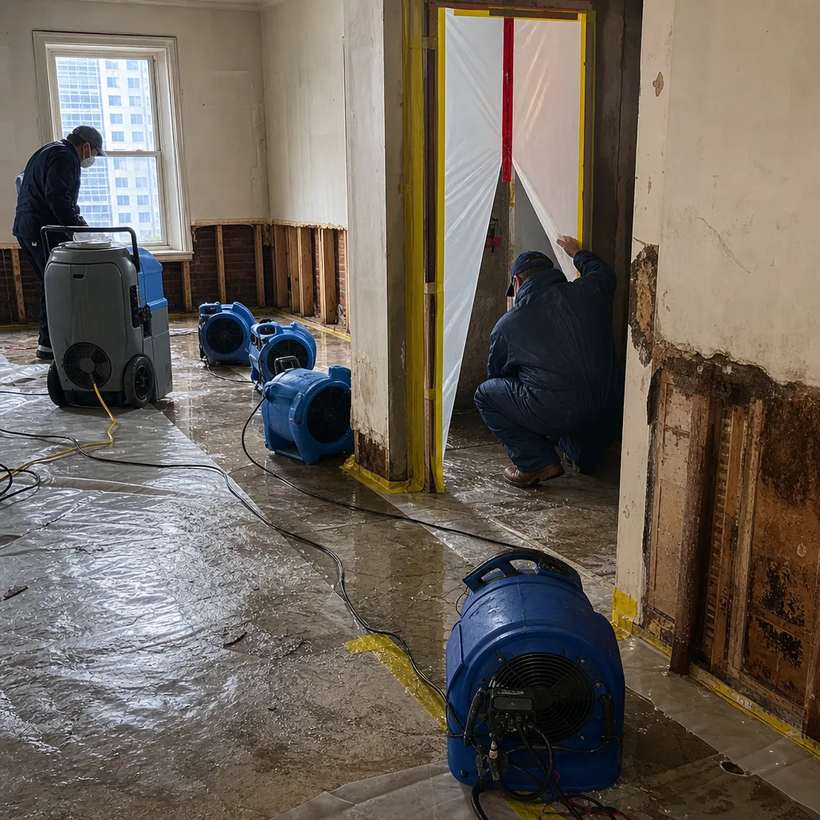
Lessons from real jobs, in writing
Test Before You Tear: What Experienced Crews Do Before Any Wall Comes Down
After a leak, a flood or a storm, the first instinct is to start tearing out wet drywall, flooring and ceilings. Experienced restorers do the opposite. The lessons below are drawn from published restoration walkthroughs, including Home RenoVision DIY's full basement flood job and Certified Restoration's testing walkthrough with Vert Environmental, written out here in full so the method is on this page, in text, where you can use it.
Why testing comes before cutting
Older building materials can contain asbestos or lead, and cutting them releases exactly what you do not want in the air. In pre-war New York homes, treat asbestos as assumed present in any building constructed before 1980 until testing proves otherwise. The safe order on an older property is: water extraction and drying first, then testing of the materials that may need to come out, then safe mitigation of anything hazardous, then clearance testing, and only then the rebuild. Clearance matters before anyone moves back in, because a room that passes a visual check can still fail an air or surface test. And hold on to the sentence every good tester repeats: looks dry does not always mean is dry.
The wet test: how pros find the dry line
On a finished basement job with about six to seven inches of water, much of it mixed with sewage, the walkthrough method is blunt and practical. Take a screwdriver to the wet drywall: it should pop through really easily, so easily that a ten year old could punch through a wet wall with one. Work upward, punching as you go, until the board starts giving real resistance. That point is the dry line, the height the cut needs to reach. Do not trust the visible stain to mark it. Readings above the stain can still show moisture content far too high to save, falling step by step the higher you test, which is why the meter and the screwdriver travel together and the stain alone never sets the scope.
The flood cut, done the walkthrough way
Where board cannot be saved, the cut height used on real jobs is the height of a doorknob: a practical guide that clears the soaked zone with room to work. The board is scored, pulled twice, and worked loose stud by stud until it pops off the screws. Before that, what cannot be saved comes off: baseboards, door casings and door jambs are removed and thrown away on a sewage job, and doors that the water reached go too. A watermark stain on a door is the honest record of whether the water touched it.
Treat the framing, then wait
Once the cavity is open, the wood inside is treated so bacteria are killed, not just dried. On the walkthrough job, insurance crews cut out the damage and treat the wood; the home method shown is a solution of bleach and water sprayed down over the studs. Then comes the part impatient people skip: wait before you rebuild. Three to four days at a minimum, a week is better, and use your nose as one of the instruments. If the basement still smells bad, bacteria are still active and the wood needs treating again. Rebuilding over a smell is rebuilding over a problem.
Small details that decide whether the rebuild lasts
Discard every old screw you pull. A rusty screw left in the framing will telegraph its stain straight through new mud work months later. Mark your stud positions on the floor or subfloor before the new board goes up, so fixing is fast and nothing is missed. Half inch ultra light drywall keeps a repaired basement wall manageable, and the compound choice sets the schedule: regular mud means three coats, while a hot mud first coat followed by one finish coat can do the same job in two. None of this is glamorous. All of it is the difference between a wall that was repaired and a wall that merely looks repaired.
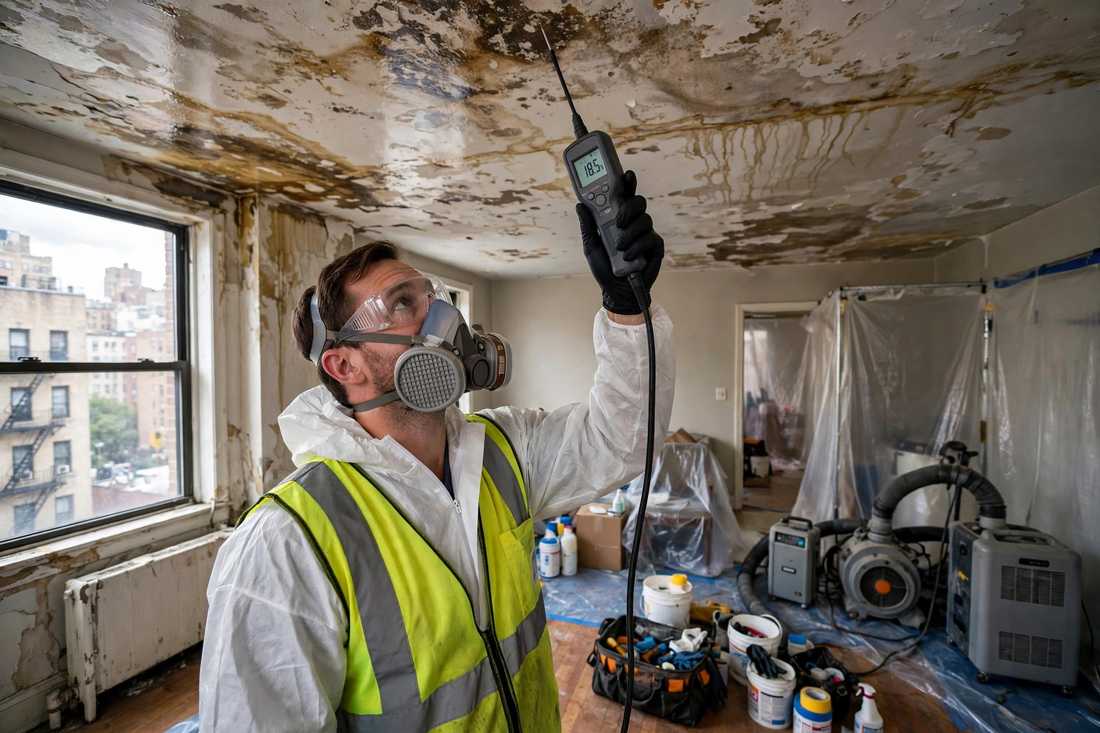
Hiring, without regrets
How to Choose a Water Damage Company in New York
At 2 a.m. with water coming through the ceiling, you will not run a tender process. You will call whoever answers. That is fine, emergencies are triage, but the choice you make that night decides the next three weeks of your life, so it pays to know in advance what separates a professional outfit from a man with a van and a fan.
The top water damage restoration providers in New York, and what they have in common
When you compare providers, national network or local firm, look for the same short list:
- A live answer 24/7, and emergency extraction and drying started the same day
- IICRC certified technicians working to the S500 standard
- Moisture mapping on day one, and a written drying log updated daily
- An exact written quote on site before any work starts, never a price guessed over the phone
- Full documentation for your insurance claim, and a crew that works with your adjuster
- Certificates of insurance ready for co-op and condo building management
- Extraction, drying, mould treatment and rebuild handled without a gap between crews
The five checks, side by side
| Check | Ask this | A good answer sounds like |
|---|---|---|
| 24/7 response | Who answers at 2 a.m., and how fast can a crew start? | A live person answers around the clock, and extraction and drying start the same day. |
| Standard followed | What standard do your technicians work to? | ANSI/IICRC S500, with technicians trained and certified to it. |
| Verified dryness | How will you prove my home is dry? | Moisture readings at mapped points, compared against the dry standard, logged daily in writing. |
| Insurance documentation | What paperwork does my insurer get? | Photographs, a moisture map, a daily drying log and itemised invoices, from day one. |
| Building access | Can you get into my co-op or condo? | Certificates of insurance sent to management the same day, with elevator and work hour rules followed. |
What the good ones have in common
They measure before they talk. The first tool out of the bag is a moisture meter, not a contract. A company that prices your job by looking at the stain is guessing, and you are the one who pays for guesses.
They write things down. Moisture maps, daily readings, photographs, an itemised scope. Documentation is not bureaucracy; it is your insurance claim, your defence in a neighbour dispute, and your proof the work was done. Companies that do it as routine are telling you how they work when nobody is watching.
They can get into your building. In New York this is a skill in itself: insurance certificates sent to management the same day, familiarity with co-op alteration rules, elevator bookings, work-hour limits. Ask directly, a company that works in towers will answer without hesitation.
They explain the dry standard. Ask how they will know when your home is dry. The right answer involves readings compared against unaffected material. "It'll feel dry in a few days" is the wrong answer, however friendly the person saying it.
They do the rebuild, or honestly say they do not. Some excellent firms only mitigate. That is fine, as long as you know before they start, and the handover to a builder is planned, not discovered.
Questions that take two minutes and save two months
- Are you insured, and can you send a certificate to my building today?
- Will I get moisture readings in writing, every day, until the job is verified dry?
- What standard do you dry to, and who checks it?
- Is the rebuild included, and is its scope fixed in writing before it starts?
- Who talks to my insurance adjuster, and what paperwork do you hand them?
- What happens if you find asbestos, lead or hidden damage mid-job?
Red flags: walk away from these
The full payment up front. Especially in cash, especially before work starts. Emergency work is commonly billed to insurance or paid in stages; a demand for everything now is the oldest warning sign in home repair.
The phone quote. A firm number given over the phone for a job nobody has metered, or a "special offer" that expires tonight. A real quote follows the scope, and the scope comes from readings taken in your home.
No paperwork, ever. No written scope, no drying log, no invoices, just a total. If it is not written, it did not happen, and your insurer will treat it exactly that way.
The fan-and-paint special. Any plan that dries a discoloured, musty wall from the outside, or paints over a stain without finding the source, is not a repair. It is a postponement with a bill attached.
Pressure about your insurance. A company should help you document a claim. A company that urges you to claim for damage that did not happen, or to inflate a contents list, is involving you in fraud, walk away and say nothing more.
Nobody can say who they are. No verifiable business name, no insurance, no address, a phone that changes between the website and the invoice. In a city where buildings require certificates of insurance before entry, a legitimate company treats that paperwork as routine.
A word about national franchises and local firms
New York has both, and the name on the van matters less than the crew in your kitchen. The big national names run a single hub page for this whole city, their strength is scale and insurer relationships; their weakness can be distance from your building's rules and your borough's housing stock. Strong local firms know which supers want which paperwork, which buildings ban weekend work, and how a brownstone wall behaves when it is wet, and the best of them hold the same IICRC standards and produce the same documentation. Judge the firm in front of you by the questions above. A franchise crew that meters, documents and dries to standard beats a local crew that guesses, and the reverse is equally true. The standard is the standard; ask who is actually going to meet it in your home.
Cheaper than any cleanup
Preventing Water Damage: A New York Homeowner's Working List
Almost every job on this page was preventable, not with money or genius, but with dull, cheap habits done on time. Nobody frames it that way after a flood, so here it is framed that way now, while your floors are dry.
The one-hour tour of your own home
Once a year, put it in the calendar, tie it to something you never skip, like the start of heating season, walk your home with a torch and this list. Run a dry hand along every pipe you can reach under every sink; dampness, green corrosion or a crusty white deposit on a joint is a leak introducing itself politely. Look at the ceiling below every bathroom. Check the floor around every radiator for softness or lifted boards. Open the water-heater closet and look at the base of the tank and the floor beneath it. Behind the washing machine, find the hoses: if they are rubber, note their age, and if you do not know their age, that is your answer, replace them with braided steel. Test your shut-off valves by turning them a quarter turn and back; a valve that has seized solid is a decoration, and you want to learn that today rather than during a burst. Take photographs of anything doubtful. Next year's tour then has something to compare against, and a stain that is growing is a very different conversation from a stain that has not changed in a year.
The short list of devices that pay for themselves
Braided steel hoses on the washing machine and dishwasher, the cheapest serious protection in the home. A water alarm, a small battery device that sits on the floor by the water heater, under a sink or behind the washer and shrieks when it gets wet; ten dollars of noise that has saved more floors than any smart gadget. An automatic shut-off valve on the main line, which senses abnormal flow and closes the water when you are out, worth serious thought in any home that empties for weeks at a time. A backwater valve on the drain line in any home that has taken sewer water once, or sits below street level in a combined-sewer neighbourhood. A sump pump with a battery backup wherever a pump already exists, because storms that flood basements also cut power, and a pump without power is a hole with a lid. None of these is exciting. All of them together are cheap insurance against one night of standing water.
Season by season in New York
Winter is pipe season. Keep the heat at a sane level even when you travel, insulate pipes in unheated spaces, open cupboard doors on outside walls during a hard freeze, and know that the burst usually announces itself at the thaw, not during the cold. Spring is roof and drain season: clear the gutters and roof drains that winter filled, and walk the basement after the first heavy rain to see where the building is honest about its weaknesses. Summer is storm and air-conditioning season, condensate lines clog and overflow into ceilings, and the big rain events test every window well and basement drain in the city; check the pump before the forecast, not during it. Autumn is preparation: service the boiler and radiators before heating season so the first cold night is not also a leak, clear the gutters again after the leaves, and re-run the one-hour tour while the weather still lets you fix what you find.
Apartment buildings: the shared version
In a co-op, condo or rental, half your flood risk lives in other people's flats, so prevention there is partly social. Know your super's and management's emergency numbers and keep them in your phone, not in a drawer. Know where your own flat's shut-off valves are, kitchen, bathroom, washing machine, and make sure everyone in the home knows too, including the person most likely to be home alone. When you renovate, use licensed plumbers, pull the permits your building requires, and pressure-test new work before the walls close; a large share of upstairs leaks are renovation leaks in their first year. When you travel for more than a few days, tell the super, shut your flat's water if your building allows it, and leave a key with someone who can open the door, buildings have watched a flat flood for a weekend because nobody could legally enter it. And when the flat above you renovates, introduce yourself to the contractor. Friendly neighbours get called when something drips. Strangers get claimed against.
If you are buying or renting
Water leaves a record, and it is readable if you look before you sign. In a sale, ask directly about past water damage, floods and mould, and read the disclosure like it matters, because it does. Look for the tells: fresh paint on one ceiling only, new baseboards in one room, a musty note in a basement or a cupboard, warped floorboards by a bathroom door, water stains in the basement at the height of a tide line. None of these automatically kills a purchase, a properly dried, documented repair is a home that had a problem and solved it, but undocumented patches deserve hard questions and a moisture meter during the inspection. Renters should do the same walk before signing, photograph existing stains and damage on day one with dates attached, and get the landlord's leak-reporting process in writing. In New York's rental market that ten minutes is the difference between inheriting a home and inheriting an argument.
Shops, offices, restaurants
Water Damage in Commercial Spaces
Everything on this page applies to a business, with one change of scale: for a shop, a restaurant or an office, the water bill is usually the smaller bill. The bigger one is the days you cannot trade. Commercial restoration is planned around that fact from the first hour.
The work itself runs in phases so a business can partly reopen: the damaged section contained and dried while the rest of the space trades, noisy demolition done overnight or before opening, equipment placed where customers never go. Restaurants carry extra rules, a health inspector's view of a flooded kitchen is not the same as a homeowner's, and food-contact surfaces, stored stock and grease traps all enter the scope. Offices worry about different things: server rooms and electrical closets first, document storage second, and the landlord-tenant question of whose insurance carries what, which should be answered by the lease you already signed rather than negotiated in a corridor at midnight.
Building management sits in the middle of every commercial job in this city, loading docks, freight elevators, certificates of insurance for every contractor, work windows set by the building rather than the tenant. A restoration company that works commercially will ask for the building's requirements before the first machine moves, and will put the drying plan in front of the property manager the same day. If yours does not, that silence will cost you days later.
Two kinds of paperwork decide commercial claims. The first is the same as any home job: photographs, moisture maps, drying logs, itemised invoices. The second is the business record: closure dates, lost bookings, spoiled stock lists, payroll for staff who could not work. Business interruption cover exists for exactly this, and it pays on records, not recollections, start the file on day one, keep the till records and the reservation book, and log every decision you made because of the water. Insurers argue about many things; a dated, documented loss is not one of the easy ones.
Finally, the prevention maths is sharper for a business. A water alarm behind a commercial kitchen line, an automatic shut-off on a shop's water supply, a maintenance contract that actually includes the roof drains, each is a small thing set against a single closed weekend. The businesses that come through water damage best are rarely the luckiest. They are the ones whose manager knew where the shut-off was, had the restoration number saved, and had read the lease's insurance clauses before the ceiling came down. That preparation is available to every business reading this page, today, for free.
After the drying
Home Restoration: Putting a Water Damaged Home Back Together
Drying is only half of water damage restoration in New York. The other half is home restoration: the rebuild that gives you back your kitchen, your bathroom, your floors. It is the part of the job you will actually live with, and it deserves the same rigour as the drying that came before it.
What home restoration covers after water damage
Everything the water and the demolition took out: drywall and plaster, insulation, flooring and subfloor, cabinets and countertops, trim, doors and paint. In a kitchen or bathroom it can extend to the fixtures and finishes the water reached. The standard a good rebuild is judged by is simple to say and hard to fake: the room should look, feel and meter like the water was never there, with materials matched as closely as the originals allow. In pre-war homes that means plaster repaired as plaster where it matters, hardwood patched with the same species and grade, and trim profiles matched rather than replaced with whatever was on the van.
When restoration becomes renovation
Insurance pays to restore your home to the condition it was in before the loss, not to improve it. Plenty of owners use a forced rebuild as the moment to upgrade: better cabinets while the kitchen is open, a proper waterproof membrane while the bathroom floor is up. That is sensible, and honest companies handle it cleanly by splitting the scope in writing: the restoration work the claim covers, and the upgrade work you pay for, priced separately before anyone starts. What you should never accept is the two blurred together, because blurred scopes are where claim disputes and surprise bills are born.
How long the put back takes
A single room's drywall, trim and paint can be days once the structure is verified dry. A kitchen or bathroom rebuild runs to weeks, because cabinets, stone and tile are made or ordered, not grabbed off a shelf. In co-ops and condos, add the building's calendar: alteration agreements, board approvals, elevator bookings and work hour rules stretch the schedule without adding a single day of actual work. A company that works in your building type will tell you the real calendar up front, machine days and paperwork days counted separately.
One crew or two?
Some firms only dry and hand the rebuild to someone else. Some, like us, carry the job from the first extraction to the final coat of paint. Either model can work. What cannot work is a gap between them: a drying crew that leaves before the builder has the moisture readings, or a builder who boards over a cavity nobody verified. If two companies are involved, insist the drying log changes hands in writing. If one company does both, you have one phone number to call when anything is not right, and no argument about whose problem it is.
Quick answers
Water Damage Restoration New York: Quick Answers
The questions New Yorkers ask first, answered straight and short. Each answer stands on its own. The full detail, the evidence and the exceptions sit in the sections and the FAQs around it.
How long does water damage restoration take?
Extraction and setup happen on day one. Structural drying typically takes 3 to 5 days for clean water jobs, and pre-war plaster or hardwood over concrete can take 5 to 10 days. Rebuild usually follows in the second week. The job ends when moisture readings reach the dry standard, not when surfaces feel dry.
Does homeowners insurance cover water damage in NYC?
Usually yes, when the cause is sudden and accidental: a burst pipe, a failed water heater, an appliance hose letting go. Usually no for outside flooding, which needs a separate flood policy, gradual leaks, or sewer backup without a specific endorsement. Document everything, file the same day, and start drying: mitigation protects your claim.
How fast can mould grow after water damage?
Mould can begin growing within 24 to 48 hours on wet drywall, wood and carpet backing, and the EPA gives the same window. That is why drying starts immediately, and why letting a wet room air out over the weekend is the costliest decision in this business. If water has sat for two days, ask for an inspection.
How expensive is it to fix water damage?
There is no honest figure before an inspection, because the scope is set by what a moisture meter finds: one wet wall or three, clean water or sewage, drywall or pre-war plaster. That is why this page publishes no price list. The inspection is free, and you get an exact written quote on site before work starts.
Can water damage be restored?
Yes, in most cases. Water damage can be restored when the water is stopped quickly, the structure is extracted and dried to a verified dry standard, and damaged material is repaired or replaced. What cannot be restored is material left wet for weeks: rotted wood, delaminated subfloor and mould grown through plaster must come out.
How to do water damage restoration?
In order: stop the water, make the area safe, photograph everything before cleanup, extract standing water, remove material too wet or contaminated to save, dry the structure with commercial dehumidifiers and air movers, treat mould risk, verify dryness with moisture meters, then repair. Done in that order, most homes dry in 3 to 5 days.
What is the current water problem in New York City?
Inside homes, the city's water problem is old pipes meeting heavy rain. Combined sewers carry waste and storm water in one pipe, and hard storms push that water back into basement and garden level homes. Above ground, ageing pre-war plumbing, galvanised pipes, cast iron stacks and radiator systems fail a little more every year.
Who is the biggest restoration company?
By reach, the biggest restoration companies are national franchise networks with locations across the country, and their vans are in every borough. Biggest is not the same as best for your job: what decides the outcome is the crew in your home, whether they meter before they talk, log readings daily, and dry to a verified standard.
Who is Servpro's biggest competitor?
Nationally, the closest rivals to the largest franchise network are the other national networks, firms such as ATI Restoration, Rainbow Restoration and 1-800 WATER DAMAGE, which compete on the same emergency work across the country. In New York City, strong local firms compete for the same jobs, and many homeowners compare a national network against a local crew before choosing.
Does Servpro do restoration?
Yes. Servpro is a restoration franchise network, and its local franchises carry out water extraction, structural drying, cleaning and repairs, much like other national networks and strong local firms. In New York City its franchises serve individual boroughs and neighbourhoods, so the crew you get is a local franchise team working under the national brand and its standards.
How much does Servpro charge per hour?
Restoration is normally priced by scope, not by the hour, so there is no honest hourly figure for work nobody has inspected. What sets the price is what is wet, the water category, what must come out, and how long drying runs. The honest route is a free inspection and a written quote before work starts.
What does a water damage restoration technician do?
A water damage restoration technician finds where the water went, extracts standing water, sets and monitors drying equipment, takes moisture readings every day, removes material that cannot be saved, treats surfaces against mould, and documents everything for your insurer. Good technicians work to the IICRC S500 standard and can show you the readings behind every decision.
The key facts, in one place
| Fact | The short version |
|---|---|
| Mould growth window | Mould can begin within 24 to 48 hours on wet materials, per EPA guidance. |
| Standard drying time | 3 to 5 days for clean water jobs dried with commercial equipment. |
| Pre-war plaster drying | 5 to 10 days for a contained leak; multi-floor wet stack events take longer. |
| Water categories | Category 1 is clean water, Category 2 is grey water, Category 3 is black water such as sewage and flood water. |
| When a job counts as dry | When moisture readings in affected materials match the dry standard taken from unaffected material in the same building. |
| Claim acknowledgement clock | New York insurers must acknowledge a claim within 15 business days under Insurance Law section 2601 and Regulation 64 (11 NYCRR Part 216). |
| Disaster claim pay clock | After a declared natural disaster, Insurance Law section 2618 requires payment within 4 business days once the claim is agreed. |
| Suit limit | A lawsuit on a New York property policy must be started within 24 months after the loss, under Insurance Law section 3404. |
| Flood cover | Water from outside the building needs a separate flood policy; standard home policies exclude it. |
| Local Law 55 | Owners of buildings with three or more apartments must investigate mould and the moisture causing it, and use licensed workers for larger mould jobs. |
| Local Law 61 | Buildings with 10 or more apartments must use state licensed mould assessors and remediators, kept separate from each other, for mould over 10 square feet. |
Asked out loud, answered short
Who do I call for water damage in New York? Call a 24/7 water damage restoration crew. We answer around the clock, every day, across all five boroughs and Long Island, and the inspection is free.
What do I do first when a pipe bursts? Stop the water at the valve, cut power to wet rooms if water is near electrics, photograph everything, then call a crew and your insurer the same day.
How long does water damage take to dry? Most clean water jobs dry in 3 to 5 days. Pre-war plaster can take 5 to 10 days. Crews prove dryness with moisture readings, not by touch.
Does insurance cover water damage? Usually yes for sudden accidents like a burst pipe. Outside flooding needs a separate flood policy, and gradual leaks are usually not covered. File the same day.
When does mould start after water damage? Mould can start within 24 to 48 hours on wet materials. That is why extraction and drying should start the same day the water is found.
Can I stay in my home during restoration? Often yes, when the damage is clean water and affected rooms can be closed off. Sewage damage or a disabled only bathroom or kitchen usually means a few nights out.
Straight answers
Water Damage Restoration New York: FAQs
The questions New Yorkers ask most, answered plainly, with the numbers and the New York rules attached where they matter.
How long does water damage restoration take?
Extraction and setup happen on day one. Structural drying typically takes 3 to 5 days for clean-water jobs, with a monitoring visit and fresh moisture readings every day. Pre-war plaster walls and hardwood over concrete can take 5 to 10 days. Rebuild, drywall, floors, paint, usually follows in the second week. The job is finished when moisture readings reach the dry standard, not when surfaces feel dry.
Does homeowners insurance cover water damage in NYC?
Usually yes, when the cause is sudden and accidental, a burst pipe, a failed water heater, an appliance hose letting go. Usually no for outside flooding (that needs a separate flood policy), gradual leaks, or sewer backup without a specific endorsement. Insurers also expect you to mitigate: extraction and drying protect your claim rather than endanger it. Document everything and file the same day.
How fast can mould grow after water damage?
Mould can begin growing within 24 to 48 hours on wet drywall, wood and carpet backing, the EPA gives the same window. That is why drying starts immediately and why “letting it air out over the weekend” is the costliest decision in this business. If water has sat for more than two days, or you can smell mustiness, ask for a mould inspection before walls are closed.
My upstairs neighbour’s leak damaged my apartment. Who pays?
Typically three policies are involved: the neighbour’s liability cover for damage their leak caused, your own policy for your belongings and finishes, and the building’s master policy for shared structure. Notify building management in writing the same day, photograph everything, and file with your own insurer promptly, they will usually pursue the neighbour’s insurer through subrogation. Restoration moisture maps and timestamps are key evidence.
What should I do in the first hour after a burst pipe?
Stop the water (apartment valve, or the super for the riser in a co-op or condo), cut power to wet rooms if water is near electrics, move belongings off wet floors, photograph and video everything, then call a 24/7 restoration crew and your insurer, in that order, all today. Every hour of standing water widens the damage.
What is the difference between water mitigation and restoration?
Mitigation is stopping things getting worse: extraction, drying, containment, removing unsalvageable material. Restoration is putting it back: drywall, flooring, trim, paint and finishes. Some companies only mitigate and hand you off to a separate contractor for rebuild. We do both, so one crew owns the job from first extraction to final coat of paint.
Can I dry water damage myself?
A small, clean-water spill on tile, caught within hours, is reasonable DIY: mop, ventilate, run a fan and a home dehumidifier, and meter-check if you can. Anything bigger, carpet and pad soaked, drywall wet, water from a toilet or drain, or anything sitting more than 24 hours, needs commercial extraction and drying. The failure mode of DIY is invisible: moisture left inside walls becomes mould you discover months later.
What is a flood cut, and will my walls need one?
A flood cut is a clean horizontal cut in drywall, usually 2 or 4 feet from the floor, removing board too saturated to save so the wall cavity can dry. It is needed when drywall has wicked water upward or insulation inside the wall is wet. It sounds drastic but it is far safer than trapping moisture, and the rebuild replaces exactly the strip that was removed.
How do I know when everything is actually dry?
By numbers, not touch. The crew compares moisture readings in affected materials against the “dry standard”, readings from unaffected material in the same building. When readings match the standard at every mapped point, drying is done and equipment comes out. You should receive those readings in a written drying log; ask for it, especially if insurance is involved.
Is sewage backup cleanup dangerous to do myself?
Yes. Sewage is Category 3 water carrying bacteria, viruses and chemicals. It requires protective equipment, containment, removal of contaminated porous materials and proper disinfection. Keep people and pets out of the area, do not run fans that can aerosolise contaminants, and call a crew. This is the one category where DIY is a health risk, not a money saver.
Will water damage lower my home’s value?
Unrepaired or badly documented damage does, mould history and water stains are exactly what buyers and their inspectors hunt for. A professionally dried and rebuilt job with a complete drying log and paid invoices is a different story: it demonstrates the problem was handled to standard. Keep the paperwork with your closing documents.
Do I need a permit for water damage repair in NYC?
Cleanup and drying generally need no filing. Rebuild work can: structural changes, plumbing reroutes and larger renovations may require NYC DOB permits and licensed trades, and co-op or condo boards usually require alteration agreements and a certificate of insurance before work starts. A competent restoration company flags permit-triggering scope before it begins, not after an inspector visits.
What is Local Law 55 and does it affect my job?
Local Law 55 is NYC’s mould law for covered multiple dwellings. It requires owners to investigate indoor mould and the moisture causing it, and to use licensed assessors and remediators for larger areas of mould growth, following city work-practice rules. If you are a landlord or a tenant in a covered building, mould work is not a casual handyman task, it has a regulated process, and the documentation matters.
How can I tell if water damage is permanent?
Signs of permanent damage include warped or cupped hardwood that does not flatten after drying, swollen and crumbling drywall or plaster, delaminated plywood subfloor, persistent musty odour after verified drying, and staining that has wicked deep into masonry. Materials that reached dry standard quickly usually recover; materials that stayed saturated, especially particleboard, MDF and carpet pad, generally do not.
Who is responsible for water damage in a rental apartment?
The landlord is responsible for the building, the plumbing and restoring the apartment to habitable condition under NYC’s warranty of habitability. The tenant’s renter’s insurance covers the tenant’s belongings. Tenants should report leaks in writing immediately, both because the duty to repair runs from notice, and because a tenant who sits on a known leak can share blame for the damage it causes below.
What does a restoration crew do about my furniture and belongings?
Contents are triaged on day one: unaffected items are moved or protected in place, wet items are cleaned and dried where salvageable, and unsalvageable items are photographed and listed for your claim before disposal. For larger jobs, contents are packed out, stored, and returned after rebuild. Never let a crew throw things away without photos and a list, that list is your reimbursement.
Why did my ceiling stain come back after it was painted?
Because the stain was painted, not dried. A ceiling stain that returns means the cavity above is still wet or the leak source was never fixed. The correct sequence is find the source, fix it, open and dry the cavity, verify with a meter, then prime with a stain-blocking primer and paint. Paint is the last step, not the treatment.
Does renters insurance cover water damage?
Renter’s policies typically cover your belongings damaged by sudden water events like burst pipes, and additional living expenses if the apartment is uninhabitable. They do not cover the building itself, that is the landlord’s policy and responsibility. If you do not have renter’s insurance in NYC, this is your sign: water is the most common apartment disaster in the city.
What is the difference between flood damage and water damage for insurance?
Insurers define them by source. Water damage comes from inside: pipes, appliances, roof leaks, covered by standard policies when sudden. A flood is water from outside affecting the ground level, storms, overflowing rivers and drains, and it is excluded from standard policies; only a separate flood policy covers it. The distinction decides claims every storm season in this city, so describe the source accurately when you file.
Can hardwood floors be saved after water damage?
Often, yes, if drying starts within the first day or two. Specialised floor-drying mats pull moisture through the boards, and many floors that cup when wet settle back as they dry. Floors are usually lost when water sat for days, when the subfloor is particleboard that has swollen, or when Category 3 water contaminated the assembly. Speed is the whole game.
Do you work with my building management and insurer directly?
Yes. We provide certificates of insurance to co-op and condo management, follow building work-hour and elevator rules, and give adjusters the moisture maps, photos and drying logs they need. You get copies of everything. The goal is that your claim file is complete enough that nobody has to argue about what was wet, when, and for how long.
How do I prevent water damage in a NYC apartment?
Replace washing-machine and dishwasher hoses with braided steel and change them every five years. Know where your apartment shut-off valve is before you need it. Keep AC condensate lines cleared, check under sinks monthly, and never ignore a ceiling stain, it is always a smaller job this month than next. In houses, a backwater valve and a maintained sump pump are the two highest-value defences in this city.
How expensive is it to repair water damage?
There is no honest figure before an inspection, which is why this page publishes none. The scope is set by what a moisture meter finds, one wet wall or three, clean water or sewage, drywall or pre-war plaster. We inspect free, map every wet material, and give you an exact written quote on site before any work begins.
What is the most common cause of water damage in houses?
Plumbing failures inside the home: burst and frozen pipes first, then leaking appliances, washing-machine hoses, dishwashers, water heaters, and slow drips from ageing pipework. Storms and floods get the headlines, but most New York jobs start with a pipe, a hose or a valve that finally gave up inside the building.
How long does it take for a floor to rot from water damage?
Rot is a slow process, but the damage clock starts fast. Hardwood cups within days of soaking, plywood subfloor begins delaminating after prolonged wetting, and fungal decay in timber needs sustained moisture over weeks to months. Floors dried to standard within the first days usually survive; floors left wet under coverings are the ones that rot.
Do you always get mould after water damage?
No. Mould needs moisture left in place, and growth can begin within 24 to 48 hours on wet materials. A structure extracted promptly and dried to verified dry standard usually grows nothing of consequence. Mould follows the jobs where water sat for days, or where surfaces felt dry while wall cavities stayed wet, which is why verification is by meter, not touch.
Can you live in a house with water damage?
Often, yes, most households stay home through drying when the damage is clean water and the affected rooms can be closed off. Sewage contamination, a disabled only bathroom or kitchen, heavy demolition, or anyone with asthma or immune problems in the home can change that answer. If you must leave, ask your insurer about additional living expense cover first.
Should I file a home insurance claim for water damage?
If the cause was sudden and accidental and the damage clearly exceeds your deductible, usually yes, that is what the policy is for. File the same day, document before cleanup, and keep every invoice. For a tiny loss near or below your deductible, paying directly can make more sense. When in doubt, file: a declined claim costs nothing.
How do I prove water damage to my insurer?
With records, not descriptions. Dated photographs and video taken before cleanup, the crew's moisture map and daily drying log, your plumber's invoice naming the failed part and the date, and an itemised list of damaged belongings with photos. That file is what turns a disputed claim into a paid one, which is why proper crews produce it as routine.
What type of water damage is not covered by insurance?
Three kinds, mainly: flooding from outside the building, which needs a separate flood policy; gradual damage from leaks left running for weeks or months, which insurers treat as maintenance; and sewer backup, unless your policy carries the specific backup endorsement. The repair of the failed pipe itself is also usually excluded, insurers pay for the damage water did.
What should I not say to my insurance adjuster?
Do not guess at timelines, minimise how long water sat, or describe a sudden burst as “an old leak”, the sudden-versus-gradual distinction decides claims. Do not exaggerate damage or inflate contents lists either; that is fraud. Be factual, be specific about dates and times, and let your photographs, moisture map and plumber's invoice tell the story.
What are the alternatives to a big national franchise?
The largest national networks bring scale and insurer relationships, but they typically serve all of New York City from a single hub page and call-centre model. The alternative is a local NYC specialist: same IICRC standards and documentation, with working knowledge of your borough's buildings, boards and supers. Judge either by the same tests, metering, written logs, verified dry standard.
How do I file a home insurance claim for water damage?
Start the same day. Photograph the damage and the source before cleanup, stop the water, then call your insurer or broker and get a claim number. Ask what your deductible is and whether any special limits apply, such as a sewer backup limit. Start mitigation right away, your policy expects it, keep every invoice, and hand the adjuster the crew's moisture map and daily drying log when they visit. Put the first notice in writing, an email is fine, so the date is provable.
How long do I have to sue my insurer over a water damage claim in New York?
Under Insurance Law section 3404, which sets the terms of New York's standard fire policy, a lawsuit on a property policy must be started within 24 months after the loss itself, not after the claim is denied. The clock keeps running while you negotiate, and it is shorter than most people expect. If a claim is heading for a serious dispute, take legal advice well before the two years are up.
How do I know if there is water damage behind my walls?
The signs are paint that bubbles or peels in one place, a musty smell that never clears, baseboards that swell or pull away from the wall, a patch of wall that feels cool or soft, and a stain that grows after rain or after the flat above runs water. None of these proves it on its own. A crew confirms it with moisture meters and thermal imaging, and only opens the wall where the readings say the water actually is.
How expensive is it to fix water damage?
There is no honest figure before an inspection, and any company that gives you one over the phone is guessing. What sets the scope is what a moisture meter finds: one wet wall or three, clean water or sewage, drywall or pre-war plaster, and how much material can be dried in place instead of removed. That is why the inspection here is free. A technician maps every wet material and hands you an exact written quote on site, before any work begins, and you can take that quote to a second company if you want another opinion.
Can water damage be restored?
Usually, yes. Most water damage can be restored when the water is stopped quickly, the structure is extracted and dried to a verified dry standard, and damaged materials are repaired or replaced. What cannot be restored is material that stayed wet too long: swollen particleboard, delaminated plywood, carpet pad, and drywall that has gone soft or grown mould. The difference between a restorable job and a gut job is mostly time. Hours matter more than almost anything else on the whole job.
What is the current water problem in New York City?
Inside homes, the city's water problem is old pipes meeting heavy rain. Much of New York still runs on combined sewers that carry household waste and storm water in one pipe, and hard storms can push that water back into basement and garden level homes. Above ground, ageing plumbing in pre-war buildings, galvanised pipes, cast iron stacks and radiator systems, fails a little more every year. Add downpours stronger than the drains were built for, and you get the pattern crews see weekly: sewer backups below, slow pipe leaks above.
Who is the biggest restoration company?
By reach, the biggest names are national franchise networks with locations across the country, and you will see their vans in every borough. Biggest is not the same as best for your job. A national network usually serves this whole city from one hub and a call centre. What decides your outcome is the crew in your home: whether they meter before they quote, dry to a written standard, and document the job for your insurer. Judge any company, large or small, by those tests.
Who is Servpro's biggest competitor?
Nationally, the closest rivals to the largest franchise networks are the other national networks, firms such as ATI Restoration, Rainbow Restoration and 1-800 WATER DAMAGE, alongside strong regional and local companies in each city. In New York, the real competition on any given night is whoever answers, arrives with meters and drying kit, and can get into your building with the right insurance paperwork. For a homeowner, the useful question is not who competes with whom. It is which crew will measure, document and dry your home to standard.
Does Servpro do restoration?
Yes. Servpro is a restoration franchise network, and its local franchises carry out water extraction, drying, cleaning and repairs, much like other national networks and independent firms. If you are comparing providers, compare the same things on every quote: what the moisture readings showed, what will be removed and what dried in place, how dryness will be verified, and what documentation you will receive for your claim. The badge on the van matters less than the readings in the log.
How to do water damage restoration?
In order: stop the water, make the area safe, photograph everything, extract standing water, remove material too wet or contaminated to save, dry the structure with commercial dehumidifiers and air movers, read moisture levels daily until they match the dry standard, clean and treat surfaces, then rebuild what was removed. The full eight step process is set out on this page. Small clean water spills can be a home job. Anything in walls, under floors, or from a drain or toilet belongs to a crew with meters and commercial kit.
How much does Servpro charge per hour?
We cannot quote another company's rates, and you should be wary of any hourly figure offered for restoration work sight unseen. Restoration is normally priced by scope, not by the hour: what is wet, what category the water is, what must come out, and how long drying runs. The honest route is a free inspection with a written quote before work starts. Ours is free, the moisture map is yours to keep, and you can compare it against any other company's quote, franchise or local.
What causes water damage?
Inside New York homes, the causes repeat: burst and frozen pipes, leaking appliance hoses and water heaters, ageing galvanised and cast iron plumbing, radiator and steam system leaks, roof and facade leaks, and sewer backups when combined sewers surcharge in heavy rain. The causes section on this page walks through each one, how it starts and the early signs. Whatever the cause, the damage pattern is the same: water spreads down and sideways, hides in walls and under floors, and starts feeding mould within a day or two.
What does a water damage restoration technician do?
A water damage restoration technician finds where the water went, extracts standing water, sets and monitors drying equipment, takes moisture readings every day, removes material that cannot be saved, treats surfaces against mould, and documents everything for your insurer. Good technicians work to the IICRC S500 standard and can show you the readings behind every decision.
How real jobs tend to go
Three Jobs You Will Recognise
Every water job is its own story, but the same few stories repeat across this city every week. These are composite walkthroughs of the most typical ones, what happened, what the crew did, how long it took and how it ended, so you can place your own situation on the map.
The upstairs pipe, Manhattan co-op
A washing-machine hose splits in a ninth-floor flat at 11 p.m. The owner is away. Water runs for roughly an hour before a neighbour hears it through the door and the doorman gets the super, who closes the riser. By then the flat below has a soaked bedroom ceiling and wall, and the flat below that has a stained ceiling and a frightened owner.
The crew's first night is extraction and protection in two flats, photographs everywhere, and a moisture map that will later decide three insurance claims. The ceiling in the middle flat is opened where it has sagged; the plaster in the lower flat, which only caught the tail of the water, is metered daily and dries in place without demolition, the difference between the two outcomes is about an hour of water. Drying takes five days in the middle flat, three in the lower one, slowed by the building's 9-to-5 work rules. The rebuild, one ceiling, two walls, paint in two flats, runs across the following two weeks, inside the co-op's alteration paperwork.
Where it landed: drying and demo across both flats, rebuild on top, and the whole job carried by the top flat's liability cover, because the map, the log and the doorman's timeline agreed on exactly whose water it was.
The basement sewer backup, Queens house
A summer storm drops a month of rain in an evening. The combined sewer fills, and by 9 p.m. water is coming up through the basement toilet and floor drain of a two-family house in Queens, sewage, unmistakably. The family does the right things fast: nobody walks in it, the kids and the dog stay upstairs, power to the basement is cut at the panel, and the call goes out the same night.
Because the water is Category 3, the job is removal before drying: the finished basement's carpet, pad, lower drywall and insulation come out, the studs and concrete are cleaned and disinfected, and only then do the dehumidifiers start. The structure dries in four days. The contents are the hard part, stored boxes and furniture that sat in sewage are mostly a photographed list for the claim, not a cleaning job, and the crew says so honestly on night one rather than billing for cleaning that cannot make those things safe.
Where it landed: cleanup and drying done in the first week. Insurance covered only part, the policy's sewer-backup endorsement had a limit the owner had never noticed, and the rebuild was staged over two months to match. The backwater valve fitted afterwards was a small job next to the one it would have prevented.
The slow leak nobody saw, Brooklyn brownstone
No flood, no phone call at midnight. A brownstone owner notices the parquet by the bathroom door feels slightly raised, and there is a smell in the hall cupboard that was not there in spring. A moisture inspection finds the cause: the dishwasher line in the flat above the parlour floor has been dripping, a cupful at a time, for what the meter readings and the state of the subfloor suggest is most of a year.
The affected area is small and the damage is not. The subfloor has delaminated, two joist ends are soft, and mould is established inside the floor build-up where no fan could ever have reached it. The job becomes surgical: a contained opening of the floor, removal of the ruined section, treatment of the framing, verified drying, then a rebuild that includes splicing in new joist ends, with a carpenter, not just a drying crew. The plumbing fix that started it all took a plumber twenty minutes.
Where it landed: most of the work was rebuild and carpentry rather than drying. The insurer disputed the claim at first, gradual damage, and the inspection report's evidence of a specific failed fitting, photographed in place, is what turned it into a negotiation instead of a refusal. The owner's line afterwards is the one crews hear most: "It smelled funny for months. I wish I had called about the smell."
Read the three side by side and the pattern is plain. The fast, loud emergencies do the least damage per gallon because the response is immediate. The quiet jobs, the smell, the stain, the floorboard that feels wrong, are the ones that grow teeth. If anything in your home is quietly telling you water is somewhere it should not be, the best day to act on it is today, one call, and a crew will come and measure it free.
Plain-English glossary
Terms Your Adjuster Will Use
- Dry standard: the moisture level of unaffected materials in your building; the target every drying job is measured against
- Mitigation: the stop-it-getting-worse phase: extraction, drying, containment
- Demolition / flood cut: removing material too wet or contaminated to save
- Subrogation: your insurer recovering costs from the party (or insurer) actually responsible
- Backwater valve: a one-way valve on your sewer line that stops city sewer surcharges entering your basement
- Pack-out: documented removal and storage of your belongings during the job
- Category / Class: the IICRC labels for how contaminated the water is (Category 1 to 3) and how much material it has soaked into (Class 1 to 4); together they set the method and the scope
- Air mover / dehumidifier: the drying machines: air movers sweep air across wet surfaces to lift moisture out, dehumidifiers pull that moisture from the air so it can leave the building
- Moisture map: the marked plan of your rooms showing every point that was metered wet, with readings; the first page of every good claim file
- Deductible: the amount you pay out of pocket before insurance pays the rest; some New York policies carry a separate, higher storm deductible
- Actual cash value / holdback: the first insurance payment, with depreciation held back and released when you prove the repair was completed
- Endorsement: an add-on to a policy that buys cover the base policy leaves out; the sewer-backup endorsement is the one this page keeps mentioning
- Riser: the vertical water pipe running through a building floor by floor; the valve your super closes when a flat floods
- Sump pump: a pump in a pit at the lowest point of a basement that lifts collected water out of the house; useless in a power cut without a battery backup
Sources & standards
Where This Page Gets Its Facts
Method and terminology: ANSI/IICRC S500, the Standard for Professional Water Damage Restoration published by the Institute of Inspection, Cleaning and Restoration Certification (IICRC) with the American National Standards Institute (ANSI). Mould timing and safety: the U.S. Environmental Protection Agency (EPA) mould guidance (growth can begin within 24 to 48 hours on wet materials). Flood definitions: standard Federal Emergency Management Agency (FEMA) and National Flood Insurance Program (NFIP) usage. NYC mould obligations: Local Law 55 of 2018, Local Law 61 of 2018 and New York City Department of Housing Preservation and Development (HPD) guidance. The New York claim clocks: Insurance Law section 2601 and Regulation 64 (11 NYCRR Part 216) set the 15 business day acknowledgement clock; Insurance Law section 2618 sets the natural disaster clocks, including payment within 4 business days once a claim is agreed; section 3420(d) is the timely disclaimer rule for death or bodily injury under liability policies only, as soon as is reasonably possible, and does not apply to property damage claims; and Insurance Law section 3404 sets the limit of 24 months after the loss for starting a lawsuit on the policy. November 2026 storm reporting steps and the federal assistance request: Flood Cleanup NYC, floodcleanupnyc.com (updated 12 November 2026), and the City's damage reporting at 311 and reportdamage.nyc.gov. Drying and testing lessons: published restoration walkthroughs by Home RenoVision DIY and Certified Restoration with Vert Environmental, set out in text on this page.
We don’t publish prices on this page, on purpose: no two water jobs meter the same, and a number quoted before an inspection is a guess. Your exact price is set by a written estimate after a free moisture inspection, call and a crew will come and measure.
Water Doesn’t Wait. Neither Should You.
Every hour of standing water means more demo, more drying days and a bigger rebuild. One call starts extraction, documentation and your insurance file, tonight, not Monday.
Serving Manhattan · Brooklyn · Queens · The Bronx · Staten Island · Long Island