Quick answers
Quick Answers Before You Call Anyone
Most people find this page in a bad hour: a patch on the wall, a smell that will not leave, a letter from the building, a child coughing at night. The long answers fill the rest of this page. These short ones are the ones callers ask for first, each stated the way the law and the agencies state it, with the full evidence in the sections and the thirty questions below.
Is it licensed work?
Yes, above ten square feet. Mold growth greater than ten square feet is a mold project under Article 32 of the Labor Law, and licensed assessors and remediators must do the work.
Who inspects first?
An independent licensed assessor. The assessor maps the mold, finds the moisture source and writes the plan. By law the assessor cannot be the company that removes the mold.
Can I clean it myself?
Under about ten square feet, usually yes, with an N-95 respirator, gloves and goggles, per EPA guidance. Above that line, call licensees.
How is the end judged?
By an independent post remediation assessment. The containment stays up until the assessor passes the work in writing.
What about my health?
The CDC does not recommend mold testing. If you feel unwell, see a doctor. There is no endorsed mold toxicity test.
Will insurance pay?
The Department of Financial Services: mold damage is covered if it is due to a covered event, and many policies have a mold limitation. Your policy wording decides.
One habit protects you through every step that follows: paper. Photograph the mold before anyone touches it, keep every plan and report you are handed, and write down names and dates. The New York system generates good documents at every stage, and the household that keeps them is the household whose claim, complaint or resale never stalls for lack of proof.
Mold found, and you want the legal process started today?
Call (212) 555-0147. Say where the mold is, how large it looks and what water caused it. The first step is an independent licensed assessment, and it can be booked on this call.
That is the standard callers are entitled to expect from mold remediation New York work: measured first, planned in writing, contained throughout and cleared by an independent assessor at the end.
None of this is decoration. Each document in the chain exists because mold remediation New York jobs were once sold on trust alone, and trust alone produced the abuses the statute was written to end.
The definition
What the Words Mean, and Why New York Treats Them Differently
Three services share one wet wall, and New Yorkers pay for the confusion between them every week. Mold removal is the physical task: cutting out ruined material and scrubbing growth off surfaces. Mold remediation is the controlled process around that task: assessment, planning, containment, removal, cleaning, drying and independent clearance. Water damage restoration is the wider trade that handles the water itself, from extraction to rebuild. This page is about the middle term, the process, because in this state the process is not a style choice. It is a licensing system written into the Labor Law.
The definition at the top of this page is the working one used across this site: mold remediation New York is the licensed service built on separate assessors and remediators, containment and HEPA filtration. Every clause of that sentence is load bearing. Licensed, because the Department of Labor issues the licences and the law sets the threshold. Separate, because section 936 forbids one licensee from assessing and remediating the same property. Containment and filtration, because the S520 standard and the EPA tables both treat the control of airborne spores as the centre of the work, not an extra.
Why the state stepped in
Before Article 32, anyone with a spray bottle and a van could sell mold work in New York, and the same company could find the mold, size the job, do the job and declare the job finished. The conflicts were structural: the finder profited from finding more, and the finisher graded his own work. The statute, effective July 28, 2015, with licensing from January 1, 2016, broke that chain into independent parts and put a state licence on each part. The city added its own layers for rental housing in 2018. The result is the most regulated mold market in the country, and the homeowner who understands the system gets better work for the same call.
Notice what the law does not regulate. It does not set prices, and this page follows it: there are no prices here, because honest figures follow an inspection and a written plan, not a web page. It does not promise health outcomes, because no agency can. And it does not cover the moisture source: the leak is the owner problem, fixed by the owner trades, while the remediation handles the growth. Those three limits, stated plainly, are the difference between a page that informs and a page that merely sells.
The pattern repeats in borough after borough, which is why mold remediation New York practice is built as a system rather than a series of individual favours.
The law
Article 32, the Law That Runs Every Licensed Job
Article 32 of the New York Labor Law is the whole game on one page of statute, and this section walks through the parts a homeowner or a landlord actually meets. The article was signed into law with an effective date of July 28, 2015; the licensing system it created began on January 1, 2016. Those two dates are often merged in articles online. They are not the same fact, and the gap between them was the industry preparation window.
The ten square foot line
Section 930 defines a mold project as an undertaking where mold growth is greater than ten square feet. The number is not arbitrary: it matches the Environmental Protection Agency line for do it yourself cleanup, which treats less than about ten square feet, roughly a three foot by three foot patch, as a job a homeowner can usually handle. Below the line, guidance rules. Above it, licensing rules. The assessor measures the area, and the measurement, not the advertisement, decides which world your job lives in.
The same section defines the work itself: removal, cleaning, sanitizing, surface disinfection, containment and waste handling of mold, carried on by a business enterprise. And it carves out the exception that shapes every honest quote: remediating the underlying moisture source is not part of mold remediation. A remediator who finds a live leak reports it; fixing it belongs to the owner and the owner trades.
Who is exempt
- An owner of an owner occupied home with four or fewer units, doing the work personally, unpaid, on a property not rented out during the work.
- Government employees doing mold work inside their official duties.
- An owner employee with the required training and certification, working on the employer own non residential property.
- Licensed architects and engineers, for assessments that are incidental to their own projects.
Exemptions are narrower than they sound. A landlord cannot use the owner exemption on a rented unit, and a management company cannot stretch the employee exemption across a portfolio. When in doubt, the Department of Labor mold program page is the reference, and its answer governs.
Dates on this page are stated the way the sources state them: the statute effective July 28, 2015, licensing from January 1, 2016, Local Law 61 effective January 1, 2019. Where two official sources disagreed during research, the disagreement is flagged in the text rather than smoothed over.
A homeowner does not need to memorize the statute. Knowing that mold remediation New York work runs on licences, separation and written clearance is enough to ask the right three questions.
Crews who work inside the system welcome the paperwork, because mold remediation New York jobs done by the book are the ones that never come back as disputes.
The licences
Five Licences, Two Businesses, One Hard Line Between Them
The Department of Labor mold programme works with five licence types. The Mold Assessor inspects and plans. The Mold Assessment Contractor is the business side of assessment. The Mold Remediation Contractor runs removal jobs. The Mold Abatement Worker Supervisor leads crews on site, and the Mold Abatement Worker does the hands on removal. A precision worth keeping: section 932 of the statute names three of these, assessor, remediation contractor and abatement worker, while the assessment contractor and supervisor categories come from the Department programme built on the statute. Both lists are real; they answer to different documents.
Two years, then renew
Every licence runs two years. Renewal needs a continuing education certificate, and a renewal cannot be filed more than ninety days before expiry.
Thirty days to decide
The statute gives the Department thirty days from a complete application to decide on it. No agency publishes a full start to finish timeline.
Insurance at the door
Assessors and remediation contractors must carry liability insurance of at least fifty thousand dollars under section 932. The statute sets no amount for abatement workers.
Displayed at the site
Section 931 requires the licence to be displayed conspicuously at the work site. If you cannot see it, ask. If it is not produced, stop.
Penalties with teeth
Section 937 sets civil penalties of up to two thousand dollars for a first violation and up to ten thousand dollars for each later one, with licence revocation of six months after a first determination and a year after a second.
Training before paper
Each licence starts with an approved training course and an examination. The provider issues a certificate of completion; the Department issues the licence. Only one of those documents authorizes work.
For the homeowner, the system reduces to three checks that take two minutes. Look at the assessor licence and the contractor licence, and confirm they are current. Confirm the names belong to different businesses. And confirm the insurance certificates match the licence names. A company that welcomes those checks is telling you something about itself before a single wall is opened.
The same discipline protects landlords: a mold remediation New York file with a plan, readings and a signed clearance report answers a violation, a claim and a tenant complaint with one bundle.
The separation rule
Why the Person Who Finds Your Mold Cannot Be the Person Who Removes It
Section 936 is the heart of the New York system, and it deserves its exact words. No licensee may perform both mold assessment and mold remediation on the same property. And no person may own an interest in both the business that assesses and the business that remediates the same project. You will hear this shortened in videos and adverts to the claim that the two jobs cannot be done by the same company. That shorthand points the right way, but it is a paraphrase: the statute is written around licensees and ownership interests, and read literally it reaches arrangements a slogan would miss, such as two firms under one owner.
The reason is arithmetic, not suspicion. Assessment sets the size of the job, and size sets the size of the bill. When the assessor cannot profit from the removal, the measured area is just a measurement. The same logic guards the exit: the post remediation assessment that ends the job is performed by an independent assessor, so the crew is never its own examiner. Every other part of the system, the plans, the filings, the clearance criteria, hangs on this one separation.
The paper chain the separation creates
- The assessor initial report and remediation plan, kept at the job site, naming rooms, quantities, methods, protective equipment, containment and clearance criteria.
- The remediation contractor work plan, given to the client before site preparation begins, and kept at the job site with signs at the entrances.
- The independent post remediation assessment: visual check, sampling results where sampling was done, and a written pass or fail report.
- In covered New York City buildings, the Local Law 61 filings with the Department of Environmental Protection, before the job and after it.
Read the plan before work begins. It is the one document that fixes the scope while nobody can still profit from changing it, and it is the document the final assessment is judged against. Homeowners who read it ask better questions, spot scope creep early, and hold the strongest paper if a dispute or a claim ever follows.
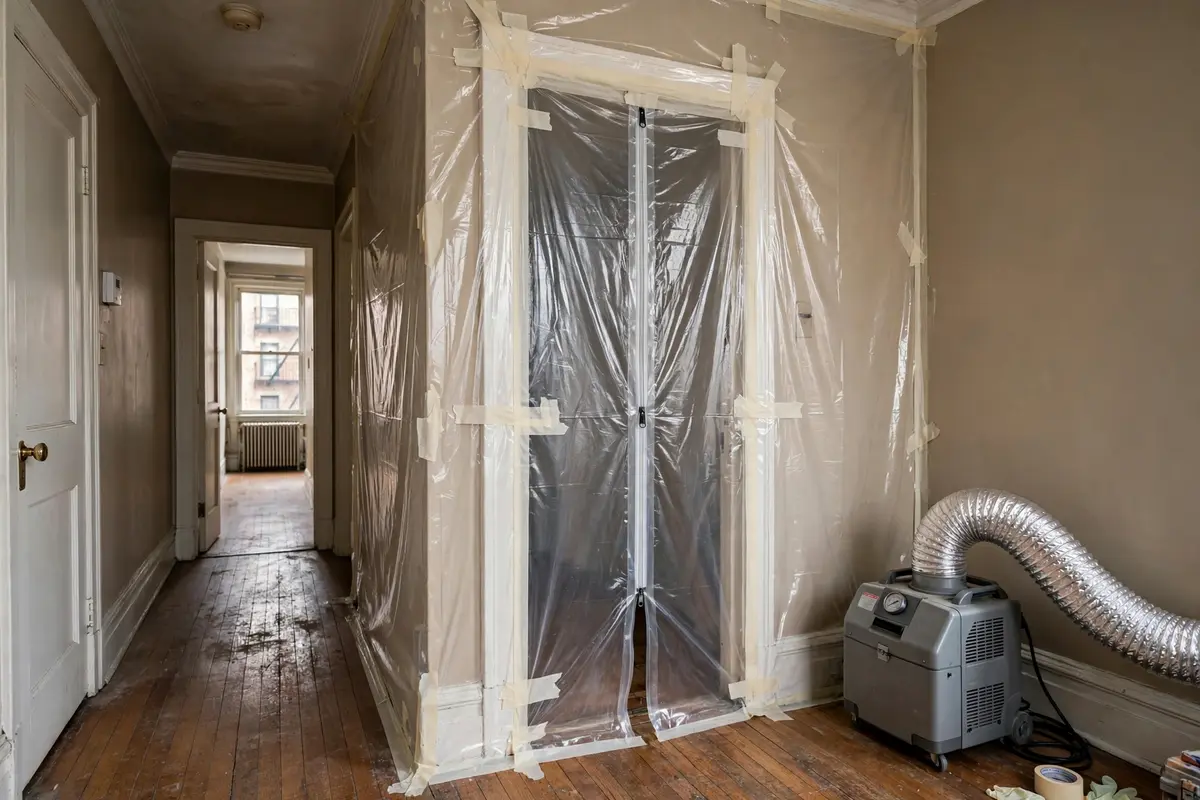
Where the water came from changes the trade you call first, but once growth is established, mold remediation New York rules decide how the cleanup itself must run.
Small patches forgive improvisation. Larger ones do not, and the ten square foot line is where mold remediation New York law stops forgiving it too.
The process
The Six Steps of a Legal Remediation Job
Strip the licences and filings away and a remediation job is six steps in a fixed order. The order is the protection: assessment before pricing, plan before plastic, clearance before teardown of the barriers. The steps below are the same six carried in this page structured data, written out in full.
1Call now and describe the mold and the water problem
Call (212) 555-0147 and say where the mold is, roughly how large the patch is, and what water caused it: a leak, a flood, a burst pipe or damp that never dried. Say whether anyone in the home has asthma or a weakened immune system. That first call starts the legal sequence, because in New York the assessment and the remediation are two separate engagements, and the order matters.
2Get an independent licensed assessor to map the mold area
A Department of Labor licensed mold assessor, independent of the company that will do the removal, inspects the property, measures the mold area in square feet, finds the moisture source and writes the remediation plan. If the mold covers more than ten square feet, this step is not optional; it is the law under Article 32 of the Labor Law.
3Read the assessor's remediation plan before work begins
The plan names the rooms, the estimated quantities, the methods, the protective equipment, the containment, the clearance criteria and the time estimates. The remediation contractor also gives you a work plan before site preparation starts. Read both. They are your contract with the science of the job, and the post remediation assessment at the end is judged against them.
4Contain the area and set negative air pressure
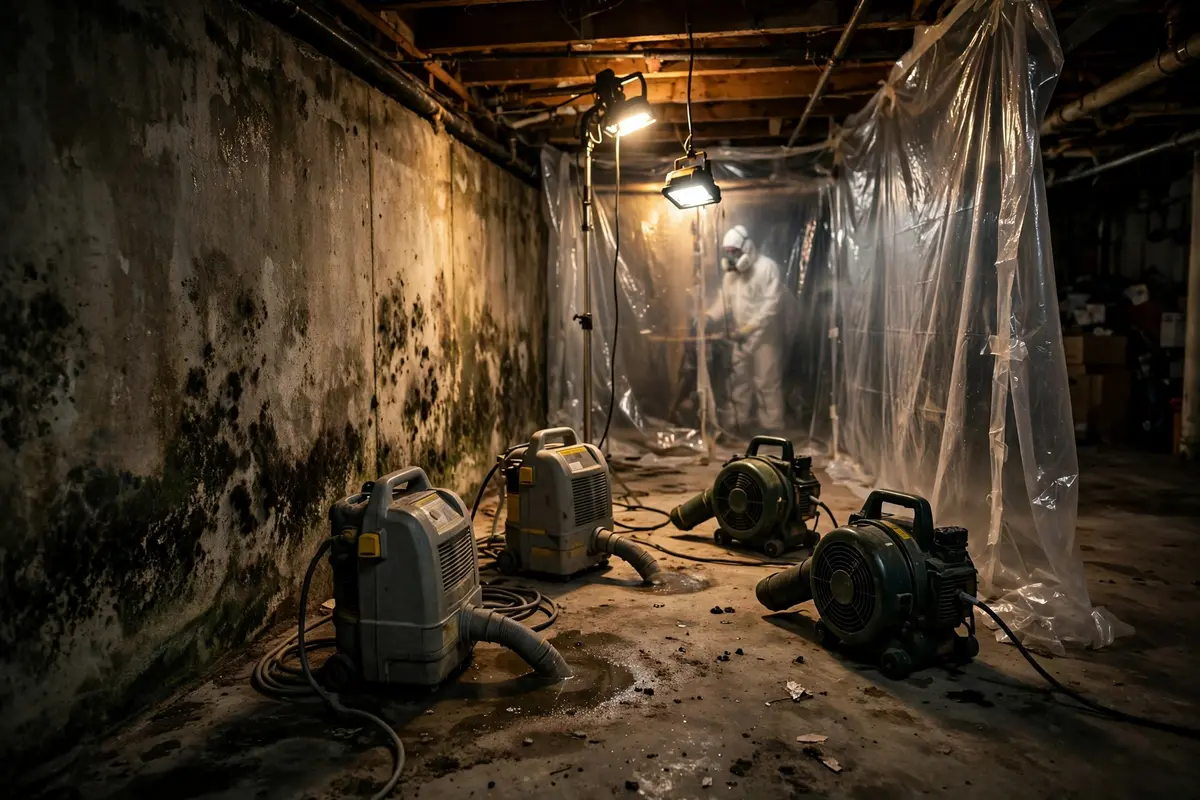
The crew seals the work area with plastic barriers, closes vents and doorways, and runs a negative air machine with HEPA filtration so air flows into the work zone and out through the filter, never into your clean rooms. Signs go up at the entrances. Containment is what separates remediation from ordinary cleaning.
5Remove moldy materials and clean every hard surface
Porous materials that cannot be cleaned, such as moldy drywall, insulation and carpet padding, are cut out, bagged inside the containment and removed. Hard surfaces, framing, concrete and tile, are HEPA vacuumed, scrubbed and sanitized. The underlying leak is repaired by its owner or a plumber; remediation law covers the mold, not the moisture source.
6Dry the structure and pass the independent post-remediation assessment
The structure is dried to its measured dry standard, and then an independent licensed assessor, not the remediation crew, inspects the work: a visual check, sampling results if samples were taken, and a written report. The containment stays up until the assessor passes the job. Only then is the room rebuilt and returned to normal use.
Two steps deserve emphasis because they are the ones skipped by cut price operators. The plan step, third, is where the clearance criteria are written down before work starts; without them, passed means whatever the crew says it means. And the final step is not finished when the room looks clean. It is finished when an independent assessor signs the post remediation report, and not a day earlier.
Ready to start at step one?
Call (212) 555-0147 and describe the mold and the water problem. The assessment is independent, the plan is written, and the clearance at the end is signed by someone who did not do the work.
It is worth repeating that the assessor works for the truth of the measurement, which is the quiet engine that makes mold remediation New York pricing honest.
The services
Fifteen Services on One Licensed Offer List
A remediation contract is a bundle of distinct services, and seeing them separated helps you read any quote. The fifteen below are the offer list carried in this page structured data. Not every job needs all fifteen: a bathroom patch needs containment, cleaning and drying; a flooded basement may need the whole list. The assessor plan, not the sales call, decides which ones your job includes.
Emergency mold remediation
The first response when mold is found after a leak, a flood or a sewer backup: make the area safe, stop the spread and start the legal process the same day.
Mold containment and negative pressure
Plastic barriers, sealed openings and a negative air machine that pulls air out of the work zone so spores cannot drift into clean rooms.
HEPA air filtration and cleaning
Air scrubbers with HEPA filters run through the job and after it, catching the fine particles that ordinary vacuums blow back into the room.
Porous material removal and disposal
Moldy drywall, insulation, carpet and ceiling tile are cut out, bagged inside the containment and carried out sealed, because porous material cannot be cleaned clean.
Hard surface mold cleaning and sanitizing
Wood framing, concrete, metal and tile are scrubbed, HEPA vacuumed and wiped down, because hard surfaces can be cleaned and kept.
Structural drying and dehumidification
Dehumidifiers and air movers bring the structure back to its dry standard, checked with meters, because mold returns wherever moisture stays.
Moisture mapping with daily readings
Meter readings across walls, floors and ceilings, written down daily, so the drying is proved on paper and not guessed at.
Wet wall and ceiling drying
Wet plaster and drywall are dried in place where they can be saved, and opened where they cannot, with the moisture source found first.
Carpet and padding removal
Wet carpet and padding hold water and mold against the floor; both are removed, bagged and disposed of under containment.
Contents cleaning and sanitizing
Furniture, stored boxes and belongings from the affected rooms are cleaned, sanitized and checked before they go back.
Antimicrobial treatment
After cleaning, surfaces are treated to discourage regrowth while the structure finishes drying and the leak repair is completed.
Black mold cleanup
Dark mold is handled with the same containment, the same protective gear and the same clearance as any other mold, because the law and the science treat all mold alike.
Basement mold remediation
Basements flood first and dry last; foundation walls, stored contents and floor drains get a dedicated plan.
Attic and crawl space mold remediation
Roof leaks and poor ventilation grow mold overhead and underfoot; both spaces are contained, cleaned and dried.
Insurance claim documentation
Photos, moisture logs, the assessor report and the work plan, organized for the claim file your insurer will ask for.
Two entries on the list are routinely misunderstood. Antimicrobial treatment is a finishing step on cleaned surfaces, not a substitute for removal; growth inside porous material cannot be sprayed away. And insurance claim documentation is a service in its own right, because the file assembled during a licensed job, plans, readings, photos and the independent clearance report, is exactly the evidence an adjuster asks for.
Tenants hold more power in this system than they usually know, because mold remediation New York duties in larger buildings are written as owner obligations, not owner options.
The clearance report is the single most valuable page in the file, since it is the one document in mold remediation New York work that the crew doing the job cannot write for itself.
Containment and cleaning
Containment, Sized to the Patch: Small, Medium and Large
Ask a room of remediators what separates their trade from cleaning and most will give the same answer: containment. Mold work disturbs colonies that sat quiet for months, and the first job is to keep that disturbance inside a sealed boundary. The Environmental Protection Agency remediation table sizes the response in three bands, and professional practice under S520 builds on the same ladder.
| Mold area | Containment | Minimum protection and method |
|---|---|---|
| Under 10 square feet | None | N-95 respirator, gloves and goggles. Direct cleaning of the patch; fix the moisture source. |
| 10 to 100 square feet | Limited containment | Plastic sheeting encloses the work zone; air controlled so spores stay inside; HEPA vacuuming and damp wiping of surfaces. |
| Over 100 square feet | Full containment | Sealed barriers with a controlled entry, negative air pressure through HEPA filtration, full protective equipment, bagging of all removed material inside the zone. |
Negative pressure is the quiet machine at the centre of the larger jobs. An air scrubber exhausts filtered air out of the work zone, so the pressure inside sits slightly below the rooms around it and every leak in the plastic flows inward. Spores released by cutting and scrubbing are drawn to the filter instead of the hallway. It is simple physics, and it is why a contained job leaves the rest of the home cleaner than an uncontained small job done carelessly.
Cleaning method follows material. Porous materials, drywall, insulation, carpet, ceiling tile, upholstered furniture, cannot be cleaned to the core and are removed, bagged inside the containment and carried out sealed. Hard and semi porous materials, framing timber, concrete, masonry, metal and tile, are HEPA vacuumed, scrubbed and wiped, then dried and checked. Contents sit between the two: hard objects clean well; soft furnishings from a heavily affected room are judged piece by piece, and the honest answer for some of them is disposal.
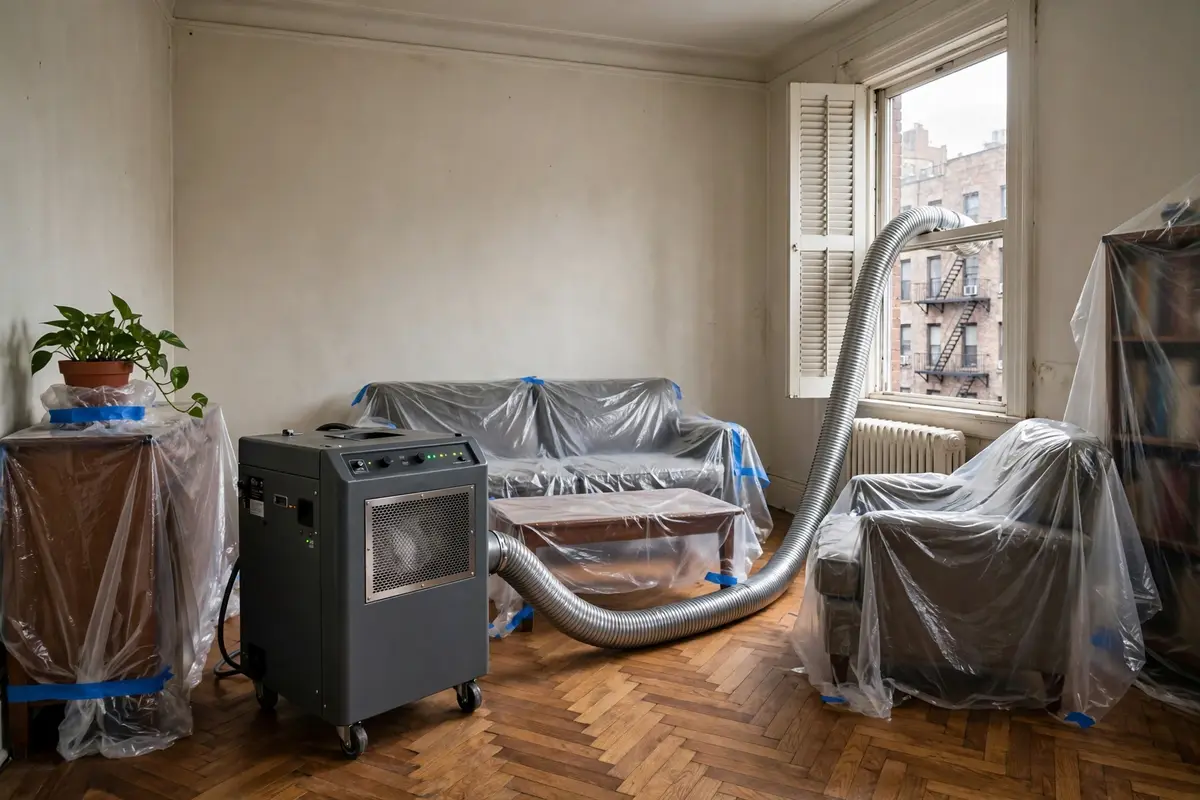
Drying is where patience pays. Structures dried to a measured standard stay cleared, and mold remediation New York assessors check those readings before they sign.
The standards
Two Standards, Two Jobs: S520 for Mold, S500 for Water
Professional practice in this trade is written down in the IICRC standards, and two of them divide the wet building between them. S520, the Standard for Professional Mold Remediation, reached its fourth edition in 2024. Its scope statement covers the principles and practices of mold remediation, including the protection of the health and safety of workers and occupants and the removal of mold contamination from structures, systems and contents. It is designed to be used with S500 and S100, the cleaning standard.
Equally useful is what S520 says it is not. The standard does not address mold assessment, mold sampling, the effects of mold on health, or the medical aspects of mold exposure. That boundary matters when a contractor waves the standard as authority for a health claim or a testing regime: the document itself refuses both roles. Assessment in New York belongs to the licensed assessor under Article 32, and health questions belong to clinicians under CDC guidance.
S500, in its fifth edition from 2021, is the water damage standard: how to extract, dry and restore after water events. The everyday sequence in a New York home runs through both books. S500 thinking dries the structure after the leak or flood. Where growth has started, S520 method contains, removes and cleans. And over both sits the state law, which no private standard can supply: licences, separation, filings and independent clearance. Both standards are paywalled in full, so this page quotes their stated scope and nothing it cannot show you.
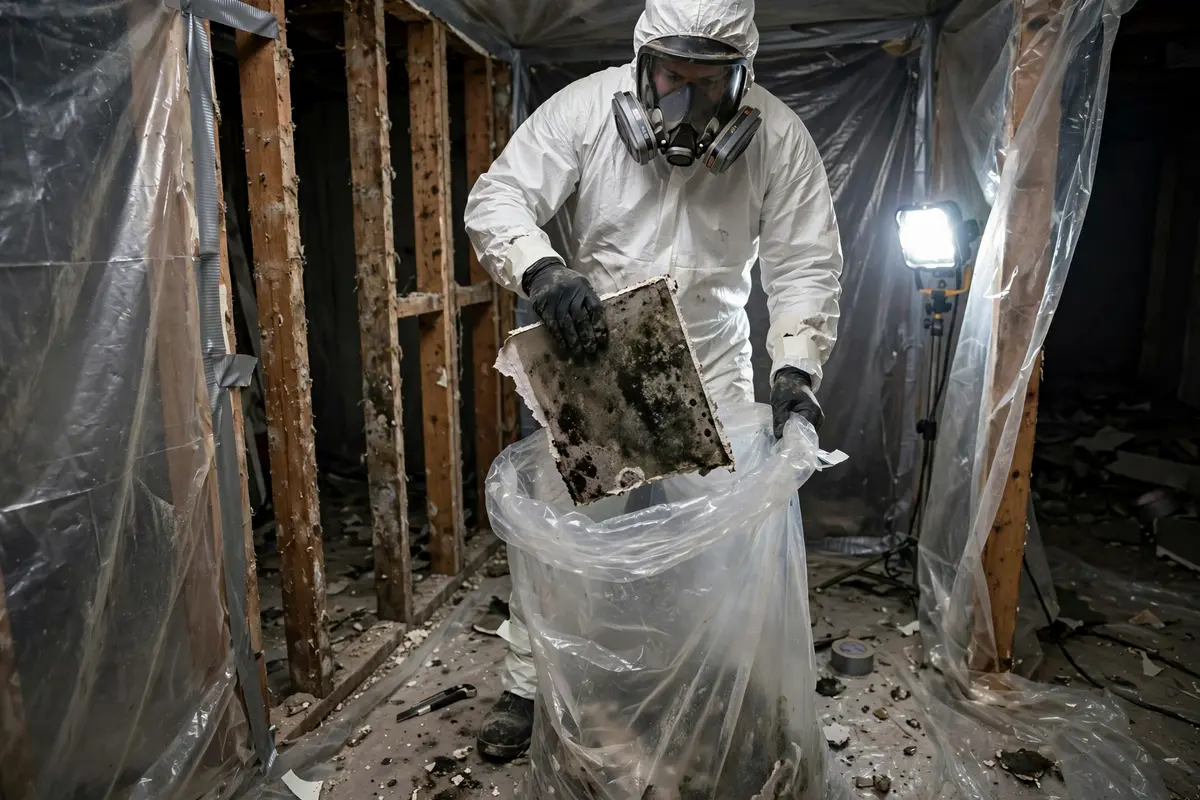
Containment looks like plastic and tape, but its real material is discipline: it is the promise that mold remediation New York work will leave the clean rooms cleaner than it found them.
Insurance adjusters read these files weekly, and a complete mold remediation New York file moves a claim faster than any phone argument.
Do it yourself limits
The Ten Square Foot Line: What You May Clean Yourself
The EPA guidance is refreshingly direct: a mold area of less than about ten square feet, in most cases, you can handle the job yourself. Scrub hard surfaces with detergent and water, dry everything completely, throw out absorbent materials that are moldy, such as ceiling tiles and carpet from the affected patch, and fix the water problem that fed the growth. Wear an N-95 respirator, gloves and goggles even for the small job; the EPA table asks for that much at every size.
- Do not paint or caulk over moldy surfaces. Paint over mold peels, and the growth continues underneath it.
- Do not run fans across visible mold. Moving air lifts spores and seeds them into clean rooms; the joint federal disaster guidance is explicit on this once growth has started.
- Do not mix cleaning chemicals, and ventilate the room while you work.
- Do bag and seal removed material before carrying it through the home.
- Do fix the moisture source first or with the cleaning, or expect the patch back within the season.
Three situations push even a small patch out of the do it yourself world. The water was sewage or flood water, which carries contamination beyond mold. The mold is inside the heating and air system, where disturbance spreads it through the building. Or someone in the home has asthma, a mold allergy or a weakened immune system; the EPA advice in that case is to consult a health professional and let others do the cleaning. In a rental, there is a fourth: the law puts the duty on the owner, and cleaning it yourself can blur the record of a violation. Report first, in writing, then decide.
The law does not ask homeowners to become experts. It asks the trade to be licensed, and mold remediation New York licensing is verifiable in two minutes at the door.
Tenants and landlords
Tenants and Landlords: Local Law 55 and the Yearly Inspection
For the third of New Yorkers who rent, mold law is housing law. Local Law 55 of 2018 applies to buildings with three or more apartments and makes mold an owner responsibility with a rhythm attached: the owner must inspect every unit at least once a year for mold and for the indoor allergen hazards and conditions that feed it, give tenants written notice of the inspection programme, correct what is found, fix the underlying condition, and keep records of all of it.
The response is graded by building size. In buildings with ten or more units, assessment and remediation must be performed by Department of Labor licensed assessors and remediators, independent of each other, the full Article 32 system. In buildings under ten units, the work is done by contractors registered with the Department of Environmental Protection. Either way, the tenant is not the customer and should not be handed the bill or the broom.
The chain when an owner does nothing
- Report the mold to the owner or managing agent in writing, dated, with photographs. Keep your copy.
- If the owner does not act, call 311. The complaint goes to the Department of Housing Preservation and Development.
- An HPD inspector can confirm the mold and issue a violation. A mold violation is class C and carries a twenty one day correction deadline.
- If the deadline passes, the city can carry out an emergency repair and bill the owner.
- If you feel unwell at any point, see a doctor. The health department advice does not wait for the paperwork.
Keep the paper. The dated letter, the 311 complaint number, the violation and your photographs form a chain that housing court, a rent proceeding or a relocation dispute can all read at a glance. Tenants who write things down get repairs; tenants who only called get condolences.
When a quote arrives without a plan behind it, the missing document tells you more about the company than the number does, a rule that holds across mold remediation New York work.
Separation sounds like bureaucracy until you price its absence: the finder who profits from finding is the oldest failure in this trade, and mold remediation New York law removes him from the job.
Local Law 61
Local Law 61: the Filing Rules for Larger Buildings
Local Law 61 of 2018, effective January 1, 2019, added section 24-154 to the Administrative Code and wrapped the biggest jobs in a filing system run by the Department of Environmental Protection. A covered building is one with ten or more dwelling units, or a non residential building of twenty five thousand square feet or more on the same zoning lot. New York City Housing Authority buildings are exempt. Inside a covered building, the remediation must be done by an Article 32 licensee, and the job leaves a paper trail with the city at both ends.
- Before work: the remediation licensee files a Mold Remediation Work Plan and Notification Form with the DEP.
- After work: the assessment licensee files a Mold Post Remediation Assessment Form and Certification.
- Filings are made online. Notice of the completed post remediation assessment reaches the agency within seven days.
- In emergencies or court ordered work, notice is due within twenty four hours of the work starting.
- The agency publishes filing information online within twenty four hours of receiving it.
On penalties, this page follows the law text and flags the conflict honestly. Section 24-154 sets penalties of up to one thousand dollars for a first violation, five thousand for a second and ten thousand for a third or later one, with an alternative per building calculation tied to square footage. A Department of Environmental Protection web summary quotes a different range, eight hundred to ten thousand dollars. Where a summary and a statute disagree, the statute is the safer citation, and it is the one used here.
For landlords and boards, the practical meaning is planning. A large job in a covered building cannot legally start on a handshake: the work plan filing comes first, and the assessment filing closes the job. Build the filing days into the schedule, and keep the filed forms with the assessor plan and the clearance report in the building permanent file.
Every borough produces the same wet wall in the end, and the response that works is the same sequence, which is the practical meaning of a single mold remediation New York system.
Health
Health Questions, Answered the Way the CDC Answers Them
Every mold page on the internet eventually makes a health promise. This one makes a smaller, more useful one: it will tell you exactly what the health agencies say, and stop where they stop. The Centers for Disease Control and Prevention, last reviewed in September 2024, lists the common reactions to mold exposure: nasal stuffiness, throat irritation, coughing or wheezing, and eye or skin irritation. People with asthma, people with mold allergies and people with weakened immune systems face greater risk, and for them exposure can mean worse symptoms and infections that a healthy person would shrug off.
Two CDC positions cut through most of the fear marketing in this trade. There are no federal limits or standards for mold exposure, which means no spore count can certify a room safe or dangerous. And the CDC does not recommend mold testing: when mold is visible, sampling is usually unnecessary, because the response, remove the growth and fix the moisture, is the same whatever the species. Its occupational health arm, NIOSH, adds that sampling cannot check compliance with limits that do not exist.
What the agencies do recommend is unglamorous and effective. Fix the building: remove the growth, dry the structure, repair the moisture source. And treat the person separately: if symptoms persist or worry you, see a doctor and describe the exposure plainly. The city health department gives tenants the same advice and routes building complaints through the owner first and 311 second. A remediation company that offers to diagnose your health is selling outside its licence; a page that repeats agency guidance word for word is doing its job.
Nothing on this page is medical advice. Symptoms belong to a clinician, buildings belong to licensees, and the two conversations should never be merged by the person selling the cleanup.
Keep the photographs. Months later, when memory has softened the details, the dated pictures are the part of a mold remediation New York file that cannot be argued with.
A passed assessment is not a trophy; it is a boundary in time after which the room returns to ordinary life, and mold remediation New York practice treats it that way.
Choosing a company
How to Check a Remediation Company Before You Sign
New York hands consumers an unusually strong toolkit for this trade, because the licensing system is checkable at every point. The questions below come from the pattern of complaints and questions New Yorkers post after bad jobs, and each one maps to a document that must exist if the company is what it claims to be.
- Ask for the licence, then look at it. It should be a Department of Labor mold licence, current, in the name of the business you are hiring, and the law requires it displayed at the work site.
- Ask who the independent assessor is. If the answer is the same company, the arrangement conflicts with section 936 on any project over ten square feet.
- Ask to see the remediation plan before you agree the scope. Quantities, methods, containment and clearance criteria should be written, not promised.
- Ask for the insurance certificate and check the name against the licence and the contract.
- Ask what happens at the end. The right answer names an independent post remediation assessment and a written report, with containment standing until it passes.
- Be wary of a species test sold as the centrepiece, of a fogging only treatment for growth inside walls, and of any quote given before anyone measured the area.
Price questions deserve the same discipline. This site publishes no prices on any page, because the honest sequence is assess, plan, then price the plan. A company that prices your job from a photograph is guessing with your money; a company that insists on the independent assessment first is following the system the state built, and the written plan it produces is the document every later step is judged by.
Borough by borough the housing changes and the water changes with it, but the sequence never does, which is why a single page can honestly describe mold remediation New York work for the whole city.
Room by room
Room by Room: Where New York Mold Hides and How Each Space Is Fixed
Basements and cellars
The first space to flood and the last to dry. Foundation walls wick groundwater, floor drains back up, and stored cardboard feeds growth. Remediation here pairs containment with serious drying and a hard look at what is stored against the walls.
Bathrooms
Failed grout, silent wax ring leaks and shower splash grow mold behind tile and under vinyl. The patch looks small from the room and large from inside the wall, which is why the assessor meter matters more than the photograph.
Kitchens
Sink cabinet leaks and dishwasher lines drip for months into particle board that swells and moulds. Expect cabinet removal, subfloor checks and a plumber in the sequence.
Attics and crawl spaces
Roof leaks and missing ventilation condense on cold sheathing. Work overhead and underfoot needs its own containment and its own drying plan, and the roof repair is the owner job that makes the clearance last.
Walls and ceilings
The upstairs neighbour leak is the classic New York case: a stain spreads, paint bubbles, and the cavity behind holds wet insulation. Opening the wall is a remediation decision, made from meter readings, not from the size of the stain.
HVAC and closets
Mold inside air handling equipment spreads spores through the whole home and takes the job out of the do it yourself class at any size. Closets on outside walls grow quiet colonies behind stored clothes wherever warm room air meets a cold wall.
A violation, a claim and a resale all ask the same question in different words: show me the paper. Licensed mold remediation New York jobs are the ones that can.
The assessor independence rule is the clause readers remember, and rightly: it is the clause that makes every other number in a mold remediation New York file believable.
Areas served
Sixteen Areas, One Licensing System
The licence is state wide, and the need is city wide. The sixteen areas in this page structured data run from the five boroughs to the neighbourhoods where the housing stock makes mold a recurring fight: pre war apartment houses in Harlem, the Upper West Side and the Upper East Side, where steam heat and old risers meet plaster walls; garden apartments and two family houses across Astoria, Flushing and Jamaica in Queens; brownstones in Park Slope and Williamsburg and the frame houses of Brooklyn; co ops and apartment towers in Riverdale and across the Bronx; and the houses of Staten Island and Long Island City growing stock of converted industrial buildings.
The housing explains the pattern. New York oldest buildings carry a century of plumbing inside walls that were never designed to be opened, and its newest carry tight envelopes that trap humidity when ventilation lags. Add nor'easters, summer humidity off two rivers and a harbour, frozen pipes in January and sewer backups in August, and every borough produces the same sequence: water first, growth second, a call third. The licensing system does not change by neighbourhood, and neither does the order of work: assess, plan, contain, remove, clean, dry, and pass an independent check.
Callers outside the sixteen named areas are not outside the system. Article 32 runs in every county of the state, and the borough, city and region pages linked at the foot of this page cover the wider map, from Long Island to the Hudson Valley and beyond.
Crews change, companies change, and buildings change hands, while the statute stays where it was written, which is the quiet strength of the mold remediation New York system.
Case studies on video
Two Jobs on Camera, Read Closely
Two short videos, watched in full for this page, show the work from inside real New York jobs. Both come with the same caveat, stated here rather than buried: they are recent, low view company videos, published in 2026 by small firms, and they are illustrations of practice, not official sources. The law and the agency guidance quoted elsewhere on this page outrank anything said on camera.
Case study one: a Brooklyn basement, start to finish
The first film, Basement Water Damage and Mold Remediation in NYC, from Crown Mold Specialists, runs thirty nine seconds and compresses a whole basement job into its skeleton: a licensed team, full containment going up, and the borough wide service claim in the description. Watched against the Article 32 sequence, its value is the order it shows: barriers and protection before removal, which is the step hurried jobs skip. Watch it here: Basement Water Damage and Mold Remediation in NYC, Crown Mold Specialists.
Case study two: when an inspection is worth it
The second film, Do You Need a Mold Inspection in NYC, from Water Damage Restoration Brooklyn, runs seventy seconds and argues the consumer side: when an inspection earns its fee and when it does not. One line in it needs a correction this page is glad to make. The video describes the assessor remediator separation as a rule about the same company; the statute, section 936, is written around licensees and ownership interests, and the video phrasing is its paraphrase, not the law text. Watch it here: Do You Need a Mold Inspection in NYC, Water Damage Restoration Brooklyn.
Read together, the two films show the two halves of a good job: the physical discipline of containment and removal, and the consumer discipline of independent inspection. Neither film replaces the documents. If a real job in your home produces no plan, no readings and no independent clearance report, it has less evidence behind it than these two short videos.
When neighbours compare notes after a flood, the homes that dried in two days and the homes that waited tell two different stories, and only one of them ends in a mold remediation New York project.
There is no shortcut in the sequence that the law has not already considered and closed, a fact experienced callers learn the first time they compare a licensed mold remediation New York file with a folder of promises.
Insurance
Insurance and Mold: What the State Regulator Actually Says
Insurance is where mold jobs go to be argued about, so this page lets the regulator speak first and in full. The Department of Financial Services answers the coverage question in its own FAQ with this wording: Mold damage is covered if it is due to a covered event. Many policies have a mold limitation for the payment of remediation services. Your policy has to be reviewed for the specific language. The department states no dollar limit, and this page invents none.
Three practical consequences follow. First, the water event is the claim: a burst pipe, a failed water heater, a storm driven flood where the policy responds. Mold that grew from that event rides on it; mold from months of damp and neglect usually stands alone and uncovered. Report the event early, before the growth becomes the story. Second, the mold limitation clause is where covered claims shrink, so read your own policy before you need it. Third, documentation decides arguments: the licensed system produces the assessor plan, the contractor work plan, daily moisture readings and an independent clearance report, and that bundle is the strongest claim file a homeowner can hand an adjuster.
If a claim stalls or is denied, the department runs consumer lines: the main line at (800) 342-3736 and the disaster hotline at (800) 339-1759. The insurance claim page linked at the foot of this page walks the full claim process for water and fire losses, clocks, letters and the denial ladder included.
Moisture is patient and mold is patient, and the only answer either of them respects is a measured, documented dry structure, which is the whole craft of mold remediation New York work in one sentence.
Common mistakes
The Mistakes That Make Mold Come Back
Cleaning before assessing
Tearing out a moldy wall without containment or a plan spreads spores through the home and destroys the measurements the assessor needed. On any patch over ten square feet it also breaks the legal sequence.
Bleach as a strategy
Surface bleach on porous material wets the surface, fades the colour and leaves the growth in the depth of the material alive. Removal and drying fix mold; colour change does not.
Painting over it
Paint over mold is a lid on a living colony. It peels, it bubbles, and in a rental it can read as concealment of a known hazard.
Drying without measuring
A room that feels dry can hold wet wall cavities for weeks. Moisture meters and daily readings exist because touch is not a standard.
Skipping the leak repair
Remediation law does not include the moisture source, so the owner must close that loop. A cleared room under a live leak is a countdown, not a cure.
One company, both hats
Assessment and removal from one business on a licensed project conflicts with section 936 and removes your only independent check at both ends of the job.
Every mistake on this list is a shortcut around the same three protections: measure first, contain always, and let an independent assessor judge the end. The system feels slower than a spray and a promise. It is also the reason a properly remediated New York room stays remediated.
The plan on paper, the plastic on the doorway and the signature at the end are one idea in three forms: nobody grades their own work in mold remediation New York practice.
For a landlord, the yearly inspection rhythm of Local Law 55 turns mold from an emergency into a maintenance line, and that shift is worth more than any single mold remediation New York job.
Records and proof
Paper That Protects You: Plans, Reports and Photos
A licensed New York remediation produces a small archive, and keeping it is the cheapest insurance a homeowner ever files. The archive has four layers. Before work: your dated photographs, the assessor report and the remediation plan with its measured area, moisture source and clearance criteria. During work: the contractor work plan, licence and insurance copies, daily moisture readings and progress photographs. At the end: the independent post remediation assessment report. Around all of it: city filings where Local Law 61 applies, insurer letters, and your own dated notes of calls and promises.
The archive earns its shelf space in four ordinary futures. An insurance claim, where the event and the sequence must be proved. A sale, where a buyer or a lender asks what was done about the mold the inspection found. A tenancy dispute, where the violation, the filings and the clearance report close the argument. And a recurrence, where the next assessor starts from your records instead of from rumour and can see at once whether the moisture source was ever repaired.
Start your file with the right first document
Call (212) 555-0147. The independent assessment that begins a legal job is also the first page of the record that protects your claim, your sale and your home.
Callers sometimes ask whether all this law makes the work slower. It makes the work provable, and provable is what a home, a claim and a family actually need from mold remediation New York services.
The first hours
The First Two Days Decide Whether Mold Starts at All
Mold is a race against a clock that starts when the water lands. The Environmental Protection Agency states the window plainly: dry water damaged areas and items within twenty four to forty eight hours after flooding and mold will, in most cases, not grow. The joint federal disaster guidance from the CDC, the EPA and their partner agencies builds on the same window from the other side: a home that was flooded and could not be dried within that time should be assumed to have mold, whether or not growth is visible yet. In mold remediation New York work, that single fact explains the difference between a drying job and a licensed remediation project.
The first hours belong to water discipline. Stop the source, extract what is standing, lift belongings off wet floors, and get air moving across wet materials while they are still only wet. Fans help at this stage, on clean water damage with no growth yet. The moment growth has started, the same fans become a hazard, because moving air lifts spores and carries them into rooms that were clean. Callers who understand that one switch, fans before growth and never after, understand the hinge on which mold remediation New York practice turns.
Documentation starts in the same window. Photograph the water line on the wall, the soaked carpet, the ceiling stain while it is still spreading. Those pictures, taken before anyone cleans anything, are the evidence an insurance claim and an assessor report both lean on later. A household that spends ten minutes on photographs in hour one saves weeks of argument in month two, and every mold remediation New York professional who reads a claim file will tell you the dated photos are the pages they turn to first.
By day two the question changes from drying to diagnosis. If materials are still wet, if a musty smell has settled in, or if any patch of growth is visible, the licensed sequence begins: an independent assessor measures and plans, and the work becomes a project under the law rather than a cleanup under a hope. Speed still matters, but from this point the order of the steps matters more, and that order is the subject of the rest of this page and of mold remediation New York law itself.
A clean smell proves nothing and a dry reading proves a great deal, which is why meters, not noses, close out mold remediation New York jobs.
The ten square foot line is small enough to memorize and large enough to matter: below it, guidance; above it, the full weight of mold remediation New York law.
The assessment
Inside an Assessment Visit, Minute by Minute
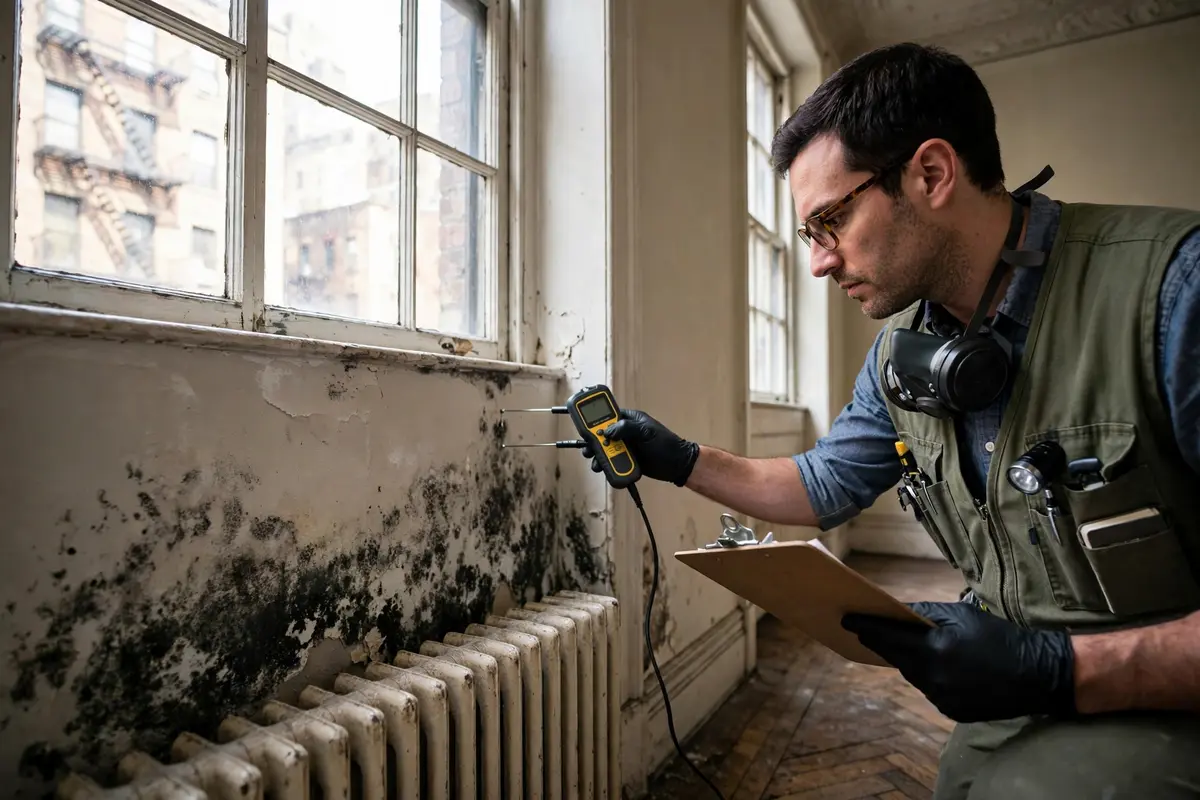
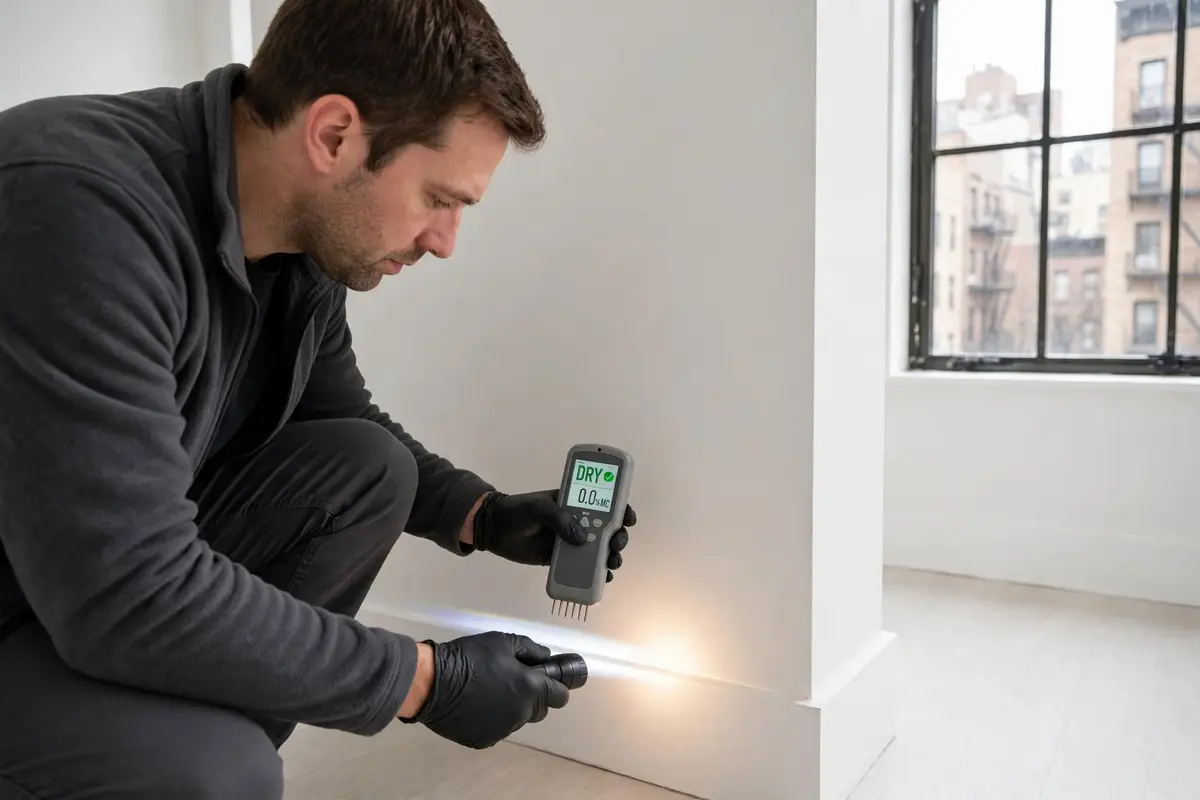
An assessment visit is a measurement exercise wearing the clothes of a walkthrough. The assessor arrives with a moisture meter, a flashlight, a camera and a floor plan, and works the rooms in order: where is the growth, how many square feet does it cover, what material is it growing on, and where is the water coming from. In mold remediation New York practice the assessor is licensed by the Department of Labor and independent of the removal company, so every number written down belongs to the record and not to a sales pitch.
The meter readings decide more than the photographs do. A stain can look finished while the cavity behind it holds wet insulation, and a wall that looks ruined can read dry and sound. The assessor probes baseboards, checks the wall behind the bathroom tile, looks under the sink cabinet and into the closet on the outside wall, because mold remediation New York jobs fail most often at the places nobody opened. Each reading goes into the report with the room and the material named, building the moisture map the remediation plan is drawn from.
Sampling is the part clients ask about most and need least. The CDC does not recommend routine mold testing, and the assessor will say so: where growth is visible, the plan does not change with the species name. Sampling has its place, for hidden growth suspected behind a wall, for a clearance question the plan itself raises, or where a doctor or a court needs data, but in ordinary mold remediation New York work the visual inspection and the moisture map carry the decision, and honest assessors explain that before they bill for a single swab.
The visit ends with the document the whole job hangs on: the remediation plan. Rooms, quantities, methods, protective equipment, containment, clearance criteria and time estimates, written before the removal company prices its work. Read it at the kitchen table, ask about every line you do not understand, and keep your copy with the insurance papers. In mold remediation New York terms, that plan is the contract between the science and the invoice, and it is written by the one person on the job who cannot profit from enlarging it.
Every trade has a version of the finder who profits from finding. New York simply wrote the cure into statute, and the cure is the backbone of mold remediation New York work.
Drying
Drying to a Standard, Not to a Feeling
Ask when a remediated room is dry and the honest answer is a number, not an adjective. Professional drying under the S500 tradition works to a dry standard: the moisture level of comparable unaffected material in the same building. The remediator measures the wet framing, the subfloor and the wallboard against that local standard every day, logs the readings, and stops when the numbers match. Mold remediation New York assessors read those logs at clearance, because a room dried to a feeling is a room scheduled to grow again.
The equipment is ordinary and the discipline is not. Dehumidifiers pull water from the air, air movers push that air across wet surfaces, and the crew returns to measure, reposition and record. Wet wall and ceiling assemblies sometimes dry in place with directed air; sometimes the baseboard comes off or small openings are cut to move air into the cavity. Each choice is a judgement the daily readings defend, and in mold remediation New York work those readings are part of the job file the client keeps, not a notebook the crew takes home.
Drying is also where the moisture source question refuses to go away. A structure can be dried to standard under a live leak and read wet again within the week, which is why the assessor plan names the source and why the owner repair, the plumber, the roofer, the repointed brick, has to land before or alongside the drying. Mold remediation New York law separates the growth from the source on paper; physics does not, and the crews who last in this trade work to the physics.
Photographs fade in importance as memories do the opposite, so the dated picture taken in the first hour remains the most honest page in many a mold remediation New York file.
Where the building is shared, the job is shared, and the filings, notices and access arrangements around mold remediation New York work in larger buildings are part of the work, not paperwork after it.
Building types
Co-ops, Brownstones, Towers and Shops: the Building Changes the Job
Co-ops and condos
Board rules, building staff and the shareholder below you all enter the plan. A leak in a co-op is a three party event, and mold remediation New York practice in these buildings runs on notice: management informed, access arranged, and the work plan shared before the plastic goes up.
Brownstones and row houses
A century of plumbing inside plaster and timber, party walls shared with neighbours, and cellars that flood from the street and the sewer in the same storm. The assessor reads these buildings slowly, because the water path is rarely the obvious one.
Rental towers
Local Law 55 duties, yearly inspections and Local Law 61 filings in the larger buildings turn mold into a compliance workflow. The landlord who treats a mold remediation New York job as paperwork plus plumbing finishes it once; the one who treats it as a complaint finishes it yearly.
Houses in the boroughs and suburbs
Owner occupied houses carry the Article 32 exemptions for the owner own hands, but the licensed route is what insurers and buyers trust. The exemption covers your labour on your home; it does not make an unlicensed contractor legal.
Shops, offices and restaurants
Non residential buildings of twenty five thousand square feet or more fall under Local Law 61 filings, and business interruption makes the schedule a commercial term. Containment that protects customers and stock is planned as carefully as the removal itself.
Schools and care settings
Sensitive occupants raise every standard: stricter containment, stricter clearance, and communication with parents, staff and regulators. The S520 standard was written with schools and commercial buildings in its history, and its discipline shows here.
One rule survives every building type. The bigger and more shared the building, the more the job is a coordination exercise wrapped around a technical core, and the earlier the building management sees the assessor plan, the smoother the containment, the access and the filings run. Experienced mold remediation New York contractors ask about the building before they ask about the patch, and that order of questions tells you most of what you need to know about them.
The standards books and the statute book agree on the essentials: contain the work, protect the people, dry the structure, and prove the result, the four corners of mold remediation New York practice.
What sets the scope
What Decides the Size of a Job, If Not a Price List
Callers ask for a figure and this page gives none, on any page of this site, because the figure is the last honest output of a process and not its first input. What can be stated in advance is the list of things the figure is built from, and a caller who knows the list can read any quote line by line. In mold remediation New York work the scope is set by the assessor plan, and the plan is built from six facts about your home and nothing else.
- Area: the measured square feet of growth, which also decides whether the job is a licensed project at all.
- Materials: porous material is removed and replaced, hard material is cleaned and kept, and the mix between the two moves the scope more than any other factor.
- Containment class: none, limited or full, following the size bands in the EPA table, with negative pressure and HEPA filtration on the larger jobs.
- Access and building rules: filings under Local Law 61, board approvals, elevator bookings and working hours in shared buildings.
- Drying time: the days the structure needs to reach its dry standard, proved by daily readings.
- Clearance: the independent post remediation assessment, and any repeat visit if the first check fails.
Read against that list, a quote stops being a single mysterious number and becomes an argument you can follow. Where a line has no fact behind it, ask. Where a fact about your home is missing from the quote, ask louder. That is the whole of consumer protection in mold remediation New York practice: the plan first, the price second, and the paper kept forever.
Seasons
A New York Mold Calendar: Four Seasons, Four Causes
Winter
Frozen and burst pipes are the season signature. A pipe lets go in a wall cavity, the home is dried in a hurry, and the cavity is not. January calls in mold remediation New York work are December leaks that were dried on the surface only.
Spring
Snowmelt, river levels and the first heavy rains test every foundation and every flat roof. Basement growth found in April usually started with March water, and the assessor job is tracing which entry point did it.
Summer
Humidity is the cause that needs no leak at all. Warm air against cold walls, closets on outside walls, and air conditioning condensate lines grow quiet colonies, and summer is when the smell complaints peak.
Autumn
Nor'easters and the tail of hurricane season drive the storm calls: roof leaks, window leaks and sewer backups in the same week. The homes that dry within two days rarely call again; the ones that wait become winter projects.
The calendar teaches one habit: after any water event, the season matters less than the forty eight hours that follow it. Every season cause on this list becomes a remediation project through the same door, water left standing in materials while the household hoped it would dry on its own. In mold remediation New York experience, hope is the most expensive drying method ever tried.
Questions people ask
The Questions New Yorkers Actually Ask, Collected From the Forums
The questions below are the ones that recur wherever New Yorkers talk about mold in public: housing forums, question and answer sites, building message boards and the comment threads under agency pages. They are answered here the way this page answers everything, from the statute and the agency guidance, because the forum answers, however confident, are where the myths in this trade breed. Each answer also stands somewhere in the thirty questions at the foot of the page in formal form; these are the same truths in the words people actually type.
My landlord painted over the mold. Is that legal?
Painting over mold corrects nothing. Local Law 55 requires the owner to correct the mold and fix the underlying condition, and a coat of paint does neither; it seals a living colony under a film that will bubble and peel. Photograph it, report it in writing, and if nothing changes, call 311. Inspectors know the look of painted mold, and in mold remediation New York enforcement the photograph of the painted patch, dated, is often the picture that starts the violation.
The company wants to fog the apartment and leave. Is that remediation?
Fogging or spraying alone is a treatment looking for a process. Growth inside porous material and inside wall cavities is not reached by a mist, and no New York document, not Article 32, not S520, not the EPA guidance, describes remediation as a spray event. Real mold remediation New York work contains, removes, cleans, dries and then proves the result to an independent assessor. A treatment that skips those steps is selling the smell of a solution.
Can I withhold rent over mold?
That is a legal question with a paper trail attached, and this page gives information, not legal advice. What the record shows is that tenants who documented the condition, reported it in writing, called 311 and kept the violation paperwork stand in a far stronger position in any housing proceeding than tenants who simply stopped paying. The mold remediation New York duties sit on the owner; your job as a tenant is to make the condition official, dated and impossible to deny.
We found mold during a home purchase inspection. Who pays?
That is negotiated between buyer, seller and their lawyers, but the New York system shapes the negotiation: an independent assessor can measure and plan the work before closing, the plan prices the job honestly, and the post remediation report can be made a closing condition. What neither side should accept is a seller side cleanup by the seller own contractor with no independent clearance, because in mold remediation New York terms that paper proves nothing.
Is the black stuff in my shower dangerous?
Shower grout mold is the most common and least regulated growth in the city: small area, hard surface, usually cleanable by the householder under the EPA small area guidance, with the moisture fix being ventilation and regrouting. Colour does not grade danger, and the CDC treats all molds alike. What moves a bathroom out of the small class is spread: growth behind the tile, a soft wall, a ceiling below staining through. Then the meter matters more than the colour, and the licensed sequence applies like anywhere else.
After clearance
After the Pass: Rebuild, Prevention and the Quiet Months
The assessor signature ends the remediation and starts the rebuild. Walls opened for removal are closed, finishes are replaced, and the rooms return in the order they were lost. Good contractors sequence the rebuild after the clearance on purpose: rebuilding before the independent pass would bury the evidence the assessment exists to check. In mold remediation New York practice that patience is contractual, not temperamental, because the containment and the open walls stay as the assessor found them until the report is written.
Prevention is a short list of unglamorous habits. Fix drips the week they appear. Keep bathroom fans running after showers and kitchen air moving after boiling pots. Watch the closet on the outside wall in January, when warm room air condenses on the cold surface behind the coats. Check under every sink twice a year with a flashlight and a dry hand. None of this is a product; all of it is why some buildings never appear in mold remediation New York records while their twins appear every third year.
Keep the file. The plan, the readings, the clearance report and your photographs go in one folder, physical or digital, labelled with the address and the year. If the home is sold, the folder answers the buyer inspector. If a new patch ever appears, the folder tells the next assessor what was done, what was dried and whether the source was fixed. A home with a mold history and a complete file is a smaller risk than a home with a mold history and a shrug, and everyone who reads files for a living knows the difference on sight.
Mold cleared, or mold found? Either way, start with the measurement
Call (212) 555-0147. An independent assessment tells you whether you need a cleanup, a project, or simply a plumber and a fan, and it puts the answer in writing.
Plain words
Plain Words: a Short Glossary for a Confusing Trade
- Assessment: the licensed inspection that measures the mold, finds the moisture source and writes the remediation plan.
- Assessor: the Department of Labor licensee who assesses. By law, never the same business as the remediator on your project.
- Clearance: the independent post remediation assessment that passes or fails the finished work against the plan criteria.
- Containment: the sealed plastic boundary, often under negative pressure, that keeps disturbed spores inside the work zone.
- Dry standard: the moisture level of unaffected material in the same building, used as the target for drying.
- HEPA: high efficiency particulate air filtration, the filter class used in the vacuums and air scrubbers on remediation jobs.
- Negative pressure: air pressure inside containment held below the rooms outside it, so leaks flow inward.
- Porous material: drywall, insulation, carpet and similar material that absorbs water and cannot be cleaned to the core.
- Project: the Article 32 term for mold work where growth is greater than ten square feet, triggering the licensing system.
- Remediation plan: the assessor written plan covering rooms, quantities, methods, protection, containment and clearance criteria.
- S520 and S500: the IICRC standards for mold remediation and water damage restoration respectively.
- Work plan: the remediation contractor plan given to the client before site preparation, kept at the job site during the work.
Words are the first containment. A caller who can say assessment, plan and clearance in the right order is a caller the trade treats carefully, because those three words describe the whole legal shape of mold remediation New York work, and everyone on the phone knows it.
The research behind this page
What the Search Data Says About This Keyword
This page was researched the way every page on this site is researched: SEMrush and Moz run separately through RankyTools in November 2026, the live search results read one by one, and the competitor pages and their structured data compared in detail. The two tools disagree about this keyword, and the disagreement is reported rather than averaged. An earlier keyword sheet listed this phrase at higher volume and lower difficulty; the fresh figures below replace it, and the sheet numbers are not quoted anywhere on this page as current.
| Measure | SEMrush, 24 Nov 2026 | Moz, 23 to 24 Nov 2026 |
|---|---|---|
| Monthly volume, US | 320 searches | 39 searches, in a range of 11 to 50 |
| Difficulty | 50 percent, classed Difficult | 24, classed Low |
| Intent | Commercial | Transactional |
| Click and cost signals | Cost per click of 7.41 dollars; competitive density 0.64 | Click through rate 61 percent; minimum domain authority 3 |
| AI Overview and People Also Ask | Neither present in SEMrush | People Also Ask present with four questions; no AI Overview listed |
The live results explain the difficulty split. SEMrush top ten for this phrase is headed by the city health department mold page and the state Department of Labor mold programme, government pages with the authority of the law itself, followed by commercial sites whose page authority runs as low as 14. Moz, reading a slightly different result set last updated November 8, 2026, counts nine organic results and finds testing companies, directories and local firms, several with very thin link profiles. Both pictures agree on the opening: the commercial results are beatable with depth, documents and honest structure, while the government pages are quoted here as sources rather than treated as rivals.
The structured data comparison behind this page read fifteen competitor results through the search rich results validator: fourteen loaded and one directory page failed to load at all. Only three of the fourteen carry a FAQ section in their markup, the largest with twenty questions. None carries a HowTo. Two carry an offer catalogue, one of them a national chain whose eighteen offers include exactly one about mold. Five carry real review ratings, which this page does not imitate: ratings are never published here without real reviews behind them. Five of the fourteen, including the city and state pages, carry no structured data at all and rank on authority alone. This page answers with thirty questions matched word for word between the visible page and its markup, a six step HowTo, and a fifteen offer catalogue devoted entirely to mold work.
One boundary was set before a word was written. A shorter variant of this keyword, built on the city abbreviation, is a separate search with its own page in this series, the removal service page linked below. The tools disagree about that variant too, one calling it easier than this phrase and the other harder, which is exactly why the two pages are kept apart: that page covers the removal service itself, while this page covers the licensed New York system around the work, the law, the licences, the filings and the clearance. Searchers land on the page that matches the job they are actually hiring for.
How New York got here
How New York Built the Strictest Mold Rules in the Country
New York did not regulate mold on a theory. It regulated mold after decades of wet housing, tenant complaints and cleanup jobs that answered to nobody. The city health department published its guidelines on assessment and remediation of fungi in indoor environments back in November 2008, a twenty five page document that taught a generation of building staff how growth should be evaluated and removed. Those guidelines advised; they did not license. In mold remediation New York history, 2008 is the year the knowledge became official, and the years that followed showed the limit of advice without a licence behind it.
The market filled the gap the guidelines left. Anyone could advertise mold work, the same firm could find the growth and sell the cure, and homeowners had no register to check and no standard to quote. The state answered with Article 32: a statute effective July 28, 2015, and a licensing system running from January 1, 2016, that put the Department of Labor in charge, split assessment from remediation, and set the ten square foot threshold that still organizes every mold remediation New York job today.
The city added its housing layer in 2018. Local Law 55 wrote yearly inspections and owner duties into the housing code for buildings with three or more apartments. Local Law 61, effective January 1, 2019, wrapped the largest jobs in Department of Environmental Protection filings. Read together, the three layers explain the shape of mold remediation New York practice now: the state licenses the people, the city obliges the owners, and the standards bodies, IICRC above all, supply the method the licences point to.
The system is still young enough that its edges show. Fee schedules in official sources disagree with each other, one agency penalty summary disagrees with its own statute, and this page flags both rather than hiding them. But the centre holds: independent measurement, written plans, containment, drying and independent clearance. A caller in 2026 hiring mold remediation New York work is hiring inside the most documented mold system in the country, and the documentation is the point.
For landlords and boards
The Landlord Playbook: Inspections, Records and Fewer Violations
Owners who handle mold well treat it as a calendar, not a crisis. Local Law 55 already sets the rhythm for buildings with three or more apartments: inspect every unit at least once a year, notify tenants in writing, correct what is found and fix the underlying condition. The landlords who thrive under the law keep the inspection records, the repair invoices and the clearance reports in one building file, because in mold remediation New York compliance the file is the defence, the audit answer and the refinancing document at once.
The expensive landlord mistake is the cosmetic response. A wiped wall and a coat of paint answer a complaint for a season and return it as a violation with interest, because the moisture condition was never touched. The correction the law wants is boring: find the leak, fix the leak, then remediate the growth with licensed hands where the building size demands them. Every mold remediation New York assessor has opened a wall behind fresh paint and found the colony the paint was hiding, and the second job always costs the owner more than the first one would have.
In buildings of ten or more units the playbook gains its filing chapter. Licensed assessor, licensed remediator, independent of each other, and in Local Law 61 territory a work plan filed with the Department of Environmental Protection before the job and an assessment certification after it. Boards that build those steps into their vendor contracts never scramble; boards that discover them mid job pay for the delay. The managing agent who can recite the sequence is worth the management fee on this line alone.
Keep the tenant relationship inside the system too. Written notices, dated access arrangements and a named contact turn a mold job from a grievance into a scheduled repair. Tenants cooperate with owners who communicate, and they call 311 about owners who do not. In mold remediation New York practice, the cheapest violation is the one the letter prevented.
For homeowners
The Homeowner Playbook: From First Smell to Signed Clearance
A homeowner meets mold as a smell before a sight: the musty note in the basement stairwell, the closet that scents the coats, the bathroom that never quite smells clean. The playbook starts with looking, not scrubbing. Find the edge of the growth, photograph it with something for scale, and check the water story behind it: the pipe above, the roof valley, the failed grout, the condensate line. In mold remediation New York terms you are doing the first half of an assessment with your eyes, and the photographs you take now become part of the licensed file later.
Size decides your lane. A patch under about ten square feet on a hard surface is household work under the EPA guidance: detergent, water, gloves, an N-95, and the moisture fixed. Anything larger, anything inside a wall, anything fed by sewage or flood water, and anything in a home with asthma or a weakened immune system belongs to the licensed sequence. The honest dividing line in mold remediation New York advice is not fear; it is the square foot measurement and the material the growth is eating.
Work the sequence without improvising its order. Independent assessor first, plan in hand, then the remediator quotes against the plan, containment goes up, removal and cleaning run, drying is logged daily, and an independent assessor passes the job before the plastic comes down. Homeowners who hold that order get one job, done once, with a file that satisfies the insurer and the next buyer. Homeowners who let a single company compress the sequence into one visit get a story they tell at closing, expensively.
After the pass, spend the small money: the plumber for the drip, the roofer for the flashing, the fan timer for the bathroom. Prevention in a remediated home is not a product line; it is the refusal to feed the next colony. The homes that stay out of mold remediation New York records are not the driest homes in the city; they are the homes where small water is treated as an emergency measured in days.
The cost of waiting
What Waiting Does: a Season in the Life of an Ignored Patch
Month one, the patch is a shadow behind the bathroom vanity, noticed while cleaning and forgotten by dinner. The wax ring under the toilet is weeping a cup of water a day into the subfloor, silently, the way the most damaging leaks in this city usually work. Nothing about month one looks like a project, which is exactly how mold remediation New York projects are born: not in floods, but in drips nobody scheduled.
Month two, the shadow has a border and the border has a smell. The subfloor is soft at the edge of the tub. The colony is feeding on the paper face of the drywall inside the wall, invisible from the room, spreading along the moisture gradient the leak maintains. The area is past ten square feet inside the cavity while the visible patch still argues it is small. This is the month the meter earns its fee, because the assessor measurement, not the photograph, tells the truth about mold remediation New York scope.
Month three, the ceiling below stains. Now two rooms are involved, the building insurer has a second claimant if the unit below is rented, and the job has containment in two spaces, contents moved, and a family washing in the kitchen sink. Nothing about the work changed except the calendar. The leak cost the same to fix in month one. The growth cost what it cost because time is the one ingredient mold never runs out of, and every mold remediation New York professional prices the calendar whether the invoice says so or not.
The moral is not panic; it is sequence. A drip fixed in week one is a plumber visit. A patch measured in month one is a small job with a short file. The same facts in month three are a project with filings. Homeowners cannot control the leak they have not found, but they can control the week they act on the one they have, and in mold remediation New York experience that week is the whole difference.
The job day
The Job on the Day: What the Crew Actually Does, Hour by Hour
Setup comes first and looks like the least skilled work of the day: plastic sheeting taped and sealed, vents covered, the negative air machine positioned and switched on, signs posted at the entrances, the work plan open on a clean surface where anyone can read it. Watch this hour closely if you want to judge a crew. In mold remediation New York work, the care taken with tape lines and seals predicts everything that follows, because containment is a promise the rest of the job has to keep.
Opening comes second: the careful cutting of the affected drywall, the removal of insulation and carpet, each piece bagged inside the containment before it travels. Dust is controlled at the cut, not chased after it. The crew works from the plan quantities outward, and when the opened wall shows more growth than the plan estimated, work pauses and the assessor is called, because in mold remediation New York practice the plan is amended by its author, not stretched by its reader.
Cleaning is the long middle of the day: HEPA vacuuming of every surface in the zone, scrubbing and wiping of framing and hard surfaces, the removal of settled dust from ledges and studs that no photograph will ever show. It is repetitive, inspected work, done in protective equipment, in a sealed room, to a standard the independent assessor will test with a flashlight and a white glove standard of looking. Short version: if the cleaning hour looks rushed, the clearance hour will be interesting, and not in a good way.
Drying closes the working day and opens the waiting days. Dehumidifiers and air movers are placed from the moisture map, readings are taken and logged, and the crew leaves a structure that is measurably drier than they found it, with the log to prove the direction. They return to read, adjust and read again until the numbers reach the dry standard. Only then is the assessor booked for the post remediation assessment, the appointment the whole mold remediation New York sequence has been walking toward since the first phone call.
Teardown is deliberately last and deliberately boring: the assessment passed, the report signed, and only then the plastic comes down, the machines leave, and the room is handed back ready for the rebuild trades. A crew eager to tear down early is telling you it would rather not be examined. The crews worth hiring treat the standing containment as a point of pride, the visible sign that their work can survive independent eyes, which is the entire design of mold remediation New York clearance.
Neighbours and shared buildings
When the Mold Is Yours but the Water Is Your Neighbour's
In a city of shared walls, the water that feeds your mold often belongs to somebody else: the upstairs neighbour bath, the adjacent unit dishwasher line, the common riser in the wall you both own a piece of. The remediation sequence does not change, but the cast grows: the neighbour, the managing agent, sometimes two insurers, and the building staff who control access to the stack. In mold remediation New York practice these jobs succeed or fail on communication before they succeed on containment.
Start with the building, not the neighbour. A written notice to management, with photographs and dates, puts the leak on the building record and starts the access process to the unit above, which in co-ops and condos runs through the board and the proprietary lease or bylaws. The assessor report matters doubly here: an independent licensed measurement of your damage and its moisture path is the document that moves a reluctant upstairs owner, because it converts your complaint into a professional finding.
Responsibility follows the water. The unit whose fixture failed, or the building where the common element failed, carries the repair of the source, while your remediation proceeds on the plan your assessor wrote. Do not let a dispute about the source delay the containment of your own rooms; growth does not wait for liability to settle, and the file you build, dated notices, the assessor plan, the clearance report, is exactly what the eventual settlement or claim will be calculated from.
The neighbourly ending exists and is common: the upstairs owner fixes the fixture, the building opens and closes the wall, your clearance passes, and both insurers close their files on the strength of the same paper. The cases that sour are the ones run on hallway conversations. Write it down, measure it independently, and let the mold remediation New York paper chain do the persuading it was designed to do.
Second opinions
When to Get a Second Assessment, and How to Use One
Most jobs need one assessor. Some jobs need two opinions, and knowing which is which saves money in both directions. Get a second assessment when the first plan surprises you: an area far larger than the visible growth suggests, a scope that reaches rooms with no stain and no smell, or a clearance failure the contractor disputes. In mold remediation New York practice a second licensed assessor is not an insult to the first; the system was built with independent measurement at its centre, and a second measurement is the system working as designed.
Bring the second assessor the full file, not a summary: the first plan, the moisture readings, the photographs and the work plan the contractor produced. A professional reading a complete file can tell you within the visit whether the disagreement is about measurement, method or money, and each of those has a different remedy. What a second assessor cannot honestly do is certify a job from the pavement; anyone offering an opinion without entering the rooms is selling the signature the law requires them to earn in person.
Use the opinion where it counts. For an insurer, a second assessment is evidence the scope was tested. For a board or a landlord, it is the neutral document that ends a meeting. For a court or a housing proceeding, it is an independent licensed record made before positions hardened. And for the homeowner it is simpler than all of those: it is how you sleep after signing a large scope, knowing the number on the plan was measured twice by people with nothing to gain from it. That is the deepest habit mold remediation New York law tries to teach, and it generalizes to every trade you will ever hire.
The short version
The Short Version, for the Caller Reading This at Midnight
If you have read this far with a wet wall in the next room, here is the whole page in one breath. Stop the water if you safely can. Photograph everything before it is cleaned. Keep people with asthma and weak immune systems out of the affected room. If the growth is bigger than a bath mat, do not tear into it yourself. Call, and let an independent licensed assessor measure it and write the plan. Let a licensed remediator, a different business, work to that plan under containment. Let the drying be proved by readings, not by touch. And let nobody, including you, call the job finished until an independent assessor has passed it in writing and the containment has come down after that signature, not before.
Everything else on this page, the statutes, the local laws, the standards, the filings and the thirty questions, exists to protect that one paragraph from the shortcuts that gather around wet buildings at midnight: the single company offering to find it and fix it by Friday, the spray that promises what only removal can do, the paint that hides what only drying can cure. Mold remediation New York law was written by people who had seen every one of those shortcuts taken, in buildings exactly like yours, and decided the order of operations should belong to the public and not to the pitch.
One last reassurance for the caller who feels behind already: almost nobody calls at the first sign. They call when the smell settles, when the stain spreads, when the child coughs at night or the letter arrives from the building. The system does not grade you on the week you called. It starts where you are, with the measurement, and it works the same for the patch found yesterday as for the colony found in month three. What matters is that from the call onward, the steps run in their legal order and the paper accumulates in your favour.
The phone number at the top of this page answers around the clock. The first call costs you a description of the problem and buys you the first step of the legal sequence, an independent measurement you can hold in your hand. From there the system does what it was built to do, in order, on paper, until your room is clean, dry and certified. That is all mold remediation New York work has ever needed to be, and it is enough.
FAQ
Thirty Questions About Licensed Remediation, Answered Straight
These thirty answers are drawn from the same sources as the rest of this page: Article 32 of the Labor Law, Local Laws 55 and 61, the IICRC S520 standard, the EPA cleanup guidance, the CDC and the Department of Financial Services. The four questions Google shows for this search are answered here word for word as asked, the price question included, answered without figures because honest remediation pricing follows an inspection and a written plan. Search the list, or read it whole.
Mold was found in my New York home. What is mold remediation, and what do I do first?
Mold remediation New York is the licensed service that assesses, contains, removes and dries mold under Article 32 of the Labor Law, and it runs in a set order. First, stop the water if you safely can and keep people with asthma or weak immune systems away from the room. Second, if the mold covers more than ten square feet, call a Department of Labor licensed mold assessor who is independent of any removal company; the assessor maps the area, finds the moisture source and writes the remediation plan. Third, a licensed remediation contractor works to that plan under containment, removes what cannot be cleaned, cleans what can, and dries the structure. Fourth, an independent assessor checks the finished work before the containment comes down. Do not tear into moldy walls yourself before the assessment; opening walls without containment spreads spores through the home. Call (212) 555-0147 and describe the mold and the water problem, and the sequence can start today.
How much does it cost to do mold remediation on a house?
This page publishes no prices, and there is a plain reason: no state agency, no insurer and no standards body publishes an official price for mold remediation New York work, and any figure quoted before an inspection would be a guess dressed as a fact. What decides the real figure is knowable in advance. The size of the mold area in square feet, because the law treats anything over ten square feet as a licensed project. The materials involved, because moldy drywall and insulation must be removed and replaced while framing and concrete are cleaned and kept. The containment the area needs, the drying time, and whether an independent assessor, a work plan and city filings are required for your building. An honest company inspects first, works from the assessor written plan, and puts the scope in writing before work begins. If your loss is insured, the Department of Financial Services notes that mold damage is covered when it comes from a covered event, and many policies carry a mold limitation, so the claim file matters as much as the cleanup.
How long does it take to get a mold remediation certificate?
There is no document called a mold remediation certificate in New York, and anyone selling you one is selling paper. What exists is a Department of Labor licence. The route runs like this: take the approved training course for the licence type you want, pass the course, and receive a certificate of completion from the training provider; that certificate is the only certificate in the system. Then apply to the Department of Labor with the application, the fee and a copy of that certificate. The statute gives the Department thirty days from a complete application to decide, and the licence, once issued, is valid for two years. Renewal needs a continuing education certificate, and a renewal cannot be filed more than ninety days before the licence expires. No agency publishes a total processing timeline, so any source promising the licence in a set number of days or weeks is inventing it. For a homeowner, the practical check is simpler: ask to see the licence itself, because the law requires it to be displayed at the work site.
How to get checked for mold toxicity?
The honest answer is that the Centers for Disease Control and Prevention does not recommend mold testing, and no agency endorses a mold toxicity test that can tell you mold caused your symptoms. The CDC position is that mold sampling is usually unnecessary when mold is visible, that there are no federal limits or standards for mold exposure to test against, and that a test result cannot prove a health effect. The city health department and the Department of Labor say the same in their own guidance. What the agencies do recommend is a doctor. If you have nasal stuffiness, throat irritation, coughing or wheezing, or eye or skin irritation that worsens in a moldy room, see a health professional and describe where you live and where the mold is. People with asthma, mold allergies or weakened immune systems are at greater risk and should not wait. Treat the building and the body as two separate jobs: a licensed assessor and remediator fix the building, and a clinician, not a test kit, handles the health questions.
Is it safe to stay in an apartment with mold?
No agency publishes a yes or no rule for this, and this page will not invent one. What the sources do say is specific. The CDC lists the common reactions: nasal stuffiness, throat irritation, coughing or wheezing, and eye or skin irritation, with greater risk for people with asthma, allergies or weakened immune systems. The Environmental Protection Agency advises consulting a health professional when health concerns arise. The city route for tenants is practical rather than medical: tell the owner, and if the owner will not act, call 311 so the Department of Housing Preservation and Development can inspect and issue a violation. During the remediation itself, the work area is contained and under negative pressure precisely so the rest of the apartment is protected, and the crew will tell you which rooms to stay out of while work runs. If symptoms are strong, if a baby, an older person or anyone with a weakened immune system lives in the home, talk to a doctor about staying elsewhere until the post remediation assessment passes. That is a health decision, made with a clinician, not a rule printed on a website.
What is the difference between mold removal and mold remediation in New York?
Removal is one task inside remediation. Removal means the physical taking out of mold and moldy material: cutting out ruined drywall, bagging carpet and insulation, scrubbing growth off surfaces. Remediation is the whole controlled process around that task: an independent assessment, a written plan, containment and negative air pressure, removal, HEPA cleaning, drying to a measured standard, and an independent post remediation assessment before the room is handed back. There is also a hard truth both words must live with: mold spores exist in every indoor space, so no honest service promises a sterile home with zero spores. Remediation returns a room to a normal, clean, dry condition; it does not empty the air of the background spores found in every building. In New York the difference is not just vocabulary. Once mold covers more than ten square feet, the process, the licences and the separation between assessor and remediator are set by Article 32 of the Labor Law, whichever word the advertisement uses. That distinction is the working heart of mold remediation New York law, and it is why the process, not the patch, is what you are hiring.
What is the difference between mold remediation and water damage restoration?
Water damage restoration deals with the water: extraction, drying, cleaning and repair after a flood, a burst pipe or a leak, and it follows the IICRC S500 standard, now in its fifth edition from 2021. Mold remediation deals with the growth the water left behind, and it follows the IICRC S520 standard, in its fourth edition from 2024, plus the licensing system in Article 32 of the New York Labor Law. The two jobs overlap in the middle: both dry structures and both use moisture meters and dehumidifiers. They part company on the law and the method. Restoration has no state licence and no rule separating the inspector from the worker. Remediation in New York requires licensed assessors and licensed remediators who must be independent of each other, written plans, and a post remediation assessment before containment comes down. In practice the sequence is usually restoration first, remediation second: dry the building fast enough and mold may never start; find mold already growing and the licensed remediation process takes over. Knowing which trade your problem belongs to is the first saving in mold remediation New York work, because the two jobs are priced, planned and judged differently.
Does New York require a licence for mold remediation?
Yes, for projects above the legal threshold. Article 32 of the Labor Law, effective as a statute on July 28, 2015, with licensing running from January 1, 2016, requires Department of Labor licences for mold assessment and mold remediation work on any project where the mold growth is greater than ten square feet. The licence must be displayed conspicuously at the work site, so you can ask to see it before anyone opens a wall. There are exemptions: an owner occupied home with four or fewer units where the owner does the work personally, unpaid and not as a rental during the work, sits outside the licensing requirement, as do certain government employees and trained employees working on their employer own property. Architects and engineers are exempt for assessments incidental to their own projects. Below ten square feet, the Environmental Protection Agency guidance is that a homeowner can usually handle the cleanup personally, with the protective gear its table sets out. Above the line, hiring unlicensed remediation is not a saving; it is a violation the property owner carries. When anyone offers you unlicensed work above that line, the offer itself is the warning, and mold remediation New York enforcement treats it that way.
What are the five New York mold licences?
The Department of Labor lists five licence types in its mold program guidance: Mold Assessor, Mold Assessment Contractor, Mold Remediation Contractor, Mold Abatement Worker Supervisor and Mold Abatement Worker. One caution belongs with that list: the statute itself, in section 932, names three of them, the assessor, the remediation contractor and the abatement worker, while the assessment contractor and the supervisor are Department of Labor categories built on the statute. The assessor inspects, measures and writes the remediation plan. The remediation contractor runs the job and gives the client a work plan before site preparation. Supervisors and workers carry out the removal under the contractor licence. Every licence follows the same route: an approved training course, an examination, a certificate of completion from the provider, then an application to the Department with the required insurance where the statute demands it. Each licence is valid for two years, and renewal requires continuing education. When you hire, match the licence to the task: the person assessing your mold and the person removing it hold different licences from different businesses.
Why must the assessor and the remediator be separate in New York?
Because the person who measures a problem should never be paid to enlarge it. Section 936 of Article 32 states it exactly: no licensee may perform both mold assessment and mold remediation on the same property, and no person may hold an ownership interest in both the assessment business and the remediation business on the same project. Notice what the statute does not say: it does not use the words same company, a phrase you will hear in videos and advertisements. The law is written around licensees and ownership interests, and it is stricter than the slogan. The separation protects you twice. At the start, the assessor has no reason to inflate the area, because the assessor does not profit from the removal. At the end, the post remediation assessment is done by an independent assessor, so the crew that did the work never grades its own homework. If one business offers to inspect your mold and remove it in a single visit on a project over ten square feet, that offer conflicts with the statute, whatever the price.
When is mold remediation legally required in New York?
The licensing law is triggered by size and by setting. Under Article 32, mold growth greater than ten square feet makes the job a mold project, and assessment and remediation on a project must be done by Department of Labor licensees working independently of each other. In New York City, Local Law 55 of 2018 adds the rental rules: in buildings with three or more apartments, owners must inspect units at least once a year, fix mold and the condition feeding it, and in buildings with ten or more units the assessment and remediation must be done by licensed assessors and remediators, while smaller buildings use contractors registered with the Department of Environmental Protection. Local Law 61 of 2018 adds filings for larger buildings, covered below. Separately, a city housing inspection can turn mold into a violation with a correction deadline, which makes remediation a legal duty for the owner regardless of size. And practically, remediation is required the moment mold is growing indoors, because the moisture feeding it does not stop on its own. Size is therefore the first fact in every mold remediation New York file, measured before money is discussed.
What is a mold project under Article 32?
Section 930 of the Labor Law defines it by size: a mold project is an undertaking where the mold growth is greater than ten square feet. Cross that line and the full system applies: licensed assessor, written remediation plan, licensed remediation contractor, work plan given to the client before site preparation, signs at the entrances, containment, and an independent post remediation assessment before the job is passed. The same section defines mold remediation itself as the removal, cleaning, sanitizing, surface disinfection, containment and waste handling of mold, done by a business enterprise. Read the definition closely, because it also says what remediation is not: it does not include fixing the underlying moisture source. The leaking pipe, the failed flashing and the broken drain are repaired by the owner, a plumber or a roofer, outside the remediation contract. A remediation that ignores the moisture source is a cleanup scheduled to fail, which is why the assessor plan identifies the source and why no clearance lasts if the water keeps coming.
How long is a New York mold licence valid?
Two years. Section 934 of Article 32 sets the term, and it adds the machinery around it: the Department of Labor decides on a complete application within thirty days, renewal requires a continuing education certificate from an approved provider, and a renewal application cannot be filed more than ninety days before the licence expires. The licence is not a framed certificate for an office wall; section 931 requires it to be displayed conspicuously at the work site while the job runs, so a homeowner can check the name, the licence type and the expiry date on the day work starts. That display rule is your simplest verification tool. Ask which licence the assessor holds and which licence the remediation contractor holds, look at both, and confirm they belong to different businesses, as section 936 requires. If a licence has expired, the work it covers is not licensed work, however experienced the crew. The two year cycle with continuing education exists because methods and standards move; the current remediation standard, IICRC S520, is itself in a fourth edition dated 2024. The two year term is one more reason the licence check at the door takes seconds and settles arguments in mold remediation New York hiring.
What insurance must a New York mold remediator carry?
Section 932 of Article 32 requires liability insurance of at least fifty thousand dollars, and it places that requirement on both the mold assessor and the mold remediation contractor. The statute sets no insurance amount for abatement workers, who work under the contractor licence. Fifty thousand dollars is a floor set in 2015 era legislation, not a measure of a good company, and established firms carry more; what matters for a homeowner is that the coverage exists, is current, and matches the licence. Ask for the certificate of insurance with the licence, before work begins, and check the name on both documents against the name on the contract you sign. Insurance is also where the separation rule quietly helps you: two independent businesses on your job means two policies standing behind the work, the assessor professional judgement on one side and the contractor operations on the other. If a company cannot produce either document, the licence, the insurance certificate, or both, the Department of Labor mold program is the place to verify before you let the work start.
What is a mold remediation work plan, and who writes it?
Two plans run a legal job, and they come from two different hands. The assessor writes the remediation plan under section 945: the rooms and areas involved, the estimated quantities of material, the methods to be used, the protective equipment, the containment approach, the clearance criteria the finished job must meet, and estimates of time and cost. The remediation contractor then prepares a work plan under section 946 and gives it to the client before site preparation begins; it is kept at the job site, with signs posted at the entrances. The assessor own work plan for the assessment is kept at the job site too, under section 935. These papers are not bureaucracy for its own sake. The plan fixes the scope before anyone profits from expanding it, the clearance criteria define what passed means before the work starts, and the post remediation assessment is judged against the plan rather than against anyone memory. Keep your copies; they belong in your insurance file and your records if the property is ever sold or the mold ever returns. Keep both plans together; together they are the script the clearance is performed against in mold remediation New York practice.
What happens in a post-remediation assessment?
It is the independent check that ends the job, set out in section 947. After the remediation contractor finishes, a licensed assessor who is independent of the remediation business inspects the work area. The assessment includes a visual check of the surfaces and the space, the results of any sampling that was done, and a written report stating whether the work passed or failed against the clearance criteria in the remediation plan. The detail homeowners most often miss is the timing of the plastic: under section 946, the containment stays in place until the assessor passes the job. A crew that tears down its barriers and leaves before the independent assessment has reversed the legal order, and you have no third party proof the room was clean. If the assessment fails, the contractor corrects the work and the assessment is repeated. When it passes, you receive the written report; file it with the assessor original plan, the contractor work plan, the moisture readings and the photos. That bundle is the evidence your insurer, your buyer or your tenant case will ever ask for. A written pass from an independent assessor is the only finish line mold remediation New York law recognizes.
What is the S520 standard, and how is it different from S500?
They are the two IICRC standards that divide wet buildings between them. S520, the Standard for Professional Mold Remediation, is in its fourth edition from 2024. Its stated scope covers the principles and practices of mold remediation, including protecting the health and safety of workers and occupants and removing mold contamination from structures, systems and contents. It is written to be used alongside S500 and S100, and it states plainly what it does not cover: mold assessment, mold sampling, the effects of mold on health and the medical side of exposure. S500, in its fifth edition from 2021, is the water damage standard: extraction, drying and restoration after water events. In a New York job the two meet in sequence. S500 thinking dries the building; S520 method contains, removes and cleans the growth; and Article 32 of the Labor Law sits over both, adding the licences, the separation of assessor and remediator, and the independent clearance that no private standard can impose. Neither full text is free; both sit behind the IICRC paywall, which is why this page quotes scope, not chapters.
How much mold can I clean myself in New York?
The Environmental Protection Agency draws the line by area: less than about ten square feet, roughly a patch three feet by three feet, can in most cases be handled by the homeowner. For larger areas the EPA points you to its mold remediation guidance for schools and commercial buildings and to professional help, and New York law takes over at the same line: growth greater than ten square feet is a mold project requiring licensees. The EPA cleanup table sizes the response. Small areas under ten square feet need no containment, with an N-95 respirator, gloves and goggles as the minimum gear. Medium areas from ten to one hundred square feet call for limited containment. Large areas over one hundred square feet call for full containment. Two cautions ride with the small job permission. Fix the moisture source first, or the patch returns; and if you have health concerns, the EPA advice is to consult a health professional rather than scrub mold yourself. In a rental, cleaning it yourself also skips the owner legal duty to fix it, so tenants should report first and clean second. The ten square foot line is where household cleaning ends and mold remediation New York licensing begins, and the EPA table and the statute agree on it.
What containment does mold remediation use for small, medium and large areas?
The sizing most often quoted comes from the Environmental Protection Agency remediation table. A small area, under ten square feet of mold, needs no containment; the work is direct cleaning with an N-95 respirator, gloves and goggles. A medium area, ten to one hundred square feet, uses limited containment: plastic sheeting encloses the work zone and the air inside it is controlled so spores do not migrate. A large area, over one hundred square feet, uses full containment, with sealed barriers, an airlock style entry and negative air pressure maintained by HEPA filtered machines. Professional practice under the S520 standard builds on the same ladder: the bigger the area and the more sensitive the building, the stricter the barrier, the pressure and the cleaning verification. In New York, containment has one more legal feature. On a licensed project the barriers stay standing after the cleaning ends, because the independent post remediation assessment must pass before they come down. Containment is therefore not just dust control; it is the physical boundary of the legal job, from the first cut to the assessor signature. Containment sized to the area is the visible difference between a cleaning and mold remediation New York work.
What are my rights as a tenant with mold in New York City?
Start with the duty: in buildings with three or more apartments, Local Law 55 of 2018 makes the owner responsible for keeping units free of mold hazards, inspecting every unit at least once a year, correcting the mold and fixing the underlying condition that feeds it, such as the leak behind the wall. The owner must give tenants written notice about the inspection and keep records. Your side of the process is to report the mold to the owner in writing and keep a copy. If the owner does not act, call 311; the Department of Housing Preservation and Development can inspect, and mold found by an inspector becomes a housing violation the owner must correct within a set deadline, twenty one days for a mold violation, with emergency repair by the city and a bill to the owner at the end of the road if the owner still refuses. In buildings with ten or more units, the assessment and remediation must be done by Department of Labor licensed assessors and remediators, independently of each other. You also have the right to see a doctor if you feel unwell; the health department advises exactly that.
What does Local Law 55 require landlords to do about mold?
Local Law 55 of 2018 wrote mold into the city housing code for residential buildings with three or more apartments. The owner duties are active, not reactive: inspect each unit for mold and the conditions that cause it at least once a year, and more often when a tenant reports a problem; correct any mold hazard found; and fix the underlying condition, because cleaning mold off a wall that stays wet is a violation postponed, not corrected. Owners must notify tenants in writing about the inspection programme and keep records of inspections and repairs. The law also grades the response by building size. In buildings with ten or more units, the mold assessment and the remediation must be performed by Department of Labor licensed assessors and remediators, separate businesses under Article 32. In buildings under ten units, the work goes to contractors registered with the Department of Environmental Protection. When an owner ignores the duty, the tenant path runs through 311 to a Housing Preservation and Development inspection, a violation, and if needed a city emergency repair billed back to the owner. Building size decides which rulebook applies, and both rulebooks end at the same place: licensed, independent mold remediation New York work.
What does Local Law 61 require for larger buildings?
Local Law 61 of 2018, effective January 1, 2019, added section 24-154 to the Administrative Code and put a filing system around big remediation jobs. A covered building is one with ten or more dwelling units, or a non residential building of twenty five thousand square feet or more on its zoning lot; New York City Housing Authority buildings are exempt. The work itself must be done by an Article 32 licensee. Before work starts, the remediation licensee files a Mold Remediation Work Plan and Notification Form with the Department of Environmental Protection; after work ends, the assessment licensee files a Mold Post Remediation Assessment Form and Certification. Filings are made online, notice of the post remediation assessment reaches the agency within seven days of its completion, and in emergencies or court ordered work the notice window is twenty four hours from the start of work. The law text sets penalties per violation at up to one thousand dollars for a first offence, five thousand for a second and ten thousand for a third or later, with an alternative per building calculation based on square footage. One warning: agency web summaries quote a different penalty range; the figures here follow the law text itself.
How do I report mold in my apartment if my landlord will not fix it?
Use the chain in order and keep paper at every step. First, tell the owner or managing agent in writing, dated, describing where the mold is, how large it looks and what water you believe feeds it; keep your copy. Second, if the owner does not respond or the work is not done, call 311 and file a complaint; the city routes tenant mold complaints to the Department of Housing Preservation and Development. Third, an inspector can visit, and mold confirmed by inspection becomes a violation with a correction deadline, twenty one days for mold, that the owner must meet and then certify. Fourth, if the owner still does not act, the city can do an emergency repair and bill the owner, and tenants have further routes through housing court. Two habits strengthen every step: photographs with dates, and notes of every call, name and promised date. If anyone in the home feels unwell, the health department advice is to see a doctor; do not wait for the paperwork to finish before taking symptoms seriously. None of this requires you to hire anyone yourself. The 311 chain works because every step leaves paper, and paper is the currency of mold remediation New York disputes.
What is the deadline for fixing a mold violation in New York City?
Twenty one days. Mold violations issued by the Department of Housing Preservation and Development are class C, immediately hazardous, and the department own correction table gives mold twenty one days to correct. That figure is worth stating carefully, because a generic statement about class C violations, twenty four hours, circulates widely and is wrong for mold: the twenty four hour window belongs to other class C conditions, while the department table lists mold at twenty one days. The clock runs from the violation, and correcting means more than wiping the wall: the owner must fix the mold and the underlying moisture condition, and in buildings with ten or more units the work must be done by Department of Labor licensed assessors and remediators working independently. When the deadline passes without correction, the city can carry out an emergency repair and bill the owner. If you are a tenant counting days, count from the date on the violation notice, keep the 311 complaint number that started the case, and photograph the wall on the day the violation issues and again on day twenty one.
Is black mold treated differently from other mold in New York?
No, and the science agencies are blunt about why. The CDC position is that all molds should be treated the same way: the colour of a colony does not change the cleanup, the containment or the urgency, and testing a mold to name its species does not change what you do about it. The dark species most people mean, Stachybotrys chartarum, needs constant moisture and grows on material rich in cellulose, such as paper faced drywall and ceiling tile, which is why it appears in rooms that stayed wet for a long time. The feared link between that species and infant lung bleeding was investigated and not proven, and no test proves that a person symptoms were caused by a particular mold. New York law follows the same line: Article 32 licenses remediation by area and process, not by species, and no New York rule sets a different procedure for black growth. What changes the job is size, material and moisture, not colour. A black patch over ten square feet is a licensed project; a green or white patch of the same size is the same project. Colour never sets the procedure; area, material and moisture do, in every mold remediation New York assessment.
Does homeowners insurance pay for mold remediation in New York?
The state regulator answers this one in its own words, and this page quotes the Department of Financial Services exactly: Mold damage is covered if it is due to a covered event. Many policies have a mold limitation for the payment of remediation services. Your policy has to be reviewed for the specific language. The department states no dollar limit, and neither does this page. Translated into practice: mold that follows a covered water event, such as a burst pipe, stands a chance; mold from long term damp, slow leaks left unfixed or poor maintenance usually does not, and many policies cap what they pay for remediation even when they cover it. The practical work is documentation. Report the water event promptly, photograph the damage and the mold, keep the assessor plan, the work plan, the moisture logs and the post remediation report, and keep every letter the insurer sends. If a claim is denied or underpaid, the department runs consumer lines you can call: the main line at (800) 342-3736 and the disaster hotline at (800) 339-1759. Review your own policy wording before you need it; the limitation clause is where mold claims are won and lost.
What should I do first when water damage causes mold?
Work in the order the agencies set. In the first hours, stop the water if you can do it safely: shut the valve, move belongings out of the wet area, and keep clear of wet electrical fittings. The joint federal guidance from the CDC, the EPA and their partner agencies is built around the first twenty four to forty eight hours: dry water damaged areas and items within that window and mold will in most cases not grow; if a home was flooded and could not be dried in time, assume mold is present. Once mold has started, do not blow fans across it, because moving air spreads spores to clean rooms. Photograph everything for the claim file. Then split the job the way New York law splits it: a licensed assessor maps the mold and writes the plan, a licensed remediator contains, removes, cleans and dries, and an independent assessor passes the finished work. If the water event is insured, notify the insurer early and keep the paper trail from day one. Speed matters, but sequence matters more. Sequence beats speed in the first two days, and the sequence is written into mold remediation New York practice for exactly this reason.
How do I know the mold is really gone after remediation?
You know it the way the law defines it: an independent licensed assessor passes the job in writing. The post remediation assessment under section 947 is a visual inspection of the cleaned area, together with sampling results if samples were taken, measured against the clearance criteria written into the assessor original remediation plan. The containment stays up until that pass is given, which is the moment the room is certified clean. Your own senses play a supporting part: a properly remediated room looks clean, smells neutral rather than musty, and reads dry on a moisture meter, because mold cannot regrow on material held at its dry standard. What you should not rely on is a species test or a spore count presented as a health verdict; the CDC does not recommend testing and sets no exposure limits to pass or fail against. Keep the written post remediation report with the plan and the moisture logs. If mold reappears in the same place, the written record shows whether the moisture source was ever fixed, which is the first question any new assessor will ask. Proof, not appearance, is the standard, and independent proof is the design principle of mold remediation New York clearance.
Does mold remediation fix the leak that caused the mold?
No. The statute draws the line in its own definition: section 930 describes mold remediation as the removal, cleaning, sanitizing, surface disinfection, containment and waste handling of mold, and it does not include remedying the underlying moisture source. The pipe, the roof flashing, the cracked drain and the failed grout belong to the owner and to the trades that fix them: a plumber, a roofer, a mason. This is not a loophole; it is a division of labour, and it protects you from paying remediation rates for plumbing work. But it creates the single most common failure in mold work: a perfect cleanup over a live leak. The assessor plan identifies the moisture source, the remediation dries the structure, and the owner must complete the source repair, ideally before or alongside the remediation, so the clearance the assessor signs is still true a month later. When you read a remediation quote, look for the sentence that names the moisture source and says who is fixing it. If that sentence is missing, the quote is incomplete, whatever else it promises. Naming the moisture source and its owner in writing is the mark of a complete mold remediation New York quote.
What records should I keep for my insurance claim?
Keep the full paper chain the New York system generates, because it happens to be exactly what an adjuster wants to see. Before work: dated photographs and video of the water damage and the mold, a note of when the water event happened and when you reported it, and the insurer claim number. From the assessment: the licensed assessor report and remediation plan, with the measured area, the moisture source and the clearance criteria. From the job: the contractor work plan, the licence copies for both businesses, the insurance certificates, daily moisture readings and progress photographs. At the end: the independent post remediation assessment report, the paid invoices and any city filings, including Local Law 61 forms where your building is covered. Add your own file of every insurer letter, email and call note, with names and dates. The Department of Financial Services reminds policyholders that mold cover depends on the covered event and on the policy mold limitation wording, so the documents that prove the event and the sequence carry the claim. Keep the bundle after the claim closes; if mold returns, it is also your remediation history. That bundle, kept whole, is the strongest asset a homeowner takes out of mold remediation New York work.
All pages on this site
All Fifty-Six Pages, in One Licensed List
This remediation page is the thirty-ninth page of this site. The thirty-eight pages below are the rest of it: the state home page, the city hub, the borough, city and region pages, and the specialist guides, including the removal service page and the mold timeline page that pair with this one. Start where your problem lives.
Water Damage Restoration New York
The home page: the full New York water damage guide, from the first 60 minutes to the last drying check.
Water Damage Restoration NYC
All five boroughs, the Hudson and East rivers, one fast response.
Water Damage Restoration Brooklyn
Brownstones, pre-war pipes, sewer backups and basement flooding across 20 Brooklyn neighbourhoods.
Water Damage Restoration Queens
Queens water systems, storm flooding and drying for the borough most varied housing stock.
Water Damage Restoration Bronx
Pre-war risers, steam heat, Co-op City and Ida lessons for Bronx apartment buildings.
Water Damage Restoration Staten Island
Sandy, the seawall, raised houses and three source flooding on the Island.
Water Damage Restoration Long Island
Nassau and Suffolk, sewers against cesspools, Sandy and the nor'easter record, town by town.
Water Damage Restoration Manhattan
Stack leaks, co-op boards and pre-war plaster in the borough of apartment buildings.
Water Damage Insurance Claim New York
The claim clocks, the denial ladder and the paper trail, for water and fire losses alike.
Water Damage Behind Walls NYC
Moisture meters, hidden leaks and the tests that find water before the wall comes open.
Fire Damage Restoration NYC
The full road back after a fire: cleanup, repair, permits and rebuild, with the same New York fire record.
Flood Cleanup NYC
Storm, sewer and coastal flooding cleanup, flood zones and the basement rules that keep people safe.
Water Damage Remediation NYC
Mold remediation under IICRC S520 and New York mold law, with clearance testing explained.
Fire Damage Cleanup
Debris, soot cleaning and odor removal after a fire, before the rebuild begins.
Rochester
Lake Ontario shoreline, Genesee River flooding and frozen pipes across Monroe County.
Albany
Hudson River flooding, frozen pipes and historic homes across the Capital Region.
Buffalo
Lake-effect snow, frozen pipes and basement floods across Erie County.
Water Damage Restoration Syracuse
Lake-effect snow, frozen pipes and creek floods across Onondaga County.
Water Damage Restoration Yonkers
Saw Mill River floods, burst pipes and pre-war buildings across Westchester County.
Water Damage Restoration New Rochelle
Long Island Sound storms, Hutchinson River floods and pre-1980 homes across Westchester County.
Water Damage Restoration Mount Vernon
Hutchinson River floods, century-old sewers and basement backups in Westchester's most densely packed city.
Water Damage Restoration Schenectady
Mohawk River floods, Stockade ice jams and frozen pipes across the Capital Region.
Water Damage Restoration Utica
Mohawk River floods, Sauquoit Creek overflows and frozen pipes across Oneida County.
Water Damage Restoration White Plains
Bronx River floods, Mamaroneck River overflows and frozen pipes across Westchester County.
Water Damage Restoration Troy
Hudson River floods, Poesten Kill overflows and frozen pipes across Rensselaer County.
Water Damage Restoration Niagara Falls
Niagara River ice jams, Cayuga Creek floods and frozen pipes across Niagara County.
Water Damage Restoration Binghamton
Susquehanna and Chenango River floods, burst pipes and frozen pipes across Broome County.
Water Damage Restoration Westchester County
Mamaroneck River floods, Bronx River and Saw Mill River flash floods, frozen pipes across Westchester County.
Water Damage Restoration Hudson Valley
Hudson River and creek floods, tidal surge, frozen pipes across the Hudson Valley.
Water Damage Restoration Capital Region
Hudson and Mohawk floods, burst pipes, ice jams across the Capital Region.
Water Damage Restoration Western New York
Lake effect snowmelt, ice jams and creek floods across the eight county region.
Water Damage Restoration Finger Lakes
Eleven lakes, Genesee River floods and canal towns across the fourteen county region.
Water Damage Restoration Central New York
Syracuse and Utica, Oneida Lake and the Mohawk River, across two state regions.
Water Damage Restoration Southern Tier
Binghamton and Elmira, Susquehanna and Chemung rivers, across eight counties.
Mold Removal in New York City
Safe mold removal, containment and drying for every NYC home.
How Long Does Mold Take to Grow After Water Damage?
The 24 to 48 hour mold timeline, warning signs, and what stops it.
Water Damage Restoration Process
The full restoration process, step by step, from first call to dry home.
What Is Water Damage Restoration?
What restoration really is, what it includes, and when to call.
Water Removal NYC
Standing water pumped out fast, then dried safe, for every NYC home.
Water Damage NYC
Water damage in NYC explained plainly, with fast help for every home.
Water Damage Cleanup Nyack NY
Water damage cleanup in Nyack explained plainly, with fast help for every home.
How to Choose a Water Damage Restoration Company in New York
How to choose a water damage restoration company in New York, with every check that protects your home.
How to Choose a Water Damage Restoration Company in New York
Commercial Water Damage Restoration NYC | 24/7 Emergency Help
Commercial water damage in NYC explained plainly, with fast help for every business.
Commercial Water Damage Restoration NYC | 24/7 Emergency Help
Basement Water Damage Restoration NYC
Basement water damage in NYC explained plainly, with fast help for every basement.
Water Damage Repair New York
Water damage repair in New York explained plainly, with fast help for every home.
Water Damage Restoration Poughkeepsie New York
Water damage restoration in Poughkeepsie explained plainly, with fast help for every home.
Emergency Water Damage NYC
Emergency water damage in NYC explained plainly, with fast help when every minute counts.
Water Damage Cleanup in NYC
Water damage cleanup in NYC explained plainly, from torn-out materials to dry rooms again.
Flood Damage Restoration NYC
Flood damage restoration NYC explained plainly, from flood events and NFIP claims to dry rooms and a flood-resistant rebuild.
How Long Does Water Damage Restoration Take
How long water damage restoration takes in New York explained plainly, from the first drying day to the final moisture check.
Flood Damage Cleanup Washington Heights
Flood damage cleanup in Washington Heights explained plainly, with fast help for every home.
Does Insurance Cover Water Damage Restoration
Whether insurance covers water damage restoration, explained plainly, by cause and New York rule.
Water Damage Mold Remediation
Mold that grew after a leak or flood, remediated the New York way, by licensed assessor and remediator.
Water Damage Restoration Companies New York
Compare the companies serving New York: national franchises, regional firms and local independents, and how to verify licences and certification before you hire.
Water Damage From Upstairs Neighbor
Water damage from an upstairs neighbor in New York City: who pays, what to do in the first hour, and how to document, report and claim.