Water Damage Remediation NYC: Measured Drying, Not Guesswork
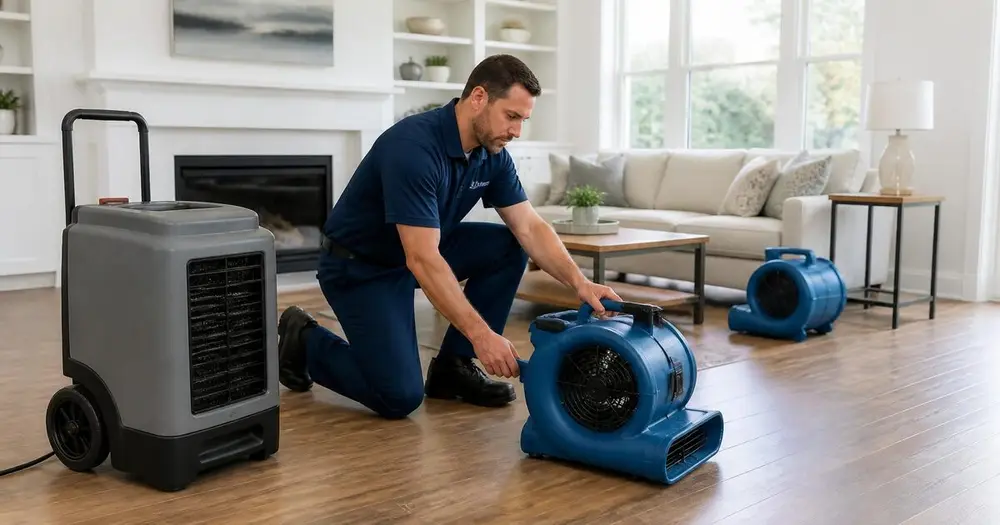
The plain English version
What Water Damage Remediation Actually Is
Key takeaways for water damage remediation NYC
- Mold can begin growing on wet drywall and wood within 24 to 48 hours of water exposure, the window the United States Environmental Protection Agency (EPA) gives for drying wet materials before growth starts.
- The governing standards are the ANSI/IICRC S500 Standard for Professional Water Damage Restoration for water work and the ANSI/IICRC S520 Standard for Professional Mold Remediation for mold work, published by the Institute of Inspection, Cleaning and Restoration Certification (IICRC) and approved by the American National Standards Institute (ANSI).
- Structural drying takes 3 to 5 days on most clean water jobs, and a full job runs 1 to 4 weeks end to end, according to the timeline guides published by PuroClean and NARESTCO.
- Dry is a measurement, not a date: under the dry standard method in ANSI/IICRC S500, a wet material is dry when its moisture reading matches a reference reading from the same material in an unaffected part of the same home.
- Under New York Labor Law Article 32, mold work over 10 square feet requires a licensed mold assessor and a separate licensed mold remediation contractor, and the same company cannot perform both roles on one property.
- New York City Local Law 55, the Asthma-Free Housing Act, requires owners of buildings with 3 or more apartments to inspect every unit for mold at least once a year and fix what they find, enforced by the New York City Department of Housing Preservation and Development (HPD).
- Under Regulation 64 (11 NYCRR Part 216), issued under New York Insurance Law 2601, an insurer must acknowledge a claim, reply to communications and begin the investigation within 15 business days.
Last updated: November 2026
Remediation is the middle stage of a water loss: mitigation stops the water, remediation removes contamination and dries the structure to a verified standard, and restoration rebuilds what was removed. People use three words for this work as if they were the same thing: mitigation, remediation and restoration. They are not the same thing, and the difference matters when you are reading a quote, talking to an adjuster or wondering why one company wants to dry your walls for four days while another wants to rip them out on day one. This page is about the middle word, water damage remediation NYC, because it is the stage that decides how big the whole job becomes.
Mitigation is the emergency brake. It is the first few hours: stop the water, extract what is standing, protect what is still dry, board or cover anything exposed. Mitigation limits the size of the loss. Water damage remediation NYC is the measured work that follows. A water damage remediation NYC crew classifies the water, maps exactly which materials are wet and how wet they are, sets a drying goal for each material, builds a drying system out of air movers and dehumidifiers, treats surfaces against microbial growth, removes only the material that cannot be saved, and checks readings every day until each material reaches its dry standard. Restoration is everything after that: putting back baseboards, drywall, flooring, paint and cabinets so the home looks the way it did before the leak.
Here is why the order matters in a New York apartment or house. Water does not stay where you see it. A supply line leak on the fourth floor wets the ceiling of the third floor, runs inside a shared wall, soaks a hardwood floor from underneath and shows up two rooms away at a baseboard. The visible puddle is the smallest part of the loss. Water damage remediation NYC exists to find the whole loss, including the part inside walls and under floors, and to dry it before two clocks run out: the mold clock, which starts at roughly 24 to 48 hours on wet drywall and wood, and the materials clock, because hardwood that stays wet cups and crowns, plaster softens and loses its key, and particleboard cabinets swell past the point where any drying can save them.
Good water damage remediation NYC is boring on purpose. It runs on numbers: moisture content percentages in wood, relative humidity and grains of moisture per pound of air, surface temperatures, and a written log that shows each reading moving toward the goal day by day. When a crew tells you a room feels dry, that is an opinion. When a crew shows you a drying diary where the wall cavity reads the same as the dry wall in the next room, that is water damage remediation NYC finished properly. Everything on this page, from the categories table to the equipment list to the questions homeowners ask us, comes back to that one idea: measure first, dry to a standard, prove it in writing.
| Stage | What it covers | When it happens | How you know it is done |
|---|---|---|---|
| Mitigation | Stop the source, extract standing water, protect dry areas, secure the property | The first hours after the loss | No new water is entering and standing water is out |
| Water damage remediation NYC | Moisture mapping, classification, structural drying, antimicrobial treatment, containment, controlled removal of unsalvageable material | Day one through the day the dry standard is met | Daily readings match the dry standard and the log is signed off |
| Restoration | Repairs and rebuild: drywall, plaster, flooring, trim, paint, cabinets | After water damage remediation NYC sign off | The home is back to its pre-loss condition |
Terminology follows the way the IICRC S500 standard and most New York adjusters separate emergency services, drying and repairs on a scope of work. If a quote mixes all three into one line, ask for them separated: it is the fastest way to see what you are actually paying for.
This page covers water damage remediation NYC only, on purpose, so it does not repeat our other pages. For the full recovery picture, start at our water damage restoration New York home page. If the water is already inside your walls, the water damage behind walls page goes deeper on cavity drying. If the water came from a storm or a sewer surcharge, see flood cleanup NYC. And when the claim paperwork starts, the water damage insurance claim page walks the filing step by step.
Not sure how far the water went?
That is the normal situation, not the exception. A free inspection with meters and a thermal camera shows you the real map before you agree to anything.
Direct answers
Water Damage Remediation NYC: Direct Answers to the Questions People Also Ask
Water damage remediation NYC is the measured drying stage that removes water and contamination and returns wet materials to a verified dry standard. Short standalone answers about water damage remediation NYC, written so each one stands on its own: the question, the answer, and nothing you have to scroll for. The full explanations sit in the sections that follow and in the FAQ at the end of this page.
Is water remediation the same as water damage restoration?
No. Remediation is one stage inside the larger restoration job. Remediation removes contamination and wet material that cannot be saved, then dries and treats the structure to a verified standard. Restoration is the whole process, and in everyday use it also names the repairs and rebuilding that follow once remediation is complete and the structure is proven dry.
How long does mold take to grow after water damage?
Mold can start growing on wet drywall and wood within 24 to 48 hours of water exposure. The EPA gives the same 24 to 48 hour window for drying wet material before growth begins. In NYC apartments with limited ventilation and high humidity, a slow leak behind a bathroom wall can show visible growth in under three days.
What should I do first after water damage?
Stop the water at the source, keep people clear of standing water near wiring, and photograph every wet room before anything moves. Then extract what you can reach safely, notify your insurer and your landlord or building management the same day, and call a remediation crew within the first 24 hours, before the mold window closes.
Key facts at a glance
| Fact | The short version |
|---|---|
| Mold start window | Growth can begin on wet drywall and wood within 24 to 48 hours of water exposure |
| Drying time, clean water | Three to five days of monitored drying for most jobs in one or two rooms |
| Full job, end to end | One to four weeks for most homes, with repairs and rebuilding included |
| When dry means dry | Wet readings match the dry reference readings taken in the same home, logged in a drying diary |
| Mold do it yourself limit | About ten square feet; larger areas need a licensed assessor and a separate licensed remediator in New York |
| Rentals | The landlord pays for mold remediation and building repairs; the renters policy covers belongings |
| Insurance | Sudden and accidental damage is usually covered; rising flood water and gradual leaks usually are not |
Asked out loud: the short versions
What is water damage remediation NYC?
Water damage remediation NYC is the measured drying stage after a leak: extract the water, map the moisture with meters, dry the structure to a verified standard, and log the readings daily until every wet material matches the dry rooms.
How fast should it start?
The same day, inside the first 24 hours if you can. Mold can start within 24 to 48 hours, so the first day decides how much material can be saved.
How long does it take?
Three to five days of monitored drying for most clean water jobs in one or two rooms. Hardwood, plaster and concrete take longer.
Does insurance cover it?
Usually yes for sudden and accidental damage, like a burst pipe or a failed appliance. Rising flood water needs its own flood policy, and long term leaks are often excluded.
Can I stay in my home?
Usually yes on clean water jobs, even though the equipment is loud. On sewage jobs, stay out of the affected area until cleaning and clearance are done.
Who pays in a NYC rental?
The landlord pays for the building work and the mold remediation. Your renters policy pays for your own belongings.
Before any crew arrives
The First Hour After Water Damage in NYC
The first hour after water damage should be spent stopping the source, making the area electrically safe and photographing every wet room before anything moves. The first hour sets the size of the whole job. Water spreads through flooring, wall bases and ceiling cavities while you wait, and in a New York building the source is often in another unit, a riser or a roof you do not control. These six steps are written for that reality.
Stop the water at the source
Close the valve at the fixture first, then the unit shut off, then the building main if you have access. In a co-op, condo or rental, call the super and management the same minute you find the water: riser and stack valves often sit in locked chases, and a ten minute wait for a porter with a key is still faster than mopping against a live line. If the source is a roof or facade leak during a storm, you cannot stop it from inside, so move straight to protecting the rooms below and call management to get the building roofer moving.
Make the area electrically safe
Water and wiring do not mix. Keep people and pets out of standing water that has reached outlets, power strips, appliances or a panel. If a ceiling is bulging with water above a light fixture, do not touch the switch. Building staff or Con Edison handle anything that involves the panel. A water damage remediation NYC crew will not start extraction in a room that is not electrically safe, so sorting this early saves real time later.
Photograph and video everything
Walk every wet room slowly with your phone before anything is moved. Film the source, the floors, the baseboards, the ceiling of the room below, and your belongings where they sit. Open closets and cabinets. Say the date out loud as you record. This ten minute record is the backbone of your insurance claim and of any dispute with a neighbour, a landlord or a building about where the water came from and what it touched.
Lift and move what you can, dry
Get furniture legs up on blocks, cans or foil so wood and metal feet stop wicking water. Lift curtains and bed skirts clear of wet floors. Roll rugs and take them to a dry room rather than leaving them to dry in place on top of hardwood. Move dry belongings out of the wet zone entirely. Do not drag soaked items through dry rooms: you will spread the loss into rooms that were never wet.
Start removing standing water
Mop, wet vac or bail whatever you can reach safely. Extraction is the cheapest drying there is: every bucket of liquid water you remove by hand is water the dehumidifiers never have to pull out of the air, which is slow and costs equipment days. Push water toward a drain or out a door rather than spreading it thinner across the floor.
Call for water damage remediation NYC and open the claim
Call a water damage remediation NYC crew the same day, and notify your insurer the same day too. Ask for the claim number, write it down, and keep every receipt from this hour onward: the plumber, the porter, the wet vac rental, all of it. Tell the water damage remediation NYC dispatcher what leaked, which rooms are wet, whether anyone is above or below you, and whether the water is still running. That information decides what the first truck carries.
One New York specific warning: if the water came from a toilet overflow, a drain backup or a sewer surcharge, treat it as contaminated from the first minute. Keep children and pets out, do not use your household vacuum on it, and do not save porous items it touched until a crew has classified them. Category 3 water is the one part of a water loss where enthusiasm with a mop can make things worse, because it pushes contaminated water deeper into flooring and wall bases. The categories are explained in full further down this page.
Renters have one extra step: notify the landlord or management in writing, email is fine, with the photos attached. In New York the building owns the pipes, the risers and the structure, and your written notice starts the clock on their duty to repair the source and the building fabric. Keep your own copy. The who pays section further down explains how responsibility usually splits between owner, renter, landlord, co-op and condo.
Catch it early
Signs You Need Water damage remediation NYC, Not Just a Mop
You need remediation, not just a mop, when water has reached material you cannot see: inside a wall, under a floor or in a ceiling cavity. Some water losses really are a towel and a fan. Others look small on the surface while the structure underneath stays wet for weeks. These are the signs that separate the two, drawn from the calls we get across the city every week.
Signs on the surface
- A musty smell that stays after the floor looks dry. Odour is wet material talking. If a room smells earthy two days after a leak, something inside a wall, under a floor or inside a cabinet base is still wet.
- Paint bubbling, peeling or showing a tide line. Drywall and plaster wick water upward well above the waterline you saw. Bubbling paint at a wall base means the board behind it is wet or was wet long enough to fail.
- Baseboards separating from the wall or swelling. MDF baseboard swells like a sponge and does not shrink back. A gap opening along the top edge means the wall base took water.
- Hardwood that cups, crowns or clicks underfoot. Boards cup when the underside is wetter than the top. That is water under the floor, not on it, and surface drying alone will not fix it.
- A ceiling stain that grows or feels soft. A stain is a map of a wet cavity above. Soft or sagging plaster or drywall is a safety issue first and a drying job second.
- Laminate or vinyl that feels spongy or lifts at seams. Water travels under sheet and plank flooring and sits on the subfloor, invisible from above, sometimes for the whole width of a room.
Signs you can only find with instruments
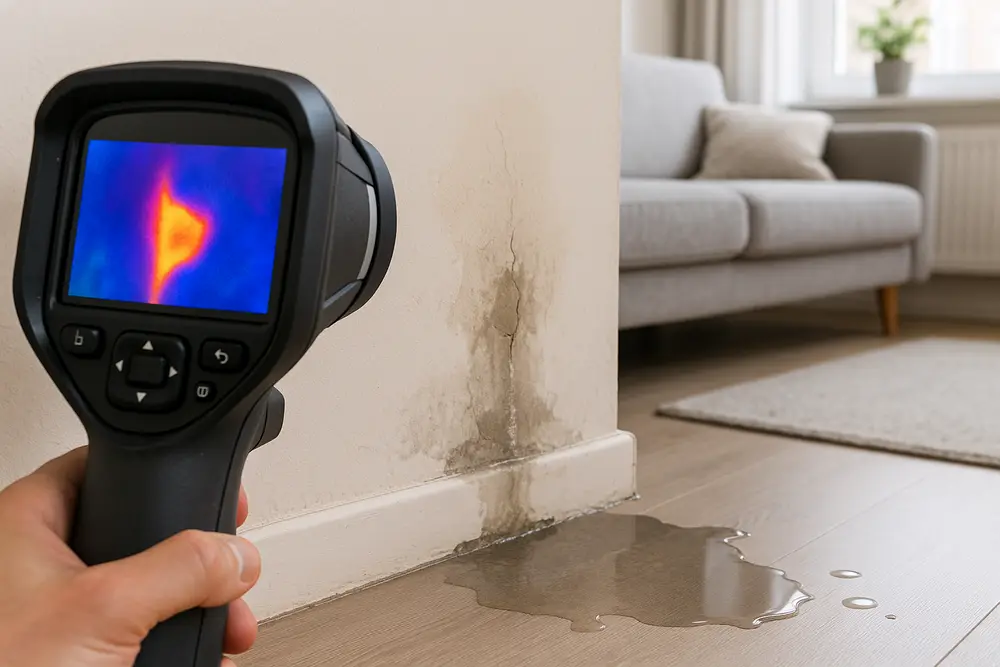
A pinless meter swept across a wall tells a trained tech whether the material behind the surface is wet before a single hole is made. A thermal camera shows the cold pattern of evaporation and traces how far water ran inside a wall or across a ceiling. Pin meters then confirm exact moisture content in wood framing and subfloor. This pairing, scan first and confirm second, is how a water damage remediation NYC scope gets drawn, and it is why a room can look untouched and still test wet three studs past the visible stain.
The most common version in NYC housing: a bathroom leak upstairs that shows as one small ceiling spot downstairs, while the meter finds the whole bathroom footprint wet in the ceiling cavity, the party wall wet on both sides, and the hardwood in the hall outside the bathroom wet from underneath where water ran along the subfloor. None of that is visible. All of it grows mold if it is left to dry on its own in a closed cavity, which in practice means it does not dry at all.
There is also a time test. Clean water on a hard, sealed surface that you fully extract within a few hours, in a room you can ventilate, is a housekeeping problem. The same water under flooring, inside a wall, in a basement, or anywhere it sat for a day or more, is a water damage remediation NYC problem. When in doubt, the free inspection exists for exactly this question: we test, we show you the readings, and if the answer is that it will dry safely on its own, we tell you that in the same visit.
Where NYC water comes from
The Causes We Remediate Most in New York
The source decides the category, the category decides the method, and the method decides what can be saved. These are the sources behind most water damage remediation NYC jobs in the five boroughs and Long Island, and what each one usually means for the building.
Burst and leaking supply lines
Angle stop valves, braided hoses, ice maker lines and old galvanized pipe let go with pressure behind them, so they move a lot of water fast. Clean water at the start, but it runs down inside walls and across ceilings, which makes the drying map much bigger than the room where the pipe failed.
Upstairs bathroom leaks
Failed wax rings, cracked grout, split shower pans and overflowing tubs in the unit above. The downstairs ceiling is the symptom; the cavity, the party wall and both units are the job. These losses are where stack and neighbour documentation matters most.
Radiator and steam system leaks
Pre-war steam heat is hard on valves, traps and radiator vents. A slow radiator leak can wet a floor and the ceiling below for a whole heating season before anyone sees it, which is why these jobs so often arrive with mold already started.
Appliance failures
Dishwashers, washing machines, water heaters and refrigerator lines fail quietly and run until someone comes home. Particleboard cabinet bases and toe kicks soak first and usually cannot be saved; the floor under the appliance is the hidden part of the loss.
Sewer and drain backups
Combined sewers surcharge in heavy rain and push water back through basement drains and ground floor fixtures. This is Category 3 water: contaminated, handled with containment, protective equipment and disposal rules, never with a household mop and bucket.
Roof, facade and window leaks
Storm driven rain finds failed flashing, cracked parapets and old window frames. The leak appears rooms away from the entry point, and water damage remediation NYC includes tracing the path so the same wall is not dried three times in one winter.
Basement and ground water
High water tables, failed sump pumps and cove joint seepage wet basements from below. Finished basements hide wet wall bases behind paneling and drywall for weeks. Long Island and Staten Island houses see this pattern most.
HVAC and condensate
Clogged condensate lines, cracked drain pans and sweating ducts drip slowly into ceilings and closets. Slow, clean and hidden is a bad mix: by the time the stain shows, the cavity has often been wet long enough for growth.
Firefighting and sprinkler water
A sprinkler head or firefighting hose lines put clean water through several floors at once. The fire page covers the fire itself; the water damage remediation NYC half is extraction and drying on a multi floor map, run fast because the structure is already stressed. See fire damage restoration NYC.
Two patterns cut across all of these. First, slow leaks do more total harm than dramatic ones, because a burst pipe gets a phone call within the hour while a dripping trap gets a bucket under the sink for six months. Second, in attached New York housing the unit with the damage is often not the unit with the leak, which is why water damage remediation NYC reports in this city always name the source unit, the affected units and the shared elements between them. That paper trail is what buildings, boards and insurers use to sort out payment, and it starts with the first moisture map, not with a lawyer.
Still leaking, or leaked and gone quiet?
Both need readings. A quiet leak is not a dry leak. Call for a free inspection and we will map what is actually wet.
The industry language, translated
Water Categories and Drying Classes
Under ANSI/IICRC S500, every water loss carries two labels: a category for how contaminated the water is, and a class for how much of the structure is wet and how hard it is to dry. Once you know what the labels mean, you can read any water damage remediation NYC quote and spot the ones that are padded or missing steps.
Category: how clean is the water?
| Category | What it means | Typical NYC sources | What it changes on the job |
|---|---|---|---|
| Category 1: clean | Water from a sanitary source that does not pose a health risk at the start | Supply lines, ice maker lines, rain through a roof, melted snow, a clean tub overflow | Dry in place where readings allow; most materials are candidates to save |
| Category 2: grey | Water with significant contamination that can cause discomfort or illness | Washing machine and dishwasher discharge, toilet water with urine only, sump pump water, aquarium leaks | Carpet pad usually comes out; antimicrobial treatment is standard; soft furnishings are judged item by item |
| Category 3: black | Grossly contaminated water that can contain pathogens and chemicals | Sewer backups, toilet backflow with waste, rising flood water, storm surcharge through drains | Containment and protective equipment; porous materials it touched are removed and disposed of, not dried |
One rule catches people out: categories degrade over time. Clean water that sits in a warm apartment for two or three days, picking up whatever it touches, does not stay Category 1. This is the technical reason behind the advice to start fast. A job that would have been dry in place on day one can become a removal job by day four, with the same water, in the same room.
Class: how much of the building is wet, and how hard is it to dry?
| Class | What it means | What drying looks like |
|---|---|---|
| Class 1 | A small amount of water in part of one room, absorbed into low evaporation materials | Few air movers, short run time, often one to two days of monitoring |
| Class 2 | A whole room or more, water wicked up walls less than about two feet, carpet and pad wet | Full room drying system, pad removal where needed, daily readings for several days |
| Class 3 | Water from overhead: ceilings, walls and insulation wet, the highest evaporation load | Ceiling and cavity drying, more dehumidification capacity, careful sagging checks before drying starts |
| Class 4 | Water trapped in low porosity materials: hardwood, plaster, concrete, crawlspaces, deep pockets | Specialty systems such as floor drying mats, wall cavity injection and longer, slower drying with close monitoring |
Class 4 is where New York housing earns its reputation. Pre-war plaster on wood lath, original hardwood over sleepers, and concrete slabs in garden level units all hold water in places air cannot reach on its own. A Class 4 loss dried with a Class 2 setup is the classic failed job: the surface passes, the readings underneath do not, and the first warm week brings the smell back. When a quote for a plaster and hardwood apartment looks identical to a quote for a drywall and carpet apartment, ask which class the tech assigned and why. The answer tells you whether anyone actually assessed your home or just counted rooms.
Step by step
The Water damage remediation NYC Process, Start to Sign Off
Remediation follows nine measured steps, from moisture mapping and extraction through structural drying to a verified dry standard sign off. Nine steps, in order, the same on a studio in Astoria and a brownstone in Park Slope. The steps do not change; the readings decide how long each one takes.
Inspection and moisture mapping
The tech walks the whole loss, not just the wet room: the rooms beside it, the unit below, the closets and the cavities. Pinless scans and a thermal pass draw the wet map; pin readings confirm numbers in wood and subfloor. You get the map, the category and class, and a written scope with an exact quote before work starts. If part of the home tests dry, the scope says so.
Source control confirmation
Drying a building that is still leaking is money into a bucket with a hole in it. The crew confirms the repair held, the valve is closed or the building work order is in, and rechecks the source area at every monitoring visit. Where the source is a building system, management gets the readings too, because a riser that is still weeping will undo the whole job.
Extraction
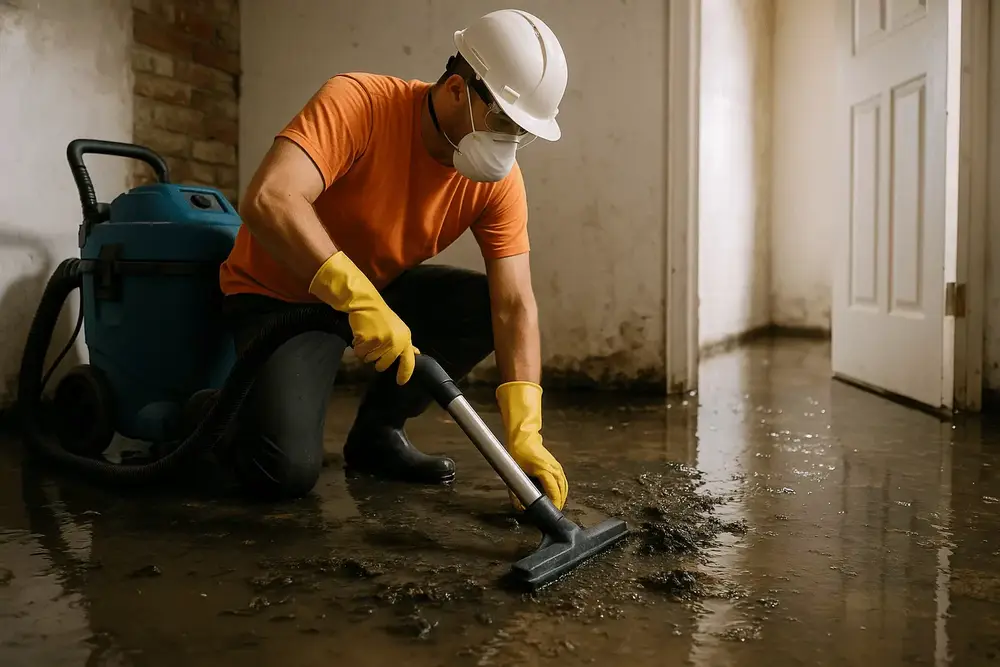
Standing and surface water comes out with weighted extraction tools, portable extractors or truck mounted equipment depending on access. Extraction removes water hundreds of times faster than evaporation, so this step is never rushed. Carpet is extracted in place where the category allows, then lifted at a corner to check pad and subfloor readings.
Contents protection and pack out where needed
Furniture is blocked and lifted, belongings in the drying zone are moved or covered, and anything that needs specialist cleaning is inventoried and packed out. The inventory is photographed item by item, because it doubles as part of your claim record.
Controlled removal of what cannot be saved
Swelled particleboard, Category 3 touched porous material, wet carpet pad and drywall that has lost its strength come out under control, bagged at the point of removal. The bias is always to save material that readings say can be dried. Removal is a conclusion the numbers reach, not a first move, and flood cuts are a last resort with a specific reason, not a house style.
Containment and air filtration where the job calls for it
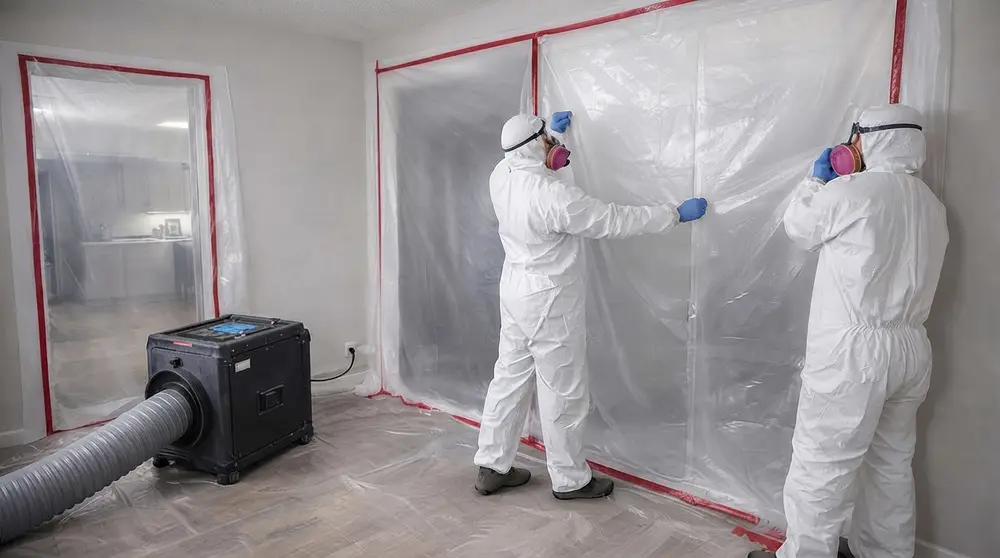
When removal, sewage or existing growth is involved, the work zone is sealed with plastic sheeting and put under negative air with HEPA filtration, so dust and spores move into the filter instead of into the rest of the home. Clean, simple dry downs do not need containment, and a scope that adds it to every job is padding.
Drying system setup
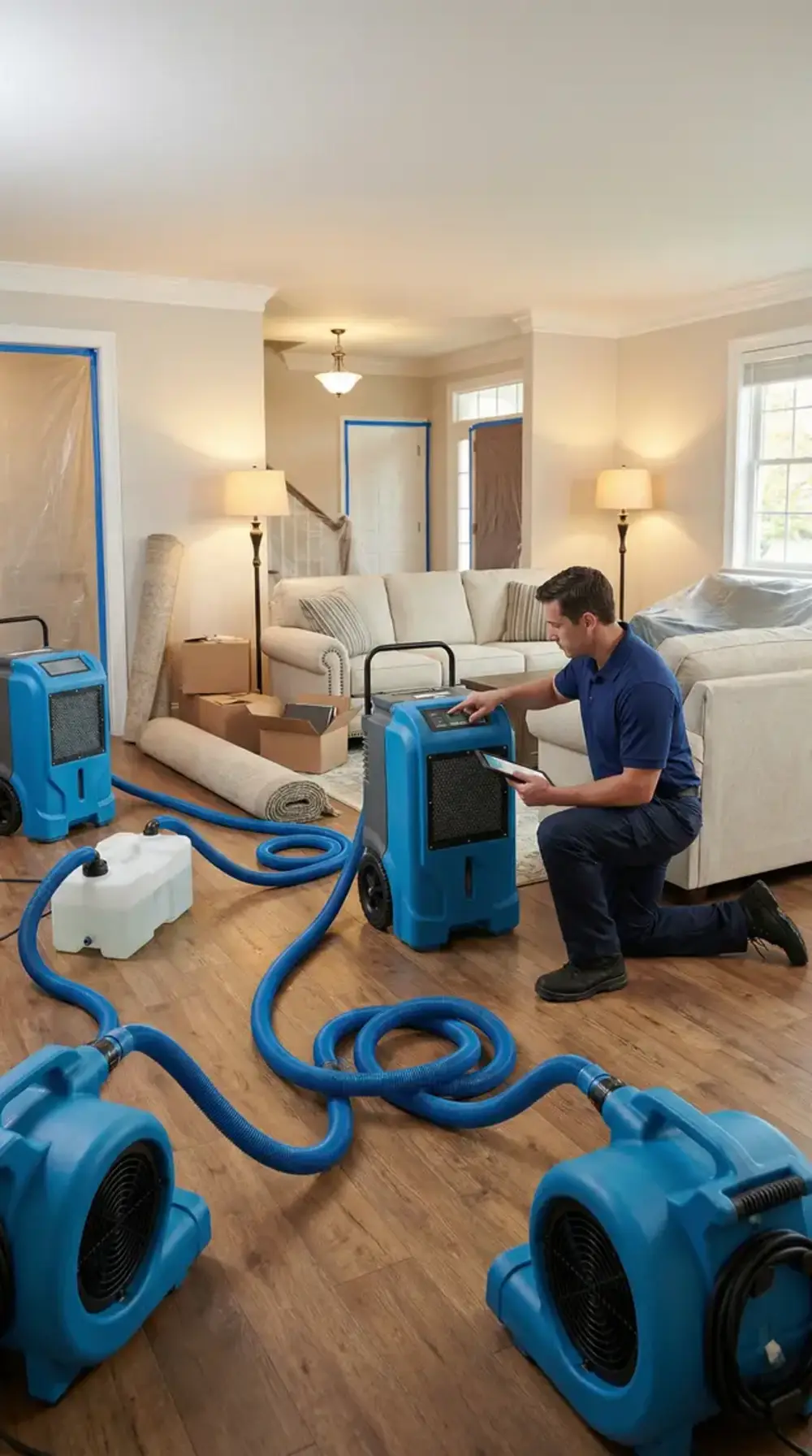
Air movers are placed to sweep wet surfaces at the angles that strip the boundary layer of saturated air off the material. LGR dehumidifiers are sized to the class of loss and the volume of the space. Cavities get injection drying, floors get mat systems, and the whole setup is tuned against the first day of readings, not left as first placed.
Cleaning and antimicrobial treatment
Surfaces that were wet are cleaned, and an antimicrobial is applied where the category and materials call for it. This step supports drying; it never replaces it. No spray makes a wet wall safe, and any company that offers to treat instead of dry is selling you the cheaper half of the job.
Daily monitoring, verification and sign off
A tech returns each day to take the same readings at the same points, record temperature and humidity, and adjust the equipment. When every material reaches its dry standard, equipment comes out and you get the drying diary: the dated record of the loss, the readings and the result. That document is what closes the water damage remediation NYC stage with your insurer and clears the way for repairs.
Why readings rule the job
Drying Science in Plain English
A drying job is finished when moisture readings match the dry standard taken from the same home, the finish line ANSI/IICRC S500 sets, not when a fixed number of days has passed. You do not need a certification to follow your own job. You need four ideas: evaporation, dehumidification, the dry standard, and the drying diary. With those, you can read a monitoring report and know whether your home is actually getting dry.
Evaporation does the work, air movement feeds it
Wet material dries when water at its surface turns to vapour and leaves. The thin layer of air right against a wet wall saturates quickly, and once it is saturated, drying stalls no matter how long you wait. Air movers exist to keep stripping that layer away and replacing it with drier air. That is why placement is a skill: fans pointed at a wall at the right angle, in the right number for the room, dry in days what a single fan in a corner will not dry in two weeks.
Dehumidifiers take the vapour out of the room
Evaporation loads the room air with moisture. If nothing removes it, the air saturates, drying stops, and moisture starts condensing on cooler surfaces in other rooms. LGR dehumidifiers pull that vapour out as liquid water and drain it away. Technicians track the air in grains of moisture per pound of dry air, and in the drop in grains between the air going into the machine and the air coming out. A falling grain count across the room, day by day, is the sound of a job going right.
Heat helps, inside limits
Warm air holds more moisture and warm material gives up water faster, so controlled heat is part of many drying plans, especially in winter in drafty pre-war buildings. Heat without dehumidification is a mistake: it loads warm wet air that then condenses somewhere colder, often inside the next wall. The three legs of the system, air movement, dehumidification and temperature, are always set together.
The dry standard: dry compared to what?
Dry is not a feeling and it is not zero. The dry standard for a wet material is the moisture level of the same material in an unaffected part of the same building. A tech takes baseline readings in a dry room first, then dries the wet rooms until their readings sit at or near that baseline. Wood framing, subfloor, drywall and plaster each have their own normal range, and the standard is local to your home, which is why a reading that is fine in a house on Long Island might be high for a heated Manhattan apartment in January.
The drying diary: the job on paper
Every monitoring visit adds a dated line: readings at the same marked points, temperature and relative humidity, equipment running, and any change made. Plotted across days, the diary shows the curve bending toward the dry standard. If the curve flattens for two visits, something is wrong: a hidden pocket of water, a source still weeping, or not enough dehumidification for the class of loss. The diary is also your claim evidence. Adjusters pay for equipment days they can see were needed, and the diary is how they see it.
Typical drying goals by material
| Material | What is measured | Typical dry goal | Watch out for |
|---|---|---|---|
| Wood framing and studs | Moisture content by pin meter | Back to the baseline of dry framing in the same building, commonly in the low teens or below | Pockets at bottom plates and inside corners dry last |
| Hardwood flooring | Moisture content, top and underside where accessible | Within a few points of the dry reference floor in the home | Cupping can relax as it dries; sanding or replacing before it is dry wastes the floor |
| Drywall | Relative reading by pinless and pin meters | Matching the dry reference wall in the same building | Paper facing feeds mold early; strength loss means removal, not drying |
| Plaster on lath | Deep probe readings through the plaster into the lath | Matching dry plaster elsewhere in the unit | Dries slowly and unevenly; patience beats demolition in pre-war units |
| Concrete slab | Surface and in situ humidity readings | Stable readings at the level the floor covering requires | Slabs wick ground moisture; a slab can test wet from below long after the leak is gone |
Goals are always set against the dry reference in the same building. The ranges above are the ones techs talk about on site; your baseline readings govern your job.
The tools, and what each one is for
Water damage remediation NYC Equipment, Explained Honestly
Each machine on a remediation job has one job: air movers feed evaporation, dehumidifiers remove the moisture from the air, and meters prove whether either one is working. Equipment days are a line on every scope, so you should know what each machine does and when it earns its place. No machine on this list dries anything by being present. It dries by being the right tool, in the right number, in the right spot.
LGR dehumidifiers
The workhorse. Low grain refrigerant units pull moisture from the air and drain it as liquid, and keep working as the air gets drier, which is when ordinary units give up. Sized to the class of loss and the space; undersized dehumidification is the most common reason jobs run long.
Air movers
High velocity fans that sweep wet surfaces and feed evaporation. Count and placement follow the moisture map: roughly one per wet wall section or floor area, angled to push the saturated boundary layer toward the dehumidifier.
HEPA air scrubbers
Filtered machines that clean the air and, ducted out, create negative pressure inside containment. Standard on sewage, removal and mold involved jobs. On a clean water dry down with no demolition, they are usually not needed.
Wall cavity drying systems
Injection systems that push dry air into wall cavities through small holes drilled at the base, often under the baseboard line, so wet insulation and studs dry without opening the wall. The method behind most saved plaster and drywall.
Floor drying mats
Sealed mats that pull air and moisture out of hardwood and layered floors from the surface. They are how cupped floors get a real chance to dry flat instead of being torn out on day one.
Extraction tools
Weighted wands and ride on or stand on extractors that squeeze water out of carpet and pad under pressure. Extraction done well removes the bulk of the water in hours; drying then handles what is left in the structure.
Pin and pinless meters
Pin meters give exact moisture content in wood. Pinless meters scan depth without holes and find wet areas fast. A crew needs both: scan to find, pin to prove.
Thermal cameras
Infrared cameras that show temperature patterns from evaporation, tracing hidden water in walls and ceilings. Every thermal finding gets confirmed with a meter, because cold spots have other causes too.
Thermo-hygrometers and data loggers
The instruments that record temperature, relative humidity and grains, the air side of the drying diary. On longer jobs, loggers track conditions between visits so a stall is caught on paper, not by smell.
How to read an equipment list on a quote
Three checks. First, does the count follow the wet map? Equipment should appear where the water is: a dry bedroom needs no air mover, and a Class 3 ceiling loss needs more dehumidification than a same size floor loss. Second, is there a monitoring line? Equipment without daily readings is rent without a driver. Third, is there an end condition? The scope should say equipment runs until readings meet the dry standard, not for a fixed number of days chosen in advance. A fixed day count in either direction, always three days, always seven, is a sign the quote was written from a template rather than from your readings.
Home equipment deserves an honest word too. A household fan and an open window help a small, clean, surface spill in good weather. They do not dry a wall cavity, a floor system or a basement, and a home dehumidifier from a closet removes a small fraction of what one LGR unit removes. The gap is not effort; it is physics. Where the loss is small and truly on the surface, we say so at inspection and leave you to it with a few pointers. Where it is not, renting time with the wrong tools costs more than the job, because the materials clock keeps running while the water sits.
The race water damage remediation NYC is really running
Mold Prevention: Why the First Two Days Decide
Mold prevention is a race against a 24 to 48 hour clock, because growth can start on wet drywall and wood within that window if the structure is not dried in time. Mold is not a separate disaster that strikes at random. It is what wet building material does next, on a timetable. Water damage remediation NYC is mostly the art of beating that timetable.
Mold spores are already in every home, in the air and in dust. They need three things to grow: moisture, food and time. Your walls and floors supply the food for free, because paper faced drywall, wood, dust and paint are all food. The only leg of the three you control is moisture, and the time window is short: on wet drywall and wood in a warm apartment, growth can start within 24 to 48 hours, the window the EPA gives for drying wet materials before mold growth begins. That is why the industry treats the first two days as the whole game. Extract and start drying inside that window and mold usually never starts. Miss it, and the job changes from drying to remediation of growth as well, with containment, removal and New York State rules in play.
Drying beats spraying, every time. Antimicrobial products have a place on cleaned surfaces, but no product makes a wet wall safe, because growth happens inside the cavity and under the floor where spray never reaches. If a company offers to fog a wet apartment and call it handled, they have sold you the smell of treatment while the moisture that causes the problem stays exactly where it was. The order on a proper job is always: remove the water, dry the structure to the standard, clean, then treat surfaces as a finishing step.
New York rules when growth is already there
New York Labor Law Article 32 requires a licensed mold assessor and a separate licensed mold remediation contractor for mold work over 10 square feet, and the assessor and the company doing the water damage remediation NYC must be separate companies. In rentals, Local Law 55 puts indoor allergen hazards, including mold, on the owner to fix, with HPD enforcement behind it. We work inside those rules: where a job crosses into licensed mold work, we tell you at inspection, in plain terms, what that means for the scope and the paperwork. Our water damage behind walls page covers the hidden growth version of this problem in depth.
What you can do while you wait for a crew: run the bathroom fan, keep air moving in the wet room if the water is clean, keep the heat or air conditioning running normally rather than shutting the unit down, and do not close a wet room up tight. Do not apply bleach to large areas, do not paint over stains to seal them, and do not pull baseboards or open walls yourself on a contaminated loss. Every one of those well meant moves makes the professional job slower or the claim harder.
Wet for more than a day already?
Then the inspection matters even more, because the scope may now include growth. Call and describe when the water started, as honestly as you can. The timeline changes the plan, not the welcome.
Lessons from real drying jobs
Three Jobs, and What Each One Teaches
The visible water is almost always the smallest part of a loss; the readings under the surface decide the real scope. Patterns from jobs we see again and again in this city, plus the lessons that filmed case studies of carpet and pad extraction keep teaching: map the moisture, check under the surface, and let readings, not appearances, call the job dry. A short video walkthrough of that extraction and moisture mapping method is linked at the end of this section.
The carpet that felt dry
A living room carpet dried on top within a day of a clean water spill, and the owner nearly cancelled the crew. The meter told the real story: the pad underneath was soaked and the subfloor readings were high across half the room. Lesson one from every filmed extraction case study is the same: carpet lies. Pad holds water like a sponge, and the only way to know is to lift a corner and test. The pad came out, the subfloor dried in two days, and the carpet, extracted and dried properly, went back down. Total loss: one pad. The version where nobody lifts the corner ends with a musty room and a floor replaced in the spring.
The upstairs bathroom, two units
A failed shower pan on the third floor showed as one ceiling stain on the second. Thermal scan and meters found the ceiling cavity wet across the whole bathroom footprint, the party wall wet on both sides, and the hall floor in the lower unit wet from underneath. Both units were dried on one map, with the building copied on the readings, because the source was a shared problem with a shared paper trail. Lesson: in attached housing, remediation is a building job wearing an apartment costume. The crew that only dries the unit that called will be back when the neighbour smells it.
The basement that dried twice
A finished basement dried once after a sump failure, then smelled again a month later. The first job dried the room; nobody had checked the wall bases behind the paneling, where the bottom plates were still wet. Second time around, baseboards came off, cavity drying went in, and readings at the plates were logged daily until they matched the dry wall upstairs. Lesson: the last place to dry is the place nobody measured. A drying job is finished at the wettest point, not at the average.
The filmed case studies make one more point worth stealing: good techs narrate their readings. They show the meter on the pad, the subfloor and the wall, at the start and at the end, so the viewer can watch the numbers fall. Hold any crew, including ours, to that standard on your job. Readings you can see are readings you can trust, and a company that films and logs its numbers for a stranger on the internet should be happy to write yours in a diary and hand it over. The test before you tear section further down this page links to two filmed jobs that show the same discipline on camera.
Asked on Reddit, Quora and WikiHow, answered straight
Questions Homeowners Actually Ask
Most homeowner questions after a leak have the same answer at their core: surfaces can feel dry while walls and floors stay wet, so readings decide what happens next. These are the questions people type into forums at midnight with a wet floor in front of them. Short, honest answers, with the longer version somewhere on this page.
My floor feels dry. Can I stop worrying?
Feeling dry is about the surface your hand touches. Water sits under floors and inside walls where hands cannot reach. If the loss was small, clean and fully on the surface, you are probably fine. If water went under flooring, into a wall base or through a ceiling, get readings before you relax. The meter check is quick, and it is the difference between knowing and hoping.
Will a fan and an open window dry it?
For a small clean spill on a sealed floor in dry weather, yes. For anything inside a structure, no: a fan moves room air, it does not pull moisture out of a cavity, and New York humidity in summer can be higher outside the window than inside. Cavities and floor systems need dehumidification and directed air, measured daily.
Should I cut the drywall myself to let it dry?
Usually no, and never on a contaminated loss. Most wet drywall dries in place with baseboard removal and cavity air. Cutting is for walls that have lost strength, hold wet insulation, or test with growth inside. A homeowner cut made on day one often turns a dry in place job into a patch and paint job for no gain.
Is the black stuff under my sink mold, and is it dangerous?
Dark staining under a sink that has leaked for months is growth until testing says otherwise, and the honest answer is that nobody can grade it from a photo. What is certain: the leak made it, drying alone will not remove it, and disturbing it dry spreads it. Small surface areas on hard surfaces can be cleaned carefully; cabinet bases and drywall with growth go through the licensed route described in the mold section.
My landlord says a fan for a day is enough. Is it?
For a structure that tests wet, no, and you do not have to take anyone's word for it: ask for the readings. In a New York rental, the owner is responsible for the structure and for fixing the source, and Local Law 55 covers mold conditions. Put your request in writing, keep the photos, and call 311 if a wet or moldy condition is left unaddressed. Our who pays section below lays out the split.
Can I stay in the apartment during water damage remediation NYC?
On most clean water drying jobs, yes. The equipment is loud and the rooms in the drying zone are awkward to use, but the home is safe to live in. On sewage jobs or where growth is being removed under containment, the affected area is sealed and sometimes the unit is better empty for a few days. Your tech should tell you plainly which case yours is at inspection.
Why does the quote have equipment days if nobody knows how long drying takes?
Because the scope has to estimate something, and the honest version is an estimate tied to readings: equipment runs until the dry standard is met, checked daily, and the diary justifies each day. Be wary of the opposite extremes, a fixed total promised before inspection, or open ended days with no monitoring visits to prove the equipment is still needed.
The leak was my neighbour's. Why is the crew in my apartment?
Because water does not respect the lease line. Your unit holds the damage; your neighbour or the building holds the source. Water damage remediation NYC documents both, which is what lets insurers and the building sort out payment through subrogation later. Refusing the drying to make a point about blame only damages your own home further.
Responsibility in NYC housing
Who Pays for Water damage remediation NYC?
In water damage remediation NYC, who pays follows the source of the water and the kind of home: building systems fall to the owner, damage from a neighbour's leak falls to the neighbour's side, and your own belongings fall to your own policy. The drying should start before this question is settled, because water does not wait for paperwork. But the answer follows a pattern in New York housing, and knowing it helps you make the right calls on day one.
| Your situation | Usually responsible for the source | Usually responsible for your damage | First move |
|---|---|---|---|
| Homeowner, house | You, or the appliance or pipe that failed | Your homeowners policy, subject to limits and deductible | Open the claim the same day; keep the failed part if a plumber removes it |
| Renter | The landlord or building, for pipes, risers and structure | Building covers structure; your renters policy covers your belongings | Written notice to the landlord with photos, the same day |
| Co-op owner | Split by the proprietary lease: building systems to the corporation, unit fixtures to the shareholder | Your co-op policy for your unit and contents; the master policy for building elements | Notify management and your insurer together; ask management for the building claim details |
| Condo owner | Split by the bylaws, similar pattern to co-ops | Your unit owner policy and the association master policy divide it per the bylaws | Same as co-op: management plus your insurer, in writing |
| Upstairs neighbour leaked on you | The neighbour's unit or the building, depending on what failed | Open your own claim first; your insurer can pursue the responsible side through subrogation | Document your damage as if the loss were yours; get the source unit identified in writing |
| Landlord | You, for building systems and structure | Your landlord policy for structure; tenants claim their own belongings on theirs | Fix the source fast and document the drying; Local Law 55 duties sit with you |
Two habits protect you in every row of that table. First, same day notice, to the insurer and to the building, in writing. Claims and building disputes both run on timelines, and the person who reported first with photos wins most arguments. Second, keep the documentation the water damage remediation NYC crew produces: the moisture map, the drying diary and the sign off. That file is the shared facts everyone, adjuster, board, landlord, neighbour, argues from, and it is much harder to argue with dated readings than with memories of a wet Tuesday. Keep a copy with your policy papers, not in the apartment that flooded.
Water damage remediation NYC and the claim
How Water damage remediation NYC Fits Your Insurance Claim
Insurers divide a water loss into the emergency and drying work and the repairs, and water damage remediation NYC is the first half. Adjusters expect to see three things from it: proof of the source and the date, a moisture map that shows the scope was measured rather than guessed, and a drying diary that justifies every equipment day. A water damage remediation NYC file built that way speeds the whole claim, because the adjuster is not re-litigating what was wet.
Coverage follows the cause. A sudden burst pipe or appliance failure is the classic covered loss. Long term leaks that ran for months, and rising flood water from outside, sit in different territory: flood damage needs a flood policy, and gradual damage is often excluded, which is one more reason the timeline in your documentation matters. Sewer backup cover depends on an endorsement many New York policies carry and many do not. Read the claim page for the full picture: water damage insurance claim, step by step.
Why this page has no prices
People ask why a water damage remediation NYC page carries not a single price. Because the scope is set by facts nobody knows before the meters come out: the category, the class, how many materials are wet, and how many days the readings say the drying needs. A price published before those facts is a guess dressed as a promise, and this site is built for phone calls, not checkout buttons. The inspection is free, the written scope and exact quote are given on site before work starts, and the drying diary then proves the days that were billed were the days the readings required.
Same science, different buildings
Water damage remediation NYC Notes by Borough
The drying standard does not change across the city. The buildings do. Pick your borough for the patterns we plan around, and follow the link to the full borough page.
Full local pages: New York home page, Brooklyn, Queens, Bronx, Staten Island, Long Island and Manhattan. Related service pages: insurance claim help, water damage behind walls, fire damage restoration NYC and flood cleanup NYC.
Where water hides, room by room
Room by Room Water damage remediation NYC Guide
In water damage remediation NYC, each room hides water differently: bathrooms leak downward into the unit below, kitchens hide it under cabinets and toe kicks, and basements collect what every floor above sends down.
Bathrooms
The wettest room in the home and the source of most multi unit losses. Check the toilet base, the tub overflow, grout and caulk lines and the vanity cabinet floor, which rots quietly under a slow trap leak. Tile over a failed substrate feels solid while the board under it is soaked; readings at the wall base and floor decide.
Kitchens
Sink traps, dishwasher lines and ice maker hoses fail behind and under cabinets. Toe kicks hide the first inches of every leak. Cabinet bases made of particleboard swell and are usually removed; the floor under the cabinet run is the reading that matters and the one most often skipped.
Basements and cellars
Ground water, sump failures and sewer surcharges all land here. Finished basements hide wet bottom plates behind wall finishes. Water damage remediation NYC plans for a slab that may keep wicking moisture from below, and for the fact that everything stored on the floor is part of the loss.
Living rooms and bedrooms
Usually the receiving end of a leak from above or beside. Hardwood cupping, ceiling stains and wet wall bases are the signs. Furniture and rugs drive the contents work here, and floor drying mats earn their keep on original hardwood.
Laundry areas
Hoses and drain standpipes in units without pans or floor drains turn a small failure into a multi room loss. Supply hoses have a service life; remediation reports note their condition because insurers ask, and because the next failure is preventable.
Hallways and closets
The forgotten zones. Water runs along halls under flooring and pools in closets where nobody looks for days. Closet wall bases and the backs of linen closets under bathrooms are standard stops on every moisture map we draw.
A realistic water damage remediation NYC timeline
Timelines bend around access in New York buildings: freight elevator bookings, work hour rules, and a neighbour who must let a tech in to read the other side of a party wall. A crew that works the city plans for those on day zero instead of discovering them on day three.
Straight answers
DIY or Professional, Myths, and Prevention
Do it yourself only when the water is clean, small, caught within the hour and sitting on a hard surface you can fully dry; water inside a wall, under a floor or sitting for a day or more is professional work.
When DIY drying is reasonable
A small clean water spill on tile, sealed stone or another hard surface, caught within the hour, fully extracted, in a room you can ventilate: dry it yourself with towels, a wet vac and moving air, and check it over the next two days for smell or staining. The moment any of those conditions is missing, water under a floor, inside a wall, from a dirty source, sitting for a day, or bigger than one room, the job has crossed into measured territory and the free inspection is the right next step.
Five myths that cost New Yorkers money
It looks dry, so it is dry. Surfaces dry first; structures dry last. Readings or it did not happen. More fans always means faster. Air movement without enough dehumidification just moves moisture around the building. Bleach fixes mold. On porous material it does not reach the growth that matters, and it does nothing about the moisture that caused it. Every wet wall needs a flood cut. Most walls dry in place; cutting is for specific failures, not a default. Waiting to see is free. Waiting is the most expensive option on the list: categories degrade, materials pass the point of saving, and the mold clock runs out.
Prevention checklist for NYC homes
- Replace rubber washing machine and dishwasher hoses on a schedule, braided steel where you can, and turn the valves off when you travel.
- Put a battery water alarm under every sink, behind the toilet and by the water heater. They cost little and they shout early.
- Know where your unit shut off is, and label it. In a building, know the super's number and keep it in your phone, not in a drawer.
- Regrout and recaulk tubs and showers before the grout lines crack through; failed grout is a slow leak with good manners.
- Test the sump pump before storm season and keep the pit clear; a pump that fails during the storm is the Long Island and Staten Island classic.
- Insulate pipes in unheated spaces and let a trickle run on the coldest nights in exposed runs; burst pipes in January are a heating problem first.
- After any leak, however small, check the room below and the wall bases for a week. The second stain is the one that tells you it was not small.
Words you will hear on your job: a short glossary
Dry standard
The moisture level of the same material in a dry part of your building. The target every wet reading is dried toward.
Grains (GPP)
Grains of moisture per pound of dry air. The number techs use to track how much water the air holds and the dehumidifiers are removing.
LGR dehumidifier
Low grain refrigerant drying machine that keeps pulling moisture out as air gets drier, where standard units stall.
Moisture mapping
The measured drawing of what is wet, where, and how much, made with scans, thermal imaging and pin readings.
Containment
A sealed plastic work zone, usually under negative air, that keeps dust and spores from spreading during removal.
Subrogation
Your insurer paying your claim, then pursuing the party whose leak caused it. Good documentation is what makes it work.
Before you book anyone
What to Check, and How to Reach Us
Any water damage remediation NYC company working in your home should be able to show you these four things. Ours are marked as placeholders until the real business details are added to this page, and we would rather show you an honest placeholder than a borrowed claim.
Licence and insurance
Ask for the licence number and a certificate of insurance naming your building where the board requires it.
Add yours hereTrained technicians
Ask what standard the drying follows and who takes the daily readings on your job.
Add yours hereWritten scope before work
The moisture map, the category and class, and an exact quote in writing before equipment is placed.
Standard on every jobReviews
Read recent reviews for drying jobs specifically, not just fast arrival.
Add yours hereCall now for a free water damage remediation NYC inspection
Phone: (212) 555-0147 (placeholder number). Tell us what leaked, which rooms are wet, and whether the water is still running. We dispatch 24 hours a day across Manhattan, Brooklyn, Queens, the Bronx, Staten Island and Long Island.
The rulebook behind the readings
Standards and Training Behind Water Damage Remediation NYC Work
Water damage remediation NYC is one of the few home services with a written standard that everyone in the chain, crew, adjuster and building, can point to. Knowing it exists, and roughly what it says, protects you when two companies describe the same wet apartment in completely different ways.
The IICRC S500 standard
The main reference for this trade is the S500, the standard for professional water damage restoration published by the IICRC, the Institute of Inspection, Cleaning and Restoration Certification. It is the document that defines the categories and classes used earlier on this page, sets out how drying goals are established, and describes the monitoring a job should receive. When an adjuster reviews a scope, the S500 is the yardstick on the desk. When a water damage remediation NYC company says its work follows the standard, the practical meaning is testable: categories assigned, classes assigned, baselines taken, readings logged daily, dry standard verified before equipment leaves. Ask to see those five things and you have checked the claim better than any logo on a truck can.
The standard also explains why two honest quotes can differ. It gives methods and judgement ranges, not a single recipe, because a plaster wall in a pre-war Bronx building and a drywall wall in a new Queens condo are different drying problems wearing the same name. Where quotes differ, the useful question is not which one is standard and which is not; it is which one can show you its readings and reasoning for your rooms.
Training you can ask about
Technicians in this trade commonly hold IICRC certifications such as Water Damage Restoration Technician and Applied Structural Drying, which cover exactly the skills this page describes: classification, extraction, psychrometrics, equipment sizing and monitoring. Certification does not dry a wall by itself, and plenty of good techs learned on the tools, but a company that trains and certifies its people is telling you something about how it runs jobs when nobody is watching. On any water damage remediation NYC job, the person taking your daily readings should be able to explain, in plain words, what the numbers mean and what happens next if they stall.
Where the standard meets New York rules
Layered over the trade standard are the local rules that make this city different. New York Labor Law Article 32 licenses mold assessment and mold remediation as separate roles once a mold job passes 10 square feet. Local Law 55 makes owners responsible for indoor allergen hazards, including mold, in rentals. Buildings add their own layer: insurance certificates, work agreements, elevator reservations and quiet hours. A water damage remediation NYC scope that ignores those layers is not cheaper; it is unfinished, and the missing pieces surface mid job, when the apartment is already open and the clock is running.
Documentation is part of the standard, not a favour
Moisture maps, dated readings, grain calculations, photos before and after, and the sign off: in this trade the paperwork is not bureaucracy added to the real work. It is how the real work is proven, to you, to your insurer and to the building. If a company resists putting readings in writing, it is telling you the readings are not the point of its jobs. Choose the company whose water damage remediation NYC work you can read, because the version you can read is the version that happened.
What happens on days one to five
Inside a Monitoring Visit: A Drying Diary, Day by Day
A water damage remediation NYC job is not equipment dropped off and collected a week later: it is a short monitoring visit every day, readings at the same marked points, and those visits are where jobs are won or lost. Here is a typical clean water job in a two bedroom apartment, told the way the diary reads.
Day zero: the map and the setup
A supply line to a dishwasher failed while the owners were at work. By evening there is water across the kitchen, under the living room hardwood and into the hall. The inspection maps it: kitchen subfloor saturated, hardwood readings high for the first six feet from the kitchen doorway, hall wall base wet on both sides, the bedroom dry and recorded as the baseline. Category 1, Class 2 with a Class 4 pocket where the hardwood sits over sleepers. Toe kicks come off, the dishwasher is pulled, extraction takes the surface water, mats go on the hardwood, two LGR units and five air movers are placed, and the first readings are logged with the dry standard for each material written at the top of the page.
Day one: the steep part of the curve
The visit takes about forty minutes. Air readings first: the grain count in the drying zone has dropped sharply, which says the dehumidifiers are winning. Surface readings on the hardwood are down. The hall wall base is moving. One pocket lags: the subfloor under the sink cabinet, where air cannot reach, so a small injection line is added through the toe kick void. The diary notes the change and the reason. This is what monitoring is for: not admiring the equipment, but finding the one place the plan is wrong while there is still time to fix it cheaply.
Day two: holding pattern, on purpose
Readings fall more slowly, which is normal: the easy water is gone and the deep water is migrating out. The hardwood cupping is visibly relaxing. The cabinet subfloor pocket has started to move since the injection line went in. Nothing is added and nothing is removed; the diary records steady progress and the tech confirms the building has signed off on one more day of elevator access for the final pickup, whenever the numbers call it.
Day three: first material signs off
The hall wall base matches the baseline wall in the bedroom. It is signed off in the diary and the air mover serving it comes out, because equipment that has finished its job should leave, and its day should leave the bill with it. The hardwood is within a few points of the reference floor in the dry bedroom. The kitchen subfloor needs another day. A good water damage remediation NYC diary reads like this: materials finishing one by one, each against its own baseline, not a single dramatic all dry moment.
Day four: the wettest point decides
Only the sink cabinet subfloor is still above standard, and it is close. The tech checks the underside with a pin meter through the toe kick void rather than trusting the surface. This is the discipline that separates a finished job from a callback: the job ends at the wettest point, not at the average, and the wettest point is usually the one that is hardest to reach and easiest to skip.
Day five: verification and handover
Final readings match baselines across the map. Equipment comes out, the antimicrobial wipe down of the previously wet surfaces is done, and the owners get the diary: five days of dated numbers, the map, the photos and the sign off. The repair list is short, because the fast start saved the floor and the walls: toe kicks back on, a cabinet base panel, paint. The same loss found on day five instead of day zero would have read very differently, and that difference, more than any machine, is what water damage remediation NYC work is really selling.
Beyond apartments
Water damage remediation NYC for Businesses, Landlords and Property Managers
For businesses, landlords and property managers, the drying file matters as much as the drying itself, because the moisture map, the drying diary and the sign off are what insurers, tenants and regulators ask for.
Commercial spaces: the clock is money twice
A wet restaurant, shop, office or clinic loses twice: the damage itself and every day the doors stay closed or a floor stays unusable. Commercial water damage remediation NYC work runs on the same science with a different plan around it. Drying is zoned so part of the space can reopen while the rest is still under equipment. Work is scheduled around trading hours where the category allows it. Documentation is written for a commercial adjuster and a landlord at the same time, because in a leased space both are reading it. Sprinkler and supply failures in commercial buildings also wet the neighbours below, so the moisture map usually covers more than the tenant who called, and the building engineer is part of the job from the first visit.
Contents change too: stock, point of sale equipment, files and medical or food storage each have their own rules after water. The water damage remediation NYC plan separates what dries in place, what moves to a dry zone, and what is documented as lost, and it does so on day zero, while the choices are still cheap.
Landlords and managers: the file is the job
If you manage buildings, you already know the water is the easy half. The hard half is the record: which unit, which source, what the readings were, when the tenant was notified, and proof the structure was dried to standard before the walls were closed. That file is what Local Law 55 compliance, HPD visits, insurance renewals and the occasional lawyer letter all ask for. A water damage remediation NYC partner worth keeping is one whose paperwork arrives without being chased: map, diary, photos and sign off, in a format your office can file the same day.
Second opinions and failed drying jobs
A steady share of our inspections are second looks: a room that still smells a month after another company dried it, a floor that cupped worse after the equipment left, a claim reopened because the first scope missed a cavity. The pattern is almost always the same, and it is rarely bad machines. It is missing measurement. The first job dried the rooms it could see, signed off on feel or on surface readings, and never took a baseline, so nobody can even say what dry was supposed to be.
A second opinion on water damage remediation NYC work is straightforward: re-map the whole loss with fresh eyes, take baselines in the dry areas, and compare. Sometimes the answer is good news, the structure is dry and the smell is a surface problem with a simple fix. Sometimes a pocket is still wet and needs a few more days of targeted drying, which is still far cheaper than the mold job it becomes by summer. Either way, you leave with numbers. If you are in that situation now, call and say second opinion when you book; it changes what the first visit carries.
After water damage remediation NYC: the handover to repairs
Water damage remediation NYC ends with a dry, documented structure. What happens next decides whether the whole episode becomes a bad week or a bad season. Repairs should start from the water damage remediation NYC file: what was removed, what was saved, and the sign off that says the structure is ready to close. New drywall over an unverified wall is how homes get to meet a remediation crew twice. Our restoration stage, covered on the home page, runs in that order on purpose, and any contractor you hire for the rebuild should be happy to work from the drying diary rather than around it.
Managing a building or a business?
Set up the relationship before the emergency. One call now means the map, the diary and the paperwork arrive in your format when a pipe fails at 2 in the morning.
The New York water calendar
Water Damage Remediation NYC by Season
Water damage remediation NYC follows the New York water calendar: frozen pipes and steam leaks in winter, ground water in spring, humidity and condensate in summer, and storm water in autumn.
Winter: burst pipes and steam
Freeze breaks in unheated spaces, radiator and steam leaks at full season load, and ice dam leaks on older roofs. Heating helps drying once the system is controlled, but winter losses hide longest, because windows stay shut and slow leaks run for weeks behind radiators and inside chases. Water damage remediation NYC crews earn their keep in January by finding the leak that has been running since the first cold snap.
Spring: thaw, rain and basements
Ground water rises, sump pumps wake up or fail to, and the first heavy rains find every weak parapet and window frame. Basement losses lead the season. Spring is also when winter's hidden leaks announce themselves as smell, which makes spring the second opinion season described above.
Summer: humidity fights the drying
Summer air in this city arrives wet. Open window drying stops working, dehumidification capacity decides timelines, and mold grows at its fastest. Air conditioning condensate leaks join the list. A water damage remediation NYC plan written in July carries more dehumidification than the same plan in January, and the diary shows why.
Autumn: storm season and heating start up
Coastal storms push surge and surcharge into Staten Island, the Rockaways and low lying Brooklyn and Queens, while the first heating days wake up boiler and radiator faults that sat all summer. Puff back soot belongs to the fire page; the water half of autumn is storm driven, and it arrives in clusters that reward buildings with a crew already on call.
Holiday travel: the empty apartment losses
The worst residential losses of the year are found, not made: a hose or valve fails on day two of a two week trip and runs until a neighbour's ceiling complains. Water alarms and a shut off valve used before travel are the whole prevention plan, and they work. If you manage units, the pre holiday reminder to residents is the cheapest remediation you will ever buy.
Year round: the slow leak
Every season has the same quiet leader: the dripping trap, the sweating pipe, the failed grout line. Slow leaks cause a large share of the mold involved water damage remediation NYC jobs we inspect, in every month. The fix is boring: look under your sinks twice a year, and believe a stain the first time it appears.
Old buildings, careful work
Water damage remediation NYC in Pre-War and Historic New York Buildings
In pre-war buildings, plaster on wood lath and original hardwood hold water deep and dry slowly, so they are saved by patient measured drying far more often than they are torn out. A large share of the city's housing was built before modern drywall, modern plumbing or modern anything. Water damage remediation NYC in these buildings is a different craft from drying a new condo, and it is where water damage remediation NYC experience shows most clearly. Plaster on wood lath, the wall system in most pre-war apartments, holds water deep and gives it up slowly. It also survives wetting far better than drywall when it is dried with patience. The failure mode is the opposite of drywall: crews in a hurry tear out plaster that readings said could be saved, and the owner loses original fabric, gains a patch that never matches, and pays for demolition that the numbers never asked for.
Deep probe readings are the tool that settles the argument. A surface scan on thick plaster can read calm while the lath behind it is wet, or read damp while the body of the wall is fine. Probing through the plaster into the lath and the stud bay gives the real number, and drying goals are set against dry plaster in the same unit, because a hundred year old wall has its own normal. Cavity injection drying suits these buildings well: small holes at the baseboard line, dry air through the bay, baseboards back on at the end, and the wall never opened.
Original hardwood tells the same story. Floors that have been in place for a century are often thicker, slower grown and more forgiving than modern stock, and cupping that looks dramatic in week one frequently relaxes as the floor reaches its dry standard. The discipline is to judge the floor at the end of drying, with readings, and to resist sanding a floor that is still moving. Sanding a cupped floor flat while it is wet guarantees a crowned floor when it finishes drying, and that mistake cannot be un sanded.
Health and safety while work runs
Water damage remediation NYC is construction work inside a home, and it should be run like it. On contaminated jobs that means protective equipment for the crew, containment for the work zone, and clear rules for residents about which rooms are closed and for how long. On clean water jobs the risks are plainer: electrical safety around water, trip hazards from cords and hoses, noise from equipment, and dust control when any material is cut. A professional water damage remediation NYC crew briefs you on all of it at setup, in about two minutes, and writes the closed areas on the scope so there is no guessing at midnight.
Children, older residents and anyone with asthma or a weakened immune system get extra caution on any job involving sewage or existing growth: those areas stay sealed, air filtration runs during work, and re-entry follows the cleaning and clearance steps rather than the calendar. Pets move out of drying zones too, less for the air than for the cords, the hoses and the open doors that equipment days bring. None of this is meant to alarm. It is the ordinary discipline of a trade that works in other people's homes, and a crew that skips the briefing is telling you how it runs the rest of the job.
Working around landmarks and co-op rules
Some of these buildings are landmarked, and many are co-ops with alteration rules written for renovations, not emergencies. Drying and extraction are emergency services and proceed at once; it is the removal and repair stages that meet the paperwork. Crews who work the city keep the sequence straight: stabilize and dry first, document everything, and let the repair scope carry the approvals. That order protects the building fabric, which is what the rules exist to protect, and it keeps a wet apartment from waiting on a committee while the mold clock runs.
Your things, not just your walls
Belongings and Contents During Water damage remediation NYC
Every water loss is two losses: the building and the things in it. Water damage remediation NYC plans usually lead with the building, because the building is what grows mold and fails structurally, but the contents decisions made in the first day are the ones owners remember. The working rule is simple: dry things are moved out of the wet zone, wet things are judged by what they are made of and which category of water touched them, and nothing is thrown away before it is photographed and listed.
Furniture first. Solid wood furniture that got wet feet usually recovers when it is blocked up, dried slowly and cleaned; rushing heat at wet wood checks and splits it. Upholstered pieces are harder: foam and padding hold water deep, and with clean water a fast extraction and drying can save them, while Category 2 or 3 water usually ends the argument. Particleboard and flat pack furniture swell at the first soaking and almost never come back; expect those pieces to be documented for the claim rather than dried. Rugs follow the carpet logic from the case studies: natural fibre rugs can often be cleaned and dried off site, while a rug that sat on a wet floor for days has usually wicked enough to need specialist judgement.
Paper is the least forgiving content in the home. Books, files and photographs start to distort within hours and grow mold early. If they matter, say so at the inspection, before the general work starts: wet paper can be frozen to stop the clock and dried later by specialists, a trick borrowed from library disaster work, but only if someone acts while freezing is still an option. Electronics sit in the middle: never power on a wet device to test it, let it dry fully, and let the contents team decide; corrosion, not water itself, is what kills boards, and speed matters more than hope.
Pack out: when belongings leave the home
On bigger losses, or where the drying zone is the whole living space, belongings are packed out: inventoried, photographed, wrapped and taken to a facility for cleaning, drying and storage while the structure is dried and repaired. A proper pack out inventory reads like a claim document because it is one: item, condition, room it came from, and what was done with it. Owners get a copy. Items judged unsalvageable are listed separately and held for the adjuster's release before disposal, which protects the claim value that a well meaning clear out destroys.
What to do yourself in the first hours
Move dry belongings out of the wet zone entirely. Lift what you cannot move onto blocks or foil. Take small valuables, documents and medicines to a dry room yourself, and photograph the rooms as they were before you start, because the claim wants the before picture and your memory of it will fade by the weekend. Do not bag wet clothing or linens in sealed plastic and leave them in a warm corner; that is a mold incubator with a lid. Spread, ventilate or hand them to the crew for the laundry decision on day zero. And keep a short list, on paper, of anything you cannot find or anything that was damaged, started while the loss is in front of you. Contents claims are won and lost on that list more than on any other document.
Storm season is not over
The First 48 Hours: What the 2026 Storms Taught This City
Water damage remediation NYC is won or lost in the first two days, and the autumn of 2026 proved it twice. The September 2026 nor'easter dropped 2.5 to 3.8 inches of rain on the city by the NYCEM count, pushed Jamaica Bay to 8.95 feet, and left Hamilton Beach under more than 30 inches of water for over ten hours. The 12 November 2026 nor'easter then set a final figure of 3.56 inches at JFK in the National Weather Service record, the second wettest November day on record there, with a tornado warning for southern Queens and closures on the JFK Expressway. Homes that were extracted and mapped on day one dried. Homes that waited for the water to go down on its own are the mold jobs of this winter.
On 5 November 2026 Governor Hochul directed the Department of Environmental Conservation to seek Army Corps help for four coastal projects, Rockaway Beach, Long Beach, Fire Island to Montauk Point and Fire Island Inlet, and made a separate Major Disaster Declaration request for Nassau and Suffolk. Read that list carefully if you live in Manhattan or on Staten Island: neither was named in the 5 November request. Federal help, where it comes at all, moves on its own calendar. Your drying calendar is 24 to 48 hours, because that is the window the EPA gives before mold starts growing on wet material. No grant, no declaration and no adjuster visit changes that clock, which is why this page treats the first 48 hours as the job, not as the wait before the job.
Do this in the first 48 hours
- Stop the source and extract the same day. Liquid water removed by a pump or a vac is water the dehumidifiers never have to pull out of the air. Extraction on day one is the cheapest drying there is.
- Get the loss mapped while it is still wet. Moisture readings taken on day one set the scope, place the equipment and anchor the insurance file. A map drawn on day five, after surfaces have dried, understates the loss and shortchanges the claim.
- Photograph and video everything before anything moves. The source, every wet room, the ceilings below, belongings where they sit. Say the date out loud as you record.
- Report a sewer backup to 311 as well as to your insurer. These are two separate steps. The Department of Environmental Protection inspects a reported sewer backup within about six hours, and the city record matters later if a claim against the City is ever filed.
- Keep the drying space closed and controlled. Professional drying runs in a sealed space where temperature, humidity and airflow are managed. On a humid New York day, open windows pull wet outside air in and can slow drying, whatever older how to guides say about ventilation.
- Start the paper trail on day one. Claim number, receipts, the plumber invoice, the building incident report. The claim clocks in the section further down this page run from dates, and dates are proven by paper.
Do not do this
Do not paint over a stain or a moldy patch to make it look finished. A verified user post quoted in a New York mold guide describes exactly this: a warped living room wall, bubbling paint, a bathroom floor starting to cave in, and a landlord whose answer was to paint over the evidence. The EPA mold guide says the same thing from the other side: do not paint or caulk a moldy surface, because paint put over one is likely to peel, and the growth underneath keeps going. Do not close a wall because it feels dry to the touch; looks dry does not mean is dry, and only a meter reading against a dry reference from the same home settles it. Do not run a household vacuum or a mop on sewage or floodwater; Category 3 water is handled with containment, protective equipment and air filtration, not housekeeping tools. And do not throw damaged belongings away before they are photographed and listed, because items discarded without records are the ones claims most often reduce.
Water came in with the last storm?
The map and the first readings matter most while the materials are still wet. Call for a free inspection today and the scope is drawn from numbers, not from memory.
How long, honestly
Drying Times and Dry Targets, by Situation and by Material
No honest company quotes one number of days for every job, because drying time follows the water category, the materials and the building. What can be quoted is the consensus range for each situation, and the measured target each material has to reach before anyone calls it dry. Both tables below come from the guides and standards the trade actually works to, and where sources set different targets for the same material, both figures are shown with the standard they belong to. They are not merged into one tidy number, because on a real job the difference between them is the difference between a wall that passes clearance and one that does not.
| Phase or situation | What happens | Typical time |
|---|---|---|
| Emergency response | Stop the source, inspect, map wet areas with moisture meters and thermal imaging | Hours |
| Extraction and tear out | Remove standing water and the materials that cannot be saved | Day 1 |
| Structural drying, Category 1, one room | Air movers and dehumidifiers dry the area to the dry standard | 3 to 5 days |
| Structural drying, Category 2, several rooms | Same equipment, more space and more wet material | 5 to 10 days |
| Structural drying, Category 3 | Drying starts once contaminated material is removed and the area is cleaned | 7 to 21 days |
| Mold remediation, if needed | Containment, removal, cleaning and clearance testing before any rebuild | Adds days before rebuild |
| Reconstruction, moderate house job, no permits | Drywall, flooring, paint and trim | 3 to 6 weeks |
| Reconstruction, NYC co-op | Board review typically 2 to 6 weeks, DOB permits 2 to 6 weeks, building work hours typically 9 a.m. to 5 p.m. on weekdays | 6 to 11 weeks total for a Category 1 to 2 multi room job, 8 to 16 weeks for a major flood job |
Consensus totals across the timeline guides read for this page: a minor loss runs 1 to 2 weeks end to end, a moderate loss 2 to 4 weeks, a severe loss 1 to 2 months or longer. The two week average quoted by most national guides reflects a moderately damaged single family suburban home with no administrative complications, a scenario that covers a small fraction of New York water damage situations, where board approvals, permits and work hour rules stretch the rebuild long after the drying is done.
What slows a job is predictable: a delayed start, water under flooring or in a concrete slab, contaminated water, mold that needs its own water damage remediation NYC, hidden damage found after walls are opened, insurance review of estimates, co-op board cycles, DOB permits, pre-war plaster, concrete basement floors that trap moisture beneath flooring, and dense construction with minimal airflow. One point surprises most homeowners: more equipment speeds up extraction, but it does not compress structural drying in proportion. Drying time is controlled by the moisture content of the materials, the ambient humidity and the airflow pattern, not by how many machines fit in the room. Overloading a room with air movers can even work against the dehumidifiers, pushing more vapor into the air than the machines can take out of it. Balanced drying means the rate of evaporation stays equal to, or just below, the rate of dehumidification; push past that balance and the extra moisture lands in rooms that were dry, which is how a one room loss becomes a three room loss.
| Material | Dry target | Standard or source |
|---|---|---|
| Wood framing and hardwood | Below 16 percent moisture content | IICRC S500, as applied in the trade timeline guides |
| Structural lumber at clearance | Below 15 percent wood moisture equivalent | IICRC S520 post remediation verification |
| Wood, field target range | 12 to 16 percent, with 13 percent the strictest figure used on Manhattan jobs | Field practice across New York and Long Island drying guides |
| Concrete | Below 0.5 percent | Trade drying guides |
| Drywall and plaster | Matches the dry reference reading from an unaffected wall in the same home | Dry standard method, IICRC S500 |
| Room air after the first day | Aim for about 40 percent relative humidity after the initial 24 hours of drying; hygroscopic materials start taking on humidity readily at 60 percent | IICRC drying science |
The dry standard method behind the drywall row deserves one plain paragraph, because it is the idea this whole page stands on. A dry standard is a measured target, not a feeling and not a calendar date. A technician takes reference readings from unaffected materials in the same home, a dry wall, a dry stretch of the same floor, and dries the wet materials until their readings match those references. A short drying explainer published in November 2026 puts it in one line: drying is measured, not guessed. A wet floor can look dry on top while water stays in the pad, the subfloor and the wall behind the baseboard. That is why the equipment comes out when the numbers say done, and not a day before, and why the drying diary, not the schedule, decides the finish date.
When water becomes a mold job
Mold Remediation Under IICRC S520: Conditions, Containment and Clearance
Water damage remediation NYC and mold remediation are governed by two different standards, and confusing them is how bad jobs happen. IICRC S500 governs the water work. The moment growth is present, the ANSI/IICRC S520 Standard for Professional Mold Remediation governs, and it requires two things above all: physical removal of the growth, and correction of the moisture source underneath it. Spraying, fogging or painting over living colonies is not remediation under S520, whatever the invoice calls it.
S520 describes every indoor space with one of three conditions, and the condition decides the scope. Condition 1 is normal fungal ecology: the indoor spore profile matches the outdoor reference, there is no active growth and no settled residue, and no remediation is required. Condition 1 is also the goal state, the threshold a clearance test has to demonstrate before a job is called finished. Condition 2 is settled spores: residue from a previous event sits on surfaces, but nothing is actively growing. It still matters, because settled spores become airborne the moment the material is disturbed and then settle somewhere else. S520 calls for HEPA cleaning and removal of contaminated porous material, verified afterwards. Condition 3 is actual growth: visible colonies actively growing on a surface, almost always fed by a moisture source that is still live. Condition 3 always requires the source found and stopped, full containment with negative air HEPA filtration, removal of the contaminated porous material, antimicrobial treatment, and a post remediation clearance test confirming the space is back to Condition 1.
Containment is the part of a mold job you can judge from the doorway. For growth above roughly ten square feet being disturbed, the work area is sealed with 6 mil polyethylene sheeting, HVAC diffusers and doors are covered, a zipper airlock forms the entry, and a HEPA filtered machine holds the space under negative pressure, exhausting to the exterior at about minus 0.02 inches of water column with four to six air changes per hour, so spores released by the work travel into the filter and not into the rest of the home. Below that footprint, source capture controls, a HEPA vacuum at the cut and a HEPA air scrubber in the room, are usually enough. HEPA filtration captures 99.97 percent of particles at 0.3 microns, which is why every serious step in the cleaning sequence runs through it. The cleaning itself follows what the trade calls the sandwich method: a thorough HEPA vacuuming, then a damp washdown with an EPA registered quaternary ammonium biocide, then a second HEPA vacuuming once the surface has dried. Vacuum, wash, vacuum. Skipping the first pass smears spores across the surface; skipping the last leaves the loosened residue behind.
Clearance is where the job proves itself, and S520 is strict about who does the proving: post remediation verification, usually called clearance testing, is carried out by an independent environmental consultant with no financial stake in the remediation work. Three criteria have to be met. First, a thorough visual inspection under white light and an angled beam: every surface free of visible dust, debris, staining and moisture. Second, moisture equilibrium: structural lumber below 15 percent wood moisture equivalent, confirming the drying underneath the cleanup is genuinely complete. Third, volumetric air sampling inside the containment under agitated airflow, compared against an outdoor baseline; a defensible protocol samples at least three locations, inside the work zone, in an adjacent occupied area to prove nothing migrated, and outdoors as the baseline, and the work zone should land at or below that baseline. Barriers stay sealed until the site passes. One more test belongs in the record: HERTSMI-2 dust testing, which measures five mold species associated with water damaged buildings, is best collected four to six weeks after remediation finishes, with a score under 11 generally read as safe. And two household habits to retire: bleach does not kill mold spores, it only bleaches them, and a moldy surface should never be painted or caulked over, because the paint will peel and the colony underneath keeps growing.
The EPA draws the do it yourself line at about ten square feet: a patch smaller than that can usually be handled by the occupant with proper precautions, though people at higher risk should not do the cleanup at all. Anything larger, anything behind walls, and anything in the HVAC system needs professional remediation with containment. In New York that line is not just guidance, it is where the licensing law in the next sections takes over.
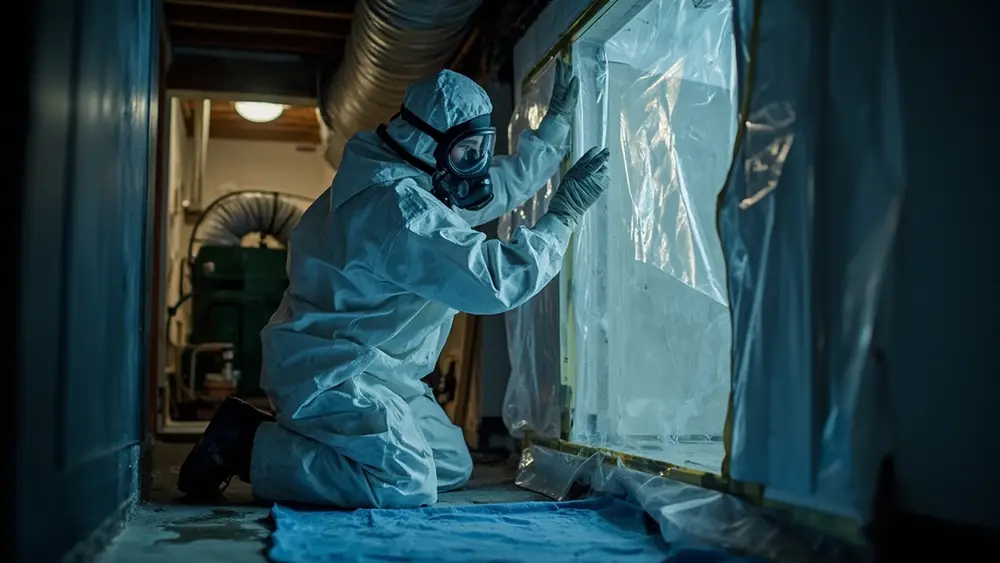
Test before you tear
Test Before You Tear: The Wet Test, the Flood Cut and the Rules for Old Buildings
The cheapest square foot of remediation is the one you do not cut. Before any wall is opened, the material is tested, the moisture line is measured, and in an older New York building, the wall itself is tested for what is inside the paint and the plaster. Two filmed jobs teach the method better than any brochure, and their lessons are written out here as text, because no video plays on this page.
The wet test comes first, and it comes from a filmed basement job where six to seven inches of sewer mixed water stood in a finished basement. The lesson the film opens with is the right one: with water like that, bacteria is the issue, not just water. The test itself is simple. Wet drywall loses its strength, so a screwdriver punches through it easily; dry drywall resists. The technician works up the wall, punching as he goes, reading moisture as he climbs, about 90 percent at the base falling toward 60 percent higher up. The stain line on the surface is not the cut line, because water wicks above what you can see. You cut where the board gives resistance again, which in that job meant a flood cut at doorknob height, well above the visible damage. Baseboards and doors come off, rusty screws come out, the exposed wood is treated, and then the wall waits, three to four days to a week of drying before anything is rebuilt, with the stud positions marked so the new board goes back onto known framing.
The second film makes the ordering point, and its title is the whole lesson: test before you tear. The sequence it teaches is extract and dry, test, mitigate, clearance, rebuild. Test for asbestos and lead before cutting, not after the dust is already in the air. And it repeats the sentence every homeowner should hold a crew to: looks dry does not mean is dry. Watch both jobs on YouTube, where they open outside this page: Home RenoVision DIY, Water Damage? Do This BEFORE Mold Takes Over, and Certified Restoration, After Storm or Water Damage Test Before You Tear. One caution belongs with the first film: its do it yourself bleach advice is presenter advice, not the professional standard for Category 3 water, and on sewage the containment rules in the S520 section above are the ones that apply.
Two New York warnings ride on top of the method. First, the wet test and the flood cut apply to drywall. They do not apply to pre-war plaster on lath, which is three coats thick, holds water far longer, and is tested and dried by readings, not punched and cut on a line; and no co-op shareholder should cut anything without board approval in any case. Second, the testing duty in older buildings is law, not preference. Buildings put up before 1978 can carry lead paint, and testing may be required before demolition disturbs it. Pipe insulation, floor tile and other older materials can carry asbestos, and a pre 1987 building needs its survey under Rule 56 of the New York City Department of Environmental Protection (DEP), with the ACP-5 and ACP-7 forms that go with it, before suspect material is touched. These checks typically add one to three business days to a job, and they are the difference between a controlled removal and a contaminated apartment. A crew that waves them away to start faster is telling you something about every other standard on this page.
Before anyone cuts your wall
Ask what the meter read, where the cut line came from, and what the testing showed. A free inspection answers all three in writing before work starts.
The rules that stack
New York Mold Law: Article 32, Local Law 55, Local Law 61 and HPD Classes
Four separate rules govern mold work in this city, they stack on top of each other, and most service pages explain none of them. They decide who is allowed to assess your mold, who is allowed to remove it, why those two can never be the same company, and how long your landlord has to fix a violation. One widely read competitor page gets the most basic fact wrong, saying Local Law 55 covers buildings of ten or more units. It does not. Local Law 55 starts at three units; ten units is Local Law 61. The table below is the corrected version.
| Rule | Who it covers | What it requires |
|---|---|---|
| NYS Labor Law Article 32 | Any business doing mold work on an area over ten square feet, anywhere in New York State | A licensed assessor and a separate licensed remediation contractor, a written plan, containment and a clearance notice. The same company cannot assess and remediate the same property. It has been unlawful since 1 January 2016 to advertise mold services without a licence. Administered by the NYS Department of Labor. |
| NYC Local Law 55, the Asthma Free Housing Act, 2018 | NYC residential buildings with 3 or more apartments | The owner must inspect every occupied unit and the common areas for mold, mice, rats and roaches at least once a year, use approved work methods, fix the moisture source behind the mold, and clear mold before a new tenant moves in. Enforced by HPD. |
| NYC Local Law 61, Admin Code 24-154, 2018 | Buildings with 10 or more units, or 25,000 or more square feet of non residential floor area | A licensed assessor and a licensed remediator for every mold project over ten square feet, whether or not HPD has issued a violation. The contractor gives notice two business days before work starts, the assessor report is filed within seven days, the remediation contractor files a Mold Remediation Notification Form with DEP before work begins, and the assessor files a Mold Post Remediation Assessment Form at completion. Enforced by DEP and HPD. |
| HPD violation classes | NYC multiple dwellings | Class A allows 90 days to correct, Class B allows 30 days, Class C generally allows 24 hours, but mold is the exception: a Class C mold violation carries a 21 day correction deadline before daily fines begin. A Class B violation upgrades to Class C if it is not certified corrected in time and HPD re-inspects within 70 days to find the condition still there, or if it was falsely certified. |
The assessor and remediator split, side by side, because it is the part of the law homeowners get wrong most often:
| Question | Licensed mold assessor | Licensed mold remediator |
|---|---|---|
| What do they do? | Inspects the property, identifies the moisture source and sets the scope of the mold work | Performs the physical removal, cleaning and containment the plan calls for |
| What do they produce? | A written Mold Remediation Plan, and at the end a post remediation assessment confirming the work passed | The completed remediation work, done to the plan; the remediator cannot deviate from it without a written amendment from the assessor |
| What does the law forbid? | Assessing a property and then selling the remediation of what its own assessment found | Remediating a property it assessed itself; HPD will not accept certification from a company that also performed the assessment |
The scale behind these rules is worth knowing. HPD recorded more than 47,000 mold violations and more than 57,000 water leak violations in 2024, and 41,345 mold violations in fiscal year 2025. One mold industry guide counts 36,178 mold complaints logged in the city in 2024, up 59 percent on the year before; that figure is that guide's count, not an HPD published total, and it is labelled that way here because the distinction matters. What is not in dispute is the direction: leaks and mold are the two most common housing complaints in the city, and the annual inspection duty under Local Law 55 exists because owners were not finding either one on their own.
The practical licence check takes two minutes and belongs in every hiring decision. Confirm that the company holds the right licence for the work it is offering, assessment or remediation, and that the assessor and the remediator on your job are separate licensed parties, as Article 32 requires. Both lists are public on the state open data portal, licensed mold contractors and licensed individuals. A home inspector who assesses mold needs the assessor licence too. If a company offers to test your mold and then sell you the removal of what its own test found, it is offering the exact conflict the law was written to prevent, and its clearance paperwork will not be accepted by HPD in any case: the city will not take certification from a company that also performed the assessment.
This section is general information about the rules as published, not legal advice. Where a violation, a lease dispute or a filing deadline is live, the HPD and DEP guidance pages and a New York housing attorney are the authority, not a service page.
Deadlines, corrected
New York Claim Clocks: Regulation 64, Section 2618 and the 3420(d) Correction
Insurance deadlines decide claims as often as damage does, and the most repeated deadline fact on New York restoration pages is wrong. Several guides attribute a 15 day acknowledgement clock to Insurance Law 3420(d). That section says no such thing, and the correction is set out below with the statute's own words, because a homeowner who quotes the wrong section to an adjuster starts the conversation by losing credibility. The real clocks are Regulation 64 and, after a declared disaster, Insurance Law 2618.
| Clock | Deadline | Source |
|---|---|---|
| Acknowledge your claim | Within 15 business days | Regulation 64, 11 NYCRR Part 216, under Insurance Law 2601 |
| Reply to your communications | Within 15 business days | Regulation 64 |
| Begin the investigation | Within 15 business days | Regulation 64 |
| Accept or reject in writing | Within 15 business days after proof of loss and the items requested, with a status letter every 90 days while the claim is undecided | Regulation 64 |
| Pay the settlement | Within 5 business days of settlement | Regulation 64 |
| Respond to the Department of Financial Services | Within 10 business days | Regulation 64. The regulation gives no private right of action; enforcement runs through DFS. |
| Disaster claims, accept or reject | 15 business days after proof of loss for a non commercial claim, 30 where arson is suspected, with one 15 business day extension and written updates every 15 business days | Insurance Law 2618, natural disasters |
| Disaster claims, payment | Within 4 business days of settlement | Insurance Law 2618 |
| Sue on the policy | Within 24 months of the date of loss | Insurance Law 3404, the standard fire policy |
Now the correction itself. Insurance Law 3420(d)(2) requires notice of a disclaimer "as soon as is reasonably possible". Those are the statute's words. It is the timely disclaimer rule for death or bodily injury claims under liability policies, it does not apply to property damage claims at all, and it contains no 15 day figure of any kind. The 15 business day clocks above come from Regulation 64 and Insurance Law 2618, and those are the sections to cite. One smaller correction of the same kind: the disaster payment clock under Section 2618 is four business days, not three. The three day figure that still circulates online comes from the 2021 bill draft, S6595, and was never the enacted text. One more case belongs in every New York claimant's notebook: in Bi-Economy v Harleysville and Panasia v Hudson, decided by the Court of Appeals on 19 February 2008, consequential damages were held recoverable where an insurer wrongfully delays or denies, even beyond the policy limits, which is why a documented delay is worth more than an angry phone call. A public adjuster, if you hire one, is capped at 12.5 percent of the recovery, with a 20 percent supplemental exception in the regulation. The proposed FISPA bill, S166, is sometimes described online as if it were already law; as of mid 2026 it is proposed, not law. The DFS consumer hotline is (800) 342-3736, Monday to Friday, 8:30 a.m. to 4:30 p.m., with complaints also taken online at dfs.ny.gov; the separate disaster hotline is (800) 339-1759.
Flood claims run on a second set of clocks. An NFIP policy normally carries a 30 day wait before cover begins, with four exceptions. After a flood, the Proof of Loss is due within 60 days of the loss, a FEMA appeal is due within 60 days of the denial letter, and a lawsuit is due within one year of the first written denial; filing an appeal does not extend the suit clock, which is the trap that catches people who appeal in good faith and sue too late. Basement cover under NFIP is narrow, installed building systems in the main, with finished walls and most contents outside it. The NFIP help line is 877-336-2627. Claims against the City itself are a third track: report the sewer backup to 311, and a notice of claim to the NYC Comptroller is generally due within 90 days of the incident under General Municipal Law 50-e, with suit to follow within one year and ninety days. Set expectations with one hard fact from the last great flood: the Comptroller denied all 4,703 Ida claims, citing Holzhausen v City of New York from 1907, on the ground that the storm exceeded what the system was built to handle. A city claim needs negligence shown, not just damage suffered.
Two honest answers close this section. Mold cover, where it exists at all, applies only when the mold results from a covered water event, and only within a mold sublimit written into the policy; the pipe or appliance that failed is usually not covered, while the damage it caused usually is, and if a discovered leak is left unmitigated until mold develops, carriers may refuse the mold costs on the ground that the policy required prompt action. And the question no competitor page answers, whether filing a claim raises your premium, has no honest general answer: it varies by carrier, by policy and by claim history, so ask your own agent before you file, and weigh a small claim against that answer.
This section is general information, not legal or financial advice. Policy wording controls every individual claim.
The clocks start at the loss, not at the paperwork
Same day notice, dated photos, a moisture map and a drying diary are what a claim stands on. The free inspection produces the first three documents of that file.
Keep or remove
Save or Replace: What Survives Water damage remediation NYC and What Does Not
Every remediation scope is a series of keep or remove decisions, and the category of the water makes most of them before anyone arrives. Clean water rewards speed: the same material that dries in place on day one is removed on day five. Category 3 water reverses the logic: porous material it touched is removed however fast you call, because drying does not make contaminated material safe. The table states the usual outcome for each material, and the paragraphs after it cover the two arguments that cause the most trouble, carpet padding and paint.
| Material or item | Clean water, fast start | Category 3 or long wet |
|---|---|---|
| Drywall | Usually dried in place with baseboard removal and cavity air | Removed to the flood cut line where it was touched or has lost strength |
| Pre-war plaster on lath | Dried in place by readings; slow, and worth saving | Assessed piece by piece; contaminated sections removed under the old building rules |
| Hardwood flooring | Often saved with mat drying; judged only after it reaches the dry standard | Usually removed where floodwater or sewage sat on or under it |
| Carpet | Can be cleaned and dried if the backing is intact and drying starts within 24 to 48 hours, the EPA window | Removed and disposed of |
| Carpet padding | Usually replaced; it holds water like a sponge and rarely dries to standard in place | Removed and disposed of |
| Fiberglass insulation | Sometimes dried in place with cavity air if it has not compressed | Removed; wet cellulose insulation is removed in either case |
| Solid wood furniture and cabinets | Often saved if dried evenly and early | Porous and swollen pieces are usually lost; particleboard that has swelled does not recover in any category |
| Upholstery, mattresses, soft toys | Case by case, professional cleaning only | Disposed of; they cannot be reliably decontaminated |
| Paper, books and documents | Freeze drying can save items of real value if they are frozen fast | Photograph for the claim, then dispose of contaminated paper |
Carpet padding is the line item homeowners argue about most, so here is the reasoning in full. Pad is a sponge by design, it sits in the darkest and least ventilated layer of the floor assembly, and it is the layer where the wettest readings in the room are found on almost every job. Removing pad while saving the carpet above it is often the fastest route to a dry subfloor, and pad is the cheapest layer of the assembly to replace. The drying explainer quoted in the timelines section makes the same point from the meter's side: a wet floor can look dry on top while the water is still in the pad, the subfloor and the wall behind the baseboard. Crews that promise to dry pad in place on a sewage job are not describing water damage remediation NYC; they are describing a smell that comes back in August.
Paint is the other argument, and it is shorter. Never paint over mold, a stain that is still damp, or a wall that has not reached its dry standard. The EPA guide says paint over a moldy surface is likely to peel, sealing primer over a wet wall traps the moisture that feeds the next colony, and the verified tenant account in the first 48 hours section shows where the paint over habit ends: warped walls, bubbling paint and a floor giving way, in a home where every warning sign had been painted shut. Remediation ends with verified dry readings and a signed off log. Paint is restoration, it comes after, and any company that offers it as the treatment has skipped the job this page describes.
The full site
All Pages: Water Damage Help Across New York
This page covers water damage remediation NYC, the measured drying and decontamination stage. The rest of the site covers the places and the problems around it, and each page goes as deep on its own subject as this one does here.
Water Damage Restoration New York
The home page: the full service, the first sixty minutes checklist, the process and the borough map for the whole city.
Water Damage Restoration NYC
All five boroughs, the Hudson and East rivers, one fast response.
Water Damage Restoration Brooklyn
Brownstones, party walls, garden level flooding and sewer backups across twenty Brooklyn neighbourhoods.
Water Damage Restoration Queens
Flushing Creek, the Jamaica groundwater rise, basement apartments and attached homes across Queens.
Water Damage Restoration Bronx
Pre-war risers, steam heat, Co-op City and the oldest housing stock in the city.
Water Damage Restoration Staten Island
Three shorelines, raised houses, clay soil and the borough Sandy hit hardest.
Water Damage Restoration Long Island
Nassau and Suffolk: sewers against cesspools, sump failures and fifty towns with their ZIP codes.
Water Damage Restoration Manhattan
High-rise stacks, board rules, pre-war plaster and leaks that travel five to ten floors down a riser.
Rochester
Lake Ontario shoreline, Genesee River flooding and frozen pipes across Monroe County.
Albany
Hudson River flooding, frozen pipes and historic homes across the Capital Region.
Buffalo
Lake-effect snow, frozen pipes and basement floods across Erie County.
Water Damage Restoration Syracuse
Lake-effect snow, frozen pipes and creek floods across Onondaga County.
Water Damage Restoration Yonkers
Saw Mill River floods, burst pipes and pre-war buildings across Westchester County.
Water Damage Restoration New Rochelle
Long Island Sound storms, Hutchinson River floods and pre-1980 homes across Westchester County.
Water Damage Restoration Mount Vernon
Hutchinson River floods, century-old sewers and basement backups in Westchester's most densely packed city.
Water Damage Restoration Schenectady
Mohawk River floods, Stockade ice jams and frozen pipes across the Capital Region.
Water Damage Restoration Utica
Mohawk River floods, Sauquoit Creek overflows and frozen pipes across Oneida County.
Water Damage Restoration White Plains
Bronx River floods, Mamaroneck River overflows and frozen pipes across Westchester County.
Water Damage Restoration Troy
Hudson River floods, Poesten Kill overflows and frozen pipes across Rensselaer County.
Water Damage Restoration Niagara Falls
Niagara River ice jams, Cayuga Creek floods and frozen pipes across Niagara County.
Water Damage Restoration Binghamton
Susquehanna and Chenango River floods, burst pipes and frozen pipes across Broome County.
Water Damage Restoration Westchester County
Mamaroneck River floods, Bronx River and Saw Mill River flash floods, frozen pipes across Westchester County.
Water Damage Restoration Hudson Valley
Hudson River and creek floods, tidal surge, frozen pipes across the Hudson Valley.
Water Damage Restoration Capital Region
Hudson and Mohawk floods, burst pipes, ice jams across the Capital Region.
Water Damage Restoration Western New York
Lake effect snowmelt, ice jams and creek floods across the eight county region.
Water Damage Restoration Finger Lakes
Eleven lakes, Genesee River floods and canal towns across the fourteen county region.
Water Damage Restoration Central New York
Syracuse and Utica, Oneida Lake and the Mohawk River, across two state regions.
Water Damage Restoration Southern Tier
Binghamton and Elmira, Susquehanna and Chemung rivers, across eight counties.
Water Damage Insurance Claim
Filing step by step: the New York claim clocks, the paper trail, denials and the adjuster process.
Water Damage Behind Walls
Hidden moisture, cavity drying, moisture thresholds and the tests that find water you cannot see.
Fire Damage Restoration NYC
Soot, smoke and the IICRC S700 standard, plus the firefighting water that turns a fire job into a drying job.
Flood Cleanup NYC
Storm and sewer water: pump out, muck out, sanitation, and the city systems behind New York flooding.
Fire Damage Cleanup NYC
The cleanup stage after a fire: debris, soot removal and making the property safe to enter and work in.
How Long Does Mold Take to Grow After Water Damage?
The 24 to 48 hour mold timeline, warning signs, and what stops it.
Water Damage Restoration Process
The full restoration process, step by step, from first call to dry home.
What Is Water Damage Restoration
What restoration really is, what it includes, and when to call.
Mold Remediation New York
New York's licensed remediation system, from assessment to clearance.
Water Removal NYC
Standing water pumped out fast, then dried safe, for every NYC home.
Water Damage NYC
Water damage in NYC explained plainly, with fast help for every home.
Water Damage Cleanup Nyack NY
Water damage cleanup in Nyack explained plainly, with fast help for every home.
How to Choose a Water Damage Restoration Company in New York
How to choose a water damage restoration company in New York, with every check that protects your home.
How to Choose a Water Damage Restoration Company in New York
Commercial Water Damage Restoration NYC | 24/7 Emergency Help
Commercial water damage in NYC explained plainly, with fast help for every business.
Commercial Water Damage Restoration NYC | 24/7 Emergency Help
Basement Water Damage Restoration NYC
Basement water damage in NYC explained plainly, with fast help for every basement.
Water Damage Repair New York
Water damage repair in New York explained plainly, with fast help for every home.
Water Damage Restoration Poughkeepsie New York
Water damage restoration in Poughkeepsie explained plainly, with fast help for every home.
Emergency Water Damage NYC
Emergency water damage in NYC explained plainly, with fast help when every minute counts.
Water Damage Cleanup in NYC
Water damage cleanup in NYC explained plainly, from torn-out materials to dry rooms again.
Flood Damage Restoration NYC
Flood damage restoration NYC explained plainly, from flood events and NFIP claims to dry rooms and a flood-resistant rebuild.
How Long Does Water Damage Restoration Take
How long does water damage restoration take explained plainly, from the first hours of drying to the day your home is dry again.
Flood Damage Cleanup Washington Heights
Flood damage cleanup in Washington Heights explained plainly, with fast help for every home.
Does Insurance Cover Water Damage Restoration
Whether insurance covers water damage restoration, explained plainly, by cause and New York rule.
Water Damage Mold Remediation
Mold that grew after a leak or flood, remediated the New York way, by licensed assessor and remediator.
Water Damage Restoration Companies New York
Compare the companies serving New York: national franchises, regional firms and local independents, and how to verify licences and certification before you hire.
Water Damage From Upstairs Neighbor
Water damage from an upstairs neighbor in New York City: who pays, what to do in the first hour, and how to document, report and claim.
Everything on this page is general information about water damage remediation NYC, not legal or financial advice. Business name, phone, licence and review details shown as placeholders are to be replaced with the real business details before advertising use.
Questions and answers
Water Damage Remediation NYC: Frequently Asked Questions
The questions we hear on the phone and at the door, answered the way we answer them in person.
What is water damage remediation NYC?
It is the measured process of removing water from a building and returning wet materials to their normal dry state: source control, extraction, moisture mapping, structural drying, cleaning and antimicrobial treatment, and a verified sign off with dated readings. Repairs and rebuilding come after water damage remediation NYC, once the structure is proven dry.
What is the difference between remediation, mitigation and restoration?
Mitigation is the emergency stage: stop the source and extract standing water in the first hours. Water damage remediation NYC is the technical stage: map the moisture, dry the structure to a verified dry standard, treat surfaces and remove only what cannot be saved. Restoration is the repair stage: drywall, flooring, trim and paint that put the home back to how it looked.
How fast should water damage remediation NYC start after a leak?
The same day. Extraction and drying should begin within the first 24 hours where possible, because mold can start growing on wet drywall and wood within 24 to 48 hours, and clean water that sits for days degrades into a dirtier category that forces more removal. Speed is the difference between drying material in place and replacing it.
How long does water damage remediation NYC take?
Most clean water jobs in one or two rooms reach the dry standard in three to five days of monitored drying. Class 4 losses, hardwood, plaster and concrete, can take longer, and sewage or multi unit losses add time for containment and removal. The honest answer for your home comes from the first day of readings, and the drying diary shows the finish line approaching day by day.
How do you know when my home is actually dry?
By readings, not by touch. A technician takes baseline readings in a dry part of your building, then dries until the wet materials match that baseline, called the dry standard. Every visit is logged in a drying diary with dated readings at the same points. When the numbers match, the job is verified dry and signed off.
Can wet drywall be dried, or does it always come out?
Most wet drywall from clean water dries in place with baseboard removal and cavity drying, and saving it is the default. Drywall comes out when it has lost strength, holds wet insulation that cannot dry, was touched by Category 3 water, or has growth inside the cavity. The decision is made from readings and condition, not from habit.
Will my hardwood floor survive?
Often, yes, if drying starts fast. Cupping, where board edges lift because the underside is wetter, usually relaxes as the floor dries evenly with mat systems and dehumidification. Floors are judged after they reach the dry standard, not on day one, because sanding or replacing a floor that was still drying wastes a floor that would have recovered.
What is a moisture map?
It is the measured record of what is wet, where, and how wet, built with pinless scans, thermal imaging and pin meter readings at marked points. The map sets the scope, places the equipment, and becomes part of your claim file. Without a map, a drying job is guesswork with fans.
Do I need to leave my home during water damage remediation NYC?
Usually not on clean water jobs. The equipment is loud and the drying rooms are hard to use, but the home stays safe to live in. On sewage jobs or where growth is removed under containment, the affected area is sealed off, and for some jobs the unit is better empty for a few days. Your technician should tell you plainly at inspection which case yours is.
Why do you not publish prices for water damage remediation NYC?
Because the scope depends on facts nobody knows before inspection: the water category, the class of loss, which materials are wet and how many days the readings require. A price published before those facts would be a guess dressed as a promise. The inspection is free, and you get a written scope with an exact quote before any work starts.
Does insurance cover water damage remediation NYC?
Sudden and accidental water damage, like a burst pipe or a failed appliance, is covered by most homeowners, renters, co-op and condo policies, subject to limits and deductible. Rising flood water needs a separate flood policy, sewer backup depends on an endorsement, and long term leaks are often excluded. Documentation decides how smoothly it pays: same day notice, photos, a moisture map and a drying diary.
What is Category 3 water and why is it treated differently?
Category 3 is grossly contaminated water: sewer backups, toilet backflow with waste and rising flood water. It can carry pathogens and chemicals, so it is handled with containment, protective equipment and air filtration, and porous materials it touched are removed and disposed of rather than dried. It is never a mop and bucket job.
Can mold start before the crew arrives?
Yes, if the material has been wet for more than a day or two, especially in warm weather. Growth can start on wet drywall and wood within 24 to 48 hours. That is why the first call matters more than the first quote. If growth is already present, New York State rules for assessment and licensed remediation may apply, and we will tell you at inspection.
Is antimicrobial spray enough on its own?
No. Antimicrobial treatment is a finishing step on cleaned surfaces after drying. It cannot reach moisture inside a wall cavity or under a floor, and growth happens exactly in those hidden wet places. Any offer to treat instead of dry is selling the cheaper half of the job. Dry first, clean, then treat.
What happens during the free inspection?
A technician walks the whole loss, including the rooms beside and below, scans with pinless meters and a thermal camera, confirms readings with pin meters, and identifies the source and category. You get the moisture map, a written scope and an exact quote before any work starts. If part of the home tests dry, the scope says that too.
My landlord is responsible. What should I do?
Notify the landlord or management in writing the same day, with photos attached, and keep your copy. In New York the building owns the pipes and the structure, and Local Law 55 puts mold conditions on the owner to correct. Open a claim on your renters policy for your belongings. If a wet or moldy condition is left unaddressed, call 311.
The leak came from my upstairs neighbour. Who pays?
Open your own claim first: your policy covers your unit and belongings, and your insurer can pursue the responsible party afterwards through subrogation. The building master policy may also be involved for shared structure. Document your damage exactly as if the loss were yours, and get the source unit identified in writing by management.
Can I dry it myself with fans?
For a small, clean spill on a hard sealed surface that you caught within the hour and fully extracted, home drying is reasonable. For water under flooring, inside walls, in a basement, from a dirty source, or sitting more than a day, fans alone will not do it: they move air but do not dehumidify cavities, and the mold clock keeps running. That is what the free inspection is for.
Why does the equipment need to run for days?
Because evaporation from deep material is slow physics, not a choice. Surfaces dry in hours; studs, subfloors, plaster and slab take days, and the equipment has to run until readings at the deepest points reach the dry standard. Daily monitoring visits exist to prove each day is still needed and to stop the day the numbers say done.
What is a drying diary and why should I keep it?
It is the dated log of your job: readings at marked points, temperature and humidity, equipment in place and changes made, from the first map to the final sign off. Keep it because it is your proof for the insurer that the work and the equipment days were needed, and your record that the structure was verified dry before repairs closed everything up.
Do you work in co-ops and condos with strict building rules?
Yes. Co-op and condo jobs need contractor insurance certificates, an alteration or work agreement where the building requires one, freight elevator bookings and work hour coordination. We flag all of it at inspection so the paperwork never becomes the reason a wet apartment sits waiting.
What about lead and asbestos in older buildings?
Pre-war buildings can hold lead paint and asbestos in plaster, pipe insulation, floor tile and roofing, and cutting or demolition disturbs them. Where those materials are present or suspected, testing and the city and state handling rules come before any removal. Ask any company you interview how they handle suspect material in an older building.
Should baseboards always be removed?
On most wall drying jobs, yes. Baseboards trap moisture against the wall base and block cavity air. Removing them is a small, repairable step that lets the wall base and cavity dry, and it is far cheaper than opening the wall. MDF baseboard that has swelled is replaced; solid wood that dries flat usually goes back on.
What is the difference between water damage remediation NYC and flood cleanup?
Flood cleanup is the response to water that entered from outside or from a surcharge: pump out, muck out, removal of ruined material and sanitation. Water damage remediation NYC is the measured drying and treatment stage that follows any water loss, flood included, and ends with a verified dry standard. Our flood cleanup NYC page covers the storm and sewer side in full.
How fast can you get to my building?
We dispatch 24 hours a day, every day, across all five boroughs and Long Island. Call (212) 555-0147 (placeholder number) and tell us what leaked, which rooms are wet and whether the water is still running. That information lets us send the right first crew with the right extraction and drying equipment.
Will water damage remediation NYC remove the musty smell?
If the smell is coming from wet material, yes, because the smell leaves when the moisture does. A musty odour that survives verified drying means a wet pocket was missed or growth is present somewhere, and the answer is more measurement, not air freshener. Odour is treated as a reading on our jobs: a symptom that points back to moisture.
What should I not throw away?
Damaged belongings, until they are photographed, listed and released by your adjuster. A soaked rug, a swollen cabinet door, ruined books: each is evidence of value on your contents claim, and items discarded without records are the ones claims most often reduce. If something is a health hazard, photograph it well and note why it was discarded.
Can water damage remediation NYC save wet insulation?
It depends on the type. Fiberglass batts that got wet with clean water can sometimes be dried in place with cavity air if they have not compressed or picked up contamination. Wet cellulose and Category 3 touched insulation come out. The cavity readings and the category decide, and the scope should say which and why.
Do you handle the repairs after drying?
Yes, repairs and rebuild are the restoration stage that follows sign off, and our home page covers the full service. Water damage remediation NYC ends with a verified dry structure and the drying diary; restoration then replaces what was removed and refinishes the rest, in that order, so new material is never closed over a wet wall.
How do I choose a water damage remediation NYC company?
Ask four things. What standard does your drying follow, and what is the dry standard for my walls? Will I get a written scope and the drying diary? How do you handle co-op and condo paperwork and suspect materials in older buildings? And will you show me the baseline readings you took in my dry rooms? Companies that measure will answer in numbers. Companies that guess will answer in adjectives.
What is the difference between water mitigation and water restoration?
Mitigation stops the damage from getting worse: source control, extraction and drying setup in the first hours. Restoration is the umbrella term for the whole job, call to walkthrough, and in everyday use it also names the rebuild at the end. Water damage remediation NYC sits between them, removing contamination to a verified standard. The order never changes: mitigate first, remediate where contamination exists, restore last.
Can I stay in my home during water damage remediation NYC?
Often yes, if the water was clean and the loss is limited to one area; the equipment is loud and the drying rooms are hard to use, but the home stays safe. If the water was sewage or floodwater, or growth is being removed under containment, plan to be out of the affected area until clearance, and on widespread Category 3 jobs out of the home entirely.
Does water damage remediation NYC always require permits?
No. Cosmetic repairs, painting, like for like drywall and standard flooring typically do not require a permit. Work involving plumbing, electrical or structural changes does. The DOB Emergency Work Notification process lets contractors begin emergency repairs immediately while the formal permit application is processed alongside, so a permit question should never be the reason a wet apartment sits waiting.
Who pays for mold remediation in a NYC rental?
The landlord. In a New York City residential rental the owner pays for mold remediation, and that holds even when a tenant's habits helped cause it, because the warranty of habitability is part of every residential lease in the state and no lease clause can waive it. Local Law 55 also puts the duty on owners of buildings with three or more apartments to fix mold and the leak behind it. If an owner will not act, file a 311 complaint with HPD.
How do I know if there is hidden water damage in my property?
The surface signs are a persistent musty odor after a loss that looks resolved, paint or wallpaper bubbling or peeling days later, soft spots in floors or walls, and staining that reappears after cleaning. The certain answer comes from instruments: thermal imaging and calibrated moisture meters find moisture you cannot see, and hidden moisture in pre-war construction is a particularly common long term damage source in this city.
Will my insurance cover mold after water damage?
Only when the mold results from a covered water event, a burst pipe or a failed appliance, and only within the mold sublimit written into the policy. Gradual leaks, long term neglect and outside floodwater are generally excluded. The documentation insurers want is evidence of the source, the extent of the damage and a professional scope of work, which is what the moisture map and drying diary provide.
What is IICRC S520 and why does it matter for my mold job?
S520 is the ANSI/IICRC standard for professional mold remediation. It classifies a space as Condition 1, normal fungal ecology, Condition 2, settled spores, or Condition 3, actual growth, and it requires physical removal of growth, correction of the moisture source, containment with HEPA filtration, and clearance testing by an independent consultant before the space is called finished. A company working to S520 can show you the condition, the containment and the clearance result in writing.
Does filing a water damage claim raise my premium?
There is no honest general answer, and any page that gives you one is guessing. It varies by carrier, by policy and by your claim history. Ask your own agent before you file, and weigh a small claim against that answer. What never varies is the documentation duty: same day notice, dated photos and a professional scope protect the claim whatever you decide.
Is water remediation the same as water damage restoration?
No. Remediation is one stage inside the larger restoration job. Remediation removes contamination and wet material that cannot be saved, then dries and treats the structure to a verified standard. Restoration is the whole process, and in everyday use it also names the repairs and rebuilding that follow once remediation is complete and the structure is proven dry.
How long does mold take to grow after water damage?
Mold can start growing on wet drywall and wood within 24 to 48 hours of water exposure. The EPA gives the same 24 to 48 hour window for drying wet material before growth begins. In NYC apartments with limited ventilation and high humidity, a slow leak behind a bathroom wall can show visible growth in under three days.
What should I do first after water damage?
Stop the water at the source, keep people clear of standing water near wiring, and photograph every wet room before anything moves. Then extract what you can reach safely, notify your insurer and your landlord or building management the same day, and call a remediation crew within the first 24 hours, before the mold window closes.