Water Damage From Upstairs Neighbor: Who Pays, and What to Do in the First Hour
The short version, with sources
Key Takeaways
This is the fifty-sixth page of this site, and it is the one about the leak that comes from the home above yours. Eight facts decide almost every case of water damage from upstairs neighbor events in New York City, and each one below is stated with the source it comes from, so it can be checked and quoted exactly as it stands.
Last updated: November 2026
- Who pays depends on the leak's source, not on which apartment has the visible damage. When a common building pipe or the building's roof fails, the co-op or condo is typically responsible. When a fixture, pipe or appliance inside the upstairs unit fails, the upstairs owner or their insurer usually pays. That is the source first rule, stated in an NYC attorney's guide to upstairs neighbor leak damage at hochmanlawpc.com, and it organises everything else on this page.
- The building restores its own layer and you restore yours. After a leak, the co-op or condo normally restores the building's original finishes, ceiling, walls and floors, while the affected owner's HO-6 policy typically covers personal property and improvements such as paint, flooring and cabinetry beyond the original finishes.
- In a co-op or condo, the first call is the building management company or the board, before HPD. The city's own 311 guidance for co-op and condo complaints routes residents to management first, and HPD expects a landlord or owner to have been contacted before it acts on any complaint.
- Renters hold a law, not a favour. Real Property Law section 235-b, the warranty of habitability, warrants that a rental is fit for human habitation and that occupants shall not be subjected to conditions dangerous, hazardous or detrimental to life, health or safety, and any waiver of it is void. Housing Maintenance Code section 27-2005 separately requires the owner of a multiple dwelling to keep the premises in good repair.
- HPD correction deadlines are set by violation class: Class A allows 90 days, Class B allows 30 days, and Class C runs from 24 hours for most conditions to 21 days for mold at the largest scale, on HPD's own published tables. Local Law 55 of 2018 requires owners of buildings with three or more apartments to keep homes free of mold and to fix the leaks and moisture that cause it.
- NYCHA residents have their own route and their own clocks: report through MyNYCHA or the Customer Contact Center at 718-707-7771, and for an emergency NYCHA's stated standard is access within 24 hours and clean and dry within 48 hours, with escalation after three business days.
- Insurance follows a negligence test. If the upstairs owner was negligent, their HO-6 liability coverage is the first to respond. If the leak came from the building's system, the master policy covers the repairs. If no one was negligent, the affected owner's own HO-6 is likely the primary coverage, and subrogation, your insurer recovering from the responsible party's insurer, is possible but never guaranteed.
- Small Claims Court in New York City hears money claims up to 10,000 dollars, verified on nycourts.gov, you do not need a lawyer to sue there, and the strongest evidence in these cases is a plumber's report that identifies the source and the extent of the leak, backed by dated photographs and written notices.
Who stands behind the work
Standards You Can Check, Not Slogans You Have to Trust
Every rule, deadline and dollar figure on this page was checked against its source during research in November 2026: the New York Courts site for the Small Claims limit, HPD's own pages for violation deadlines and the Local Law 55 mold table, NYCHA's leak page for its response standards, the statute text for the warranty of habitability, and a New York attorney's published guide for the responsibility rules. Where a source could not be verified, this page says so and prints nothing. That habit, claim labelled with its owner, is exactly the habit to demand from everyone who touches your ceiling.
Rules from the sources themselves
The responsibility rules come from an NYC attorney's guide, the deadlines from HPD, the court limit from nycourts.gov, the habitability warranty from the statute text, and the NYCHA standards from NYCHA's own leak page, each linked in the sources list at the foot of this page.
Licensed & insured in NYC
Certificates of insurance are sent to your co-op board, condo management or landlord the same day you call, before a single machine crosses your lobby.
Licence no.: add yours hereReviewed by a working technician
The guidance on this page is written from live NYC job experience, burst risers, overflowing tubs, pre-war plaster and ceilings that came down wet, and reviewed against EPA and IICRC guidance, not copied from a national template.
Expert name & cert.: add yours hereReviews you can verify
We would rather show you real, checkable reviews than a star graphic we drew ourselves. Read what past customers say on public profiles before you decide who dries your home.
Review profile links: add yours hereThe definition, in 46 words
Water Damage From an Upstairs Neighbor, Defined Plainly
That definition hides the two features that make this kind of loss different from every other water problem in a home. The first is direction. The water arrives from a space you do not control, behind a door you cannot open, from a fixture you cannot switch off. Your first repair tool is not a wrench; it is a knock on a neighbor's door, a call to a superintendent, and a building's riser valve. The second feature is division. In your own burst pipe, one owner, one insurer and one bill argue among themselves. Here, the source, the structure and the damage can belong to three different parties before breakfast: the upstairs owner, the building, and you. Almost every dispute in these cases is a dispute about which of those three owns which layer of the problem, and almost every one of those disputes is settled by the same evidence: where the water started.
The scale of the problem runs wider than the stain suggests. Water that enters a ceiling does not stop at the ceiling. It travels along joists, down inside wall cavities, across the tops of partitions and into the unit below yours if it runs long enough, which is why a leak that looks like one brown ring can produce wet plaster in three rooms and a claim file with four parties in it. The companion page on this site about water hidden behind walls covers the detection and drying of water inside your own wall cavities in full; this page stays with the upstairs case, the responsibility question, the first response, and the documentation that decides who pays.
This page is deliberately narrow in one way and broad in another. It is narrow because it covers only the upstairs neighbor case: who is responsible, what to do in the first hour, how the claim and complaint routes run in New York City, and how the case ends, by agreement, by insurer or by court. It is broad because that one dripping ceiling reaches into co-op and condo law, the warranty of habitability, housing code enforcement, two kinds of insurance policy and a court with a 10,000 dollar ceiling of its own. All of it is here, sourced, because a wet ceiling is no place to discover it by accident.
Water coming through right now?
Skip the reading and start the drying clock. One call opens the job, the documentation and the insurance file together, and the source investigation this page describes begins on the first visit. Water damage from upstairs neighbor does not wait for a convenient hour, and neither do we.
The first hour decides the claim
The First Hour: Six Steps, in Order
The steps below are the same six steps carried in this page's structured data, and they follow the order the evidence demands: water first, safety second, people third, proof fourth, the city fifth, and the professionals alongside all of it. In water damage from upstairs neighbor cases, the first hour is not a panic. It is a procedure.
Stop the water at the source
Knock on the upstairs door and ask for the valve or appliance to be shut off. If nobody answers, call the super, doorman or managing agent at once: building staff can close a riser, and every minute a riser runs adds damage to the homes below.
Protect your belongings and yourself
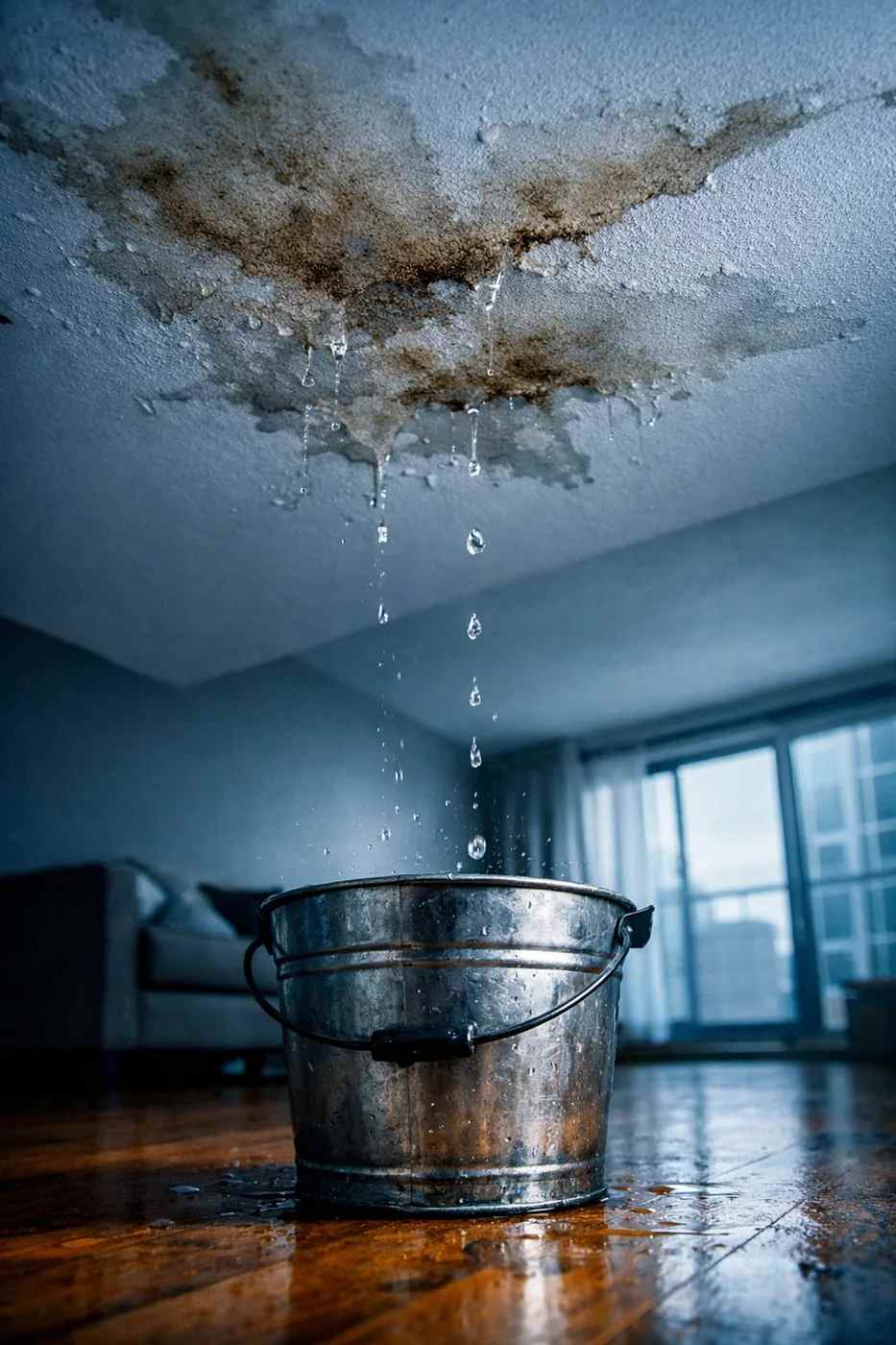
Move furniture, electronics and anything porous out of the wet area, put a bucket under the active drip, and keep clear of a bulging ceiling, which can come down under the weight of pooled water. Treat any water near lights or outlets as an electrical danger.
Notify the neighbor, the super and the board
Tell the upstairs neighbor, the superintendent and, in a co-op or condo, the managing agent or board, the same hour, and follow up in writing. In a rental, notify the landlord. Written notice starts the paper trail every later claim depends on.
Document everything while it is wet
Photograph and film the active leak, the source if visible, and every affected surface, with dates and times. Keep every notice, receipt and report, and ask for a plumber's report that identifies the source: it is often the strongest evidence in the case.
File with 311 and HPD if the building does not fix it
If the landlord, board or managing agent does not correct the condition, file a complaint with 311 by phone, online or the mobile app, and keep the Service Request number. HPD contacts the managing agent, inspects if needed, and issues violations with correction deadlines.
Call your insurer and a restoration company the same day
Open the insurance claim while the damage is fresh and every deadline is ahead of you, and start extraction and drying inside the 24 to 48 hour moisture window, before damp materials turn a drying job into a mold job.
Why the order matters
Each step protects the one after it. Stopping the water caps the loss that every later document describes. Protecting belongings limits the property claim to what water actually reached, rather than what it reached while you were on the phone. Notification starts clocks: the building's duty to respond, your insurer's duty to acknowledge, and the record that you acted promptly, which insurers and courts both read as good faith. Documentation freezes the scene before cleanup erases it. The city complaint exists for the cases where the building's response fails, and it works best when it can point to the notice you already gave. And the restoration call belongs inside the same day because drying is a race against a biological clock: moisture left in plaster, wood and insulation beyond the first day or two is what turns water damage from upstairs neighbor leaks into the mold problem that Local Law 55 then governs.
There is one more reason the first hour matters, and it is human rather than legal. The upstairs neighbor is usually hearing about the problem for the first time when you knock, often with water already through their own floor. The tone of that first conversation decides whether the next month runs on cooperation or on lawyers. Arrive with information, not accusation: where the water is showing, what you have done, what the building has been told, and what needs to happen in their unit to stop it. Most neighbors cooperate when they understand the source rule, because the same rule that may bill them today protects them when the leak runs the other way.
Still dripping?
Our crews work both sides of the ceiling: extraction and drying in your home, and the access and coordination the building needs to reach the source in the home above. That is the shape of water damage from upstairs neighbor work done properly.
Where the water actually starts
The Usual Sources Upstairs, and What Each One Points To
Because the source decides the payer, the first investigation in any upstairs leak is a short list of usual suspects. Each source below sits in a different legal place: inside the upstairs unit, inside the building's systems, or on the boundary between them, and the plumber's report should name which one failed.
The overflowing tub or sink
The most human source of all: a tub left filling, a sink that overflowed, a faucet left running. The water is clean, the event is sudden, and because the fixture and the act both sit inside the upstairs unit, responsibility normally sits there too, with the upstairs owner's liability coverage first to respond. These are the cases where the negligence side of the test is clearest, and where a fast, honest conversation between neighbors settles most claims without a court.
The failed appliance hose
Washing machine and dishwasher supply hoses age, split and let go, often at night, often in a unit whose owner is away. The appliance sits inside the upstairs unit, so the bill normally follows it there, but the negligence question is softer: a hose that fails without warning can be a pure accident, which is the case where the affected owner's own HO-6 policy is likely to be the primary coverage for the damage below.
The toilet and its wax ring
A toilet that leaks at its base sends water down around the flange and into the ceiling below, often slowly, often for weeks before the stain announces it. Slow leaks are the hardest cases in this field: insurers treat gradual damage very differently from sudden damage, and the documentation question becomes when the leak could first have been discovered. The fixture is the upstairs unit's; the argument is about time.
The radiator and heating pipes
In pre-war New York buildings, steam and hot water heating brings its own leak family: radiator valves, traps and risers that weep or fail at the start of heating season. Here the boundary question is real. The radiator inside the unit may be the unit's, while the riser and the system behind it are the building's, and the plumber's report has to say which side of the valve the water escaped from before anyone can assign the bill.
The building riser or common pipe
When a shared supply riser, a common drain or a stack fails, the source is the building itself, and the building is typically responsible: the repair of the pipe, and the restoration of the original finishes in every unit the water crossed. These leaks can wet several floors in a line, which is why the building's managing agent, not any single neighbor, has to run the response.
The roof and the top floor
For the top floor unit, upstairs is the roof. A failed roof or terrace sends rain where a pipe would send tap water, and the responsibility analysis is the building's from the first drop, because the roof is a common element in co-ops and condos and the landlord's structure in a rental. The proof problem differs, though: rain driven leaks appear with storms and vanish between them, so photographs dated against the weather are the evidence that matters.

The report is the verdict in embryo
Notice what every card above ends with: a question only a tradesperson's report can answer. Which side of the valve. Which element failed. Sudden or gradual. Inside the unit or inside the building's system. Attorney guidance on these cases is blunt about the hierarchy of evidence: a plumber's report that identifies the source and the extent of the leak is often the strongest evidence in the case, stronger than photographs, stronger than recollection, stronger than the stain pattern argued over by two neighbors in a hallway.
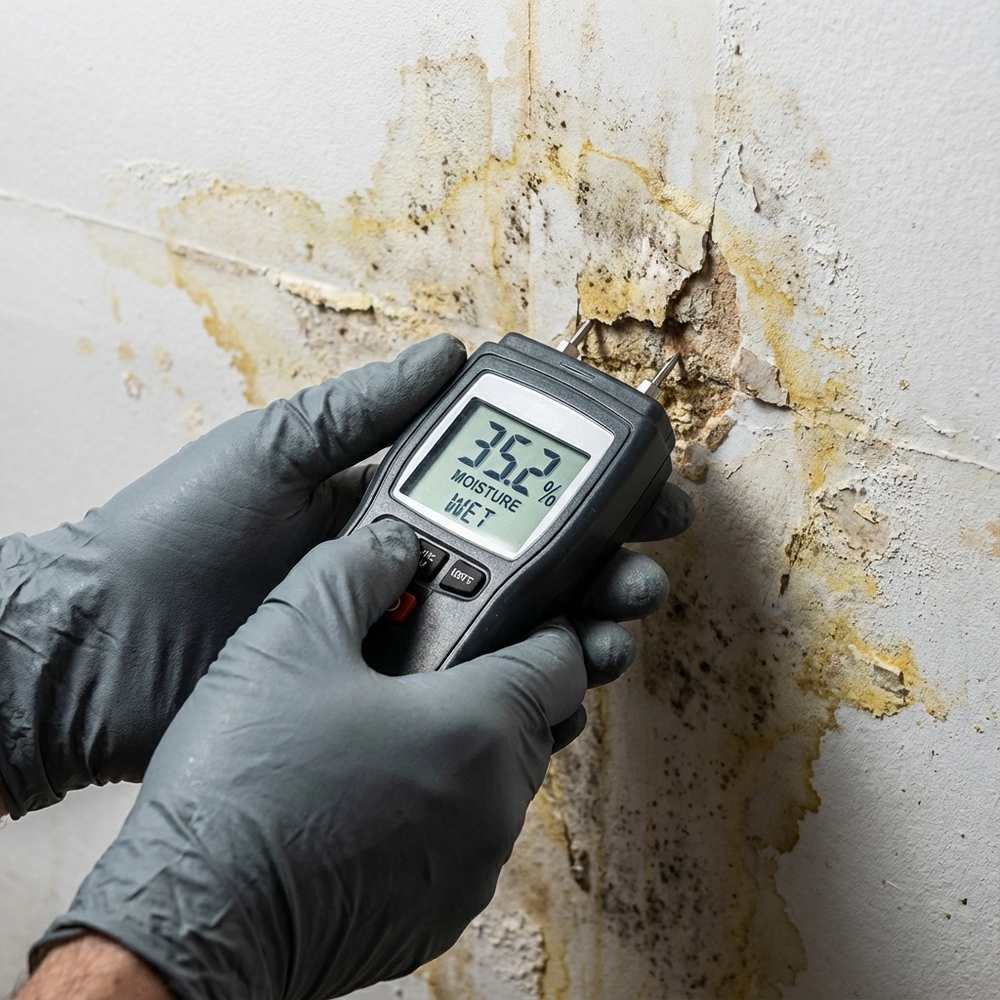
So commission the report like evidence, not like a repair. Ask for the failed component to be named, the location of the failure to be described against the unit and common element boundary, the likely duration of the leak to be estimated, and the path of the water to be traced. Moisture meters support the same report from your side of the ceiling: they can show where the water traveled inside your walls and ceilings, which is the map that connects the source upstairs to the damage downstairs. When water damage from upstairs neighbor events reaches an insurer or a courtroom, the file with the named source and the measured path is the file that wins.
The source first rule
Who Pays: The Rule That Decides Almost Every Case
An NYC attorney's guide to upstairs neighbor leak damage states the rule this page is built on, in words worth quoting exactly: who pays depends on the leak's source, not which apartment has the visible damage. When a common building pipe or the building's roof fails, the co-op or condo is typically responsible. When a fixture, pipe, or appliance inside the upstairs unit fails, the upstairs owner or their insurer usually pays.
| Where the water started | Who normally pays | What that payer covers |
|---|---|---|
| Common building pipe, riser or roof fails | The co-op, condo or landlord | Repair of the source, and restoration of the building's original finishes in the units below |
| Fixture, pipe or appliance inside the upstairs unit fails | The upstairs owner, or their insurer | Repair of the source inside their unit, and the damage their leak caused below |
| Upstairs owner was negligent, such as a faucet left running | The upstairs owner's HO-6 liability coverage, first to respond | The loss their negligence caused in the unit below, pursued directly or by subrogation |
| Nobody was negligent, a pure accident | The affected owner's own HO-6 policy, as primary coverage | That owner's own unit, improvements and belongings, unless fault later appears |
| The damage below, whoever caused the leak | Split by layer | Building restores original finishes; the owner's HO-6 covers personal property and improvements |
Source: Hochman Law, upstairs neighbor leak damage guide for New York City, hochmanlawpc.com. The insurance rows follow the negligence test and policy split set out in the insurance section below.
Why the rule is built this way
The rule follows control. The party who owns and maintains the thing that failed is the party who could have maintained it, inspected it and replaced it before it failed, so the cost of the failure lands on the desk that held the duty. A co-op cannot ask a shareholder to maintain the riser inside the wall that the co-op owns. A building cannot bill a downstairs owner for the upstairs owner's washing machine hose. And a neighbor cannot be billed for an accident nobody caused, which is why the no negligence case falls back on each owner's own policy. Once the logic is visible, most cases stop being arguments about fairness and become questions of fact: which thing failed, and whose thing was it.
The rule also explains why the first inspection matters more than the first demand letter. A demand written before the source is known is addressed to a guess. A demand written after a plumber has named the failed element is addressed to a fact, and it can be copied to the correct insurer the same day. In practice, the sequence in water damage from upstairs neighbor cases is always the same: find the source, name the owner of the source, then talk about money. Pages, adjusters and judges all reward the party who kept that order.
Where the rule meets resistance
Three situations strain the rule, and naming them early saves weeks. The first is the slow leak: a wax ring or a valve that wept for months. The source is clear, but the damage accumulated gradually, and insurers treat gradual damage differently from a sudden event, so the fight moves from who to how long and who should have known. The second is the absent owner: a source inside a unit nobody can enter, where the building's right of access and the managing agent's persistence become the whole case until the door opens. The third is the rented upstairs unit, where owner and tenant divide the duties between them: the tenant can be responsible for damage their own negligence caused, while the owner keeps the building systems and the unit's fixtures as installed. None of these breaks the rule. Each one just adds a second question after the first: once the source is named, whose duty, and whose timeline, was it.
Forum discussions of these cases, on Reddit's New York and apartment communities and on Quora, circle the same questions the rule answers: who is responsible, who files the claim, can I sue, what if the neighbor denies it, what if I have no insurance. The sections that follow take each of those in turn, in New York terms.
Not sure whose pipe it was?
The first visit settles it: metering, moisture mapping and a written source finding you can hand to the building, the neighbor and the insurer alike. In water damage from upstairs neighbor cases, that finding is the document everything else follows.
Four kinds of home, four rulebooks
Co-op, Condo, Rental or NYCHA: Where Your Home Fits
The source rule is the same everywhere in the city. What changes with your tenure is who sits in the building's chair, which document divides the duties, and which complaint route stands behind you when the building does not act. Pick your home below.
The co-op split, in detail
In a co-op, you own shares in a corporation that owns the building, and your home is held under a proprietary lease. The division of repair duties follows that structure. The co-op repairs the building systems and the common elements: the risers, the shared pipes, the roof, the structure itself. Shareholders repair the fixtures and appliances inside their own units: the tub, the toilet, the sink lines, the washing machine and its hoses. When a leak starts inside a shareholder's unit, that shareholder generally repairs the source and the damage below. When the co-op owns or controls the failing element, the co-op is generally responsible, and the shareholder's insurance is not the first payer for that repair.
The first contact in a co-op is therefore not the city. It is the building management company or the co-op board, before HPD, as the city's own 311 guidance directs for co-op and condo buildings. The board and its managing agent control access to the unit above, the building's plumber, the riser valves and the building's insurance position, and a leak case that begins with the board begins with every lever already in reach. Keep the notice in writing anyway. Boards change, managers change, and the file should not depend on anyone's memory of a hallway conversation.
The condo split, in detail
In a condo, you own your unit itself, and the association owns the common elements. Responsibility divides at the unit and common element boundary. The condominium repairs the common elements: the building pipes, the shared systems, the roof. The unit owner repairs the interior of the unit and the fixtures and appliances inside it. When a fixture or appliance inside the upstairs unit fails, the upstairs owner generally pays: for the source repair, and for the damage the water caused below.
Below the leak, the same layering applies in both co-ops and condos. The building normally restores its original finishes, the ceiling, walls and floors as delivered, and the affected owner's HO-6 policy typically covers the personal property and the improvements, the paint, flooring and cabinetry that go beyond the original specification. That is why two documents decide a condo leak case before any adjuster visits: the bylaws, which draw the boundary between unit and common element, and the master policy, whose type, all-in or bare walls, decides how much of the interior the building's insurance reaches. Read both in the first week, not the first month.
The rental rulebook: a warranty and a code
A renter's position rests on two texts, and both are worth reading in the original words. Real Property Law section 235-b, the warranty of habitability, warrants that a rented home is fit for human habitation and that its occupants shall not be subjected to any conditions which would be dangerous, hazardous or detrimental to their life, health or safety. The same section closes the two exits a landlord might look for: there is no cause of action where the tenant caused the condition, and any agreement to waive the warranty is void. A ceiling that rains every time the upstairs bath is used is not a favour the landlord does you by fixing; it is a condition the statute speaks to directly.
The second text is the Housing Maintenance Code. Section 27-2005(a) provides that the owner of a multiple dwelling shall keep the premises in good repair, and section 27-2005(b) makes the owner responsible for compliance with the code, except where responsibility is imposed on the tenant alone. Together the two texts draw the rental version of the source rule: the building's systems and the structure are the owner's, the apartment must be kept fit and in repair, and the tenant's own belongings remain the tenant's, protected by renters insurance where it exists and by the other parties' liability where it does not. The enforcement machinery behind those duties, the 311 complaint, the HPD inspection and the violation deadlines, is set out in the next section.

Board, landlord or neighbor not responding?
The drying cannot wait for the paperwork to win. Start the mitigation now, with documentation the building and the insurers will all accept later. Water damage from upstairs neighbor keeps spreading while committees deliberate.
Public housing has its own system
NYCHA Apartments: Report It Inside the System First
A NYCHA resident does not start with a landlord, a board or a managing agent. The landlord is NYCHA, and NYCHA runs its own reporting system, its own response standards and its own escalation ladder. All three are published on NYCHA's own leak page, and they are set out here in its order.
How to report, and what to expect
Report the leak through the MyNYCHA app or website, where photographs can be attached to the report, or through the Customer Contact Center at 718-707-7771, which answers 24 hours a day, seven days a week. Attach the photographs: the same evidence discipline that wins a co-op dispute works inside NYCHA's system, because the work order it creates is the record everything else builds on.
NYCHA's own guidance makes a point residents often miss: your leak may be coming from another apartment, and NYCHA may need to access apartments in your building, including your neighbors', to find the leak. Expect staff to ask for access to your home and to the homes around and above it, and grant it. Access is not a courtesy in these cases; it is the mechanism by which the source gets found, and the source is what decides the repair. For an emergency, NYCHA's stated standard is access within 24 hours, and clean and dry within 48 hours. Note the shape of that standard: it mirrors the moisture window in the first hour section of this page. The system knows, as the science knows, that two days is the line between a leak and a mold problem.
When the system stalls: the escalation ladder
If three business days pass without action, NYCHA's own page gives the next step: call 718-707-7771 again and choose option 7, the Compliance Department. Beyond NYCHA itself, the published routes are the Compliance Hotline at 800-342-7119, the New York City Department of Investigation at 212-825-5959, and the NYCHA Ombudsperson at 888-341-7152, reachable through ombnyc.com.
Work the ladder in order and keep the record at every rung: the date and time of the original report, the work order or reference it produced, the photographs you attached, the date of the three business day call, and the name or reference given at each escalation. An escalation that arrives with a dated file moves faster than one that arrives with a story, in public housing exactly as in a co-op boardroom. And keep living in the evidence: if the leak continues, photograph it again on the new date. A recurring leak with a dated series of photographs is a different case from a recurring leak described in a single call.
The city's machinery, in its own order
311 and HPD: The Complaint Route, Step by Step
When the building does not fix the leak, New York City has a process, and the process has an order. Skip the first step and the rest of the machinery will send you back to it. Follow it, and a leak becomes a dated city record with an inspection, a violation and a deadline attached.
Contact the landlord, owner or super first
Report the leak to the landlord, owner or superintendent before anything else. HPD will not act otherwise. In a co-op or condo, the equivalent first contact is the building management company or the board. Keep the date, the time and the name of the person you reached.
File the complaint with 311
If the condition is not fixed, or the responsible party cannot be reached, file with 311: by phone at 212-NEW-YORK (212-639-9675 from outside the city), by TTY at 212-504-4115, or through 311ONLINE or the 311MOBILE app. A large active leak justifies calling 311 immediately; a smaller leak can go through the online form. Keep the Service Request number you are given, and check its progress on HPDONLINE.
HPD contacts the managing agent, then inspects
HPD tries to contact the building's managing agent about the condition. If the condition is not corrected, HPD sends an inspector to the building. HPD publishes no fixed inspection time on its page, so treat any promised day as a guess, and keep your Service Request number quoted on every call instead.
A violation sets the owner's clock
If the inspector finds a violation, HPD issues a Notice of Violation, and the owner must correct the condition within the time its class allows, in the table below. The violation is dismissed only after a re-inspection confirms the correction was actually made.
The correction deadlines, from HPD's own pages
| Violation class | Meaning | Time to correct |
|---|---|---|
| Class A | Non-hazardous | 90 days |
| Class B | Hazardous | 30 days |
| Class C: lead paint | Immediately hazardous | 21 days |
| Class C: window guards | Immediately hazardous | 21 days |
| Class C: mold, and mice or rats | Immediately hazardous | 21 days |
| Class C: self-closing door | Immediately hazardous | 14 days |
| Class C: heat and hot water | Immediately hazardous | Immediately |
| Class C: all other conditions | Immediately hazardous | 24 hours |
Source: NYC HPD, violation class deadlines as published on its services pages, nyc.gov/site/hpd. One honesty note: the research behind this page verified no leak specific violation class, so this page does not tell you which class your leak will draw. The class is HPD's decision after inspection. What you control is the start of the clock.
Local Law 55: the law that reaches the moisture
Local Law 55 of 2018 requires owners of buildings with three or more apartments to keep apartments free of indoor allergen hazards, mold and pests among them, including safely fixing the conditions that cause them. HPD's guidance states the connection in plain words: leaks and moisture are among the most common causes of mold, and properly repairing leaks and moisture problems as soon as possible is the best way to prevent mold from growing. The mold complaint route is the same 311 route described above.
HPD's mold table runs on the size of the growth and the class it draws. Class A mold, under 10 square feet in a room, or under the aggregate thresholds HPD publishes, carries a 90 day correction window. Class B, 10 to 29 square feet in a room, carries 30 days. Class C, 30 square feet or more in a room, carries 21 days. And the table has teeth: a violation upgrades from A to B, and from B to C, if it is not certified corrected or is falsely certified. For an upstairs leak, the lesson of Local Law 55 is that the city's interest does not end when the dripping stops. The damp ceiling cavity the leak left behind is the condition the law is aimed at, which is one more reason the drying in the first 48 hours matters as much as the repair of the pipe.
Which agency is which, so the complaint lands right
Three agencies touch water in this city, and only one of them owns your leak. HPD, Housing Preservation and Development, owns housing conditions: the apartment leak complaint, the inspection and the violation all live there, reached through 311. The Department of Buildings takes complaints about illegal or unsafe work, plumbing and construction, through 311 and 311ONLINE, but DOB does not take the primary apartment leak complaint; 311 routes that to HPD. The Department of Environmental Protection owns water in the street and in the main: water main and street leaks and water quality, reached through 311, not the interior leak in your ceiling.
The distinction saves real time in real cases. A complaint about a leak sent as a buildings or water supply problem can spend days travelling to the desk that was always going to handle it. File it as what it is, a housing condition in your home, after the building has been told, and keep the Service Request number as the thread that ties the landlord notice, the inspection and the violation together. In water damage from upstairs neighbor cases, that thread is also evidence: a dated city record that the condition existed, that the owner was told, and that the clock was running.
The complaint is filed. The ceiling is still wet.
HPD's clock and the moisture clock run at different speeds. Drying now, with readings and logs, protects the home while the violation protects the record. Both clocks belong in every case of water damage from upstairs neighbor.
Two policies, one wet wall
Insurance: The Master Policy, Your HO-6, and the Negligence Test
Most upstairs leak claims are decided at the junction of two policies: the building's master policy and the unit owner's HO-6. This section explains what each one covers, the test adjusters use to decide which responds first, and the recovery mechanism, subrogation, that runs after the cheques are written. One sourcing note, stated plainly: the policy guidance in this section draws on a restoration firm's insurance explainer published from New Jersey, therestorationgroup.com. The policy mechanics it describes are general; the New York duties elsewhere on this page come from New York sources.
The master policy: the building's layer
The master policy covers the building's exterior and common areas such as the walls, roof, and lobby. How far it reaches into your unit depends on its type. An all-in policy reaches furthest: the master policy can cover fixtures and improvements originally installed by the developer. A bare walls policy stops at the line its name describes: the master covers only the structure's exterior and the common areas, and everything inside the unit belongs to the owners' own policies. Two buildings on the same street can run opposite answers to the same wet ceiling, which is why the managing agent's answer to one question, what type is our master policy, belongs in your file in the first week.
Your HO-6: the layer that is yours
The HO-6 is the policy written for the co-op shareholder or condo unit owner, and it exists to fill the gaps left by the association's master policy. It can cover unit improvements, interior walls and floors as the policy provides, personal property, and liability for damage to neighboring units. That last item runs in both directions: it is the coverage that responds when your tub damages the home below, and the coverage whose absence you feel when the home above has none and the bill for your ceiling starts looking for a payer. Condo owners need an HO-6 policy to fill the gaps left by their association's master policy; a co-op shareholder is in the same position, as the next section's insurance requirement discussion shows.
The negligence test: which policy responds first
Adjusters sort these claims with a three way test, and it is worth learning in its own terms. If the upstairs unit owner was negligent, for example, they left a faucet running, their HO-6 policy's liability coverage would be the first to respond. If the leak came from the building's plumbing system or common areas, the master policy would cover the repairs. If no one was negligent, the affected unit owner's HO-6 policy would likely be the primary coverage for their unit.
Notice how the test mirrors the source first rule, with one refinement: it adds fault to geography. A source inside the upstairs unit plus negligence puts their liability coverage first. A source inside the upstairs unit without negligence, the hose that simply failed, can leave your own policy primary for your loss. That is not a loophole; it is how property insurance is built, each home insured against the accidents that befall it, with fault based recovery running afterward through subrogation. Which brings the file back, as everything in these cases returns, to evidence: the test cannot be applied to a leak whose source nobody documented.
Subrogation: the claim after the claim
Subrogation is the process by which your insurance company pays for your damages and then seeks reimbursement from the responsible party's insurance company. If the upstairs neighbor was negligent, your insurer may attempt to subrogate the claim against their HO-6 policy. However, subrogation is not guaranteed. It depends on the evidence of source and fault surviving the drying, the demolition and the months the claim takes to settle, which is precisely the evidence the documentation section below teaches you to keep. You will rarely see the subrogation file, and you do not control it. What you control is whether the photographs, the plumber's report and the written notices exist when the recovery team asks for them.
Renters insurance: belongings, not the building
For a renter, the policy question is narrower and the answer cleaner. Sudden, accidental water damage is typically covered, and coverage applies to your belongings, not the building: renters insurance protects your furniture, electronics, and clothing, not walls, ceilings, or floors. The insurer's own FAQ gives the classic case: if the damage is sudden and accidental, such as an overflowing tub or burst pipe damaging your belongings, renters insurance will generally cover it; however, if it is a long-standing issue that isn't addressed promptly, the damage may not be covered. The exclusions list is the other half of the lesson: flooding, sewer backup, gradual damage, damage caused by tenant negligence, and mold from ongoing or long term leaks are not covered. Adjacent apartment coverage exists for the water that travels sideways, and personal liability covers the damage you cause to a neighbor's unit when the leak is yours. Report promptly, photograph everything, and remember that in a rental the structure is the landlord's claim, never yours.
The co-op insurance requirement, and its limit
Many New York co-ops tell shareholders to carry their own insurance, and a 2019 Habitat Magazine analysis of the requirement explains both why it exists and where its teeth end. Co-op master policies cover fires, vandalism, machinery breakdown and furnishings in public areas, and this protection does not extend to individual apartments. Shareholders need to purchase their own policies to protect personal property and the unit's floors, walls, appliances, and fixtures. A personal liability policy will protect the shareholder in the event someone is injured in the apartment or an overflowing bathtub causes damage to neighboring apartments.
The enforceability point is the one to carry away. The requirement is enforceable only if it sits in the proprietary lease: then, in the words of the attorney quoted, the board would be able to enforce the shareholder obligation by threatening to terminate the proprietary lease, impose a fine or fines, or obtain the insurance at the shareholder's sole cost and expense. Requirements stemming solely from house rules may not be enforceable. For the neighbor below a leak, this matters practically: the upstairs shareholder's liability policy is the deepest pocket in the room, and whether the building could have compelled its existence is a question answered by a document, the proprietary lease, that the managing agent holds.
Sources: The Restoration Group, condo insurance and water damage guide, therestorationgroup.com (New Jersey based; policy mechanics, not New York law). GEICO, does renters insurance cover water damage, geico.com. Habitat Magazine, Insurance Required, 23 September 2019, habitatmag.com. For the claim process itself, deadlines and Regulation 64 clocks, see this site's insurance claim page.
Insurers ask for readings, not stories
Our documentation pack, photographs, moisture maps and daily drying logs, is built to be handed straight to an adjuster, whichever of the two policies ends up paying. Water damage from upstairs neighbor claims are settled on readings, not recollections.
The file that wins
Documentation: Build the Case While the Ceiling Is Still Wet
Every route on this page, the neighbor conversation, the insurer's negligence test, the HPD complaint, the Small Claims case, runs on the same raw material: a dated, written record built in the first days. Attorney guidance on these cases lists the file's contents, and they are set out here as a checklist to work through, not a theory to admire.
- Photo and video of the active leak, including the source if you can see it and every affected surface, each image dated and timed.
- The names of everyone you told: the neighbor, the super, the managing agent, the board, with the date and hour of each conversation.
- Copies of every notice and email you sent, kept with the replies.
- Receipts for emergency repairs, for mitigation, and for temporary housing if the home could not be lived in.
- The plumber's report, invoices and estimates: the report that identifies the source and the extent of the leak is often the strongest evidence in the case.
- Your lease, proprietary lease, bylaws, house rules and insurance policy, gathered into the same file.
- The 311 or HPD Service Request number, and the NYCHA work order reference where the home is NYCHA's.
- Moisture readings where you can get them: moisture meters can show where the water traveled, which is the map between the source above and the damage below.
Two sentences from the attorney guidance behind this page deserve to be read as instructions. Written notice to the neighbor, the superintendent, the managing agent, and the board is essential. And: the longer the paper trail, the stronger the case. Notice the direction of both. They do not say the loudest case wins, or the angriest. They say the longest paper trail wins, and a paper trail is a thing any resident can build, starting the hour the dripping starts, with a phone camera and a notebook.
What good documentation looks like from the other side
Read your file the way its future readers will. The adjuster applying the negligence test needs the source named and the timeline tight: when the water started, when it stopped, what failed. The managing agent deciding whether the building pays needs the failed element identified against the common element boundary. The neighbor deciding whether to hand the matter to their insurer needs to see their own fixture in the story, proved rather than asserted. The judge in Small Claims needs the loss priced by receipts, not estimated in the courtroom. One file, honestly built, answers all four readers, because all four are asking the same two questions: where did the water start, and what did it cost. Build the file that answers both, and most of the argument this page describes never has to happen.
The physical half of the case
Drying Both Sides of the Ceiling: What Restoration Actually Does Here
Responsibility decides who pays. Drying decides how much there is to pay for. The physical response to water damage from upstairs neighbor leaks has its own sequence, and it runs in two homes at once, which is what makes this work different from a leak inside a single unit.
In your home: extract, open, dry, prove
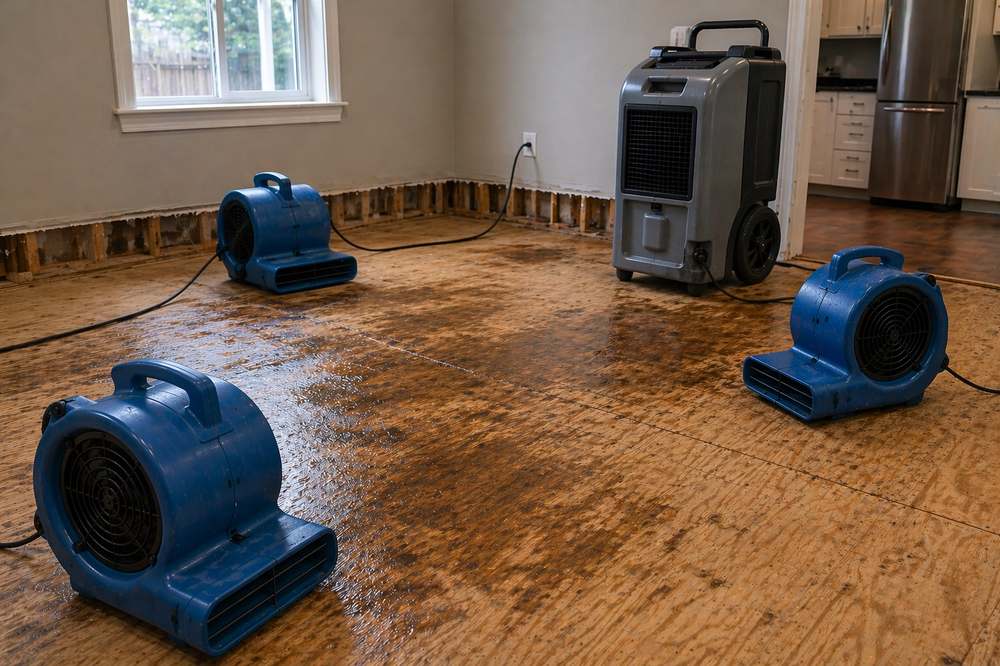
The crew's first work is measurement, not machinery: moisture readings at the ceiling, the walls and the floor, mapped so the wet area is known rather than guessed. Standing water is extracted, materials that cannot be saved are identified, and where water has entered the ceiling cavity or the wall, controlled openings let the drying reach the space the water actually occupies. Air movers and dehumidifiers then run against daily readings, because the job is finished when the structure reaches its dry standard, not when the surfaces feel dry to a hand. Every reading goes into the drying log, and the log joins your documentation file: it is the proof, for the insurer and for the Local Law 55 question alike, that the moisture was mitigated inside the window that matters.
In the home above: access is the repair
Your ceiling cannot be finally dried, let alone repaired, while the source above it is still wet or still leaking. The upstairs unit needs its own inspection and, where its floor or fixtures are wet, its own drying, and that requires access the building arranges: the managing agent, the super, and where necessary the board's authority under the proprietary lease or bylaws. This is the practical reason the building belongs in the case from the first hour even when the building will not pay a dollar of it. The building is the only party who can open both doors.
One boundary this page keeps deliberately: how mold grows after water damage, hour by hour and day by day, is the subject of this site's mold timeline page, and it is not rebuilt here. What belongs on this page is the leak side of that clock: mitigate moisture within 24 to 48 hours, dry the cavity and not only the surface, and keep the readings. A leak handled that way rarely becomes a mold case at all, and a leak handled any other way is how the mold cases begin.
Two homes, one drying plan
We coordinate with the super and the managing agent from the first visit, so the source repair upstairs and the drying downstairs run as one job, not two arguments. Water damage from upstairs neighbor is a two home problem, and it gets a two home response.
When cooperation fails
Denial and Repeat Leaks: The Escalation Ladder
When the neighbor denies the leak is theirs
Denial is the most common first response in these cases, and it is usually information arriving badly rather than bad faith: the neighbor is hearing, in one conversation, that their bathroom has damaged a home they have never seen. The answer to denial is measurement. A plumber's report that identifies the source and the extent of the leak is often the strongest evidence in the case, and moisture meters can show where the water traveled, which walls it crossed and whether the wet pattern sits under the neighbor's fixtures or under a common riser. Commission that report while the trail is fresh, and deliver it calmly, in writing, with your own written notice to the neighbor, the superintendent, the managing agent and the board.
If the building will not investigate, the 311 and HPD route creates an inspection and a record that do not depend on the neighbor's agreement. And keep the tone of the file professional even when the hallway is not: every notice you write may one day be read aloud by someone deciding the case, and the resident whose letters are dated, factual and reasonable is the resident the reader believes.
When the leak keeps happening
A repeat leak is a different problem wearing the same stain. Document every recurrence as its own event: date, time, photographs, the surfaces affected, and who was told, because a dated pattern is evidence and a general complaint is not. Notify in writing each time. Return to 311 and HPD: a fresh complaint on a recurring condition builds the violation record, violations carry correction deadlines, and dismissal requires a re-inspection that confirms the correction, which a still leaking ceiling will not pass.
The legal routes widen as the pattern hardens. Mediation fits where the parties still communicate and a quick settlement matters. Small Claims recovers money up to the 10,000 dollar limit, but it is a money only court: it cannot order the upstairs plumbing fixed. Where what you need is the leak stopped, by injunction or by court ordered access and repair, that is the point at which attorney guidance says a lawyer earns their fee, in the legal routes section below. Water damage from upstairs neighbor cases that repeat are rarely about plumbing by then. They are about records, deadlines and escalation, climbed in that order.
Money, mediation and court
Legal Routes: Small Claims, Mediation, and When a Lawyer Earns the Fee
Most upstairs leak cases end at a kitchen table or inside an insurer's file. The ones that do not end there have three formal routes, and the New York Courts' own site fixes the shape of the first. One boundary is kept throughout this section: it explains the routes and their verified limits; it is not legal advice, and the attorney views quoted are labelled as attorney opinion where they appear.
Small Claims Court: up to 10,000 dollars
The New York Courts site states it directly: in New York City, you can sue for up to 10,000 dollars in Small Claims Court. The court's shape matters as much as its limit. You can sue for money only, not for something to be done or to get your property back. You do not need a lawyer to sue in Small Claims Court. Only an individual can sue there; a business, corporation, LLC, partnership, association or non-profit uses Commercial Claims instead, while the defendant can be an individual or a business. Attorney guidance on these cases adds the practical arithmetic: a repair example priced at 10,600 dollars, just above the limit, shows why a claimant may trim the claim to the 10,000 dollar limit when the extra amount does not justify a higher court.
Mediation: the middle route
Attorney guidance on upstairs leak cases points to mediation where three conditions meet: the damage is limited, the parties still communicate, and a quick settlement matters more than a verdict. A mediated settlement can cover what no court order in Small Claims can reach, the repair itself, the access to do it, and the timetable, because the parties are agreeing rather than being ordered. It also preserves the one asset a court case spends freely: the neighbor relationship in a building both parties still live in. Where those conditions hold, mediation is not the soft option. It is the fast one.
A lawyer: the three triggers
The same attorney guidance, offered as opinion rather than law, names three situations where a lawyer earns the fee. Larger claims, above the Small Claims limit, belong in Civil Court or Supreme Court. Injunctions and repeat leaks need remedies a money only court cannot give. And multiple party cases, building, neighbor, tenant and two insurers pointing at each other, need someone who can identify the correct defendant, obtain records and assess the insurance positions before they harden. This page does not publish a general Civil Court dollar limit, because the research behind it could not verify one; what is verified is the Small Claims figure above, from the courts' own site.
Whichever route a case takes, it travels on the file from the documentation section: the photographs of the active leak, the plumber's report naming the source, the written notices, the receipts. Courts and mediators do not reward the party with the worst ceiling. They reward the party whose ceiling comes with a paper trail. That is not cynicism; it is the design of every route above, and it is why this page put documentation before law.
Before any route: the drying record
A restoration file with dated photographs, moisture maps and a drying log is the exhibit every route starts from. Get it built while the evidence is still wet, because water damage from upstairs neighbor cases are decided on exactly that evidence.
Watch and read, with the flags on
Two Videos Worth Watching, and What the Forums Keep Asking
The videos, honestly labelled
No New York specific video was found among the top results for this search, and the two explainers below are linked with their limits stated, not hidden. Watch them for the general shape of the problem. Do not take New York law from either of them.
The Claim Squad Public Adjusters, “Water Damage from Condo Above Me [Who is responsible for what?]” (7 minutes 58 seconds, about 7.1 thousand views, published March 2022). A clear walk through of who is responsible for what when the condo above leaks, under Florida law: the video itself describes what every Florida condominium association is required to do. Florida's rules are not New York's rules, and nothing in it covers the source first rule as New York applies it, the 311 and HPD route or Local Law 55. Watch on YouTube.
Twin Home Experts, “Water Leak In A Condo: Who is Responsible, HOA or Homeowner?” (4 minutes 48 seconds, about 24 thousand views, published August 2018). A plumber's eye view of the condo leak responsibility question, framed around a homeowners association, by a California plumbing channel. New York co-ops and condos do not divide responsibility the HOA way, and rentals here run on the warranty of habitability instead. Useful for the source hunting mindset; not a New York authority. Watch on YouTube.
Forum perspectives on claims
The search results for this problem are dominated by forums and question sites rather than companies, and that is itself information: thousands of residents are working this out in public, one ceiling at a time. The threads cluster on a handful of communities, r/AskNYC (“Water leak in apartment from upstairs neighbor”), r/nyc (a co-op leak case built around a faulty HVAC unit), r/Apartmentliving (“Upstairs neighbor water damage, what are my rights?”), r/legaladvice (“Can I sue my upstairs neighbor for water damage?”), r/Home (a flooded condo thread with well over a hundred answers), and Quora questions on the proper procedure for handling water damage from the unit above, each drawing dozens of answers.
Read across them and the same six questions recur, and they are the questions this page was built to answer in New York terms. Who is responsible, and who pays. Who files the insurance claim: me, the upstairs neighbor, or the association. Can I sue the upstairs neighbor, and for how much. What happens when the neighbor denies responsibility, or the leak keeps happening. What if I have no renters insurance. And who pays for the ceiling and walls below, as against the source leak above. One honesty note: the research behind this page read these threads at snippet level only, because the platforms blocked fuller access, so the themes above are reported as themes, and nothing here quotes a thread's contents. The answers, though, do not have to come from a forum. Every one of the six questions has a sourced New York answer in the sections and the thirty FAQs below.
Check every claim
Sources for This Page
- Hochman Law, upstairs neighbor leak damage in NYC: the source first rule, the co-op and condo splits, documentation and the legal routes. hochmanlawpc.com
- NYC 311, leaks and water damage complaints: building first, then 311, for rentals and for co-ops and condos. portal.311.nyc.gov
- Real Property Law section 235-b, warranty of habitability, text as published. newyork.public.law
- Housing Maintenance Code section 27-2005, duties of owner, text as published. up.codes
- NYCHA, Stop Leaks: reporting, access, emergency standards and the escalation ladder. nyc.gov/site/nycha
- NYC HPD, report a maintenance issue: the complaint, agent contact, inspection and violation process. nyc.gov/site/hpd
- NYC HPD, indoor allergen hazards, mold and pests: the Local Law 55 duties, the mold table and the correction deadlines. nyc.gov/site/hpd
- NYC 311, mold complaints and Local Law 55. portal.311.nyc.gov
- New York Courts, Small Claims: the 10,000 dollar New York City limit, money only, no lawyer needed. nycourts.gov
- GEICO, does renters insurance cover water damage: belongings, sudden and accidental cover, and the exclusions. geico.com
- Habitat Magazine, Insurance Required, September 2019: co-op master policy limits and when a shareholder insurance requirement is enforceable. habitatmag.com
- The Restoration Group, condo insurance and water damage: master policy against HO-6, the negligence test and subrogation. New Jersey based; cited for policy mechanics, not New York law. therestorationgroup.com
Not published on this page, deliberately: a general NYC Civil Court dollar limit and a leak specific HPD violation class could not be verified from official sources during research, and a typical repair cost range circulating in search snippets was snippet only and unverified, so none of the three appears here as fact.
The Ceiling Will Not Dry Itself.
One call starts extraction, drying, documentation and the source investigation, tonight, not Monday. And the discipline on this page applies to us as it does to everyone: ask for the moisture readings, the drying log and the written source finding, from whoever you call, us included.
Serving Manhattan · Brooklyn · Queens · The Bronx · Staten Island · Long Island
One problem, five building stocks
Water Damage From Upstairs Neighbor in the Five Boroughs
The law does not change at a borough line, but the buildings do, and the building decides where the water hides, how fast it travels and whose door the super knocks on. This is how water damage from upstairs neighbor cases tends to present, borough by borough, in the stock our crews actually work in.
Manhattan: co-ops, risers and board paperwork
Manhattan is the co-op borough, and water damage from upstairs neighbor events here runs through management companies, alteration rules and riser diagrams. The typical case is a bathroom renovation upstairs that was never quite finished, a radiator valve in a pre-war tower, or a riser that fails inside a wall shared by ten homes in a line. Because the stack is tall, one failure can wet several floors, and the building's engineer becomes a central witness. The paperwork is heavier here than anywhere else in the city: incident reports, insurance certificates before a crew crosses the lobby, and board minutes that later get read by adjusters. Start with the managing agent, document as if the file will be audited, because in Manhattan it often is.
Brooklyn: brownstones and stacked bathrooms
Brooklyn's brownstones and small walk-ups stack their bathrooms one above another, which is why water damage from upstairs neighbor leaks in Brooklyn so often begins in the same wet wall, floor after floor. The buildings are older, the plumbing is a mixture of original cast iron and a century of repairs, and the ownership is often a small landlord or a four unit co-op where the board is also the neighbor. Access is usually easier than in Manhattan and the formality lower, which cuts both ways: repairs start faster, and the paper trail is thinner when a dispute arrives. Write the notices anyway. A friendly building is exactly the place where nobody documents anything, right up to the week everybody wishes somebody had.
Queens: garden apartments and condo conversions
Queens mixes garden apartment complexes, condo conversions and one and two family homes cut into units, and water damage from upstairs neighbor cases here often involves a management company at arm's length and a super responsible for several buildings at once. The practical consequence is response time: the first hour steps on this page matter more, not less, when the person with the riser key is twenty minutes away. Photograph early, notify in writing so the management company's own system timestamps it, and keep your 311 route warm if the response stalls. In the converted houses, the tenure question can be genuinely unclear at first, owner above, tenant below, or the reverse, and the lease documents settle what the hallway argument cannot.
The Bronx: pre-war rentals and the habitability route
The Bronx stock is heavily pre-war rental, which makes water damage from upstairs neighbor events here primarily a landlord duty case: the warranty of habitability and the Housing Maintenance Code do the heavy lifting, and the 311 and HPD route is the enforcement engine behind them. Steam heat adds its own leak family each winter, radiator valves and traps that weep into the ceiling below. The pattern to avoid is the informal fix repeated five times: a super who patches the stain while the valve above keeps leaking. Each recurrence deserves its own dated photographs and its own complaint if the building's response fails, because the violation record, not the memory of the patching, is what moves an owner.
Staten Island: top floor means the roof
Staten Island's stock is lower and more detached, and a share of its upstairs cases are really roof cases: the neighbor above is the sky. Water damage from upstairs neighbor complaints on Staten Island frequently trace to a roof, a terrace or a top floor unit in the small condo and co-op buildings along the island's ridges, and the responsibility analysis starts with the building, because the roof is a common element and the landlord's structure. Where the source is a genuine upstairs unit, the cases run like Brooklyn's, smaller buildings, closer neighbors, thinner paperwork. The island's coastal storms add one wrinkle: rain driven leaks that appear with the weather and vanish between storms, which makes photographs dated against the storm the decisive evidence.
Long Island: the same rule, a county line away
Nassau and Suffolk run the same source logic in a different housing stock: more top floor condos, more garden complexes, and more homes where the upstairs neighbor is a tenant of an owner who lives elsewhere. Water damage from upstairs neighbor cases there turn on reaching that absent owner early, in writing, through the managing agent, before positions harden. The New York duties described on this page are city duties in their HPD form; outside the city the complaint routes differ, but the evidence discipline, the source report, the dated photographs and the written notices, is identical, and it is what every insurer and court on either side of the line will ask for.
How cases actually run
Three Cases of Water Damage From Upstairs Neighbor, Worked End to End
The rules above are easier to use when they are wearing clothes. The three cases below are composites, built from the patterns the sources describe, with the names and addresses removed. Each one turns on a different payer, which is the point: the facts decide, and the facts are found in the first days.
Case one: the riser in the wall, and the building pays
A Manhattan co-op shareholder wakes to a stain spreading across the bedroom ceiling and a drip finding the wardrobe. The super shuts the riser within the hour. The upstairs neighbor's bathroom is dry: no overflow, no failed fixture, nothing inside that unit has let water go. The building's plumber opens the wall and finds the failure in the shared riser itself, a common element the co-op owns and maintains. That single finding organises the whole case. The co-op repairs the pipe. The co-op restores the building's original finishes in the flat below, the ceiling, the walls, the floor as delivered. The shareholder's HO-6 policy covers the wardrobe's contents and the upgraded flooring the shareholder had installed beyond the original specification. Nobody argues, because nobody has to guess: the plumber's report named the source, the source named the payer, and the layering rule divided the rest. The case is remembered in the building mainly for how boring it was, which is what a well documented case of water damage from upstairs neighbor looks like from the inside.
Case two: the tub that overflowed, and the neighbor's liability responds
In a Queens condo, a bath is left filling while a doorbell is answered, and by the time the owner returns the water has crossed the bathroom floor, found the door threshold and gone looking for the unit below. The downstairs owner does the first hour properly: belongings moved, the active leak filmed while it is still running, the neighbor and the managing agent told the same hour, the insurer told the same day. The source is not in doubt, a fixture inside the upstairs unit, left running by its owner, and the negligence test answers the insurance question in one step: the upstairs owner's HO-6 liability coverage is the first to respond for the damage below. The building restores nothing here beyond its own inspection, because no common element failed; the upstairs policy carries the ceiling, the walls and the damaged property, and the two owners, who still share a staircase, settle the small remainder between themselves. What made the difference was not goodwill, though there was some. It was that the film of the active leak existed. Cases of water damage from upstairs neighbor events are easy when the water is still running on camera and very hard when the first photograph is taken of a dry stain three weeks later.
Case three: the slow leak, the denial, and the file that settled it
The hardest of the three begins as a rental in the Bronx: a faint stain above the bathroom door that grows a little each month. The tenant reports it; the landlord paints it. It returns. The upstairs tenant, approached directly, denies any leak: their bathroom floor is dry, and from their side of the ceiling they are telling the truth as they know it. The turn comes when the case stops being an argument and becomes a measurement. A plumber, given access by the landlord, finds the toilet in the upstairs unit leaking at its wax ring, sending a small volume of water down around the flange with every flush, invisible from above, unmistakable from below. Moisture readings map the path through the ceiling and the wall. Now the file has what the hallway never had: a named source, inside the upstairs unit's fixture, on a dated report. The landlord, whose duty under the warranty of habitability and the Housing Maintenance Code was engaged all along, replaces the ring and repairs the ceiling properly this time, and the upstairs owner's side carries the fixture failure. The tenant's own damaged belongings go to the responsible party's coverage with the report attached. The lesson the case teaches is the one the documentation section is built on: in water damage from upstairs neighbor disputes, denial is rarely the end of the matter. It is the point where the matter changes from conversation to evidence, and evidence, patiently built, is what ends it.
Your case will have its own facts
What it should not have is its own evidence problems. The first visit produces the source finding, the readings and the photographs all three cases above turned on, whatever form your water damage from upstairs neighbor takes.
After the drip, the deadlines
The Clocks That Run on a New York Water Damage Claim
The drying clock is measured in hours. The claim clock is measured in business days, and New York writes it into regulation. These are the deadlines that govern your own insurer once your claim is open, the same clocks this site's insurance claim page sets out in full. They matter in upstairs cases for a simple reason: while the building, the neighbor and two insurers argue about whose loss it is, your own claim should already be open and its clocks already running.
Read the four boxes again and notice what they reward. Every clock starts from an act of yours: your notice, your proof of loss. The homeowner who files on the first day of water damage from upstairs neighbor events owns a timetable; the homeowner who waits for the building and the neighbor to finish arguing owns a hope. File first, argue second, and let the argument proceed inside a claim that is already open, already acknowledged and already counting down someone else's deadlines for a change.
Expensive habits
Six Mistakes That Cost Money in Upstairs Leak Cases
None of these requires bad luck or bad faith. Each is a thing reasonable people do in the first week of water damage from upstairs neighbor cases, and each one quietly moves money from the person who made it to someone else.
1. Waiting for the stain to dry on its own
A ceiling that stops dripping has not stopped being wet. The cavity above it holds the water the surface hides, and the 24 to 48 hour moisture window closes while the room looks better. Drying delayed is mold invited, and mold converts a restoration bill into a remediation case under a stricter legal regime. In water damage from upstairs neighbor cases, the wait is doubly expensive because the other parties take their cue from you: a resident who treats the leak as urgent gets an urgent response.
2. Painting over the evidence
The stain is ugly and the instinct to cover it is human, but paint seals the record as surely as it seals the plaster. Photographs taken before any cosmetic work, readings taken while the material is still wet, and the damaged materials themselves, kept until the adjuster has seen them, are the loss made visible. Once the ceiling is painted, every later conversation about how bad it was becomes your word against a clean white surface.
3. Keeping the notice verbal
A hallway promise has no date on it. The attorney guidance behind this page is explicit: written notice to the neighbor, the superintendent, the managing agent and the board is essential, and the longer the paper trail, the stronger the case. An email sent the same evening, restating the conversation and the hour it happened, takes four minutes and outlives every memory in the building. Verbal notice is how water damage from upstairs neighbor cases become disputes about whether anyone was ever told.
4. Throwing the damaged property away
The soaked rug, the ruined books, the electronics that died in the puddle: out they go in the first cleanup, and with them goes the property half of the claim. Insurers pay for belongings they can see, in photographs at minimum and in person at best. Photograph every damaged item where it lies, list it with its date and its replacement reality, and keep anything the adjuster may want to inspect until the claim position is clear.
5. Arguing about money before finding the source
A demand addressed to the wrong party is worse than no demand: it hardens a position, starts a clock of ill feeling, and has to be withdrawn when the plumber's report lands. The sequence in water damage from upstairs neighbor cases is find the source, name its owner, then talk about money. Residents who keep that order are surprised how often the money conversation turns out to be short.
6. Letting your own claim wait for their argument
The building blames the neighbor, the neighbor blames the building, and meanwhile your insurer has heard nothing, because you were waiting to see whose claim it would be. It is yours, at least to open: the Regulation 64 clocks in the section above run from your notice, and they run whether or not the responsibility argument has finished. Open the claim on day one and let subrogation sort out the ending.
The human step
The Knock on the Door: Talking to the Neighbor Above
Every route on this page, insurer, board, HPD, court, begins or fails at a doorway. The first conversation about water damage from upstairs neighbor leaks is a negotiation most people conduct badly because they conduct it angry, frightened or both. It deserves a method.
Arrive with information, not accusation
Open with what is happening, not with whose fault it is: water is coming through your ceiling, here is where, here is when it started, the super has been called, and the fastest way to stop it is to check the water in their home together. You are asking for help with a shared problem at this point, because until the source is found, that is what it is. The neighbor who feels accused defends. The neighbor who feels enlisted helps, opens the door to the plumber, and finds the split hose you both needed found.
Explain the source rule early, because it lowers the temperature in both directions. It tells the neighbor that a building pipe is the building's problem, not theirs, and it tells you the same thing about your own ceiling. People cooperate with rules they can see applying fairly to everyone. And whatever is agreed, close the conversation the way the documentation section insists: a short written note the same day, restating what was found, what was shut off, and what happens next, sent kindly and kept carefully.
When the conversation goes wrong
Sometimes the door does not open, the neighbor is away, or the first talk ends in denial. None of those ends the case; each simply moves it to the next rung, and the rungs are built for exactly this. The building comes next: the super and the managing agent hold the access rights and the riser keys, and a managing agent's letter carries a weight a neighbor's knock does not. The city follows if the building fails: the 311 complaint and the HPD inspection create a record and a visit that do not depend on the neighbor's mood. The insurers proceed in parallel throughout, because the negligence test is applied to documents, not to hallway relations. And the legal routes wait at the end, sized by the file you have built.
Hold one thought through all of it: you will very likely live under this household for years after the ceiling is repaired. The file should be relentless and the tone should not be. In the long record of water damage from upstairs neighbor cases, the residents who recover most, fastest, are almost never the ones who shouted loudest. They are the ones whose paper trail was longest and whose first knock was polite.
Door not opening?
We work through supers and managing agents every week. One call puts a documented, insured crew on the building's own access process while the drying starts below. A closed door slows water damage from upstairs neighbor work; it does not stop it.
Diagnosis before argument
Reading the Stain: What the Pattern of Water Damage From Upstairs Neighbor Tells You
Before any plumber arrives, the ceiling is already testifying. Where the stain sits, when it grows and how it behaves are the first three clues in every case of water damage from upstairs neighbor, and reading them well shortens the investigation that decides who pays.
Position: the map above your ceiling
Apartments stack their wet rooms. The bathroom above your bathroom, the kitchen above your kitchen, the radiator against the same wall in both homes: the building's plan repeats floor by floor, which means the stain's position is a rough map of the room above it. A stain spreading under the upstairs bathroom points first at that bathroom's fixtures, its tub seal, its toilet base, its sink lines. A stain along a wall line rather than a room centre suggests the pipes inside the wall, the riser or the stack, which leans toward the building's side of the line. A stain that appears at an outside wall or a top floor ceiling raises the roof and facade questions. None of this is proof, and water travels sideways along joists before it drops, which is why the stain can sit a metre from the source. But position sets the order of the search, and in water damage from upstairs neighbor investigations the order of the search is most of its cost.
Timing: when the stain grows
A leak keeps a schedule, and the schedule names its family. A stain that grows when the upstairs shower runs, and rests when the home above is empty, is a fixture or drain leak living on someone's routine. A stain that grows steadily through the night, in an empty building, at a constant pace, is a pressurised supply line, which does not sleep. A stain that arrives with rain and leaves with the sun is the roof or the facade until proved otherwise. A stain that swells at the start of heating season belongs to the radiators and the risers. Note the times the way the documentation section teaches: dated observations, not impressions. Two weeks of timing notes, honestly kept, can do the work of an opened wall.
Behaviour: drip, damp and the bulge
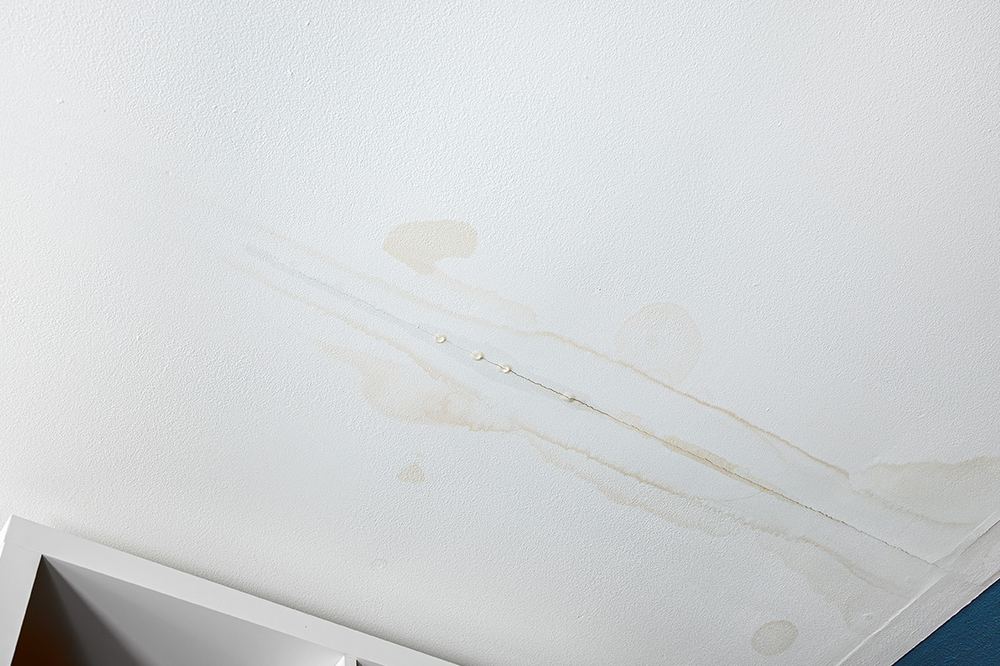
How the water presents matters as much as where. An active drip from a defined point means water is arriving faster than the ceiling can absorb it, and the bucket and the phone calls belong to that hour. A damp patch with no drip, growing slowly, is the signature of the small, long leak, the wax ring and the weeping valve, and its danger is different: not collapse but duration, the gradual damage argument and the mold clock. A ceiling that bulges is holding a pool above the plaster, and it is a safety fact before it is an evidence fact: keep people out from under it and treat it as the emergency the first hour section describes. Each behaviour also writes a different first sentence in the claim file, which is why the photographs should catch the behaviour, the drip mid fall, the bulge in profile, and not only the stain after the fact.
What reading cannot do
Reading the stain narrows the search; it does not close the case. Water lies about its path, travelling along a joist, a pipe or a wire before it shows itself, and two different sources can paint the same ceiling in the same colours. The reading earns its keep by directing the professional work: it tells the plumber where to open first, tells the technician where to place the meter probes, and tells you which of the usual sources to ask about in the first conversation upstairs. After that, the case belongs to the report and the readings, as every section of this page keeps insisting. In water damage from upstairs neighbor work, the stain is the question. It is never the answer.
After the repair
Preventing the Second Leak: What Changes After Water Damage From Upstairs Neighbor
The cruellest sentence in this field is the second stain in the same ceiling. A case of water damage from upstairs neighbor should change the building that hosts it, in small, specific, mechanical ways, most of them cheap, all of them cheaper than the drying bill that taught the lesson.
Replace the hoses before they fail
The washing machine and dishwasher hoses that cause so many of these cases age invisibly and fail without warning. After water damage from upstairs neighbor events, the upstairs unit, and frankly every unit in the line, should treat supply hoses as consumables: inspected, dated and replaced on a schedule rather than on a flood. Braided steel replacements and shutoff valves that a resident can actually reach turn the next failure from a night's flooding into a wet hour.
Put a sensor where the water would go
A battery leak sensor behind a washing machine, under a sink or beside a water heater costs less than a takeaway dinner and shouts at the moment water arrives, which is the only moment that matters. Buildings that have lived through water damage from upstairs neighbor once often adopt them line by line; the second leak in those buildings is usually found by a beep, at a litre, instead of by a stain, at a ceiling.
Keep the access open
Many leaks run long because reaching the valve or the pipe means demolishing a sealed renovation. Access panels at shutoffs, traps and cleanouts are unglamorous and decisive. When the building next approves an upstairs bathroom renovation, the access question belongs in the approval: the managing agent who asks it is buying the whole line a shorter first hour at the next failure.
Make the building's rules match the risk
House rules and alteration agreements are where prevention becomes policy: hose replacement duties, sensor requirements in renovated bathrooms, insurance requirements written into the proprietary lease where they are enforceable, and a standing rule that any leak is reported to management the day it is found. Water damage from upstairs neighbor repeats in buildings whose rules treat leaks as private events. It declines in buildings whose rules treat them as building events from the first drip.
Re-read the two policies
After a case closes, both households should re-read the documents that decided it: the master policy's type, all-in or bare walls, and their own HO-6 or renters cover, with its water and mold terms. The gaps a claim exposed, the improvement that was not scheduled, the liability limit that felt thin at 2 in the morning, can be closed at renewal for very little. A leak is an expensive audit. Take the audit's findings.
Keep the file
The last preventive act is archival. The reports, readings, photographs and correspondence from the case should be kept by the resident, the building and the managing agent, because the next event in the same line will be investigated against them: a recurring source is proved by the old file, and a new source is distinguished by it. In water damage from upstairs neighbor work, yesterday's documentation is tomorrow's baseline.
None of this requires the building to become anxious. It requires the building to become specific: named hoses, dated replacements, reachable valves, written rules and a file that survives. The homes that suffer water damage from upstairs neighbor twice are rarely unlucky. They are usually unchanged.
Just closed a leak case?
Ask us for the prevention walkthrough while the crew is still in the building: hoses, valves, sensors and access, checked in the units the water actually visits. The cheapest case of water damage from upstairs neighbor is the one that never happens.
What happens when you call
The Restoration Visit, Hour by Hour
Residents facing water damage from upstairs neighbor for the first time often delay the call because they cannot picture the visit. It runs like this, and none of it requires the responsibility argument to be settled first.
The crew arrives with the building's formalities already moving: the certificate of insurance goes to the managing agent or the super, because in a co-op or condo no reputable company starts work in a unit while the building's paperwork is outstanding. The first work inside your home is measurement. The technician meters the ceiling, the walls and the floor, marks the wet boundary, and photographs everything before a single piece of equipment is placed, because those first readings and images are the baseline your claim, and the building's, will be judged against. Where the water is still arriving, the visit goes upstairs in the same hour, with the super, to find and stop the source; drying a ceiling under a running leak is labour spent twice.
Then the scope is stated in writing: what will be extracted, what will be dried in place, what must be opened so a cavity can dry, and what cannot be saved. In water damage from upstairs neighbor jobs the scope names both homes, yours and the source unit, because the two dry together or not at all. Equipment follows the scope: extraction first, then air movers and dehumidifiers placed against the moisture map, with cables and access arranged around a home that is still being lived in. You receive the documentation habit this page keeps describing, photographs, readings and a drying log, as a routine of the visit rather than a favour after it.
The monitoring visits are the part new customers underestimate. The crew returns to read the same points on the same map, adjusts or removes equipment as the structure dries, and records each reading against the dry standard. This is where water damage from upstairs neighbor work earns its fee: a ceiling dried to a measured standard can be closed and painted with confidence, while a ceiling dried to a guess stays a question that the next stain reopens. The final visit verifies the readings, removes the last equipment, and leaves the file complete, source finding, photographs, maps and logs, ready to be handed to whichever insurer the negligence test assigns.
What the visit never does is wait for permission from the argument. The building, the neighbor and the insurers can take their weeks; the moisture takes its hours. Starting the drying while the responsibility question proceeds is not a concession by anyone, and no party's position is weakened by the home being dry. If anything, the reverse holds: the resident who mitigated promptly is the resident every adjuster, mediator and judge in the later story is predisposed to believe.
Straight answers
Water Damage From Upstairs Neighbor: FAQs
Thirty questions about the leak from the home above: who is responsible, who pays, which policy responds, how the city's complaint machinery runs, and what the courts can and cannot do. Answered plainly, with the sources named where a number or a rule is stated. The first four are the questions Google itself shows for this search, answered in New York terms.
Who is responsible for water damage from upstairs?
The source of the leak decides, not the apartment where the damage shows. That is the rule New York attorneys apply to water damage from upstairs neighbor cases, and it splits three ways. When a common building pipe or the roof fails, the co-op or condo is typically responsible, because the building owns and maintains those elements. When a fixture, pipe or appliance inside the upstairs unit fails, a tub, a toilet supply line, a washing machine hose, the upstairs owner or their insurer usually pays. When nobody was negligent and the failure was a pure accident, your own HO-6 policy is usually the primary coverage for your unit. Start every conversation by identifying the source, in writing, with a plumber's report if you can get one, because every payer, every insurer and every court will ask that question first. That is why every section of this page returns to the same instruction: in water damage from upstairs neighbor cases, find the source first.
Am I liable for water damage to neighbors property?
You can be, when the water escaped from something inside your unit that you own or control. If your tub overflowed, your faucet was left running, or your washing machine hose split, your own policy's liability coverage is normally the first to respond for the damage below, because the failure happened inside your space and under your care. If the water came from a common building pipe, a riser or the roof, liability normally sits with the co-op, the condo or the landlord who maintains that element, not with you. If nobody was negligent, the downstairs owner's own HO-6 policy usually carries their loss, and your insurer may still face a subrogation claim if fault is later shown. The practical rule for water damage from upstairs neighbor disputes is simple: find the source, document it, and let the source point to the payer. When the water is yours, the same rule decides your side of water damage from upstairs neighbor liability, so keep your own fixtures maintained and your policy current.
How long does it take for water damage to occur in a house?
Visible damage starts within minutes and deepens by the hour. Water spreads across a floor and wicks into drywall, plaster and wood almost immediately, paint and finishes begin to blister within hours, and materials that stay wet swell, stain and weaken over the following days. The moisture clock matters most: guidance for water damage from upstairs neighbor cases, and for leaks generally, is to mitigate moisture within 24 to 48 hours, because damp building materials left longer invite mold growth and turn a drying job into a remediation job. This page answers the question only in the leak context. The full hour by hour mold timeline after water damage, when growth starts and how it spreads, is covered on this site's dedicated mold timeline page, which owns that subject in full.
Who is liable for a water leak from an upstairs flat?
Liability follows the source of the leak, whether the home is called a flat, an apartment, a co-op or a condo. If the water escaped from a fixture, pipe or appliance inside the upstairs home, the upstairs owner, or their insurer through the liability side of their HO-6 policy, is generally liable for the damage below. If the water came from a common element the building maintains, a shared pipe, a riser or the roof, the building, its board or its landlord is generally liable instead. If the upstairs home is rented, the tenant can be liable for damage their own negligence caused, while the owner stays responsible for the building systems. In water damage from upstairs neighbor cases the word flat changes nothing: identify the source, prove it with photographs and a plumber's report, and liability follows that evidence. The word flat changes nothing, and neither does the word apartment: water damage from upstairs neighbor liability follows the source in both.
What should I do first when water starts coming through my ceiling?
Stop the water, protect your belongings, and start the record, in that order. If you can do it safely, move furniture, electronics and anything porous away from the wet area, put a bucket under the active drip, and keep clear of any ceiling that is bulging, because a water loaded ceiling can come down. Knock on the upstairs door at once: many leaks stop the moment the neighbor shuts a valve or turns off an appliance. Call the super, the doorman or building management the same hour, because only building staff can close a riser. Photograph and film the active leak while it is still running. Then call your insurer and a restoration company the same day. The first hour of water damage from upstairs neighbor cases decides how much of the loss is drying and how much becomes demolition. The residents who come out of water damage from upstairs neighbor events with the smallest losses are the ones who treat the first hour as a procedure, not a panic.
Who do I call first: my neighbor, the super, or my insurer?
All three, in a deliberate order, inside the first day. The neighbor comes first if the water is still running, because the fastest repair is a closed valve upstairs. The super, doorman or managing agent comes next, the same hour: building staff can shut a riser, reach units you cannot, and create the building's own incident record, which later supports your claim. Your insurer comes third, the same day, so the claim opens while every New York deadline is still in front of you and the damage is fresh enough to inspect. A restoration company belongs in the same first day, because extraction and drying inside the 24 to 48 hour moisture window is what keeps a leak from becoming a mold job. In water damage from upstairs neighbor cases, sequence is a form of evidence: the order of your calls shows everyone that you acted promptly.
Does the upstairs neighbor always pay for the damage in my apartment?
No, and assuming so is the most common mistake in these disputes. The upstairs neighbor pays when the leak's source sits inside their unit: their fixture, their appliance, their pipe, or their own negligence, such as a tub left running. The building pays when the source is a common element, a shared pipe, a riser or the roof. Your own HO-6 policy pays, at least first, when nobody was negligent and the loss is yours to carry, and your insurer may then pursue the responsible party through subrogation. There are also split outcomes: the building restores its original finishes, your policy covers your property and improvements, and the neighbor's insurer covers the source repair. Water damage from upstairs neighbor cases are decided by source and by documents, not by which apartment the water landed in. Assume nothing at the start of water damage from upstairs neighbor cases; the source, once proved, does the assigning for you.
Who pays when the leak comes from a building pipe or the roof?
The building does, in the usual case. A common pipe, a riser, a shared drain or the roof is a common element: the co-op or condo owns it, maintains it and insures the structure around it, and a rental landlord carries the same duty for the building systems in a tenancy. When that element fails and causes water damage from upstairs neighbor locations that are really the building's own plumbing, the co-op or condo is typically responsible for the repair of the source and for restoring the building's original finishes below. Your HO-6 policy still has a role: your personal property and your improvements, the paint, flooring and cabinetry you added beyond the original finishes, are normally yours and your insurer's. Get the building's position in writing from the managing agent, and keep the plumber's report that names the failed element, because that report is what moves the bill to the right desk. A common element failure is the building's case of water damage from upstairs neighbor, however personal the damage feels from below.
Who pays for my ceiling and walls: the building or my insurance?
Usually both, on different layers of the same ceiling. After water damage from upstairs neighbor leaks, the co-op or condo normally restores the building's original finishes: the ceiling, the walls and the floors as the building originally delivered them. Your HO-6 policy typically covers what sits on top of that original layer and belongs to you: your personal property, and your improvements, such as upgraded paint, flooring and cabinetry beyond the original specification. The source repair itself is paid by whoever owns the failed element: the building for a common pipe or roof, the upstairs owner for a fixture or appliance inside their unit. This layering is why the first documents matter so much: the lease or bylaws, the master policy type and your own HO-6 declarations together draw the line across your ceiling, and nobody can draw it for you after the fact. Draw the layers early, and the repair of water damage from upstairs neighbor stops being an argument about a ceiling and becomes an order of work.
What does my HO-6 policy cover in an upstairs leak?
An HO-6 is the policy written for co-op shareholders and condo unit owners, and in water damage from upstairs neighbor cases it is usually the policy that carries your side of the loss. It can cover your unit's improvements, interior walls and floors to the extent your policy provides, your personal property, your furniture, electronics and clothing, and your liability if water escaping from your unit damages a neighbor's home. It fills the gaps the building's master policy leaves, which is exactly why condo and co-op owners are told they need one. What it does not do is repair the building's common elements or the upstairs source: those belong to the building and the upstairs owner. Read your declarations page before you need it, and check the water damage and mold terms in particular, because sudden and accidental water is treated very differently from a slow leak nobody reported. Read the declarations page before water damage from upstairs neighbor ever reaches your home, and the policy's answers will not surprise you during it.
What is the difference between the master policy and my HO-6?
The master policy belongs to the building; the HO-6 belongs to you. The master policy covers the building's exterior and common areas, the walls, the roof and the lobby, and depending on its type it may reach further: an all-in policy can cover fixtures and improvements originally installed by the developer, while a bare walls policy covers only the structure and common areas, leaving everything inside the unit lines to the owners. The HO-6 covers the interior of your individual unit: improvements, interior finishes as your policy provides, personal property, and your liability toward neighbors. When water damage from upstairs neighbor events reach an adjuster, the first fight is often about which of these two policies owns which layer of the same wet wall. Knowing your building's master policy type, all-in or bare walls, before a leak happens is one of the cheapest forms of preparation there is. Ask the managing agent which type your building carries; the answer decides half of any water damage from upstairs neighbor claim before it opens.
What if nobody was negligent and the leak was a pure accident?
Then your own policy usually carries your loss. The negligence test applied to water damage from upstairs neighbor claims works like this: if the upstairs owner was negligent, for example a faucet left running, their HO-6 liability coverage is the first to respond. If the leak came from the building's plumbing system or common areas, the master policy covers the repairs. If no one was negligent, a hose that failed without warning, a fitting that gave way, the affected unit owner's HO-6 policy would likely be the primary coverage for their unit. Accident does not mean nobody pays; it means the loss stays where it fell, on the policy of the home that was damaged. That is the outcome subrogation exists to correct when fault later appears, and it is why documenting the source still matters even when everyone is being reasonable. An accident is still a claim: water damage from upstairs neighbor without negligence is what your own policy exists for.
What is subrogation and will my insurer use it?
Subrogation is the process by which your insurance company pays for your damages and then seeks reimbursement from the responsible party's insurance company. In water damage from upstairs neighbor cases it works like this: your insurer pays your claim, then steps into your shoes and pursues the upstairs owner's HO-6 policy, or the building, for the money, if the evidence shows their side caused the loss. If the upstairs neighbor was negligent, your insurer may attempt to subrogate the claim against their HO-6 policy. However, subrogation is not guaranteed: it depends on the evidence of source and fault, which is why the plumber's report, the photographs of the active leak and your written notices carry weight long after the drying is done. You do not run a subrogation claim yourself, but everything you document in the first days is the raw material your insurer's recovery team will use. Document as if subrogation will happen, because in water damage from upstairs neighbor cases it often does, months after the drying is forgotten.
Does renters insurance cover damage from an upstairs leak?
For your belongings, generally yes, when the water damage is sudden and accidental. Renters insurance protects your furniture, electronics and clothing, not the building: coverage applies to your belongings, not walls, ceilings or floors, which remain the landlord's structure and the landlord's problem. An overflowing tub or a burst pipe upstairs that damages your belongings is the classic covered case. The exclusions matter as much: flooding, sewer backup, gradual damage, damage caused by the tenant's own negligence, and mold from ongoing or long term leaks are typically not covered, and a long standing leak that nobody addressed promptly can take a claim outside coverage altogether. Renters policies also carry personal liability, which covers damage you cause to a neighbor's unit if the leak ever runs the other way. After water damage from upstairs neighbor events, photograph your damaged belongings before you throw anything away, because the claim is paid on evidence. Prompt reporting protects the cover: in water damage from upstairs neighbor claims, delay is the exclusion renters trip over most.
I have no renters insurance. What are my options?
You still have routes, and they run through the other parties' duties rather than your own policy. The building structure, the ceiling, walls and floors themselves, belongs to the landlord or the co-op or condo, and repairing the source and the structure is their side of the loss regardless of your insurance. If the upstairs neighbor was negligent, their liability coverage can respond to your damaged property, and a documented demand, photographs, receipts and a plumber's report identifying the source, is how you reach it. If the landlord will not repair, the 311 and HPD route on this page exists for exactly that failure, and HPD violations carry correction deadlines. For money you cannot recover any other way, NYC Small Claims Court hears claims up to 10,000 dollars, and you do not need a lawyer to file. Water damage from upstairs neighbor losses without a policy are slower to recover, which is why the paper trail matters even more. Slow is not hopeless: the routes above recover real money in water damage from upstairs neighbor cases every week, on paper rather than on policy.
What should I document before anything is cleaned up?
Everything, while it is still wet. Photograph and film the active leak, including the source if you can see it and every affected surface, and date and time each image. Write down the names of everyone you told: the neighbor, the super, the managing agent, the board. Keep copies of every notice and email you send. Keep receipts for emergency repairs, mitigation and temporary housing. Obtain the plumber's report and invoices: a report that identifies the source and the extent of the leak is often the strongest evidence in a water damage from upstairs neighbor dispute, and moisture meters can show where the water traveled inside walls and ceilings. Gather your lease, proprietary lease, bylaws, house rules and insurance policy into the same file, and keep your 311 or HPD Service Request number with them. The longer the paper trail, the stronger the case, and the trail is built in the first 48 hours or not at all.
How do I report an upstairs leak to 311 and HPD?
Start with the building, then go to the city if the building does not act. HPD's own process expects you to contact the landlord, owner or superintendent first; HPD will not act otherwise. In a co-op or condo, the first contact is the building management company or the board, before HPD. If the problem is not fixed, or the responsible party cannot be reached, file the complaint with 311: by phone at 212-NEW-YORK, which is 212-639-9675 from outside the city, by TTY at 212-504-4115, or through 311ONLINE or the 311MOBILE app. Keep the Service Request number you are given, and check its progress on HPDONLINE. A large active leak justifies calling 311 immediately; a smaller one can go through the online form. If there is fire or electrical danger, that is a 911 call, not a 311 call. Water damage from upstairs neighbor complaints follow this same route: building first, city second, number kept always. File the complaint the way this page orders it, and water damage from upstairs neighbor becomes a city record with a clock attached.
What happens after HPD takes my complaint?
HPD works the complaint in a set sequence. First, HPD tries to contact the building's managing agent about the condition. If the condition is not corrected, HPD sends an inspector to the building. If the inspector finds a violation, HPD issues a Notice of Violation, and the owner must correct the condition within the time the violation class allows. The violation is dismissed only after a re-inspection confirms the correction was actually made. Two cautions belong with that sequence. HPD publishes no fixed inspection time on its page, so any promise of a specific day is a guess, not a fact. And the process runs on your Service Request number: keep it, quote it on every call, and check the status on HPDONLINE rather than starting again. For water damage from upstairs neighbor cases, the HPD file also becomes evidence: a dated city record that the condition existed and that the owner was told. Quote the Service Request number on every call about water damage from upstairs neighbor, and the file stays one file.
How long does a landlord have to fix a leak under HPD rules?
It depends on the class of violation HPD issues, and HPD's own pages give the clocks. A Class A, non-hazardous, violation allows 90 days to correct. A Class B, hazardous, violation allows 30 days. Class C, immediately hazardous, violations run on the shortest clocks: lead paint 21 days, window guards 21 days, mold and mice or rats 21 days, self-closing doors 14 days, heat and hot water immediately, and all other Class C conditions 24 hours. This page does not assign your leak a class: no leak specific class was verified in the research behind it, and the class is HPD's decision after inspection, not the tenant's. What you control is the start of the clock: the landlord or agent contact first, the 311 complaint second, and the Service Request number kept. In water damage from upstairs neighbor cases the deadlines bind the owner, but they only begin when the complaint exists.
What does Local Law 55 mean for a leak that causes mold?
Local Law 55 of 2018 requires owners of buildings with three or more apartments to keep apartments free of indoor allergen hazards, mold and pests included, and to safely fix the conditions that cause them. HPD's own guidance names the connection directly: leaks and moisture are among the most common causes of mold, and properly repairing leaks and moisture problems as soon as possible is the best way to prevent mold from growing. HPD's mold table runs on area and class: Class A mold under 10 square feet in a room carries a 90 day correction window, Class B, 10 to 29 square feet in a room, carries 30 days, and Class C, 30 square feet or more in a room, carries 21 days, with violations upgrading a class if they are not certified corrected or are falsely certified. The complaint route for mold is the same 311 route. For water damage from upstairs neighbor cases, Local Law 55 is the reason a dried ceiling matters as much as a stopped leak: the law reaches the moisture that causes the mold, not only the mold itself. Local Law 55 is why the drying standard on this page is set where it is: water damage from upstairs neighbor that stays damp becomes the landlord's mold violation next.
I live in a NYCHA apartment. How do I report a leak from upstairs?
Report it to NYCHA first, through the MyNYCHA app or website, where you can attach photographs, or through the Customer Contact Center at 718-707-7771, which answers around the clock. NYCHA's own leak guidance warns that your leak may be coming from another apartment, and that NYCHA may need to access apartments in your building, including your neighbors', to find the leak, so expect staff to ask for access and grant it: access is how the source gets found. For an emergency, NYCHA's stated standard is access within 24 hours and clean and dry within 48 hours. If three business days pass without action, escalate on the same number, 718-707-7771, choosing option 7 for the Compliance Department. The further routes are the Compliance Hotline at 800-342-7119, the NYC Department of Investigation at 212-825-5959, and the NYCHA Ombudsperson at 888-341-7152. Water damage from upstairs neighbor cases in NYCHA housing runs on NYCHA's system first, and the escalation numbers exist for when that system stalls. Keep the work order reference from the first report; in NYCHA water damage from upstairs neighbor cases, the reference is the thread every escalation pulls.
Can I sue my upstairs neighbor for water damage?
Yes, if the loss is yours, the source was theirs, and the amount fits the court. In New York City you can sue for up to 10,000 dollars in Small Claims Court, and Small Claims is a money only court: you can sue for money only, not for something to be done or to get property back. You do not need a lawyer to sue in Small Claims Court, and only an individual can sue there; a business, corporation, LLC, partnership, association or non-profit uses Commercial Claims instead, while the defendant can be an individual or a business. What wins these cases is not anger, it is the file: photographs of the active leak, the plumber's report naming the source, your written notices, and receipts for every dollar of loss. One practical point from attorney guidance on water damage from upstairs neighbor cases: a repair example priced just above the limit shows why claimants sometimes trim a claim to the 10,000 dollar limit when the extra amount does not justify a higher court.
How much can I sue for in NYC Small Claims Court?
Up to 10,000 dollars, and that figure is verified on the New York Courts' own site: in New York City, you can sue for up to 10,000 in Small Claims Court. The court hears money claims only: you can sue for money only, not for something to be done or to get your property back, so a claim there recovers the cost of your damaged property and repairs, not an order forcing the neighbor to fix their plumbing. You do not need a lawyer to bring the claim, and only an individual can sue in Small Claims; businesses and other entities use Commercial Claims, though the defendant can be an individual or a business. Attorney guidance on water damage from upstairs neighbor cases gives the practical shape of the decision: where a repair bill lands just above the limit, trimming the claim to 10,000 dollars can make sense when the extra amount does not justify the slower, costlier route of a higher court. Trim or file in full, the choice is arithmetic; either way, water damage from upstairs neighbor claims in Small Claims are won on the file, not the speech.
When is a lawyer worth it for an upstairs leak?
When the money, the parties or the remedy outgrow Small Claims. Attorney guidance on water damage from upstairs neighbor cases points to three triggers. First, larger claims: losses above the 10,000 dollar Small Claims limit belong in Civil Court or Supreme Court, where a lawyer's handling is the norm. Second, injunctions and repeat leaks: when what you need is not only money but an order stopping an ongoing leak or forcing access and repair, that remedy is beyond a money only court. Third, multiple parties: when the building, the neighbor, a tenant and two insurers are all pointing at each other, a lawyer can identify the correct defendant, obtain records and assess the insurance positions before positions harden. Mediation sits at the other end: where damage is limited, the parties still communicate, and a quick settlement matters more than a verdict, mediation can end the dispute without court at all. This is attorney guidance, offered as opinion, not a statement of law.
My neighbor denies the leak is theirs. What can I do?
Answer denial with measurement, not argument. A plumber's report that identifies the source and the extent of the leak is often the strongest evidence in a water damage from upstairs neighbor dispute, and moisture meters can show where the water traveled, which walls and ceilings it crossed, and whether the wet pattern sits under the neighbor's bathroom or under a common riser. Have the inspection done while the trail is fresh, and get the finding in writing. Put your own notice in writing too: written notice to the neighbor, the superintendent, the managing agent and the board is essential, and the longer the paper trail, the stronger the case. If the building will not investigate, the 311 and HPD route creates a city record and an inspection of its own. Denial is common in the first week, when the neighbor is hearing the size of the problem for the first time. A measured report, calmly delivered, settles more of these disputes than any argument across a hallway. A denial answered with measurements usually ends the argument about water damage from upstairs neighbor, one way or the other.
The leak keeps happening. What are my options?
A repeat leak changes the problem from repair to enforcement. Document every recurrence the way you documented the first: date, time, photographs, the surfaces affected, and who you told, because a pattern of dated incidents is worth far more than a claim that it keeps happening. Notify the neighbor, the super, the managing agent and the board in writing each time, and keep copies. If the building does not act, return to 311 and HPD: a fresh complaint on a recurring condition builds the violation record, and HPD violations carry correction deadlines with re-inspection before dismissal. If the source is inside the upstairs unit and the owner will not fix it, the legal routes widen: mediation where communication survives, Small Claims for money up to 10,000 dollars, and a lawyer where an injunction or a larger claim is needed, because stopping an ongoing leak is a remedy a money only court cannot give. Water damage from upstairs neighbor cases that repeat are rarely about plumbing anymore; they are about records, deadlines and escalation, in that order. Escalate in order and keep every date: repetition is what turns water damage from upstairs neighbor from a repair into a record.
Who restores the building's original finishes after a leak?
The building does, in the usual co-op and condo pattern. After water damage from upstairs neighbor events, the co-op or condo normally restores the building's original finishes: the ceiling, the walls and the floors as originally delivered. What sits beyond the original specification belongs to you: your improvements, upgraded paint, flooring and cabinetry, and your personal property, which your HO-6 policy typically covers. The source repair is a separate bill with a separate payer: the building pays when a common element failed, the upstairs owner pays when the failed fixture or appliance sat inside their unit. In a rental, the landlord's repair duty under the warranty of habitability and the Housing Maintenance Code covers the apartment itself, while your belongings remain yours and your renters policy's. The argument to avoid is the one where everyone agrees the ceiling must be repaired and nobody has established whose layer of the ceiling it is. Establish the layers early, from the lease or bylaws and the two policies, and the repair order usually writes itself. Establish the layers in the first week, and the restoration after water damage from upstairs neighbor proceeds without waiting for the argument to finish.
Can the co-op board force a shareholder to carry insurance?
Only if the proprietary lease says so. New York co-op master policies cover fires, vandalism, machinery breakdown and furnishings in public areas, and that protection does not extend to individual apartments: shareholders need their own policies for personal property and for the unit's floors, walls, appliances and fixtures, and a personal liability policy protects the shareholder when an overflowing bathtub causes damage to neighboring apartments, which is the water damage from upstairs neighbor scenario in reverse. Whether the board can require that policy is a document question. Where the requirement sits in the proprietary lease, the board can enforce it, by threatening to terminate the lease, impose fines, or obtain the insurance at the shareholder's sole cost and expense. Requirements that stem solely from house rules may not be enforceable. So the honest answer is: read the proprietary lease. If the duty is there, it binds. If it lives only in the house rules, it may not. If your building is reviewing its insurance rules, this is the clause to fight for: water damage from upstairs neighbor is the loss it exists to cover.
Are the popular videos about condo leak responsibility based on New York law?
The two most watched explainers for this search are not, and this page flags both rather than presenting them as New York authority. The Claim Squad video, Water Damage from Condo Above Me, explains responsibility under Florida law, in its own words describing what every Florida condominium association is required to do; Florida's rules are not New York's rules. The Twin Home Experts video, Water Leak In A Condo: Who is Responsible, is framed around a homeowners association and made by California plumbers, which is not how co-ops, condos and rentals divide responsibility in New York City. Both videos are useful for the general shape of the problem: find the source, notify everyone, document everything. Neither can tell you about the source first rule as New York attorneys apply it, the 311 and HPD route, Local Law 55, or the 10,000 dollar Small Claims limit. Watch them for orientation if you like, with the flags on this page in mind, and take the New York answers from the New York sources cited here. Orientation from other states, answers from New York: that division is the safe way to use any video about water damage from upstairs neighbor.
How much does it cost to fix water damage from an upstairs neighbor leak?
No honest answer exists before the source is found and the wet materials are metered, and any number named before that inspection is a guess built to win an argument rather than to describe the work. The size of a water damage from upstairs neighbor repair is set by facts nobody can see from a doorway: how long the water ran, which materials it crossed, how deep it traveled inside walls and ceilings, whether the structure can be dried in place or must be opened, and what has to be rebuilt afterward. It is also set by a question most callers forget to ask: whose bill it is. The source repair, the building's finishes and your improvements can sit with three different payers, the building, the upstairs owner or their insurer, and your own policy, so the number that matters is the written scope for your layer, not a total shouted across a hallway. Get the inspection, get the moisture readings, get the scope in writing, and let the payers be assigned by the source. That sequence produces a defensible figure. A figure produced before it produces a dispute. A defensible figure, assigned to the right payer, is the only kind worth having in water damage from upstairs neighbor repairs.
The full site, page by page
All Fifty-Five Other Pages on This Site
This page is the fifty-sixth page of the site, and the one about the leak from the home above yours. Every other page, the boroughs, the cities, the regions and the service and question guides, is below, each written for its own place or problem. Start from the page that matches your situation.
Home Page: The Full New York Guide
The state hub: the main guide for the whole market, with the boroughs, the services and the insurance rules in one place.
Brooklyn
Brownstones, garden units, basement flooding and sewer backups across the borough.
Queens
Houses, basement apartments and combined sewer backups, from Astoria to Far Rockaway.
Bronx
Pre-war rentals, steam heat leaks, landlord duties and Local Law 55 in the Bronx.
Staten Island
Detached homes, finished basements and coastal flooding on Staten Island.
Long Island
Finished basements, burst winter pipes and slow leaks across Nassau and Suffolk.
Manhattan
Co-ops, condos and pre-war towers: upstairs leaks, risers and board paperwork.
Insurance Claim Help
Filing, documenting and defending a New York water damage claim, clock by clock.
Behind Walls
Finding and drying hidden water inside wall cavities before it becomes a mold job.
Fire Damage Restoration
Fire and smoke damage restoration for New York homes and businesses.
Water Damage Remediation
Remediation standards and methods for contaminated and long-standing water damage.
Fire Damage Cleanup
Cleanup after fire: soot, debris, odour and the water the hoses left behind.
Rochester
Lake Ontario shoreline, Genesee River flooding and frozen pipes across Monroe County.
Albany
Hudson River flooding, frozen pipes and historic homes across the Capital Region.
Buffalo
Lake-effect snow, frozen pipes and basement floods across Erie County.
Syracuse
Lake-effect snow, frozen pipes and creek floods across Onondaga County.
Yonkers
Saw Mill River floods, burst pipes and pre-war buildings across Westchester County.
New Rochelle
Sound Shore homes, basement floods and storm water in New Rochelle.
Mount Vernon
Hutchinson River flooding and older housing stock in Mount Vernon.
Schenectady
Mohawk River flooding, frozen pipes and historic districts in Schenectady.
White Plains
Westchester homes and commercial buildings in White Plains.
Niagara Falls
Tourism properties, older homes and hard winters in Niagara Falls.
Binghamton
River confluence flooding and basement losses in Binghamton.
Westchester County
The county page: licensing, rivers and commuter-belt housing stock.
Hudson Valley
River towns, septic country and second homes across the Hudson Valley.
Capital Region
The Albany metro region page: rivers, suburbs and state capital buildings.
Western New York
The Buffalo metro region page: lake effect, older stock and rural losses.
Finger Lakes
Lakeside homes, seasonal properties and creek flooding in the Finger Lakes.
Central New York
The Syracuse region page: snow belt losses and small city housing.
Southern Tier
River valleys, flooding and older housing across the Southern Tier.
Water Damage Restoration NYC
All five boroughs, the Hudson and East rivers, one fast response.
How Long Does Mold Take to Grow?
The mold timeline after water damage, hour by hour and day by day.
Mold Removal NYC
Licensed mold removal in the city: assessment, remediation and clearance.
The Restoration Process
The full process, step by step, from first call to final walkthrough.
What Is Water Damage Restoration?
The definition page: what the trade is, in plain language.
Mold Remediation New York
Article 32 mold remediation across New York State, explained in full.
Water Damage NYC
The city damage page: causes, patterns and first responses in NYC buildings.
Water Damage Cleanup Nyack NY
Rockland County cleanup: Nyack homes, river weather and county licensing.
How to Choose a Company
The companion to this page: ten checks, in order, for the hiring decision itself.
How to Choose a Water Damage Restoration Company in New York
Commercial Water Damage NYC
Shops, offices and restaurants: commercial losses and business interruption.
Commercial Water Damage Restoration NYC | 24/7 Emergency Help
Basement Water Damage NYC
Below-grade losses: pumping, drying and finishing basements safely.
Water Damage Repair New York
The repair and rebuild side: drywall, floors, finishes and permits.
Poughkeepsie
Hudson River city losses, older homes and Dutchess County licensing.
Emergency Water Damage NYC
The emergency page: what to do in the first hour, any hour.
Water Damage Cleanup NYC
Cleanup methods and standards for city homes after a loss.
Flood Damage Restoration NYC
Restoring after flooding: categories, claims and the rebuild sequence.
How Long Does Restoration Take?
Realistic timelines for drying, monitoring and rebuild, by job type.
Washington Heights Flood Cleanup
The neighbourhood page: high ground, old buildings and Hudson weather.
Does Insurance Cover It?
Coverage questions answered: sudden losses, flood policies and endorsements.
Water Damage Mold Remediation
Where water damage becomes a mold job: the combined guide.
The Companies, Verified
Every firm serving the city, counted and checked: franchises, local independents and how to verify each one.